Sentante has outlined plans to use its CE-marked SENTANTE Endovascular Robotic System as a data-generation platform for future artificial intelligence assistance in vascular procedures. The privately held Lithuanian medical robotics company said the system can record force, torque, catheter and guidewire movements, and synchronised fluoroscopy during procedures, creating multimodal datasets intended to support progressively more intelligent robotic functions.
The announcement moves Sentante’s commercial story beyond remote robotic operation and into a more ambitious field that the company describes as endovascular physical AI. Rather than claiming that its system can already navigate blood vessels autonomously, Sentante is arguing that its robotic architecture can capture the procedural information required to develop clinically useful assistance over time.
That distinction is important. Structured procedural data may eventually support functions such as movement stabilisation, force alerts, navigation guidance, workflow recognition or semi-automated device positioning. It does not, by itself, establish that an algorithm can safely reproduce expert decision-making, respond to unexpected anatomy or manage complications during a live intervention.
Why does Sentante believe endovascular AI needs more than fluoroscopy images?
Most endovascular procedures are performed under fluoroscopic imaging, which gives clinicians a two-dimensional view of guidewires, catheters and implants moving through the vasculature. Imaging remains essential, but it does not fully represent the tactile information experienced when a clinician advances, rotates or withdraws a device.
Sentante’s central technical argument is that contact force and resistance are part of the clinical signal. The company said its platform records force and torque at the catheter drive, together with device kinematics and time-aligned fluoroscopy. This creates a dataset that connects what the clinician sees, what the device is doing and how much mechanical resistance is being encountered.
That approach could be relevant because two catheter positions that appear similar under fluoroscopy may produce different resistance profiles. An experienced interventionist may respond to a subtle change in tactile feedback by reducing force, rotating the wire, selecting another device or abandoning a particular path. A computer-vision model trained only on images would not have direct access to that physical information.
However, force data are not automatically interpretable as safe or unsafe. The clinical meaning of resistance can depend on vessel anatomy, calcification, tortuosity, device characteristics, lesion composition, access route and the stage of the procedure. Developing useful machine assistance will require the company to connect sensor patterns with procedural context and independently assessed outcomes, rather than treating a force threshold as universally applicable.
How could Sentante’s motion-mimicking interface improve the quality of robotic training data?
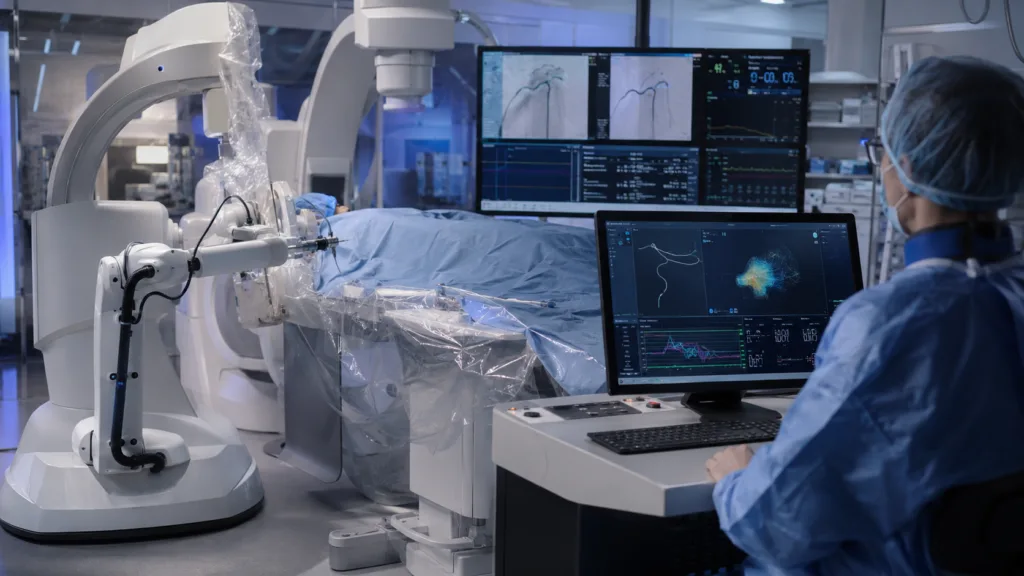
Sentante’s workstation is designed to let clinicians manipulate standard guidewires and catheters in a manner that resembles conventional manual intervention. Movements made at the workstation are transferred to a robotic unit beside the patient, while haptic feedback returns information to the operator.
The company argues that this one-to-one motion-mimicking architecture captures existing procedural skill more directly than a joystick or screen-based controller. A clinician using an unfamiliar control interface may first have to learn how joystick movements correspond to wire and catheter behaviour. Data recorded during that process may partly reflect proficiency with the controller rather than the clinician’s established manual technique.
A more familiar interface could widen the pool of physicians able to contribute useful demonstrations and reduce the amount of platform-specific retraining required before the recorded movements become representative. Sentante believes each procedure could consequently become a structured demonstration of how an experienced clinician responds to anatomical and mechanical conditions.
The quality of those demonstrations will still vary. Experts do not always use identical strategies, and a technically completed procedure does not mean every movement represents an optimal action. Before data can support automated recommendations, Sentante will need methods for labelling procedural phases, identifying unnecessary movements, linking actions to outcomes and distinguishing accepted variation from potentially unsafe behaviour.
Data collected from a small number of high-volume European centres may also fail to represent the full diversity of patients, devices and clinical workflows. Anatomical variation, rare complications and unusual device interactions are precisely the events that an assistive system must handle safely, yet they are likely to be underrepresented in early datasets.
What evidence supports the SENTANTE Endovascular Robotic System so far?
A peer-reviewed preclinical investigation published in CardioVascular and Interventional Radiology evaluated the system in six healthy porcine subjects. Five experienced endovascular specialists completed 18 robotic procedures, including renal and vertebral artery stenting, embolisation and percutaneous transluminal angioplasty.
All 18 procedures were completed without conversion to manual operation. The system was used with conventional guidewires, catheters and pushable coils, while operator radiation exposure was reported as close to zero because the physicians operated away from the fluoroscopy source. Post-procedure angiography did not identify vessel injury, although gross examination found minimal vessel trauma in three of 16 assessed target vessels. Operator assessments rated haptic feedback as very good in three models and fair in three.
These results support technical feasibility across several procedure types, but the study was preclinical and involved healthy animal vasculature. Diseased human vessels can present calcification, chronic occlusions, thrombus, fragile plaques and tortuous anatomy that may change device behaviour and procedural risk. The haptic assessments were also subjective and involved a small group of specialists.
Sentante subsequently conducted a prospective, single-centre first-in-human study of peripheral endovascular procedures. The ClinicalTrials.gov record shows actual enrolment of 10 adults, with the study beginning on July 19, 2024, and completing on October 30, 2024. Its stated objective was to assess feasibility, safety and initial clinical and technical performance when remotely manipulating compatible guidewires and catheter-based devices.
A study of 10 participants can provide useful feasibility information, but it is not designed to establish improved clinical outcomes, lower complication rates or superiority over manual intervention. Larger multicentre evidence will be needed to determine how reliably the system performs across different hospitals, clinicians, vascular conditions and procedure complexities.
What does CE marking allow Sentante to do in Europe?
Sentante announced on May 20, 2026, that its flagship endovascular robotic platform had obtained CE marking, permitting the company to begin commercialisation in European markets for its stated use. The company said the CE-marked system supports peripheral vascular interventions and can be integrated with existing catheterisation laboratory infrastructure.
CE marking indicates conformity with the applicable European requirements for the certified intended use. It should not be interpreted as proof that robotic procedures are superior to conventional procedures or that the platform’s planned AI functions have already been clinically validated.
Sentante’s remote stroke thrombectomy programme is proceeding separately. The company has reported that the SENTANTE Stroke System received United States Food and Drug Administration Breakthrough Device Designation in September 2025 and was accepted into the agency’s Total Product Life Cycle Advisory Program in February 2026. Those programmes provide regulatory engagement and potential development support, but they do not constitute United States marketing clearance.
The company has also reported remote thrombectomy work involving perfused human cadaver models and animal studies. These programmes are relevant to technical development, network performance and procedural simulation, but they remain separate from demonstrating safety and effectiveness in patients undergoing remote stroke treatment.
Why could the data strategy matter more commercially than autonomy claims?
Medical robotics companies frequently discuss automation, but the commercial value of near-term AI may lie in smaller, more measurable forms of assistance. Hospitals may be more willing to adopt features that warn about excessive force, stabilise device movements, document procedural steps or identify deviations from a planned workflow than systems attempting to replace the interventionist.
Sentante could use accumulated procedure data to build a staged product roadmap. Early functions might operate as decision-support or safety-assistance tools while keeping the clinician in control. More advanced capabilities could emerge only after sufficient validation, regulatory review and post-market monitoring.
This incremental path is likely to be more credible than moving directly toward autonomous navigation. It would also allow Sentante to test whether a feature reduces unnecessary movements, radiation exposure, contrast use, procedure duration or operator workload before making broader clinical claims.
The company’s Inflante digital indeflator illustrates how this data layer may expand. Introduced in July 2026, Inflante digitises balloon inflation and records pressure profiles, inflation timing and procedural state. These signals could help connect catheter movement with balloon deployment and vessel treatment, creating a more complete procedural record than robotic motion data alone.
The long-term opportunity is therefore not simply a robot that copies hand movements. It is a connected procedural environment that records how devices are navigated, when therapies are delivered, what resistance is encountered and how the procedure progresses.
How does Sentante fit into the increasingly competitive endovascular robotics market?
Sentante is entering a field that already includes commercially active and development-stage systems with differing regulatory status, procedure coverage and business models.
Microbot Medical’s LIBERTY Endovascular Robotic System is an FDA-cleared, remotely operated, single-use system for peripheral endovascular procedures. Microbot began a full United States market release in April 2026 and has reported adoption by hospital systems across several states. The company is pursuing CE marking for a planned European expansion.
France-based Robocath received CE marking for its R-One coronary intervention system in 2019 and now markets R-One+ for robotic-assisted percutaneous coronary intervention. Robocath’s platform is also designed to work with established catheterisation laboratory equipment and conventional interventional devices.
Sentante is attempting to differentiate itself through haptic feedback, force and torque sensing, natural catheter manipulation and multimodal procedural data capture. These characteristics may be strategically important, but commercial differentiation will ultimately depend on comparative workflow, reliability, installation requirements, training, procedure coverage, service support and total cost.
Hospitals rarely purchase capital equipment solely because its technical architecture is novel. Procurement committees will need evidence that the system solves a meaningful operational or clinical problem and can be used at sufficient volume to justify its acquisition and maintenance.
What barriers could slow hospital adoption and real-world data generation?
Sentante’s physical AI strategy depends on installed systems performing procedures. Without hospital adoption and sustained utilisation, the company will not generate the scale or diversity of data needed for its longer-term objectives.
European hospitals will assess the cost of the robotic platform, consumable requirements, service contracts, integration with existing imaging systems and the availability of trained support personnel. The company has not publicly disclosed enough commercial detail to determine how quickly centres could recover their investment.
Remote operation also does not eliminate the need for qualified staff at the patient site. Local teams must prepare the patient, establish vascular access, exchange equipment when necessary and respond immediately to bleeding, vessel injury, device failure or other complications. Hospitals will require clear protocols for network interruption, robotic malfunction and conversion to manual treatment.
The data programme creates additional governance requirements. Force signals, fluoroscopy, device movements and procedural metadata may collectively constitute sensitive clinical information. Sentante and participating hospitals will need to establish responsibility for patient consent, data control, storage, cybersecurity, cross-border transfer, algorithm development and secondary research use.
Future AI functions will also require their own validation and regulatory assessment. CE marking of the robotic hardware does not automatically authorise every algorithm subsequently trained on the data. Material changes to clinical functionality may require additional conformity assessment, risk analysis and post-market surveillance.
What milestones will show whether Sentante’s physical AI strategy is working?
The first test will be commercial execution in Europe. Sentante must establish hospital installations, complete clinician training and demonstrate that the platform can be incorporated into routine peripheral vascular workflows without creating excessive setup time or procedural disruption.
The second test will be the quality of the evidence generated from those deployments. Case numbers alone will not be enough. The company will need prospective data showing technical success, complications, manual conversion rates, radiation exposure, contrast utilisation, procedure duration, system reliability and learning-curve performance.
The third test will be whether Sentante can convert its multimodal datasets into a clearly defined assistive function that improves a measurable aspect of care. Such a feature will need external validation across clinicians and hospitals, human oversight, robust failure controls and a regulatory pathway appropriate to its intended use.
Sentante has built a credible technical argument for capturing physical information that image-only artificial intelligence systems may miss. Its CE-marked platform gives the company an opportunity to collect that information during European clinical use. The decisive question is now whether those procedural records can be transformed into validated assistance that hospitals value, regulators can assess and clinicians can trust.