Median Technologies has signed a global strategic commercial agreement with Olea Medical, a Canon Medical Systems Corporation subsidiary, to support deployment of its eyonis LCS artificial intelligence software for lung cancer screening. The companies plan to pursue commercialisation across the United States and Europe, with the possibility of entering additional mutually agreed markets, after eyonis LCS secured United States Food and Drug Administration 510(k) clearance in February 2026 and European CE marking in July.
The agreement moves Median Technologies into the most difficult phase of medical artificial intelligence commercialisation. Regulatory access has been established, but revenue will depend on whether the software can be integrated into routine radiology systems, purchased by hospitals and imaging networks, supported within local reimbursement structures, and trusted by clinicians managing growing screening volumes.
Olea Medical could help reduce some of those execution barriers by providing medical-imaging software expertise, workflow integration capabilities and access to the wider commercial footprint of Canon Medical Systems Corporation. The partnership is particularly relevant because computed tomography is the imaging modality used by eyonis LCS, while Canon Medical Systems Corporation already sells computed tomography platforms and related imaging technology to healthcare providers.
Financial terms, revenue-sharing arrangements, minimum sales commitments, customer-volume targets and detailed deployment timelines were not disclosed. That leaves the agreement strategically promising but commercially unquantified, with future significance likely to be measured through signed customers, completed installations, reimbursed scans and eventual eyonis revenue rather than the number of partnership announcements.
What does the Olea Medical agreement change in Median Technologies’ eyonis LCS commercial strategy?
Median Technologies is pursuing a mixed go-to-market structure that combines its own sales organisation with commercial partners capable of reaching different sections of the medical-imaging market. The Olea Medical agreement follows an earlier collaboration with Tempus AI, announced in February 2026, under which eyonis LCS was expected to be incorporated into the Tempus Pixel imaging environment in the United States.
Adding Olea Medical potentially opens a different route into radiology departments. Tempus AI brings a precision-medicine and data-platform channel, while Olea Medical operates within the imaging-software ecosystem of Canon Medical Systems Corporation. This means Median Technologies is not relying on a single distributor, hospital-sales team or technology platform to establish its product.
The strategy may be especially valuable during the early launch period, when implementation requirements can vary considerably between large academic hospitals, private imaging networks, regional screening programmes and community radiology centres. Customers may use different picture archiving and communication systems, reporting tools, cloud policies, cybersecurity controls and information-technology architectures. A partner familiar with radiology deployments could shorten technical discussions and reduce the risk that a cleared product remains stranded outside the clinician’s normal workflow.
However, the agreement does not automatically mean that eyonis LCS will be bundled with Canon computed tomography scanners, installed across Canon’s existing customer base or purchased by Canon Medical Systems Corporation. The announcement describes commercial support and expanded deployment pathways, not a committed equipment-integration programme or guaranteed procurement arrangement.
Why is workflow integration likely to matter as much as the algorithm’s regulatory performance?
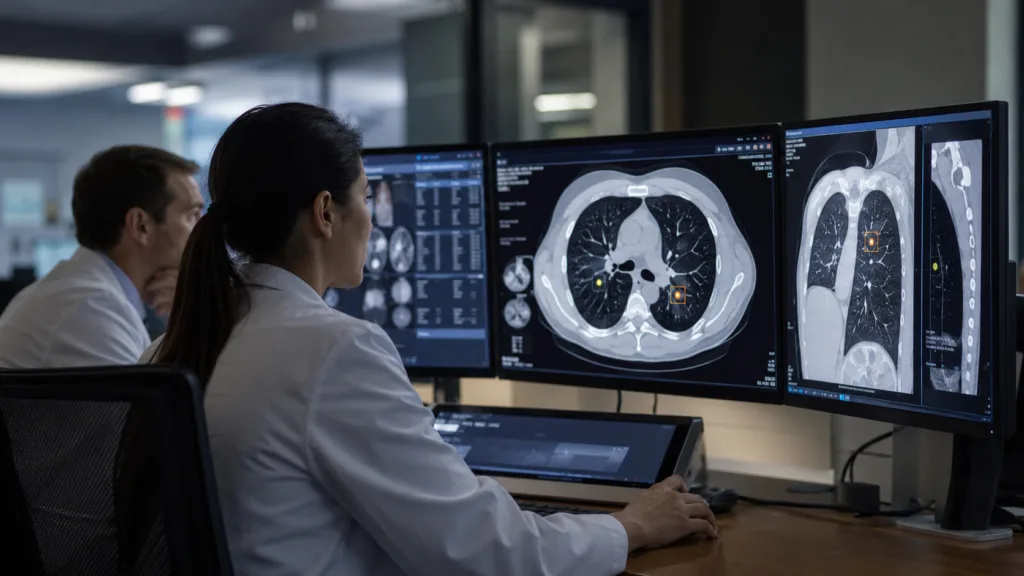
eyonis LCS is a software-only medical device designed to analyse low-dose chest computed tomography images and assist radiologists in detecting, locating and characterising pulmonary parenchymal nodules. Its output is delivered as a DICOM result report containing nodule images, measurements, volume information and a malignancy score that can be stored within a hospital picture archiving and communication system. The software can also support DICOM Web and HL7 connectivity and can be deployed through cloud-based or on-premises Kubernetes environments.
Those technical characteristics are central to the commercial case. Radiologists are unlikely to embrace an artificial intelligence system that requires separate logins, manual image transfers or additional reporting steps. The closer eyonis LCS can sit to the existing image-reading environment, the greater the possibility that clinicians will use it consistently rather than treating it as an optional external application.
Olea Medical develops image post-processing software for magnetic resonance imaging and computed tomography and has experience connecting quantitative analysis and clinical decision-support applications with radiology workflows. Its role could therefore extend beyond sales introductions to implementation planning, software configuration and workflow support, although the companies have not provided a detailed division of responsibilities.
Hospitals will still need to evaluate hosting arrangements, data movement, interoperability, cybersecurity, model maintenance, user support and accountability for software updates. Procurement teams may also ask whether eyonis LCS works equally well across scanners from different manufacturers, imaging protocols, patient populations and clinical settings. A commercially credible deployment model must address those operational questions without making customers dependent on an unnecessarily complex integration project.
What does the FDA evidence show about eyonis LCS performance and its intended clinical role?
The United States Food and Drug Administration cleared eyonis LCS as a Class II radiological computer-assisted detection and diagnosis device under 510(k) number K251474. The regulator determined that the product was substantially equivalent to a legally marketed predicate device, which permits commercialisation for the cleared indication but is not the same regulatory pathway as Premarket Approval.
The cleared indication is narrower than a general claim that the software diagnoses all forms of lung cancer. eyonis LCS is intended for use by radiologists evaluating low-dose chest computed tomography examinations from high-risk people eligible for lung cancer screening. It assists in detecting, locating and characterising solid and part-solid pulmonary parenchymal nodules measuring between 4 millimetres and 30 millimetres. Pure ground-glass lesions, mediastinal lesions and masses including hilar masses are excluded from the stated intended population.
The system is a concurrent reading aid. Its results are displayed alongside the original images, and the cleared labelling states that its output does not replace the interpreting physician’s clinical judgement. This distinction matters commercially and clinically because eyonis LCS is intended to support radiologists rather than provide autonomous screening decisions.
The regulatory submission included a retrospective standalone analysis involving 1,147 patients from seven datasets in the United States and Europe. The enriched cohort included 342 cancer cases and 805 non-cancer cases, with reference standards established through histopathology or at least 12 months of stability. At the predetermined operating threshold, the software produced patient-level sensitivity of 84.50%, specificity of 80.25% and an area under the receiver operating characteristic curve of 0.904.
A separate retrospective multi-reader, multi-case study included 16 United States board-certified radiologists and 480 patient examinations. Reader performance measured by area under the curve improved from 0.8276 without eyonis LCS to 0.8434 with the software, producing a difference of 0.0158 that met the study’s statistical criterion. Specificity improved by 4.14 percentage points, while the 1.25 percentage-point increase in sensitivity was not statistically significant for superiority.
The evidence therefore supports the cleared assistive use, but it should not be interpreted as proof that the software independently prevents deaths, eliminates diagnostic errors or produces the same performance in every screening programme. The studies were retrospective, the standalone dataset was intentionally enriched, and continued real-world evaluation will be important as the product reaches more diverse patient groups, imaging protocols and healthcare systems.
How does European CE marking broaden the opportunity without guaranteeing uniform adoption?
eyonis LCS received CE marking as a Class IIb medical device under the European Medical Device Regulation in July 2026. The certification, granted through notified body GMED, permits commercialisation within the European Economic Area for the certified intended use. It should be described as CE marking rather than United States-style regulatory approval.
European access creates a large theoretical opportunity, but the commercial environment is fragmented. Lung cancer screening is advancing at different speeds across individual countries, ranging from established national initiatives to pilots and feasibility programmes. Each market can have different procurement processes, funding structures, clinical guidelines, data-hosting requirements and reimbursement arrangements.
This makes a pan-European partner useful, but it also means that a single agreement cannot produce a uniform launch across the region. Median Technologies and Olea Medical will need country-level strategies covering screening maturity, hospital budgets, distributor responsibilities, local-language support and evidence requirements. European expansion may therefore occur in stages rather than through one broad commercial activation.
The most attractive early markets are likely to be those where organised low-dose computed tomography screening is already operating or moving beyond pilots. In less mature markets, commercial progress may depend as much on government screening policy and radiology capacity as on the software’s technical performance.
Can existing reimbursement pathways remove the economic barrier to United States adoption?
Median Technologies has highlighted existing Category III CPT codes and a New Technology Ambulatory Payment Classification pathway as supportive of the United States commercial strategy. The company has argued that this framework could give eligible providers a mechanism to seek payment when using artificial intelligence-based computed tomography tissue-characterisation technology.
A code and assigned payment structure can improve the commercial conversation, but they do not guarantee universal reimbursement. Actual payment can depend on the site of service, payer policy, documentation, coding compliance, contractual arrangements and whether the use matches the applicable reimbursement requirements.
Hospitals will also calculate whether payment exceeds the combined costs of software licensing, implementation, information-technology support, clinician training and administrative work. A product can have clinical value and still face slow adoption when economic benefits are unevenly distributed between radiology providers, hospitals and payers.
Median Technologies has not disclosed eyonis LCS pricing, whether commercial contracts will be subscription-based or volume-based, or how revenue will be shared with Olea Medical. These details will determine whether the software produces attractive recurring margins and whether partners are sufficiently incentivised to prioritise it within larger imaging portfolios.
Why does Median Technologies still need commercial proof after raising €50 million?
Median Technologies entered the second half of 2026 with €60.8 million in cash following an upsized €50 million capital increase completed in June. The company said the funding extended its cash runway through the first half of 2028, potentially reaching the first half of 2029 if outstanding warrants are fully exercised.
Its established imaging contract research organisation business generated €11.8 million of first-half 2026 revenue, an increase of 4.4% from the comparable period, while backlog reached a record €82.4 million. Importantly, Median Technologies said this services business remained its sole source of revenue during the period. That indicates eyonis LCS had reached the launch stage without yet becoming a material reported revenue contributor.
The strengthened balance sheet gives management time to recruit commercial staff, complete installations, support partners and develop further eyonis indications. It also raises the performance bar. Investors will increasingly expect the company to show that regulatory investment can produce recurring software revenue rather than a continuing sequence of clinical, regulatory and partnership milestones.
The Olea Medical relationship is therefore best understood as commercial infrastructure rather than proof of commercial success. The most informative future disclosures would include contracted healthcare systems, live clinical sites, scan volumes, recognised eyonis revenue, customer retention, deployment costs and evidence that the partner-led model can scale without eroding economics.
What does Median Technologies’ recent share performance reveal about investor sentiment?
Median Technologies shares traded around €4.14 on July 31, rising approximately 2.35% during the session following the Olea Medical announcement. The stock was about 3.35% higher over one week but remained roughly 16.5% lower over one month and about 12.1% lower since the beginning of 2026. It was nevertheless more than 60% above its level one year earlier, within a 52-week range of approximately €1.79 to €7.27.
The mixed performance suggests that investors recognise the substantial de-risking achieved through United States clearance, European CE marking and the capital raise, while remaining cautious about commercial conversion and the dilution associated with additional financing. The Olea Medical agreement strengthens Median Technologies’ distribution narrative, but it does not yet resolve uncertainty around sales velocity, pricing or profitability.
Near-term sentiment may remain sensitive to the first evidence of paid adoption. A partnership announcement can expand perceived market access, but signed and implemented customers will carry more weight than strategic language once the company begins reporting eyonis LCS commercial performance.
What measurable milestones will determine whether the Canon Medical relationship succeeds?
The next phase will be defined by execution inside radiology departments. Median Technologies and Olea Medical must identify customers, complete technical integrations, train users, establish support processes and demonstrate that the software can be incorporated into high-volume screening without disrupting established reporting pathways.
Clinical credibility will also require evidence beyond the regulatory package. Real-world studies should examine performance across scanner manufacturers, screening populations, demographic groups and healthcare settings. Hospitals and payers may also look for evidence concerning recall rates, downstream procedures, reading consistency, radiologist time and broader clinical utility.
The partnership gives Median Technologies a potentially valuable bridge between its regulated algorithm and the imaging infrastructure where lung cancer screening occurs. Whether that bridge becomes a meaningful business will depend on customer deployments and usage, not merely on Canon Medical Systems Corporation’s name appearing beside the product.
eyonis LCS has now crossed the principal United States and European regulatory thresholds. The harder test begins with converting those authorisations, Olea Medical’s workflow expertise and Median Technologies’ newly funded commercial organisation into repeatable installations, reimbursed clinical activity and software revenue that can eventually reduce the company’s dependence on its imaging-services business.