Invenio Imaging has completed patient enrolment in the ON-SITE study, a prospective United States pivotal study evaluating NIO Lung Cancer Reveal, an investigational artificial intelligence image-analysis module intended to assist physicians assessing fresh bronchoscopic lung biopsy specimens. The privately held medical device company said the study enrolled 1,006 patients at seven medical centres, involving 32 physicians and more than 3,250 specimens collected through four bronchoscopic biopsy techniques.
The announcement marks the completion of data collection rather than evidence that the system can accurately detect cancer, improve biopsy yield or reduce repeat procedures. Invenio Imaging has not yet disclosed the pivotal validation results, including the algorithm’s sensitivity, specificity, false-positive rate, false-negative rate or performance across individual biopsy methods. The company said it will now analyse the ON-SITE validation data in support of a regulatory submission.
That distinction is central to interpreting the milestone. Enrolling more than 1,000 patients across multiple centres gives Invenio Imaging a potentially substantial dataset for evaluating generalisability, but enrolment scale alone cannot establish clinical performance. The credibility of the programme will ultimately depend on how the algorithm performs against the study’s pathological reference standard, whether the validation dataset was kept independent from model development, and whether performance remains consistent across hospitals, physicians, specimen types and biopsy tools.
The product remains investigational in the United States and has neither been cleared nor approved for clinical use. Its output is intended to identify cell or tissue morphology suspicious for cancer, not to serve as the patient’s primary diagnosis. Physicians would still need to consider conventional pathology, molecular testing, imaging and the wider clinical context before making diagnostic or treatment decisions.
Why does completing enrolment materially advance the NIO Lung Cancer Reveal programme?
ON-SITE is described in the clinical-trial record as a prospective, observational study designed for the training, tuning and pivotal validation of deep-learning algorithms. The algorithms analyse fresh biopsy specimens from peripheral lung nodules, lung masses and mediastinal or hilar lymph nodes after imaging with the NIO Imaging System in the procedure room.
The study includes four arms covering transbronchial forceps biopsy of peripheral lesions, transbronchial needle aspiration of peripheral lesions, endobronchial ultrasound-guided transbronchial needle aspiration of lymph nodes and transbronchial cryobiopsy. The breadth of specimen acquisition methods is important because tissue appearance, sample size, blood contamination, crushing artefact and cellular composition can differ considerably between biopsy tools.
Invenio Imaging’s final enrolment of 1,006 patients also exceeded the 900 participants previously shown in the public study record. The registry had listed the study as beginning in December 2023, with an estimated completion around May 2026. The company’s August 3, 2026 announcement therefore provides a more current account of the final enrolment than the registry entry last updated in June 2025.
Larger enrolment can strengthen a diagnostic study by creating enough cancer-positive and cancer-negative specimens to estimate performance with greater precision. It can also support prespecified analyses across specimen types and clinical settings. However, the number that matters for regulatory interpretation may not simply be 1,006 patients because parts of the dataset were designed for training and tuning, while a separate portion is expected to provide pivotal validation.
The eventual disclosure will therefore need to explain how many patients and specimens were used for model development, how many were locked for validation, whether the reference pathology assessment was blinded to the AI result, and how multiple specimens from the same patient were handled statistically. Treating thousands of specimens as entirely independent observations could make confidence intervals appear narrower than they are if patient-level clustering is not appropriately addressed.
What clinical problem is Invenio Imaging attempting to solve during bronchoscopy?
Advanced bronchoscopy systems can help physicians navigate towards small peripheral nodules and sample difficult lung lesions, but reaching the target does not guarantee that the collected specimen contains sufficient malignant tissue. The procedural team may only discover after formal pathology processing that the sample was non-diagnostic or inadequate for the molecular tests increasingly required to select targeted therapies and immunotherapies.
Rapid on-site evaluation, commonly known as ROSE, can provide immediate cytological feedback about whether diagnostically useful material has been collected. However, ROSE normally requires a cytopathologist, cytotechnologist or other specially trained professional to prepare and assess specimens during the procedure. Availability varies between centres because of staffing, scheduling and laboratory-resource constraints.
Published bronchoscopy research indicates that ROSE can support specimen-adequacy assessment and may reduce additional sampling or repeat procedures in some settings. Its practical value is closely connected to the expertise of the person interpreting the specimen and the specific biopsy technique being used.
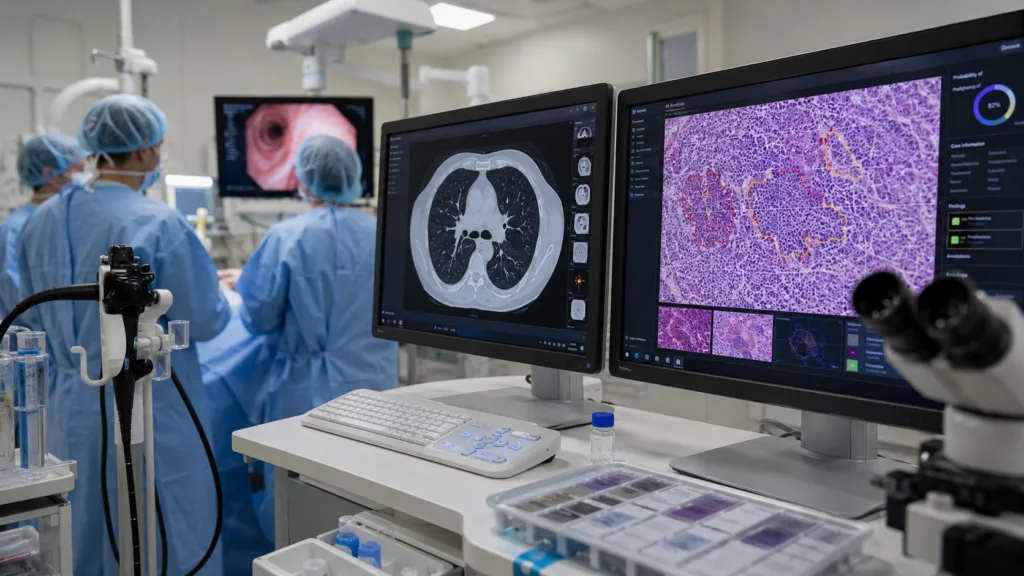
The NIO Imaging System takes a different technical approach. It uses stimulated Raman histology to generate digital microscopic images from fresh, unprocessed tissue without conventional freezing, sectioning or staining. Invenio Imaging says the tissue can subsequently be retrieved for standard pathology and molecular analysis, an important feature because lung biopsy material is often scarce and must support multiple downstream tests.
NIO Lung Cancer Reveal then applies a deep-learning model to the digital images to flag morphology suspicious for cancer. In principle, this could give the bronchoscopist rapid information while the patient is still in the procedure room, particularly when conventional ROSE is unavailable. The intended workflow is assistive, however, and should not be confused with autonomous lung cancer diagnosis.
Even a strong cancer-detection result would not eliminate the need for formal pathology. The system is not being positioned to establish the definitive histological subtype, tumour stage, programmed death-ligand 1 status or genomic alteration profile that may determine treatment. Its nearer-term clinical proposition is to help physicians judge whether suspicious tissue has been captured and whether further sampling may be justified.
Which pivotal results will determine whether the AI performs beyond controlled research settings?
The most closely watched measures are likely to include sensitivity and specificity against final pathology, although the precise prespecified endpoints have not been publicly detailed in the company’s enrolment announcement. Sensitivity will indicate how frequently the system identifies suspicious morphology in specimens that ultimately contain cancer, while specificity will indicate how often it avoids flagging benign specimens.
False negatives are particularly important because an incorrectly reassuring result could prompt the operator to stop sampling despite the absence of diagnostic tissue. False positives have different consequences, including unnecessary additional passes, extended procedure time or excessive confidence that adequate tumour material has been obtained.
The clinical significance of a false result may also vary by specimen type. Forceps biopsies produce tissue fragments, needle aspiration may provide more cytological material, and cryobiopsy can obtain larger samples but introduces different handling and procedural considerations. A pooled accuracy figure could conceal weaker performance in one modality, making arm-level results important for physicians and regulators.
Performance across participating sites will be another test of robustness. Multi-centre enrolment reduces the risk that the algorithm merely reflects the specimen handling or patient population of one expert hospital. Nevertheless, meaningful external validation requires diversity in equipment, lesion characteristics, cancer prevalence, biopsy technique and operator experience.
The company will also need to clarify whether the algorithm evaluates cancer suspicion, specimen adequacy or both. These concepts overlap but are not identical. A specimen may contain lymphocytes, bronchial cells or other material demonstrating that the target region was sampled without containing malignant cells. Conversely, visible malignant morphology may indicate cancer but not establish whether enough tissue remains for comprehensive molecular profiling.
No evidence has yet been presented showing that using NIO Lung Cancer Reveal reduces repeat bronchoscopy, improves diagnostic yield, shortens procedure time or lowers total episode-of-care costs. Those outcomes may require prospective clinical-utility studies even after analytical and clinical validation establish that the algorithm can classify the images accurately.
How does FDA Breakthrough Device designation affect the regulatory pathway?
The United States Food and Drug Administration granted Breakthrough Device designation to NIO Lung Cancer Reveal in October 2024 for its intended use in assisting physicians with the evaluation of bronchoscopic lung forceps biopsies. The designated use describes software that detects morphology suspicious for cancer in NIO images of fresh, unprocessed specimens, with the explicit limitation that its output should not be used as the primary diagnosis.
Breakthrough Device designation is not marketing authorisation and does not establish that the product is safe or effective. The programme allows more frequent interaction with the regulator and prioritised review, but the device must still satisfy the evidentiary requirements applicable to its eventual premarket pathway. The FDA also explains that granting the designation does not formally determine whether a product will proceed through premarket approval, De Novo classification or 510(k) clearance.
One regulatory detail deserves particular attention. The Breakthrough Device designation disclosed by Invenio Imaging specifically refers to bronchoscopic lung forceps biopsies, while ON-SITE collected specimens using four techniques. The broader study may provide valuable development and exploratory evidence across all four arms, but the company has not confirmed that its first regulatory submission will seek an indication covering every specimen type.
The validation results will consequently need to be interpreted against the exact proposed indication for use. Strong aggregate performance across all samples would not automatically support a broad label if one technique contributed disproportionately to the result or if the pivotal arm was limited to forceps biopsy.
Invenio Imaging already has platform experience through NIO Glioma Reveal, which is CE-marked and available for clinical use in Europe. That offers evidence that the company has previously translated stimulated Raman imaging and artificial intelligence into a regulated product. It does not, however, transfer clinical validation or European conformity to the lung application or confer United States marketing authorisation.
What operational and commercial hurdles would remain after a successful regulatory decision?
Hospital adoption would depend on more than algorithm accuracy. Bronchoscopy units would need to evaluate the NIO Imaging System’s acquisition cost, maintenance requirements, disposable slide economics, space requirements, staff training, image-acquisition consistency and compatibility with existing specimen-handling protocols.
Turnaround time will be critical. A tool designed to guide decisions during bronchoscopy must deliver results quickly enough to affect whether the physician obtains another sample. An accurate result that arrives after the procedure has effectively ended would offer less operational value.
The workflow must also preserve enough tissue for formal histopathology and molecular testing. In lung cancer, conserving tissue is commercially and clinically important because small samples may need to support diagnosis, immunohistochemistry, programmed death-ligand 1 assessment and next-generation sequencing. Invenio Imaging says its method is non-destructive and preserves specimens for downstream analysis, but ON-SITE data will need to demonstrate that this advantage holds consistently across real clinical handling.
Procurement teams are also likely to seek evidence that the system solves a measurable problem at their institution. Centres with reliable cytology coverage may compare it directly with their existing ROSE workflow, while hospitals without ROSE may view the technology as a way to obtain rapid procedural feedback without adding an on-site cytology service.
Reimbursement could become another consideration. Regulatory authorisation would not automatically create a dedicated payment mechanism or guarantee that payers will cover the technology separately. Invenio Imaging may initially need to establish value through reduced repeat procedures, improved specimen adequacy, lower staffing dependence or more efficient use of bronchoscopy-suite time.
The completion of ON-SITE enrolment moves NIO Lung Cancer Reveal from an extended data-generation phase into the more decisive period of locked analysis, regulatory preparation and public scrutiny. The study’s scale is notable, particularly for a privately held medical device company developing an AI-supported pathology workflow.
The next milestone will be far more informative than the enrolment total. Clinicians and regulators will need to see validated performance, subgroup consistency, an appropriate pathological reference standard and clear evidence that the system’s output can be safely interpreted as decision support rather than definitive diagnosis. For Invenio Imaging, the commercial opportunity rests not merely on recognising suspicious morphology quickly, but on proving that the result is reliable enough to influence sampling decisions without compromising the tissue needed for the diagnosis and treatment planning that follow.