Greenstone Biosciences has received an Industry Discovery and Development Partnership grant from Breakthrough T1D to develop a patient-derived islet cell platform designed to study why insulin-producing beta cells differ in their vulnerability to type 1 diabetes. The program will combine induced pluripotent stem cells, three-dimensional pancreatic islet organoids and multi-omics profiling, but it remains a research and drug-discovery initiative rather than a clinical-stage therapy or cell-replacement program.
The distinction matters because the commercial and scientific value of the project will depend less on whether Greenstone can generate islet-like cells, which has become an increasingly active area of biomedical research, and more on whether its models can reproducibly capture patient-specific biology that existing cell lines, donor tissue and animal models miss. Greenstone intends to expose the resulting organoids to inflammatory and metabolic stress and then investigate why some beta cells appear more susceptible than others.
That puts the project into a strategically important part of type 1 diabetes research. The autoimmune destruction of pancreatic beta cells is central to the disease, but type 1 diabetes is biologically heterogeneous, and research increasingly suggests that beta cells are not simply passive targets. Their stress responses, antigen presentation, genetic background and interaction with inflammatory signals can influence how disease develops and progresses. Recent human-cell research, for example, has shown that interferon exposure can substantially alter antigen presentation by beta cells, illustrating why human disease models that preserve cellular context could reveal mechanisms that simpler systems overlook.
Why is Greenstone building patient-derived islet organoids instead of relying on conventional diabetes models?
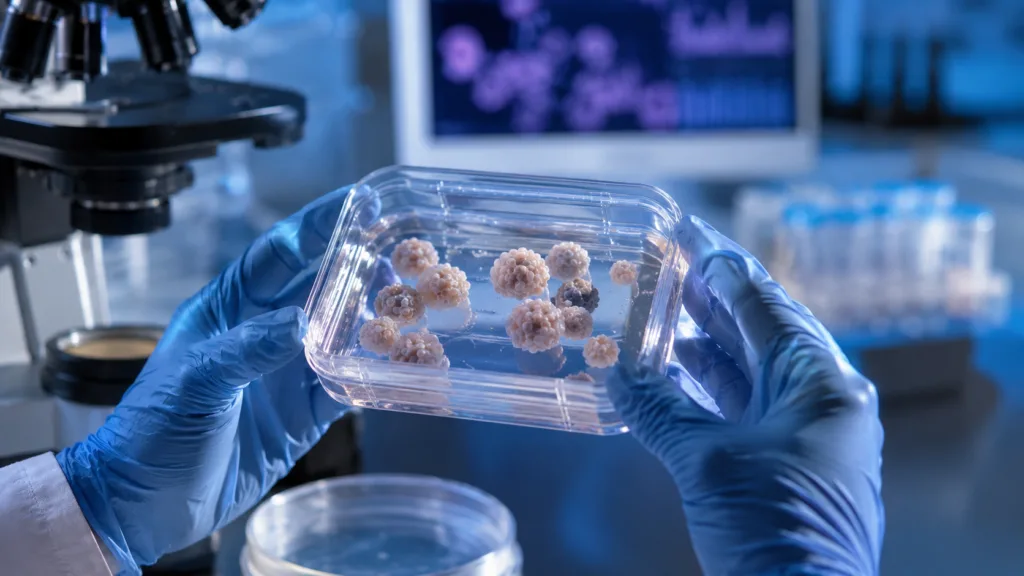
Human pancreatic tissue is difficult to obtain at the scale required for systematic drug discovery, while animal models cannot fully reproduce the human autoimmune process underlying type 1 diabetes. Greenstone’s proposed solution is to create induced pluripotent stem cells from people with type 1 diabetes and differentiate them into three-dimensional pancreatic islet organoids containing insulin-producing beta cells. The company then plans to use those organoids as renewable experimental models rather than depending on a finite supply of donated pancreatic tissue.
The patient-derived element is potentially the most consequential part of the design. A conventional immortalized cell line may provide consistency, but it can smooth away the genetic and biological variation that may explain why patients with apparently similar autoimmune profiles experience different patterns of beta-cell dysfunction. Greenstone’s approach is intended to preserve more of that patient-specific background and pair it with controlled laboratory perturbations.
That could allow researchers to ask a more granular question than whether a candidate compound protects beta cells in an average experimental system. A sufficiently validated platform could help determine whether particular molecular pathways are associated with vulnerability or resilience across genetically diverse patient-derived models. In principle, that may improve target selection before a drug program enters expensive translational and clinical development, although the grant itself does not establish that the platform can yet predict human treatment response.
Greenstone says its wider infrastructure includes an iPSC biobank derived from more than 2,500 individuals. That existing scale could give the company a practical advantage in building disease models across genetic backgrounds, but the type 1 diabetes project will still need its own evidence showing that the resulting islet organoids are biologically consistent, functionally relevant and reproducible across batches.
What could multi-omics profiling reveal about beta-cell vulnerability in type 1 diabetes?
Greenstone plans to layer several molecular measurement technologies onto the islet models, including single-cell RNA sequencing, chromatin accessibility mapping, proteomics and metabolomics. Rather than relying on one molecular readout, the objective is to examine how gene expression, regulatory state, proteins and metabolic activity change when patient-derived beta cells encounter inflammatory or metabolic stress.
This design could be useful because vulnerability may not be explained by a single gene or pathway. A beta cell under inflammatory pressure can alter its transcriptional program, stress-response pathways, antigen presentation and metabolism simultaneously. Integrating multiple layers of data could therefore help distinguish changes that are merely correlated with cell stress from pathways that repeatedly appear across different patient-derived lines and experimental conditions.
The more difficult step will be turning that volume of molecular information into experimentally validated targets. Multi-omics datasets are effective at generating hypotheses, but association does not establish causation. Greenstone will need to demonstrate that candidate pathways identified through computational or molecular profiling can be perturbed in a way that meaningfully changes beta-cell survival, function or stress response.
That distinction is commercially important. Pharmaceutical companies do not primarily need additional lists of differentially expressed genes. They need targets and screening systems with enough biological relevance to improve decisions about which compounds should advance. Greenstone’s platform will therefore become more valuable if it can connect multi-omics observations to reproducible functional assays rather than stopping at descriptive biology.
Could the platform become a drug-discovery engine rather than only a research resource?
Greenstone is positioning the project as a scalable discovery platform. The company said the iPSC lines generated through the program will be banked as a renewable resource and that summary-level data will be shared publicly. That combination suggests a model in which some outputs support the wider research community while the underlying cellular and analytical capabilities may also strengthen Greenstone’s ability to work with biotechnology and pharmaceutical partners.
The company has already been building around a broader New Approach Methodologies strategy that combines human iPSC biology, organoids, clinical genomics and artificial intelligence. Greenstone has also announced collaborations with Intel Corporation around AI-enabled drug discovery infrastructure and with Illumina around precision drug discovery, indicating that management is trying to connect cellular models with large-scale data generation and computation rather than operate as a conventional wet-lab contract research provider.
The Breakthrough T1D project fits that architecture particularly well because patient-derived organoids can generate large, complex datasets that are difficult to interpret manually. If Greenstone can standardize how the cells are generated, stressed, profiled and scored, the company could potentially create a repeatable workflow for target identification and compound screening in type 1 diabetes.
However, the current announcement does not disclose a commercial partnership, screening contract or therapeutic candidate emerging from the platform. Nor does it disclose the size or duration of the Breakthrough T1D award. That makes the grant more useful as a signal of external scientific support than as a measurable near-term financing event.
Why does the timing matter as regulators push harder toward human-relevant drug-development models?
Greenstone’s strategy also arrives as the United States Food and Drug Administration is expanding its formal framework for New Approach Methodologies. In March 2026, the agency issued draft guidance describing general considerations for validating NAMs in drug development, while subsequent FDA materials have continued to emphasize human-relevant tools such as organoids, computational methods and other alternatives that can complement or, in appropriate circumstances, reduce reliance on traditional animal testing.
That regulatory direction improves the strategic backdrop for companies developing organoid and human-cell platforms, but it should not be confused with regulatory endorsement of Greenstone’s specific model. The grant does not qualify the islet platform as an FDA-recognized drug-development tool, and the agency’s growing interest in NAMs does not mean that any individual organoid assay will automatically be accepted for regulatory decision-making.
Validation remains the bridge between a promising model and a useful development tool. Regulators and drug developers will want to know whether an assay is reproducible, whether its measured endpoints are biologically meaningful, how variable the system is across donors and production batches, and whether findings correlate with established human biology or subsequent clinical outcomes.
For Greenstone, that means the most important downstream milestone may not be simply generating a large number of T1D-derived organoids. It will be demonstrating that the model provides information that changes drug-development decisions more reliably than existing alternatives.
How large is the unmet research need behind Greenstone’s type 1 diabetes program?
The potential research population is substantial. Global estimates published in 2025 placed the number of people living with type 1 diabetes at about 9.5 million and projected that figure could reach approximately 14.7 million by 2040. The disease requires lifelong management with exogenous insulin because autoimmune destruction or dysfunction of pancreatic beta cells leads to severe insulin deficiency.
The therapeutic field is pursuing several different strategies, including improved insulin delivery, immune modulation, beta-cell preservation and cell replacement. Greenstone’s project sits earlier in that chain. It is not designed to replace beta cells in patients. Instead, it aims to build a laboratory system that could help researchers understand why beta cells become vulnerable and identify interventions that protect them.
That upstream position could make the platform relevant to several therapeutic strategies rather than one product modality. A mechanism identified through the models might be pursued as a small molecule, biologic or other intervention, depending on the target. Conversely, if the platform proves unable to replicate important immune-cell interactions or the mature physiology of native human islets, its usefulness could remain limited to selected discovery questions.
Three-dimensional organoids generally provide more biological context than simple two-dimensional cultures, but they are still engineered models. Stem cell-derived islets can differ from primary human islets in maturity, architecture, metabolic behavior and responses to environmental stress. Recent research has highlighted, for example, that stem cell-derived islets can display distinct responses to hypoxic stress, underscoring why model-specific validation is necessary rather than assuming equivalence with native pancreatic tissue.
What will determine whether the Breakthrough T1D grant creates durable value for Greenstone Biosciences?
The first test will be technical reproducibility. Greenstone will need to show that it can produce islet organoids with consistent cellular composition and beta-cell function across multiple patient-derived iPSC lines while retaining enough biological diversity to study disease heterogeneity. A platform that is too variable becomes difficult to screen at scale, while one that is over-standardized may lose the patient-specific differences that justify the approach.
The second test will be whether multi-omics findings translate into functional biology. Identifying pathways associated with vulnerable beta cells is only the beginning. The strongest evidence would come from experiments showing that manipulating those pathways changes relevant cellular outcomes under disease-like stress and that the result can be reproduced across independent patient lines.
The third test will be external adoption. Greenstone can strengthen the platform by generating internal datasets, but its commercial value will become clearer if pharmaceutical developers, academic groups or other partners use the system to select targets, screen molecules or reproduce findings that subsequently advance into development programs.
Breakthrough T1D’s Industry Discovery and Development Partnership mechanism is designed to support industry research that can move promising type 1 diabetes approaches toward development, and previous IDDP-backed programs have ranged from preclinical platform optimization to preparation for human studies. Greenstone’s award therefore places the company inside a translational funding framework, but it does not by itself establish that the new islet platform has crossed the validation threshold required for therapeutic development.
The project’s strategic promise lies in connecting three things that are often studied separately: patient-specific genetic background, experimentally controlled beta-cell stress and high-dimensional molecular profiling. If Greenstone can convert that combination into reproducible functional insights, the platform could become useful well beyond a single grant-supported study. The next meaningful evidence will be whether the company can demonstrate validated beta-cell vulnerability signatures, actionable targets and partner-ready assays rather than simply expanding the number of organoids and datasets it can generate.