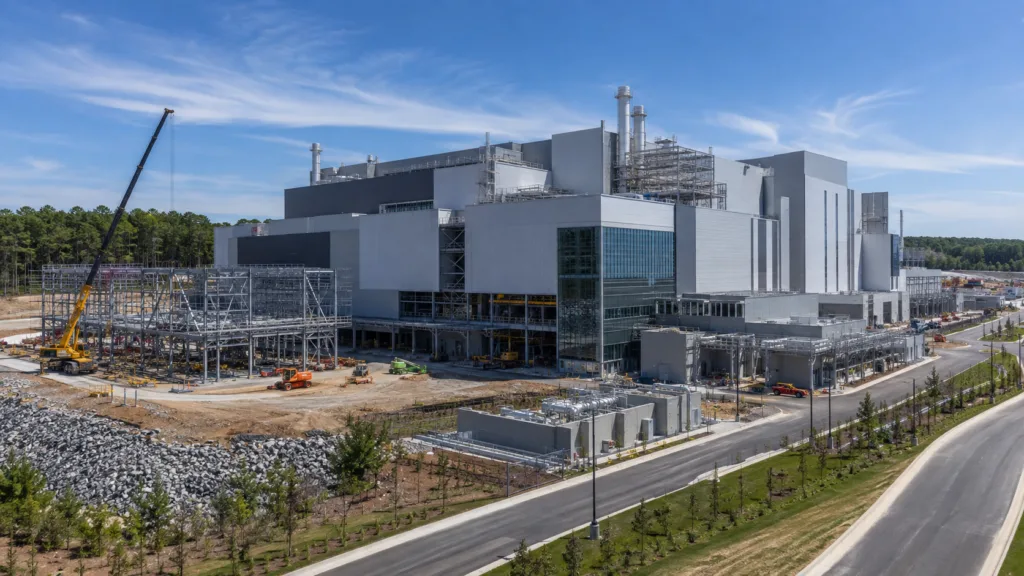
Genentech, a member of the Roche Group, has completed the structural framework of its approximately $2 billion biomanufacturing facility in Holly Springs, North Carolina, advancing one of Roche’s most consequential new U.S. manufacturing investments toward a planned 2029 start of operations. The facility, Genentech’s first manufacturing site on the U.S. East Coast, is intended to produce next-generation medicines for metabolic conditions including obesity and is expected to support more than 500 manufacturing roles alongside more than 1,500 construction jobs.
The August 18 topping-out ceremony means the final structural beam has been placed and the manufacturing building’s structural framework is complete. It does not mean the plant is ready to manufacture commercial medicines, however. Genentech still has to move through the far more technically demanding stages of equipment installation, automation integration, commissioning, qualification, process transfer and eventual regulatory manufacturing readiness before the site can contribute meaningful pharmaceutical supply.
That distinction matters because Holly Springs is no longer simply a large real-estate or construction project. Genentech initially announced more than $700 million for the site in May 2025 before expanding the commitment to approximately $2 billion in January 2026, with the additional investment intended to increase production volume and manufacturing capacity. The enlarged plant is scheduled to become operational in 2029.
At the same time, Roche is moving several obesity assets deeper into clinical development. In June, the company said enicepatide and petrelintide were progressing into Phase III development, while a Phase II programme evaluating fixed-dose combinations of the two medicines was also being initiated. Both remain investigational, making Holly Springs essentially an investment in manufacturing optionality before the ultimate composition and commercial scale of Roche’s metabolic portfolio are known.
Why has Genentech expanded Holly Springs from a $700 million project into a roughly $2 billion manufacturing bet?
The scale-up in capital commitment is one of the most important elements of the Holly Springs story.
When North Carolina announced the project in May 2025, the plan centred on a roughly 700,000-square-foot high-volume fill-finish facility with more than $700 million in investment and at least 400 new manufacturing jobs. State officials said the operation would support Genentech’s existing portfolio as well as its future pipeline.
By January 2026, Genentech had substantially enlarged the plan. The company increased the total commitment to approximately $2 billion and said the additional capital would expand production volume and scale manufacturing capacity. The expected manufacturing workforce also increased beyond 500 positions.
That represents an increase of roughly $1.3 billion from the originally disclosed investment, or close to a tripling of the initial capital commitment.
The increased spending should not automatically be interpreted as a direct forecast for future obesity-drug demand. Genentech has not disclosed a product-by-product capacity allocation, manufacturing volume target or number of doses the facility could ultimately produce.
Instead, the expansion appears to provide substantially greater manufacturing flexibility. That can be strategically important when a company is developing multiple molecules whose eventual dose, formulation, market size and commercial timing remain uncertain.
Pharmaceutical manufacturing capacity also takes years to design, construct, qualify and integrate into a commercial supply network. Waiting for a Phase III programme to succeed before building the required infrastructure could create a significant manufacturing bottleneck if regulatory and commercial development subsequently moves quickly.
How closely is the Holly Springs timetable connected to Roche’s growing obesity pipeline?
Genentech has been careful not to designate Holly Springs as a factory for a single named investigational drug.
The company says the facility will manufacture next-generation treatments for metabolic conditions such as obesity. That deliberately broad description gives Roche room to allocate capacity according to the programmes that ultimately advance toward approval and commercialisation.
Nevertheless, the timing increasingly overlaps with Roche’s obesity development strategy.
Roche said in June that enicepatide, previously known as CT-388, and petrelintide were both moving toward Phase III development. Enicepatide is an investigational once-weekly subcutaneous dual GLP-1 and GIP receptor agonist being developed for obesity and related metabolic conditions. Petrelintide is an investigational long-acting amylin analogue suitable for once-weekly subcutaneous administration.
Roche is also exploring the two approaches in combination, adding another potential manufacturing configuration if clinical development succeeds.
None of those development programmes guarantees that a particular product will ultimately be manufactured at Holly Springs. Phase III development still has to establish the evidence required to support regulatory submissions, regulators would have to assess the resulting applications, and commercial manufacturing processes would need to be incorporated into approved supply arrangements.
What Holly Springs does provide is infrastructure that could be available around the period when some of those programmes may be approaching later commercial decisions.
That creates an unusual synchronisation challenge. Roche has to advance clinical programmes, define formulations, prepare regulatory submissions and develop commercial manufacturing processes while Genentech simultaneously completes a major greenfield plant.
Can Genentech’s AI-powered digital twin materially change how the Holly Springs plant is commissioned and operated?
One of the more distinctive aspects of the facility is Genentech’s planned use of an artificial intelligence-enabled digital twin.
The company describes the technology as a data-driven virtual representation of the manufacturing facility that can simulate operations and test scenarios before changes are implemented in the physical plant. Genentech expects the system, combined with automation, robotics and other digital manufacturing technologies, to improve reliability, efficiency and waste reduction.
For a complex pharmaceutical site, the potential advantages are significant.
Manufacturing facilities contain interconnected production equipment, utilities, laboratories, warehouses, material flows, automation systems and quality controls. Changes in one part of the system can affect throughput elsewhere. Digital modelling can allow engineers to investigate potential bottlenecks, equipment configurations, maintenance requirements and production schedules without disrupting real manufacturing operations.
The technology could become particularly useful in a facility expected to support medicines that are still moving through development. Manufacturing assumptions can change as clinical doses are refined, formulations evolve, demand forecasts mature or regulators request additional controls.
But the digital twin should not be confused with regulatory validation itself.
Artificial intelligence and simulation tools can improve process understanding and operational planning, but Genentech still has to demonstrate that the physical equipment, manufacturing processes and quality systems perform reproducibly and within applicable pharmaceutical manufacturing standards.
The true value of the digital architecture therefore will not be demonstrated at topping out. It will become clearer during commissioning, process transfer and eventually routine manufacturing, when Genentech can assess whether digital modelling genuinely reduces downtime, accelerates troubleshooting or improves capacity utilisation.
Why is Roche building U.S. metabolic manufacturing capacity before its obesity portfolio reaches the market?
Holly Springs sits within a much larger strategic manufacturing commitment.
Roche and Genentech have outlined plans to invest about $50 billion in U.S. manufacturing, research and infrastructure. The Holly Springs facility is one component of that programme, with the companies currently operating 13 manufacturing sites and 15 research and development sites in the United States and employing approximately 25,000 people across 24 locations in eight states.
For Roche, domestic manufacturing capacity can serve several purposes at once.
It creates additional geographical diversification within the supply network, provides infrastructure near a major U.S. biotechnology cluster and potentially reduces the risk that future commercial launches become constrained by insufficient manufacturing capacity.
The timing is also relevant to competition in obesity medicines. Roche is attempting to build a differentiated metabolic portfolio rather than relying on a single investigational molecule. If multiple programmes eventually advance successfully, manufacturing requirements could become considerably more complex than supplying one high-volume medicine.
The decision to enlarge Holly Springs before those outcomes are known consequently resembles a capacity insurance strategy.
The downside is obvious. Approximately $2 billion of capital is being committed before the ultimate product mix and demand profile are established.
The alternative risk, however, would be arriving at regulatory success with insufficient qualified manufacturing capacity and then spending years trying to close the gap.
What does the topping-out milestone leave unfinished before Genentech can actually manufacture medicines?
The most technically important phase of Holly Springs is still ahead.
A completed structural shell must become a controlled pharmaceutical manufacturing environment containing validated equipment, qualified utilities, laboratories, material-handling systems, automation controls, trained personnel and mature quality systems.
Genentech must also prepare the site to receive manufacturing processes associated with whatever products are ultimately allocated there.
Technology transfer can itself become a substantial operational exercise. A process developed or initially manufactured at another facility has to be reproduced on new equipment and under a different physical configuration without compromising product quality or process control.
This is where the 2029 operational target becomes more meaningful than the topping-out date.
Genentech said in January that the enlarged facility remained set to become operational by 2029. The August topping-out milestone indicates construction remains on schedule, according to the company, but the increasingly specialised activities that follow structural completion provide fewer opportunities to recover easily from delays.
Recruiting will form another part of that execution challenge.
The project is expected to support more than 500 high-wage manufacturing positions, and Genentech says it is working with local academic institutions to develop talent across artificial intelligence, robotics, automation, advanced biomanufacturing, maintenance, engineering, laboratory operations and warehousing.
North Carolina already had a significant financial and workforce interest in the original project. The state said in 2025 that the initially planned jobs carried an average salary of $119,833 and estimated the original development could increase North Carolina’s economy by more than $3 billion over the 12-year term of its performance-based incentive agreement.
What will determine whether Genentech’s $2 billion Holly Springs investment pays off strategically?
The topping-out ceremony provides a visible sign of progress, but the decisive milestones will become increasingly operational rather than architectural.
Genentech must complete construction, install and qualify manufacturing equipment, bring automation and digital systems into production, recruit and train the workforce, transfer processes and prepare the facility for the quality and regulatory requirements attached to specific medicines.
Roche, meanwhile, needs its metabolic pipeline to continue advancing.
Enicepatide and petrelintide entering Phase III development improves the strategic rationale for building future manufacturing capacity, but development-stage status remains a critical limitation. Successful Phase III studies, acceptable safety findings and eventual regulatory authorisations cannot be assumed.
That is what makes Holly Springs more interesting than a standard pharmaceutical factory expansion.
Genentech is effectively building a large, flexible manufacturing platform before Roche knows precisely which metabolic medicines will require the capacity, how quickly they may reach the market or what their eventual commercial volumes could be.
If several programmes advance, having qualified capacity available could become a significant operational advantage. If development schedules change, the broader design of the facility will be tested by how effectively Genentech can redirect that capacity across its portfolio.
The final beam therefore marks an important construction milestone, but not the point at which the investment has been de-risked. The more consequential transition begins now, as Genentech attempts to convert roughly $2 billion of buildings, robotics, automation and digital infrastructure into functioning pharmaceutical manufacturing capacity by 2029 while Roche’s next generation of metabolic medicines works through the clinical development process.