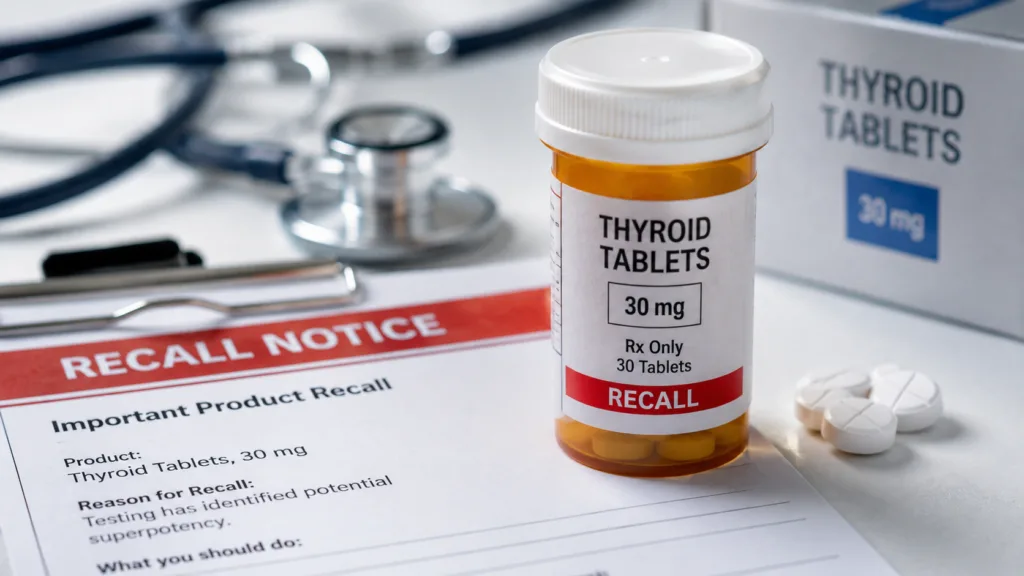
Vitruvias Therapeutics, Inc. is voluntarily recalling one lot of Thyroid Tablets, USP 30 mg across the United States after testing confirmed that the product could be superpotent, creating a risk that patients receive more thyroid hormone than intended from a medicine requiring particularly careful dose control. The consumer-level recall covers lot 504950, NDC 69680-166-00, with an expiration date of September 30, 2026, and applies specifically to the 30 mg strength rather than the company’s entire thyroid tablet portfolio. Vitruvias said 3,655 units from the lot were released and 1,955 were sold after distribution to direct accounts between January 31 and September 30, 2025, while no adverse events known to be associated with the recalled product had been reported when the recall was announced on August 21, 2026.
The recall is clinically important because the tablets contain active thyroid hormones rather than a medicine for which modest variation in exposure may be inconsequential. Each Vitruvias 30 mg tablet contains 19 micrograms of levothyroxine, or T4, together with 4.5 micrograms of liothyronine, or T3, according to the current product labeling, and the combination is used as replacement therapy in hypothyroidism. Excessive exposure can produce symptoms of hyperthyroidism including rapid heart rate, rhythm disturbances, hypertension, nervousness, heat intolerance, weakness and weight loss, while higher-risk groups include older people, pregnant patients and infants.
The timing makes the quality issue particularly notable. FDA has recently intensified its focus on animal-derived thyroid medicines, stating that these products are not FDA approved and raising specific concerns about whether batches consistently deliver predictable hormone levels. An estimated 1.5 million US patients received prescriptions for animal-derived thyroid medicines in 2024, meaning the regulatory debate extends considerably beyond a single Vitruvias lot even though the current recall itself is narrowly defined.
Which Vitruvias thyroid tablets are actually affected by the nationwide recall?
The recall is limited to Vitruvias Therapeutics Thyroid Tablets, USP 30 mg from lot 504950, carrying NDC 69680-166-00 and expiring on September 30, 2026. The company said the affected lot was distributed nationwide to its direct accounts during the nine-month period ending September 30, 2025, and wholesalers are being contacted by email and telephone to discontinue distribution while the company arranges destruction of recalled stock. Vitruvias has specifically advised patients using tablets from the affected lot not to stop treatment on their own, but instead to contact their healthcare provider for guidance and a replacement prescription where appropriate.
That last point is important because abruptly withholding thyroid replacement in a patient who requires it creates a different clinical risk from continuing a potentially superpotent batch. Hypothyroidism results from inadequate thyroid hormone production and can produce fatigue, weight gain, constipation, cold intolerance and other symptoms, while long-term replacement therapy is generally individualized according to hormone levels and clinical response. FDA emphasizes that thyroid replacement medicines have to be dosed carefully because both excessive and insufficient doses can produce clinically significant consequences, making clinician-guided adjustment more appropriate than patients attempting to solve a recall by stopping therapy without medical advice.
Vitruvias’ current label identifies its product as a prescription thyroid preparation derived from porcine thyroid glands and containing both T4 and T3. The recalled 30 mg presentation is one-half grain, with larger strengths containing proportionally more of the two active hormones, but the company’s August 21 announcement does not identify those other strengths as part of the recall. This precision matters because broad descriptions such as “Vitruvias thyroid medicines recalled” could incorrectly suggest that every strength or batch is affected when the company has identified one specific 30 mg lot.
Why can a superpotent thyroid medicine create disproportionate clinical risk?
Thyroid hormone has wide physiological effects, influencing cardiovascular activity, metabolism, temperature regulation, muscle function and neurological symptoms, which means excessive replacement can create effects across several organ systems rather than producing one isolated adverse event. Vitruvias warned that superpotent tablets could cause hyperthyroid symptoms including weight loss, heat intolerance, fatigue, nervousness, muscle weakness, hypertension, chest pain, rapid heart rate and cardiac rhythm disturbances. Older patients may be particularly vulnerable to the cardiovascular effects of excessive hormone exposure, and prolonged overtreatment can become especially important when underlying cardiac disease is already present.
Pregnancy introduces a different risk-benefit calculation because maintaining appropriate thyroid hormone levels is important for both maternal and fetal health, yet overtreatment can also be harmful. Vitruvias said excessive thyroid replacement during pregnancy has been associated with increased maternal and fetal complications including premature delivery and low birth weight, while excessive treatment in infants may adversely affect growth and development. Those risks explain why a potency problem in thyroid replacement can warrant a consumer-level recall even in the absence of reported adverse events connected with the particular lot.
T3 content adds another reason dosing precision matters. Liothyronine has more rapid pharmacological activity than T4, meaning unexpected increases in T3 exposure may generate clinically noticeable effects more quickly than equivalent proportional changes in a slower-acting thyroid preparation. The recall announcement does not disclose how far above specification lot 504950 tested or whether the excess involved T4, T3 or both, so it would be inappropriate to infer the magnitude of overdose risk for an individual patient from the term “superpotent” alone. What can be established is that testing was sufficient for Vitruvias to initiate a nationwide consumer-level recall with FDA knowledge.
Why is this recall different from an FDA withdrawal of the entire product?
Vitruvias initiated a voluntary recall of one lot because of a quality problem, while FDA’s broader concern about animal-derived thyroid medication concerns the regulatory status and consistency of a category of products that has historically remained on the US market without modern FDA approval. Those are related but distinct issues, and the current recall should not be interpreted as FDA ordering every patient taking animal-derived thyroid medication to discontinue therapy. FDA has instead said it is applying a risk-based enforcement approach while manufacturers work toward approval pathways and has advised patients using these medicines to discuss treatment with their clinicians.
FDA says synthetic levothyroxine or liothyronine products constitute the most commonly used type of thyroid replacement and have been FDA approved for decades, with approximately 22 million patients receiving levothyroxine prescriptions through US outpatient retail or mail-order pharmacies in 2024. Animal-derived thyroid medicines, sometimes described as desiccated thyroid extract, are produced from dried animal thyroid glands, typically porcine sources, and include products marketed under multiple names. FDA estimates around 1.5 million patients received these animal-derived medicines during 2024 but says they have not been reviewed through the FDA approval process for safety, purity, potency and effectiveness.
The regulator has specifically identified inconsistent hormone levels as a concern, stating that tablets produced using the same source material may not always provide identical thyroid hormone exposure. FDA also says the biological origin of animal-derived products may introduce additional impurity concerns and notes that it has received patient complaints and adverse-event reports relating to safety and potency. The Vitruvias superpotency recall therefore falls directly within one of the quality issues FDA has recently highlighted, although the agency has not stated that the individual recall itself was caused by the broader enforcement initiative.
Have potency problems occurred with animal-derived thyroid medicines before?
The current recall is not the first time potency variation has affected the category. In 2020, Acella Pharmaceuticals recalled certain lots of NP Thyroid after testing found that affected products could contain as much as 115% of the labeled amount of liothyronine, creating a superpotency problem with a similar risk of hyperthyroid symptoms and cardiovascular complications. FDA published the company’s announcement and noted at that time that patients should speak with healthcare professionals before discontinuing the medicine.
Other recalls have involved the opposite quality problem. Acella recalled multiple NP Thyroid lots in 2021 because of subpotency, while RLC Labs previously recalled Nature-Throid and WP Thyroid products after testing found insufficient hormone potency. The clinical consequences move in opposite directions, but both demonstrate why consistent hormone content matters: excessive exposure can drive hyperthyroid effects, while inadequate replacement can leave patients undertreated and allow hypothyroid symptoms or complications to return.
These historical recalls should not be used to imply that every animal-derived thyroid product or every batch is unreliable. They do, however, illustrate the quality-control challenge behind FDA’s current regulatory focus, especially because thyroid hormone replacement can require relatively precise dose adjustment and patients may remain on treatment for years. Repeated historical episodes involving both high and low potency provide context for why a one-lot recall involving fewer than 2,000 reported sold units can still carry broader regulatory significance.
What happens next for Vitruvias and patients using the recalled lot?
Vitruvias is contacting wholesalers and arranging destruction of recalled product, while patients are being directed toward their healthcare providers for replacement prescriptions rather than being told to discontinue thyroid therapy independently. The company said no adverse events known to be related to lot 504950 had been reported as of its August 21 announcement, although that status can change as a recall progresses and patients or clinicians report additional information. Adverse reactions or quality problems can also be reported through FDA’s MedWatch programme, and the company has provided its own safety contact for recall-related questions.
For Vitruvias, the immediate operational issue is containment of the specific batch, but the longer-term regulatory environment could prove more important. FDA has said it intends to issue guidance covering compliance priorities for marketed unapproved animal-derived thyroid medications and separate development guidance intended to support manufacturers seeking formal marketing applications. The agency has also warned that it may take enforcement action where manufacturers fail to meet quality standards and place patients at risk, making potency control likely to receive greater rather than lesser scrutiny across the category.
The current recall consequently has two layers. For patients, it is a specific product-safety event involving one 30 mg batch that requires identification and clinician-guided replacement; for manufacturers, it lands during a broader transition in which FDA is questioning the continued marketing of animal-derived thyroid medicines without approved applications. Vitruvias has reported no known recall-related adverse events so far, but confirmed potential superpotency in a drug class where small dosing differences can matter is enough to make lot 504950 a meaningful pharmaceutical quality-control story rather than a routine warehouse withdrawal.