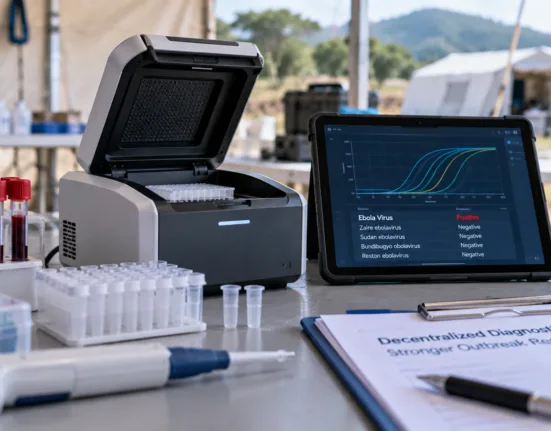
Co-Diagnostics has expanded its Vector Smart mosquito-surveillance business outside the United States for the first time, supplying laboratory equipment, consumables, reagents and mosquito-abatement materials to an overseas U.S. Air Force base. The deployment follows domestic adoption by 40 customers across 21 U.S. states and moves a molecular diagnostics platform traditionally used by mosquito-control organizations into an international military setting. Co-Diagnostics did not disclose the location of the Air Force installation or financial value of the contract.
Vector Smart uses multiplex PCR assays designed for mosquito surveillance rather than testing human patients. The assay portfolio targets pathogens associated with West Nile virus, Eastern and Western equine encephalitis, St. Louis encephalitis, Zika, dengue and chikungunya. The idea is to allow local mosquito-control teams to detect pathogens in collected mosquito populations early enough to guide interventions before growing numbers of human cases reveal that transmission is already well established.
How does testing mosquitoes help prevent human disease?
Mosquito-borne outbreaks create an unusual surveillance challenge because infected humans are not necessarily the earliest visible sign that a virus is circulating. Mosquito populations can acquire and transmit pathogens before local hospitals see enough symptomatic cases to recognize a pattern.
Vector surveillance attempts to move detection upstream. Mosquito-control teams trap mosquitoes in selected locations, identify or group specimens and test pools for genetic material from pathogens of public-health interest.
A positive mosquito pool does not mean everyone in the surrounding community is infected. It means the pathogen has been detected within the local vector population, allowing authorities to increase trapping, change spraying strategies, investigate breeding locations or intensify public warnings.
The value is therefore partly temporal. Discovering West Nile virus after a cluster of neuroinvasive human cases is very different from discovering it while infection is still appearing mainly in mosquitoes.
PCR platforms can help because they look directly for pathogen nucleic acid rather than relying on slower biological culture methods.
What diseases can Vector Smart mosquito assays look for?
Co-Diagnostics says its multiplex PCR products are designed to identify pathogens associated with West Nile virus, Eastern equine encephalitis, Western equine encephalitis, St. Louis encephalitis, Zika, dengue and chikungunya.
These diseases differ substantially in geography and clinical impact. West Nile is a recurring mosquito-borne threat across much of the United States, while dengue and chikungunya are major global health problems with expanding geographic reach. Zika gained international attention because infection during pregnancy can cause severe congenital complications.
Eastern equine encephalitis is considerably rarer but can cause severe neurological disease. From a surveillance perspective, rare but highly consequential viruses can justify targeted mosquito monitoring even when human cases are uncommon.
Multiplexing is valuable because mosquito-control laboratories do not necessarily know in advance which virus may be present. Running several independent assays on every pool increases time, material use and laboratory workload.
A multiplex assay can screen for several targets within one molecular workflow, provided analytical performance remains reliable.
Why is a U.S. Air Force base an interesting environment for vector surveillance?
Military installations can host personnel and families who originate from many regions and may be stationed in areas where mosquito-borne pathogens differ from those encountered in the continental United States.
Operational readiness is another consideration. An outbreak affecting a large number of personnel can become more than an ordinary public-health problem if it disrupts military operations.
Bases often function as relatively self-contained communities with housing, workplaces and surrounding land under coordinated management. That can make targeted mosquito surveillance and abatement operationally practical because one organization can link laboratory results directly to environmental interventions.
Co-Diagnostics has not identified the overseas base, so the specific vector ecology and pathogens of greatest concern cannot be inferred from the September announcement.
The important commercial milestone is that Vector Smart has moved beyond U.S. civilian mosquito-control customers into an international federal or military deployment.
Is Vector Smart diagnosing dengue, Zika or West Nile infections in people?
No. The product described in this release is a mosquito-surveillance platform. It tests vector samples to support mosquito abatement and public-health monitoring, not patient blood specimens to diagnose an individual infection.
That distinction matters because “molecular diagnostics” can imply a clinical test used to determine whether a patient has a disease. Vector Smart sits closer to environmental and public-health surveillance.
If a mosquito pool tests positive for dengue, physicians still need appropriate clinical diagnostic testing to establish whether a particular patient has dengue.
Conversely, a negative mosquito sample does not guarantee that no infected mosquitoes exist in the area. Surveillance results depend on where traps are placed, how frequently collections occur and how representative the tested insects are.
This is why vector testing functions as one component of a broader public-health program rather than a definitive map of infection risk.
Why does local PCR testing matter instead of shipping samples to a centralized laboratory?
Centralized laboratories can provide sophisticated testing and strong quality control, but sample transport introduces delay. Mosquito-control programs often need geographically specific information quickly because vector populations can change over short periods.
A decentralized laboratory can potentially collect mosquitoes, process pools and obtain molecular results closer to the area where intervention decisions are being made.
That speed may help teams decide where additional traps should be deployed or whether abatement measures need to intensify.
The model resembles broader changes in infectious-disease diagnostics, where developers increasingly try to move molecular testing away from a small number of highly centralized laboratories.
The challenge is maintaining quality. PCR assays require appropriate controls, specimen preparation and trained operators. A test performed locally is useful only if its analytical reliability remains high.
Co-Diagnostics’ deployment includes laboratory equipment and consumables rather than simply shipping test kits, suggesting the company is selling a broader surveillance workflow.
How established is Vector Smart in the United States?
Co-Diagnostics says Vector Smart has served 40 customers across 21 states before the current international expansion.
That domestic footprint provides more commercial context than a one-off experimental installation. The company has been building the platform around mosquito-abatement organizations that already perform routine surveillance and need molecular tools capable of detecting several pathogens.
Still, 40 customers is relatively early compared with national-scale clinical diagnostic platforms. The USAF deployment therefore matters partly because it opens another customer category: military and government public-health organizations.
If the overseas installation performs well, similar deployments could potentially follow at other bases or government-controlled locations.
The company has not disclosed whether it has a broader Air Force contract or whether this installation remains a single-customer order.
Why is mosquito surveillance becoming more important as vector geography changes?
Mosquito populations and the pathogens they transmit are influenced by temperature, rainfall, urbanization, international travel and ecological change. Diseases historically associated with one region can appear elsewhere when competent mosquito vectors are present and infected travelers introduce virus.
Dengue is a particularly useful example of why local surveillance matters. Large global epidemics can increase the number of infected travelers arriving in regions where suitable mosquitoes already live.
A surveillance network can therefore help authorities distinguish theoretical risk from evidence that a pathogen has entered a local mosquito population.
Not every positive molecular detection will lead to an outbreak, and not every outbreak will be predicted perfectly by vector testing. The objective is to improve situational awareness rather than eliminate uncertainty.
For military facilities with personnel moving between countries, that awareness may have operational as well as health value.
What are the limitations of the September deployment announcement?
Co-Diagnostics did not disclose analytical sensitivity or specificity data in the release, nor did it provide the number of instruments, tests or mosquito pools expected to be processed at the Air Force facility.
There is also no disclosed contract value, which makes it impossible to determine how financially significant this deployment is.
The company calls it the first international expansion of the Vector Smart product line, but that is a commercial milestone rather than evidence that the system improves health outcomes.
To demonstrate public-health impact, researchers would ideally show that surveillance results identify infected mosquito populations early, prompt interventions and ultimately contribute to reduced transmission or more efficient allocation of mosquito-control resources.
Such outcomes are difficult to prove because mosquito abundance, weather and human behavior change simultaneously.
For now, the strongest evidence is operational: Vector Smart has already been adopted by dozens of U.S. customers and has now reached an overseas military installation.
How does this fit within Co-Diagnostics’ broader molecular-testing strategy?
Co-Diagnostics develops PCR technologies across several applications rather than focusing exclusively on mosquito surveillance. Vector Smart demonstrates one way the company can use the same underlying molecular-detection expertise outside traditional hospital diagnostics.
That diversification can matter commercially because infectious-disease diagnostics often experience highly variable demand. Testing volumes can surge during an outbreak and decline rapidly afterward.
Mosquito surveillance is more routine. Many control districts collect and test vectors seasonally or continuously even when there is no major outbreak, potentially creating recurring demand for reagents and consumables.
Government customers may also value integrated procurement. A package including laboratory equipment, assays and mosquito-abatement materials can be easier to deploy than assembling a surveillance workflow from several vendors.
Whether Vector Smart becomes a material business will depend on how many customers convert to recurring testing programs rather than isolated installations.
What should we watch after the USAF deployment?
The first question is whether Co-Diagnostics wins additional international military or government customers. One installation proves that the company can cross the geographic boundary; a series of installations would demonstrate that the model is repeatable.
A second issue is pathogen expansion. Mosquito-borne disease threats vary geographically, so adding validated assay targets could make the platform more relevant in different regions.
Third, public-health agencies will want performance data from real surveillance programs. Turnaround time, invalid-test rates, concordance with reference laboratories and cost per mosquito pool can matter as much as the number of pathogens advertised on the assay menu.
The broader significance is that outbreak detection does not have to begin with a sick patient entering a hospital. Molecular technology increasingly allows health authorities to look for pathogens in vectors, wastewater and other environmental signals before conventional clinical surveillance becomes obvious.
Co-Diagnostics is applying that principle to mosquitoes. Its first international USAF installation is small compared with a national patient-diagnostic rollout, but the strategic idea is larger: detect the virus where it is circulating before the people exposed to it become the surveillance system.