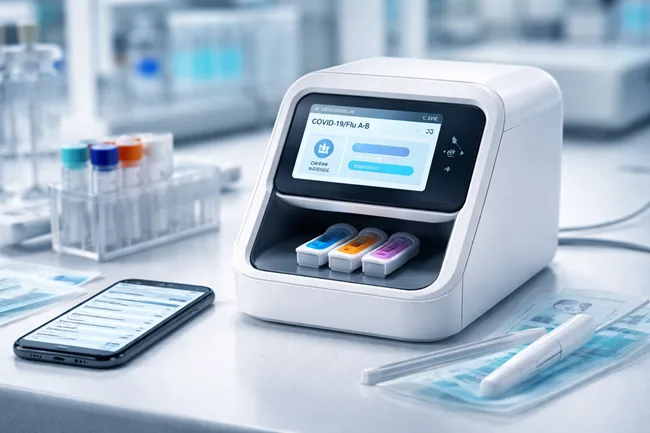
Co-Diagnostics and ReadyGo Diagnostics have begun evaluating whether ReadyGo’s field-oriented blood sample-preparation technology can be combined with the Co-Dx PCR platform to support decentralized molecular testing, with Ebola virus detection selected as the first application. The companies have started feasibility work and Co-Diagnostics has already received ReadyGo materials and devices for compatibility and workflow studies. The collaboration could eventually extend to other blood-borne pathogens including HIV and hepatitis B and C, but the companies explicitly caution that successful evaluation is not guaranteed and may never result in a commercial product.
The regulatory position is equally important. Co-Diagnostics states that the Co-Dx PCR platform, including PCR Home, PCR Pro, the mobile application and associated tests, has not been cleared or authorized by the FDA and is not currently available for commercial sale under a U.S. authorization. The present announcement is therefore a technology-development collaboration rather than a diagnostic launch.
Why is sample preparation such an important bottleneck in point-of-care PCR?
PCR is often described mainly in terms of amplification chemistry, but the quality of the result begins much earlier.
Blood contains cells, proteins and other substances that can interfere with molecular amplification. Laboratories typically use extraction and preparation steps to release and purify viral nucleic acid before testing.
Large centralized laboratories can automate these processes using expensive equipment and trained staff.
The point-of-need environment is different. A clinic, mobile unit or outbreak location may not have a full molecular laboratory.
If sample preparation remains complicated, a compact PCR instrument alone does not create genuinely decentralized testing.
ReadyGo’s value proposition is therefore to simplify the front end of the workflow enough that high-quality blood-based molecular testing becomes feasible closer to the patient.
Why start with Ebola?
Ebola illustrates the importance of turnaround time particularly clearly.
Suspected patients need rapid isolation and public-health response, but definitive molecular testing can be complicated by biosafety requirements, sample transport and limited laboratory infrastructure in outbreak regions.
Every delay can prolong uncertainty around patient management and contact tracing.
A decentralized system capable of preparing blood and performing molecular testing closer to the point of need could potentially shorten that interval.
However, Ebola testing carries exceptionally high safety requirements. Handling potentially infectious blood cannot be treated like an ordinary consumer diagnostic workflow.
Any future product would need rigorous analytical validation, appropriate biosafety procedures and authorization from relevant health authorities before deployment.
The current feasibility work does not yet establish that those requirements can be met.

What does ReadyGo contribute to the proposed workflow?
ReadyGo develops technologies intended to simplify collection and preparation of biological samples outside conventional laboratories.
Its GoCollect platform is designed around portable sample-processing workflows that could potentially feed prepared material into molecular diagnostic systems.
Co-Diagnostics brings the amplification and detection side through its Co-Dx PCR technology.
The collaboration is effectively testing whether the two components can be joined into one practical blood-testing pathway.
Compatibility involves more than physically transferring liquid from one device to another. The sample-preparation method must preserve enough target nucleic acid, remove inhibitors and produce a material suitable for reliable amplification.
If extraction efficiency is inconsistent, even an analytically strong PCR assay may produce false-negative results.
Why could the same architecture matter for HIV and hepatitis?
Blood-borne infections are particularly suitable for this type of platform because molecular testing can play an important role in diagnosis, viral-load measurement or confirmation.
HIV and hepatitis B and C affect far larger global populations than Ebola and create chronic rather than primarily outbreak-driven testing needs.
That means a successful platform could eventually have commercial applications extending well beyond emergency response.
But each pathogen would require its own assay development, analytical validation and regulatory pathway.
The companies cannot simply demonstrate Ebola compatibility and assume the same system is clinically validated for HIV.
Different viral loads, specimen requirements and clinical use cases produce different performance expectations.
How does this fit with Co-Diagnostics’ broader point-of-care strategy?
Co-Diagnostics has been building the Co-Dx PCR ecosystem around smaller, distributed molecular-testing environments.
The company has separately submitted an FDA 510(k) premarket notification for an upper respiratory point-of-care test and is conducting clinical work in other infectious-disease applications. Its investor-relations archive also shows recent activity around tuberculosis, Ebola, dengue surveillance and mobile infrastructure.
The ReadyGo agreement adds a missing sample type.
Respiratory swabs can often be processed more simply than blood. Expanding into blood testing could therefore broaden the platform’s addressable diagnostic menu substantially if the workflow proves technically robust.
It also increases development complexity.
Is this the same Ebola story as Co-Diagnostics’ earlier Vector Smart mosquito work?
No.
The Vector Smart stories involve molecular surveillance of mosquitoes for pathogens such as dengue, West Nile and related viruses. That technology is designed for environmental or public-health vector surveillance rather than diagnosing an infected patient.
The ReadyGo collaboration is about blood-based molecular testing intended to bring testing closer to patients.
Those are fundamentally different specimen types and clinical contexts.
Co-Diagnostics has also supplied Ebola assay materials for analytical work through its CoSara joint venture, but the ReadyGo collaboration focuses specifically on integrating a decentralized sample-preparation workflow with the Co-Dx platform.
That makes it a genuinely new milestone rather than a duplicate of the earlier USAF Vector Smart story we already covered.
Why does decentralization matter in infectious disease?
Central laboratories create economies of scale and high analytical quality, but they also introduce transport and turnaround time.
For routine disease management, a delay of one or two days can inconvenience patients and slow treatment decisions.
During an outbreak, the consequences can be much larger.
Portable molecular systems aim to shift testing closer to where clinical decisions are made.
This could be a district hospital, field clinic, border location or temporary outbreak facility.
The challenge is ensuring that decentralization does not sacrifice reliability.
Molecular diagnostics depend on calibration, reagent stability, quality controls and operator training. A small instrument does not remove those requirements.
What could derail the collaboration?
The companies themselves acknowledge that feasibility work may not succeed.
Sample preparation could produce insufficient nucleic acid yield, introduce inhibitors or prove too complicated for intended environments.
The combined system may also face cost, stability or regulatory obstacles even if laboratory compatibility is demonstrated.
Ebola introduces additional biosafety considerations that can limit where testing is performed.
Commercialization would require manufacturing at scale, reliable consumables and quality-control systems capable of supporting repeated field use.
A promising prototype therefore remains many steps away from a deployable diagnostic product.
Why could decentralized Ebola testing matter before FDA clearance?
Because the collaboration illustrates where molecular diagnostics are heading.
The first generation of PCR largely lived inside centralized laboratories.
The next generation increasingly aims to separate sophisticated molecular detection from large laboratory infrastructure.
That requires innovation not just in amplification but in every preceding step: collection, preparation, reagent handling, software and result interpretation.
The Co-Diagnostics/ReadyGo project is therefore useful as a case study in the hidden engineering required to make “PCR near the patient” a realistic concept.
What should we watch next?
The first milestone will be whether the companies report successful feasibility and workflow integration.
After that, analytical studies would need to establish limits of detection, precision, inclusivity, cross-reactivity and resistance to interfering substances.
Clinical evaluation would then need to compare the system against an appropriate reference method using real patient specimens.
Regulatory submissions would come only after those steps.
The most important editorial distinction is consequently simple: Co-Diagnostics has not launched an FDA-cleared Ebola blood test. It has begun testing whether its molecular platform can be paired with ReadyGo’s sample-preparation technology to make one possible.
If that engineering works, Ebola could become the first demonstration of a broader platform extending into HIV and viral hepatitis. If it fails, the reason will likely show why point-of-need molecular diagnostics remain much harder than simply shrinking a PCR machine.