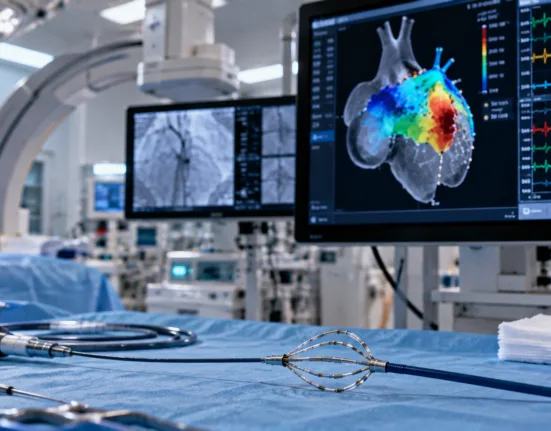
Abbott Laboratories has received U.S. Food and Drug Administration approval for the TactiFlex Duo Ablation Catheter, a focal electrophysiology device capable of delivering both pulsed field ablation and radiofrequency energy during treatment of atrial fibrillation. The approval is supported by the 180-patient FlexPulse IDE study, where 12-month follow-up showed a 1.7% primary safety-event rate, 92.6% freedom from atrial fibrillation, atrial flutter or atrial tachycardia recurrence under standard-of-care monitoring and 91.7% freedom from repeat ablation.
The device enters a market rapidly reorganizing around pulsed field ablation. PFA has attracted electrophysiologists because electrical fields can preferentially disrupt myocardial cells while reducing exposure of some surrounding structures to the thermal injury associated with radiofrequency or cryoablation. Abbott’s design takes a less binary view of that transition by assuming there are procedures in which physicians may want PFA for one target and radiofrequency for another.
That is the central strategic question behind TactiFlex Duo. If PFA eventually becomes capable of handling virtually every clinically relevant lesion set, dual-energy functionality could look like transitional complexity. If electrophysiologists continue to encounter anatomy or substrates where targeted radiofrequency remains useful, carrying both energy sources in one catheter could become an important workflow advantage.
Why combine pulsed field ablation and radiofrequency when PFA is already expanding rapidly?
PFA’s appeal comes partly from tissue selectivity. Instead of heating or freezing tissue, pulsed electrical fields create irreversible electroporation in targeted cells, which can produce myocardial ablation while potentially reducing damage to adjacent structures such as the esophagus or phrenic nerve. That safety proposition has driven remarkably fast adoption across electrophysiology.
Yet atrial fibrillation procedures are not always limited to straightforward pulmonary vein isolation. Patients with prior failed ablation, unusual anatomy or more complex arrhythmogenic substrates may require lesions in locations where an operator prefers a focal approach or has deeper experience with radiofrequency. A system that forces a complete platform change can interrupt workflow and add equipment complexity.
TactiFlex Duo allows the same flexible-tip, contact-force catheter to deliver either modality. In the FlexPulse study, PFA was used for pulmonary vein isolation in most cases, while radiofrequency remained available for regions where investigators considered it appropriate. Additional lesion sets beyond pulmonary vein isolation were also permitted, providing evidence that the catheter could be used in procedures that were not entirely uniform.
The distinction is commercially useful because Abbott does not have to argue that radiofrequency has become obsolete in order to sell PFA. Instead, the medical-device manufacturer can position both technologies as tools within one integrated electrophysiology environment. That protects its existing expertise in RF ablation while giving customers access to the faster-growing PFA category.
What does the FlexPulse IDE study really establish about safety and effectiveness?
FlexPulse treated 180 patients with paroxysmal atrial fibrillation across 24 sites in the United States and Europe. Pulmonary vein isolation was completed using PFA alone in approximately 93% of participants, while additional non-PVI targets were treated in more than one-third of procedures. Acute entrance block was achieved in all pulmonary veins after the required waiting period, demonstrating strong procedural effectiveness.
The primary safety-event rate was 1.7%, with no reported stroke or transient ischemic attack, phrenic nerve injury, clinically relevant esophageal lesion, pulmonary vein stenosis or device-related or procedure-related death in the trial dataset highlighted by Abbott. Those categories are particularly relevant because avoiding collateral injury is one of the principal reasons electrophysiologists have adopted PFA so rapidly.
At 12 months, 92.6% of patients were free of documented atrial fibrillation, atrial flutter or atrial tachycardia recurrence using standard-of-care monitoring, while 91.7% remained free of repeat ablation. Abbott also reports a 74.6% rate of freedom from any event included in the trial’s broader primary effectiveness definition. The difference between those figures highlights why device efficacy cannot be reduced to one attractive percentage.
Monitoring intensity matters as well. More aggressive continuous rhythm surveillance generally identifies more asymptomatic arrhythmia than routine clinical monitoring, making cross-trial comparisons difficult. The 92.6% figure should therefore not be treated as evidence that TactiFlex Duo is superior to another PFA system without a direct randomized comparison using the same endpoint definitions and monitoring strategy.
Does dual-energy capability create better flexibility or simply more procedural choices?
For experienced electrophysiologists, flexibility can be valuable because no two ablation procedures are identical. A physician may prefer PFA on the posterior left atrium because of concern about nearby structures while choosing radiofrequency for another focal substrate. Combining both capabilities can reduce the need to exchange catheters, reconnect systems or alter mapping workflows.
More choice can also create variability. If individual operators use different combinations of PFA and RF for similar patients, real-world outcomes may depend heavily on training, institutional protocols and lesion strategy. Abbott will need to support users with clear procedural guidance so that flexibility does not become unnecessary complexity.
The EnSite X mapping system is central to that proposition. TactiFlex Duo integrates with Abbott’s three-dimensional electroanatomic mapping environment and includes a PFA Index intended to give operators feedback relating to energy delivery and lesion formation. The broader platform also incorporates mapping and intracardiac imaging technologies, allowing Abbott to compete on an integrated procedure rather than on the catheter alone.
That ecosystem strategy can influence hospital purchasing. Electrophysiology laboratories often invest heavily in mapping infrastructure, generators, catheters and staff training, creating switching costs that extend beyond the price of an individual disposable device. Abbott can therefore use TactiFlex Duo both to expand PFA adoption within existing accounts and to strengthen the economic case for its wider EP platform.
How does TactiFlex Duo fit into Abbott’s increasingly broad pulsed field ablation portfolio?
The approval follows a rapid sequence of electrophysiology regulatory milestones for Abbott, including earlier U.S. and European authorization of its Volt PFA system and European clearance of TactiFlex Duo. The medical-device group is building multiple PFA formats rather than betting on one catheter architecture, giving electrophysiologists different options depending on procedural preference and anatomy.
That portfolio approach reflects the wider competitive environment. Major cardiovascular device manufacturers are investing aggressively in PFA because the technology is reshaping one of electrophysiology’s largest procedure categories. Hospitals that adopted early systems now have enough clinical experience to compare workflow, mapping integration, catheter design and procedure economics rather than evaluating PFA solely as a novel energy source.
Abbott’s differentiation increasingly depends on integration. TactiFlex Duo works alongside EnSite X, the Advisor HD Grid mapping catheter and ViewFlex X intracardiac echocardiography tools, creating an end-to-end environment for visualization, mapping and treatment. The commercial argument is that an electrophysiologist can manage more of a complex case without leaving the Abbott ecosystem.
The challenge is that competitors are pursuing similar platform strategies. As PFA becomes mainstream, the technology itself becomes less differentiating and execution shifts toward procedure time, lesion durability, safety, learning curve, mapping quality and hospital economics. Abbott will therefore need real-world comparative experience to demonstrate that dual energy solves a recurring procedural problem rather than simply adding an impressive feature.
What could broader U.S. adoption reveal that the 180-patient IDE study cannot?
Abbott plans broader U.S. commercialization following the approval, which will expose TactiFlex Duo to a much wider range of physicians and patients than the IDE trial. Early adopters in clinical studies usually receive intensive training and operate under defined protocols, while commercial practice includes more variable anatomy, operator experience and institutional workflow.
Real-world surveillance will therefore help determine how often physicians actually use the radiofrequency capability. If most procedures remain PFA-only, the dual-energy feature may function mainly as insurance for unusual situations. If operators frequently switch modalities during complex cases, Abbott will have stronger evidence that the architecture solves a genuine clinical workflow need.
Procedure time and discharge patterns will also be important. In FlexPulse, more than half of patients were discharged on the same day and a meaningful proportion of procedures were completed without fluoroscopy. Those findings fit the broader objective of making AFib ablation faster and less resource intensive, but commercial data will reveal whether that efficiency is reproducible outside trial centers.
Hospital economics ultimately determine scale. PFA systems involve generators, catheters and mapping infrastructure, and institutions will compare acquisition costs against procedure throughput, complication risk and repeat-ablation burden. A catheter that can replace separate energy-specific tools during selected cases could have an economic argument, but only if the additional functionality does not impose a disproportionate price premium.
Why did Abbott shares fall despite another cardiovascular approval?
Abbott Laboratories shares declined about 2.6% on September 8, closing near $105.52 during a broadly weak U.S. market session. The move illustrates the limited ability of a single device approval to determine daily performance for a diversified healthcare company spanning medical devices, diagnostics, nutrition and established pharmaceutical products.
For Abbott’s electrophysiology business, however, the approval is strategically more important than the share-price reaction suggests. PFA is not a niche technology launch but a significant transition in a large cardiovascular procedure category, and maintaining competitive relevance requires manufacturers to establish credible platforms before hospital purchasing patterns become entrenched.
TactiFlex Duo gives Abbott a differentiated answer to the question of how quickly electrophysiology should move away from thermal energy. Rather than asking physicians to choose one modality permanently, the catheter allows PFA and radiofrequency to coexist during the same case. That design may prove especially valuable in complex procedures where operators want tissue selectivity in one region and familiar focal thermal ablation in another.
The market will now decide whether that flexibility is necessary often enough to matter. FDA approval establishes that TactiFlex Duo can enter U.S. practice, and FlexPulse provides an encouraging safety and effectiveness foundation. The commercial test is whether dual energy becomes a routine procedural advantage or a feature that sounds more consequential in product specifications than it ultimately proves to be inside the electrophysiology laboratory.