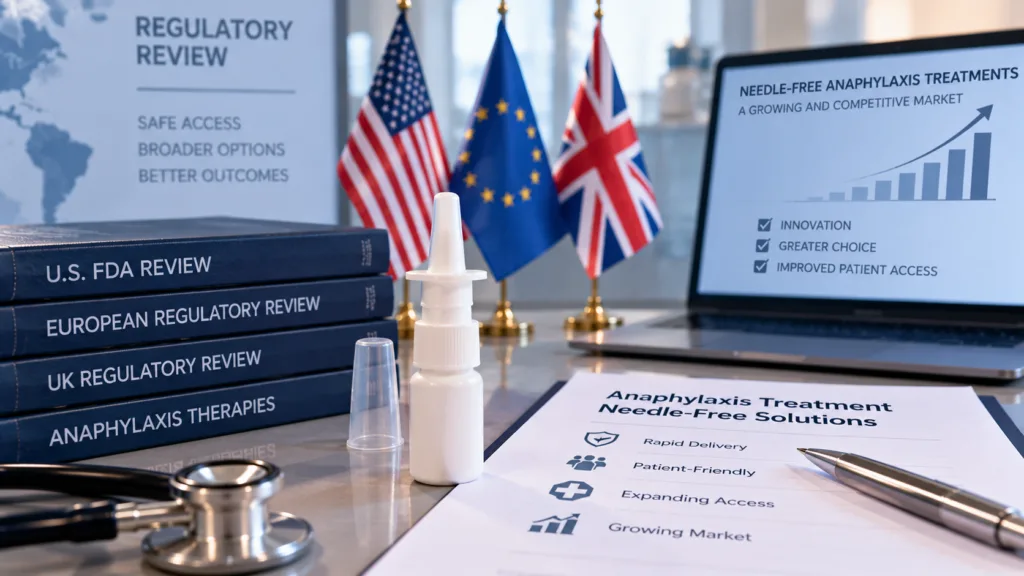
Hikma Pharmaceuticals PLC has moved its investigational epinephrine nasal spray into regulatory review across several major pharmaceutical markets, with the United States Food and Drug Administration accepting a 505(b)(2) New Drug Application and European and United Kingdom authorities validating their respective dossiers. Hikma has also submitted the product in Canada as it attempts to build a multinational commercial opportunity around a non-injectable emergency treatment for severe allergic reactions, including anaphylaxis.
The filing milestone is commercially notable but should not be confused with approval. Hikma’s product remains investigational, and the company says its United States submission contains the nonclinical and clinical package required for FDA evaluation of the nasal spray for emergency treatment of anaphylaxis. The announcement did not provide an FDA action date or disclose detailed comparative clinical results.
Hikma is also not entering an entirely new therapeutic category. The FDA approved ARS Pharmaceuticals’ neffy in August 2024 as the first epinephrine nasal spray for anaphylaxis, initially in adults and children weighing at least 30 kilograms, before expanding the indication in March 2025 to children aged four years and older weighing 15 to less than 30 kilograms.
That changes the strategic interpretation of Hikma’s filing. The company is no longer asking regulators and clinicians to accept the concept of nasal epinephrine for the first time. Instead, it must establish a second product capable of competing on clinical performance, device usability, reliability, price, distribution and reimbursement in a market that has already begun moving beyond the traditional autoinjector-only model.
What does FDA acceptance of Hikma’s 505(b)(2) application actually mean?
Acceptance means the FDA has determined that Hikma’s application is sufficiently complete to undergo substantive regulatory review. It does not mean the agency has concluded that the nasal spray is safe, effective or likely to receive approval.
The company is using the 505(b)(2) pathway, a regulatory route that allows a New Drug Application to rely partly on information not generated directly by the applicant, including established knowledge or data concerning an already approved drug, while providing the additional studies necessary to support the specific new formulation or delivery approach.
Epinephrine itself is an exceptionally well-established medicine, but converting it from an injected product into a nasal spray creates new pharmacological and device questions. Regulators need to understand whether intranasal administration produces epinephrine exposure rapidly and reliably enough for an emergency in which delays can have serious consequences.
Absorption can potentially be affected by nasal physiology, congestion, rhinitis or other conditions. Device performance also matters because the correct dose must be delivered quickly by patients, parents, caregivers or bystanders who may be experiencing significant stress.
The 505(b)(2) route consequently should not be interpreted as a simple generic approval process. Hikma has to demonstrate that the proposed product’s formulation, delivery system and pharmacokinetic evidence adequately support the emergency-treatment indication being requested.
Why did the approval of neffy change the commercial equation for Hikma Pharmaceuticals?
Before 2024, epinephrine emergency treatment in the United States depended primarily on injection, particularly autoinjectors. ARS Pharmaceuticals changed that environment when neffy became the first FDA-approved epinephrine nasal spray, providing a needle-free option for qualifying adults and children.
The commercial rationale for nasal delivery is based partly on treatment hesitation. Patients or caregivers may be reluctant to inject epinephrine because of needle fear, uncertainty about correct autoinjector technique or concern that a reaction is not yet severe enough to justify treatment. Those delays can be clinically consequential because epinephrine is the established first-line emergency treatment for anaphylaxis.
Nasal delivery does not remove the need for emergency planning or medical follow-up, but it can potentially reduce one psychological and operational barrier to administration. The FDA explicitly cited fear of injections as one reason a non-injectable alternative could address an unmet need when it approved neffy.
Hikma therefore enters a category whose underlying clinical proposition is now established. That reduces one type of market-development risk because allergists, pharmacies, patients and payers are already becoming familiar with nasal epinephrine.
It simultaneously creates a competitive hurdle. Hikma needs a compelling reason for prescribers or payers to select its product rather than an existing nasal option or established autoinjectors, and the current filing announcement does not provide enough detail to determine what that differentiation will be.
What clinical evidence will regulators examine for an emergency nasal epinephrine product?
Conducting conventional efficacy trials during life-threatening anaphylaxis presents ethical and practical difficulties. Development of alternative epinephrine delivery systems therefore relies heavily on pharmacokinetic and pharmacodynamic evidence comparing the new formulation with established injectable epinephrine exposure, alongside safety and device-performance data.
Regulators will examine how quickly clinically relevant epinephrine concentrations appear after dosing, the magnitude and consistency of systemic exposure and pharmacodynamic responses such as changes in blood pressure and heart rate. Variability is especially important because an emergency product must work reliably rather than simply producing an acceptable average response.
Repeat dosing may also matter. Severe allergic reactions can require a second epinephrine dose if symptoms do not respond adequately or recur, meaning the product needs clear instructions and an evidence package addressing that scenario.
Nasal conditions will likely receive close scrutiny because patients may experience congestion or rhinitis when a reaction occurs. The approved neffy program included studies examining absorption under different nasal conditions, establishing a reference point for what regulators can expect from a product delivered through the same general route.
Hikma has not publicly disclosed the detailed clinical results underlying its application in the regulatory-acceptance announcement. Until those data are available, it would be premature to conclude that its formulation matches, exceeds or differs materially from the performance of another nasal epinephrine product.
How could another nasal epinephrine product affect patients, pharmacies and payers?
Additional competition can expand a market even when a first product already exists. Prescribers may become more comfortable with a new route as several manufacturers invest in education, pharmacies may stock the category more consistently and payers gain greater leverage when negotiating coverage.
Price could become a particularly important differentiator. Epinephrine products have a long history of public attention around cost and access, and patients may need to keep devices in several locations because anaphylaxis can occur unpredictably. Coverage terms, copayments and replacement schedules can therefore materially influence real-world availability.
Shelf life and storage are additional commercial considerations. Emergency medicines often spend long periods unused, making expiration dates and temperature requirements relevant to patients, schools, workplaces and institutional buyers.
Device design can also determine preference. A nasal spray needs to be sufficiently intuitive that an untrained or minimally trained person can identify the correct device orientation and administer the full dose during a stressful emergency. Differences that look small in a product specification can become important when use is infrequent and urgent.
Hikma’s extensive presence in generic and specialty pharmaceuticals may give it distribution and manufacturing advantages, particularly if it can achieve competitive pricing at scale. Actual positioning will remain unclear until regulatory labeling, launch strategy and price are disclosed.
Why does epinephrine nasal spray fit Hikma Pharmaceuticals’ broader complex-product strategy?
Hikma has been increasing investment in products that are more difficult to develop and manufacture than conventional oral generics. The company has highlighted specialty nasal sprays, inhalation products and contract manufacturing among the growth drivers for its Hikma Rx business.
Its existing nasal-spray manufacturing experience is strategically relevant because formulation, spray performance, container-closure systems and device consistency require capabilities extending beyond tablet manufacturing. A successful epinephrine product could therefore leverage infrastructure Hikma already uses across its broader nasal portfolio.
The company has also been increasing research and development spending. Hikma reported R&D expenditure up 18% in the first half of 2026 and 48 product submissions during the period, reflecting an effort to build products with higher barriers to entry as conventional generics face persistent price erosion.
Hikma Rx generated $520 million in first-half revenue, broadly unchanged year over year, while core operating profit increased 16% and its core operating margin rose to 20.6%. Management has identified improved product mix and growing contract-manufacturing activity as important contributors to profitability.
A differentiated epinephrine nasal spray could fit that effort particularly well because the opportunity is based on a complex formulation and delivery system rather than being another commodity oral generic. It may also provide access to a market where branded and differentiated-generic economics can be more attractive if reimbursement and market share develop favorably.
How are Hikma Pharmaceuticals shares trading as the epinephrine filing moves into review?
Hikma Pharmaceuticals shares closed at £15.31 in London on September 11, up 2.2% for the session after falling 2.4% a day earlier. The stock remained about 18% below its 52-week high of £18.65, indicating that investors are assessing the nasal-spray filing within a much larger portfolio rather than treating it as a company-defining regulatory event.
That is appropriate given Hikma’s scale. The group generated $1.728 billion of revenue during the first half of 2026, up 4%, while core operating profit increased 9% to $405 million. Branded medicines, injectables and Hikma Rx each contribute substantial revenue, reducing the financial dependence on any single development product.
The regulatory filing is nevertheless strategically useful because it demonstrates progression of the complex-product pipeline that management has repeatedly identified as important to future growth. Investors will eventually be able to assess the commercial opportunity more clearly once review timelines, labeling and launch economics become visible.
Share-price movements around the announcement should not be assumed to have been caused exclusively by the epinephrine program. Hikma trades within a broader pharmaceutical market and is affected by generic pricing, currency movements, regional performance, manufacturing investment and expectations across its entire portfolio.
What will determine whether Hikma can build a meaningful epinephrine nasal spray franchise?
Regulatory approval is the first hurdle, but not the final commercial test. Hikma must demonstrate a sufficiently robust pharmacokinetic and safety package to convince regulators that its nasal formulation can perform reliably when used for emergency allergic reactions.
The eventual label will matter because weight thresholds, age groups, repeat-dosing instructions and warnings define the addressable population. Any difference from existing products could affect prescribing behavior positively or negatively.
Pricing and payer access may then become decisive. A second nasal epinephrine product could increase competition, but gaining market share requires formularies to cover it and pharmacies to stock it while patients and clinicians become comfortable with the specific device.
Manufacturing reliability will also be crucial. Emergency medicines need consistent availability, and supply shortages would quickly damage confidence in a product intended to be kept on hand for unpredictable life-threatening events.
Hikma’s multi-market strategy adds another dimension. The company has moved filings into review in the United States, Europe and United Kingdom and has submitted in Canada, giving it the possibility of building a geographically broader franchise rather than depending on one market.
For now, the milestone is regulatory rather than clinical or commercial validation. Hikma Pharmaceuticals has successfully moved its epinephrine nasal spray into formal review across several major jurisdictions, but the product remains investigational. The more important question is what regulators conclude about the clinical package and whether Hikma can then offer enough differentiation in price, access, device performance or distribution to win meaningful share in a needle-free anaphylaxis category that already has an established first entrant.