Revolution Medicines Inc. has crossed from clinical-stage biotechnology into commercial oncology with one of the more consequential targeted-therapy approvals of 2026. The United States Food and Drug Administration approved RASONQUE, or daraxonrasib, on August 26 for adults with metastatic pancreatic adenocarcinoma who have received at least one previous systemic therapy or cannot receive multiagent systemic treatment. The once-daily oral drug is described by the FDA as an inhibitor of the RAS GTPase family and by Revolution Medicines as the first broad RAS-targeted medicine approved in metastatic pancreatic cancer.
The pivotal RASolute 302 trial produced an unusually large survival difference for previously treated metastatic pancreatic cancer. Median overall survival reached 13.2 months with daraxonrasib compared with 6.7 months for physician-selected chemotherapy, translating into a hazard ratio of 0.40 and a 60% reduction in the risk of death. The trial also met its progression-free-survival endpoints and showed benefit across the overall intent-to-treat population, not only a narrowly defined single RAS mutation.
Why has RAS been one of cancer drug development’s most important targets?
RAS proteins act as molecular switches controlling cell proliferation and survival. Mutations can lock that switch into an active state, allowing continuous growth signalling and contributing to tumour development. RAS alterations are common across several major malignancies and are especially prevalent in pancreatic ductal adenocarcinoma.
For decades, however, RAS was often described as “undruggable.” Its protein structure lacks many of the deep binding pockets traditionally exploited by small-molecule drugs, and its high affinity for naturally occurring nucleotides made conventional competitive inhibition extremely difficult. Researchers therefore spent years targeting downstream signalling pathways rather than RAS directly.
The breakthrough came initially through mutation-specific inhibitors, particularly drugs directed at KRAS G12C. Those medicines proved that direct RAS targeting was possible, but G12C represents only a small fraction of pancreatic cancers. Revolution Medicines designed daraxonrasib differently, aiming to inhibit active RAS across multiple mutation classes rather than one specific variant.
Why is a broad RAS inhibitor particularly relevant in pancreatic cancer?
Pancreatic adenocarcinoma is dominated by RAS biology. Mutations involving KRAS and related signalling occur in the vast majority of tumours, but the exact mutation differs among patients. A drug restricted to one uncommon RAS variant would therefore reach only a limited fraction of the overall disease population.
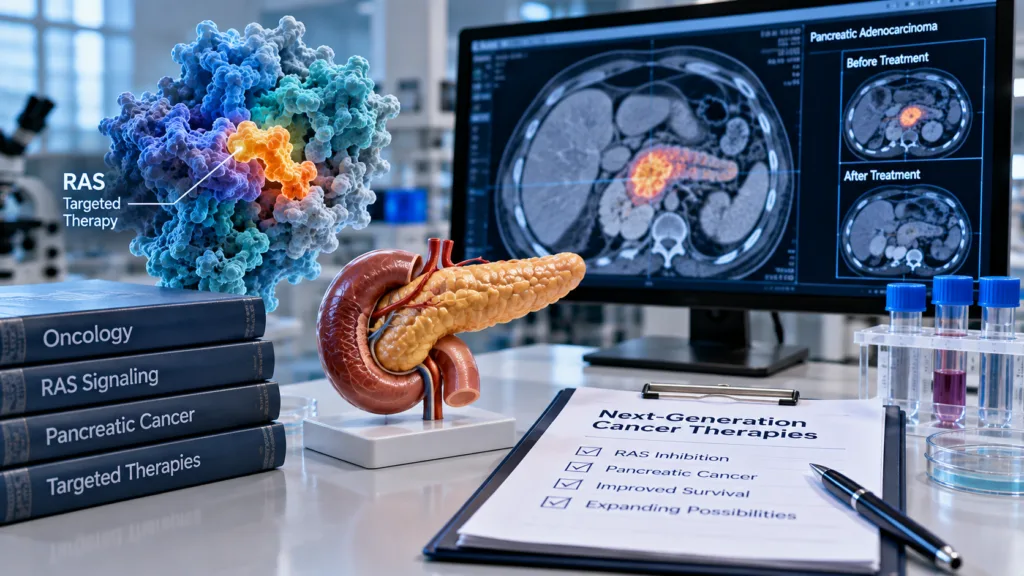
Daraxonrasib is designed as a RAS(ON) multi-selective inhibitor, meaning it targets the active, signalling form of RAS across several common mutant forms. The approved label does not require a specific identified RAS mutation, an important distinction because RASolute 302 demonstrated efficacy in the broader intent-to-treat population.
That substantially simplifies treatment eligibility. Instead of requiring physicians to identify one particular actionable mutation and exclude most other patients, the drug can be used according to the FDA-approved clinical criteria in metastatic disease. Molecular testing remains relevant to understanding tumour biology and future treatment sequencing, but the commercial market is not restricted to a tiny genotype.
How significant is a median overall survival of 13.2 months in this setting?
Patients entering RASolute 302 had metastatic disease that had already progressed after prior systemic treatment. Historically, therapeutic options after first-line pancreatic cancer treatment have produced limited survival gains, and toxicity from repeated cytotoxic chemotherapy can become increasingly difficult as patients lose weight, performance status and organ reserve.
Against that background, increasing median overall survival from 6.7 months to 13.2 months is clinically substantial. The magnitude is reinforced by the 60% relative reduction in risk of death and by improvements in progression-free survival and patient-reported outcomes reported by Revolution Medicines.
Route of administration adds another difference. RASONQUE is a once-daily oral tablet, whereas comparator regimens involved intravenous cytotoxic chemotherapy. Convenience cannot replace efficacy, but an oral therapy capable of delivering better disease control with a manageable safety profile could reduce infusion burden for patients already living with advanced disease.
Does the approval finally prove that RAS is broadly druggable?
It proves something narrower but still important: active RAS can be therapeutically inhibited across a broad enough group of pancreatic cancers to generate a randomized overall-survival benefit and support FDA approval.
That does not mean every RAS-driven tumour will respond similarly. Different cancers depend on RAS signalling to varying degrees, contain distinct co-mutations and develop resistance through multiple mechanisms. A drug highly effective in pancreatic cancer could produce a different magnitude of benefit in lung or colorectal cancer.
Revolution Medicines is therefore developing a broader portfolio rather than assuming one drug will solve every RAS-driven malignancy. Daraxonrasib is being studied in additional tumour types, while mutant-selective programmes such as elironrasib and zoldonrasib are intended to attack specific RAS alterations with greater precision.
Why does this approval transform Revolution Medicines itself?
Before RASONQUE, Revolution Medicines was valued primarily on future clinical possibilities. The approval converts the company into a commercial-stage oncology business with its own product revenue, launch infrastructure and direct relationships with oncologists.
The company had already prepared for that transition. Ahead of approval, Revolution Medicines reported commercial launch readiness and had begun regulatory submissions in Europe. It also established an expanded-access programme for eligible pancreatic cancer patients after the FDA allowed the programme to proceed in May 2026.
Commercial execution will now become a new valuation variable. Investors must track prescriptions, patient starts, payer coverage, treatment duration and the extent to which oncologists move patients onto RASONQUE after progression rather than choosing alternative chemotherapy.
Could moving daraxonrasib earlier unlock a much larger market?
Second-line approval establishes the platform clinically, but first-line pancreatic cancer represents a larger opportunity. Patients are generally healthier earlier in their disease course, treatment duration can be longer and nearly every newly diagnosed metastatic patient needs an initial systemic strategy.
The central question is whether daraxonrasib can improve upon modern combination chemotherapy when used earlier or whether its greatest relative advantage remains in later-line disease after patients become less able to tolerate intensive cytotoxic treatment. Moving a targeted drug into first-line therapy usually requires strong comparative evidence because existing regimens may already produce meaningful tumour reduction in some patients.
Combination strategies could also become important. RAS inhibition may alter tumour signalling in ways that create opportunities to combine with chemotherapy, immunotherapy or other targeted agents, but combinations must produce additional efficacy without undermining tolerability.
How could resistance shape the next phase of the RAS story?
Targeted cancer therapies almost inevitably face acquired resistance. Tumours can activate alternative signalling pathways, acquire secondary mutations, amplify target proteins or select resistant cellular populations.
A broad RAS inhibitor could theoretically reduce some mutation-specific escape routes, but it cannot eliminate tumour evolution. Understanding resistance mechanisms after RASONQUE treatment will therefore be essential for designing second-generation drugs and combination therapies.
Revolution Medicines’ portfolio strategy is particularly relevant here. Having both broad and mutation-specific inhibitors creates opportunities to sequence or combine molecules depending on resistance biology. The eventual commercial value of the platform may depend on whether the company can keep patients within its own RAS-targeted ecosystem as tumour genetics evolve.
What does RASONQUE mean for other RAS drug developers?
The approval validates the commercial and regulatory relevance of direct RAS targeting beyond KRAS G12C. Competitors developing pan-KRAS, multi-RAS, G12D and other mutation-selective inhibitors can now point to randomized survival evidence demonstrating that RAS remains therapeutically actionable even in one of the most difficult solid tumours.
At the same time, the efficacy bar has risen. New entrants will increasingly be compared not with historical chemotherapy alone but with RASONQUE or other emerging RAS-targeted therapies. Programmes will need to differentiate through stronger efficacy, better tolerability, central nervous system activity, combination potential or effectiveness against resistance mutations.
This is how successful first movers change a field. The question stops being whether the target can be drugged and becomes which approach drugs it best.
What should determine whether RASONQUE becomes a durable franchise?
Initial sales will matter, but the more important milestones are geographic expansion, earlier-line trials and data from other RAS-driven cancers. A product confined permanently to previously treated pancreatic cancer could still become commercially meaningful, particularly given the severity and prevalence of the disease, but the platform valuation assumes substantially more.
Regulatory success in lung cancer or additional tumour types would support the thesis that daraxonrasib is a broadly useful RAS medicine rather than a pancreatic-cancer-specific success. Strong results from Revolution Medicines’ mutation-selective programmes would further reinforce the company’s position.
RASONQUE therefore represents both an endpoint and a beginning. Decades of failed attempts to drug RAS made direct inhibition one of oncology’s most persistent scientific ambitions. Revolution Medicines has now shown that broad RAS inhibition can nearly double median survival against chemotherapy in a randomized pancreatic cancer trial. The next question is whether that achievement can be repeated across the much larger universe of RAS-addicted cancers.