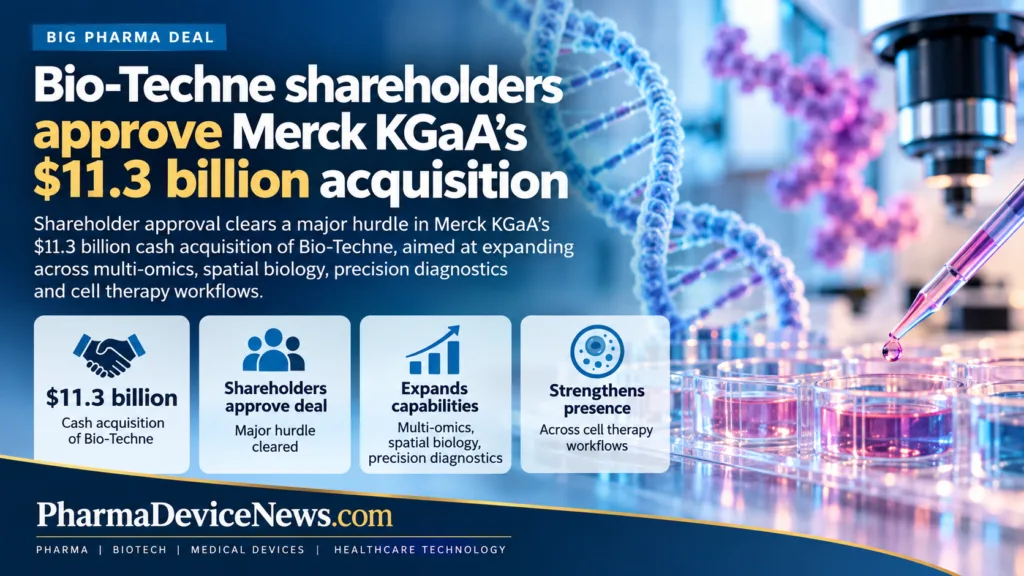
Merck KGaA, Darmstadt, Germany has moved significantly closer to completing its $11.3 billion acquisition of Bio-Techne Corporation (Nasdaq: TECH) after Bio-Techne shareholders approved the transaction at a special meeting on September 23. The deal will pay Bio-Techne investors $73 per share in cash and turn the Minneapolis-based life-science tools, reagents and diagnostics company into a wholly owned subsidiary of Merck KGaA, Darmstadt, Germany once the remaining closing conditions and regulatory approvals are satisfied. Bio-Techne continues to expect completion by late 2026 or early 2027.
The shareholder vote removes one of the most visible remaining transaction risks. The waiting period under the United States Hart-Scott-Rodino antitrust framework expired on September 18, while Bio-Techne previously disclosed that Germany’s Federal Cartel Office had cleared the transaction. Regulatory approvals in additional jurisdictions are still required, meaning shareholder backing does not itself complete the acquisition.
The transaction is strategically significant because Merck KGaA is not simply acquiring another laboratory supplier. Bio-Techne brings technologies spanning recombinant proteins, antibodies, immunoassays, automated protein analysis, spatial biology, precision diagnostics and cell-therapy manufacturing workflows. Merck KGaA expects the combination to strengthen its Life Science business from early discovery through bioprocessing and commercial manufacturing, giving the company greater exposure to areas where drug development increasingly depends on sophisticated analytical and multi-omic tools.
Why is Merck KGaA willing to pay $11.3 billion for Bio-Techne?
Merck KGaA agreed in June to pay $73 per Bio-Techne share, valuing the company at approximately $11.3 billion in enterprise value. At announcement, the price represented a 36% premium to Bio-Techne’s one-month volume-weighted average share price, reflecting the strategic value Merck KGaA assigns to capabilities that are difficult to reproduce rapidly through internal development.
Bio-Techne has built a broad portfolio used by academic laboratories, biotechnology companies, pharmaceutical developers and clinical diagnostic laboratories. The company operates through R&D Systems, Bio-Techne Spatial and Bio-Techne Diagnostics and offers more than 500,000 products worldwide. It employs more than 3,000 people across 34 locations and generated more than $1.2 billion of sales in fiscal 2025.
Its underlying technologies are particularly attractive because modern drug discovery increasingly requires researchers to understand disease simultaneously at the protein, gene, cellular and tissue levels. That is driving demand for multi-omics technologies capable of connecting different biological datasets rather than studying proteins, RNA or cells independently.
Bio-Techne’s RNAscope platform, for example, provides in situ hybridization technology that allows researchers to visualize RNA expression within individual cells and tissue environments. Its ProteinSimple business provides automated protein-analysis instruments, while R&D Systems supplies widely used cytokines, growth factors, antibodies and immunoassay products. Merck KGaA has identified those capabilities as important additions across spatial biology, diagnostics, protein research and advanced therapeutics.
How does Bio-Techne strengthen Merck KGaA’s existing Life Science business?
Merck KGaA already occupies a substantial position in the global life-science supply chain through businesses including MilliporeSigma in the United States and Canada. Its products support pharmaceutical and biotechnology customers from laboratory research through commercial manufacturing, including filtration, cell culture, analytical technologies, process materials and biomanufacturing systems.
Bio-Techne fills several gaps further upstream in that chain. Its technologies are heavily used during biological discovery, translational research and biomarker analysis, while its cell-therapy products extend into manufacturing-related applications. Merck KGaA argues that combining the portfolios can create a more continuous workflow for customers rather than forcing researchers to assemble technologies from many unrelated suppliers.
ProteinSimple provides one example of the strategic fit. Automated protein characterization is increasingly important during both discovery and bioprocess development because researchers need rapid, reproducible information about protein identity, quantity and quality. Adding that capability to Merck KGaA’s broader analytical and process portfolio could strengthen the company’s position with customers developing biologics and next-generation therapies.
Spatial biology offers another growth opportunity. Drug developers increasingly want to know not merely whether a gene or protein is present but where it is located within diseased tissue and which surrounding cells influence its behavior. That information can support target discovery, biomarker development, patient segmentation and translational research.
Bio-Techne therefore gives Merck KGaA deeper participation in the scientific decisions occurring before a medicine reaches manufacturing.
Why do cell and gene therapy capabilities matter to the acquisition?
Merck KGaA has also highlighted Bio-Techne’s position in materials, analytical tools and process technologies used by cell-therapy developers. Cell and gene therapies create unusually complex manufacturing requirements because companies must maintain living cells, control highly sensitive production conditions and demonstrate product consistency across manufacturing stages.
Bio-Techne owns 19.9% of Wilson Wolf Corporation, the manufacturer behind the G-Rex cell-culture platform, and expects to acquire the remaining stake immediately after the end of calendar 2027 under an existing forward contract. That means Merck KGaA could ultimately inherit greater exposure to a technology used in expanding cells for advanced therapies if the acquisition closes as planned.
This matters because cell therapy remains one of biopharma’s most manufacturing-intensive therapeutic categories. Products may require cell collection, activation, expansion, genetic modification, quality testing and tightly controlled logistics. Suppliers capable of providing integrated tools across those processes can capture recurring revenue each time a therapy is manufactured rather than depending solely on one-time laboratory instrument sales.
The acquisition therefore fits a wider industry trend in which life-science suppliers are trying to own larger portions of customer workflows. The more products a supplier embeds into validated research or manufacturing processes, the harder it can become for pharmaceutical customers to switch vendors without additional qualification work.
What are the financial synergies Merck KGaA expects from Bio-Techne?
Merck KGaA expects approximately €140 million of annual cost synergies, fully realized by the third year after closing. The company also expects the acquisition to improve the EBITDA pre margin of both its Life Science business and the group immediately after completion and to become accretive to pre-earnings per share by the third year.
The transaction will be financed with a combination of existing cash and new debt. Merck KGaA has said it intends to maintain a strong investment-grade credit rating despite adding acquisition-related borrowing.
Cost savings are only part of the rationale. Merck KGaA is also betting on revenue synergies created by taking Bio-Techne products through a larger global sales network. Bio-Techne gains access to Merck KGaA’s international customer relationships, manufacturing capabilities and distribution infrastructure, while Merck KGaA gains technologies that can expand the amount it sells to existing research and pharmaceutical customers.
That cross-selling opportunity could prove more strategically important than straightforward expense reduction. Life-science customers increasingly seek integrated solutions spanning research reagents, instruments, analytics, process materials and manufacturing support, particularly as biological drug development becomes more technically complex.
Is Merck KGaA buying Bio-Techne at a moment of strong growth?
Bio-Techne’s latest financial performance is solid rather than explosive, which makes the strategic rationale particularly interesting. The company reported fourth-quarter fiscal 2026 revenue of $321.2 million, up 3% organically and 1% on a reported basis. Full-year revenue was approximately $1.2 billion and was essentially flat both organically and on a reported basis.
Adjusted fourth-quarter earnings per share were $0.52 compared with $0.53 a year earlier, while full-year adjusted earnings per share increased slightly to $1.93 from $1.92. Bio-Techne therefore is not being acquired after a sudden short-term revenue surge.
Merck KGaA is instead paying for strategic positioning and technology depth. The bet is that Bio-Techne’s products can grow faster inside a larger platform with greater geographic distribution, while integration produces operating efficiencies unavailable to Bio-Techne as an independent company.
That creates an execution challenge. Paying a substantial acquisition premium makes successful integration, employee retention and customer continuity important. Merck KGaA itself has identified potential disruption, higher-than-expected operating costs and difficulties retaining customers or key employees among the transaction risks.
Why does the deal matter for precision diagnostics?
Bio-Techne is not a conventional large diagnostics company comparable with Roche Diagnostics or Abbott, but its technologies sit increasingly close to clinical decision-making.
Its diagnostic portfolio includes products used across hematology, chemistry and other laboratory applications, while spatial and molecular technologies can support biomarker research and precision-medicine development. Those capabilities become increasingly valuable as pharmaceutical companies develop therapies for narrower molecularly defined patient populations.
Precision medicine requires a chain of technologies. Researchers must identify biological targets, discover biomarkers, validate those biomarkers in tissue and eventually translate them into tests capable of helping clinicians select patients. Companies providing tools at several stages of that chain can participate economically before and after a medicine reaches the market.
Merck KGaA specifically identified precision diagnostics as one of the high-growth areas strengthened by the acquisition, alongside multi-omics, spatial biology and cell and gene therapy.
That combination makes Bio-Techne particularly relevant to the convergence between life-science research and diagnostics. Technologies initially used in drug-development laboratories can eventually migrate closer to clinical testing as biomarkers become validated and treatment decisions become increasingly molecular.
How is Bio-Techne stock trading after shareholders approved the takeover?
Bio-Techne shares closed at $72.57 on September 24, just below the agreed $73 cash consideration. The stock has traded within a narrow band around $72.50 in recent sessions, including $72.52 on September 23 and $72.55 on September 22.
That narrow gap between the market price and the proposed acquisition price indicates that investors are assigning relatively little discount to the transaction at present, although the shares remain below the $73 consideration because the deal has not yet closed and regulatory and other transaction conditions remain outstanding.
The share price also shows how dramatically the acquisition announcement changed Bio-Techne’s market valuation. The stock’s 52-week range extends from $43.20 to $72.69, with the current price sitting close to the upper boundary established around the transaction.
Until completion, Bio-Techne’s stock is likely to behave more like merger consideration than a conventional independently valued life-science stock because the $73 cash price anchors potential upside. If the transaction closes, existing Bio-Techne shareholders will receive the agreed cash consideration and the company will cease operating as a standalone publicly listed business.
What still has to happen before Merck KGaA owns Bio-Techne?
Shareholder approval eliminates one major condition, and expiration of the United States Hart-Scott-Rodino waiting period removes another. Germany’s Federal Cartel Office has also cleared the transaction, but approvals in other jurisdictions remain in progress.
Bio-Techne continues to target closing by late 2026 or early 2027. Until then, the companies remain independent, even though integration-planning teams have already begun examining areas such as financial systems, reporting structures and communication processes.
The eventual integration will be closely watched because Merck KGaA has significant experience with large acquisitions. Over the past two decades, it has deployed more than $35 billion through inorganic growth, including the purchases of Millipore, Sigma-Aldrich, Versum Materials and SpringWorks Therapeutics.
Bio-Techne represents a different type of asset from a conventional pharmaceutical acquisition. Merck KGaA is buying the tools that other biotechnology and pharmaceutical companies use to discover, analyze, diagnose and manufacture therapies.
That makes the transaction a bet on the infrastructure beneath the biopharmaceutical industry rather than on the success of one drug. If the integration works as intended, Merck KGaA will gain deeper exposure every time customers invest in protein research, spatial biology, cell therapy, precision diagnostics and next-generation biological manufacturing.
With shareholders now approving the transaction and key United States and German regulatory milestones already cleared, the central question is shifting away from whether Bio-Techne investors support the deal. It is becoming whether Merck KGaA can extract enough growth, cross-selling and integration value from an $11.3 billion purchase to justify one of the largest life-science tools acquisitions of the current cycle.