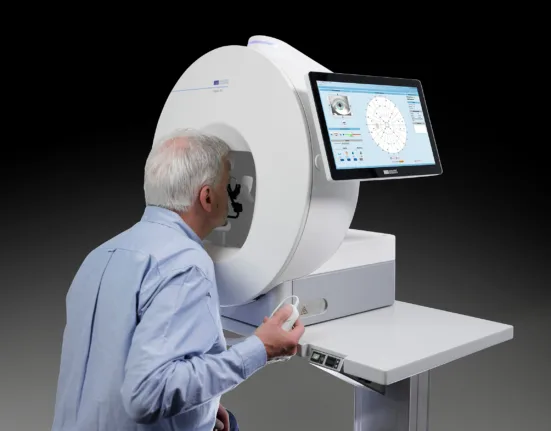
Carrot, the United States-based virtual reality eye diagnostics company formerly known as Virtual Field, has entered into an agreement to acquire GreenMan Vision, Inc., developer of the InSightVR cataract lens simulation platform. Announced on October 9, 2026, the proposed transaction would extend Carrot’s existing virtual reality testing business into preoperative intraocular lens education, allowing cataract patients to experience simulations of how different lens options could affect everyday vision before surgery.
The transaction would bring together Carrot’s established diagnostic platform, which the company says operates in more than 2,500 eye-care clinics and has supported over six million examinations, with a technology designed to assist patients making intraocular lens decisions. GreenMan’s InSightVR system uses patient-specific biometric information to simulate potential visual experiences with monofocal, toric, multifocal, extended-depth-of-focus and adjustable lenses, including monovision strategies. The companies have not disclosed the purchase consideration, financing structure, expected completion date or other material financial terms.
The commercial rationale extends beyond adding another application to a virtual reality headset. Carrot currently concentrates on measuring visual function and supporting clinical testing workflows, while InSightVR addresses a different stage of ophthalmic care in which patients must understand the potential benefits and compromises associated with lens selection. Combining these capabilities could position Carrot more deeply within the diagnostic, consultation and surgical planning activities of optometry and ophthalmology practices.
The proposed acquisition follows publication of a peer-reviewed retrospective study involving 609 cataract patients, which found that those receiving InSightVR education selected advanced-technology intraocular lenses at approximately twice the rate observed among patients receiving standard verbal counselling. The association gives the transaction a measurable clinical and commercial context, but the study was neither randomized nor designed to establish that virtual reality education independently caused the difference in lens selection. The distinction will be important as Carrot seeks to expand its platform while demonstrating that the acquired technology supports informed, patient-appropriate decisions rather than simply increasing adoption of higher-cost lenses.
How will Carrot’s GreenMan acquisition connect virtual reality diagnostics with cataract surgery planning?
Carrot’s existing platform is built around virtual reality-based visual field testing, automated clinical workflows and the interpretation of functional vision measurements. Founded in 2018, the company developed its business around replacing conventional tabletop visual field testing equipment with portable headset-based technology that can operate across different clinical environments. Its current platform supports a range of examinations, including threshold perimetry, suprathreshold screening, kinetic visual field assessment and other functional vision tests, alongside software for reporting and longitudinal assessment.
The platform also incorporates machine learning-assisted visual field staging, practice analytics and electronic medical record integration, including bidirectional medical imaging data exchange. These capabilities are intended to make diagnostic testing more accessible across examination rooms while reducing administrative work associated with managing equipment, technicians and clinical records. However, the company’s claims regarding workflow efficiency and profitability should be distinguished from independently established improvements in patient outcomes.
InSightVR operates in a different part of the clinical journey. Developed by cataract surgeons Michael Greenwood and Brandon Baartman of Vance Thompson Vision, the system is designed to help patients understand the possible visual consequences of selecting different intraocular lenses. Its simulations incorporate patient-specific biometry and present familiar activities, including reading indoors and driving in different lighting conditions, allowing users to compare potential differences in focus, glare, halos and other visual characteristics.
The acquisition would create an opportunity to connect these activities through a broader commercial platform, although the companies have not yet completed that integration. Carrot has confirmed that InSightVR currently operates on its own headset and that the simulation technology will be added to the Carrot Platform in the future. Existing Carrot and InSightVR customers are expected to retain their current support arrangements and agreements while the companies prepare the expanded offering.
For ophthalmology practices, the commercial proposition is the possibility of obtaining diagnostic testing capabilities and patient education technology through a single vendor relationship. Such an arrangement could reduce fragmentation in procurement, technical support and software management if integration is executed effectively. Whether it produces meaningful operational savings will depend on the eventual product configuration, interoperability, subscription costs and the amount of additional staff involvement required.
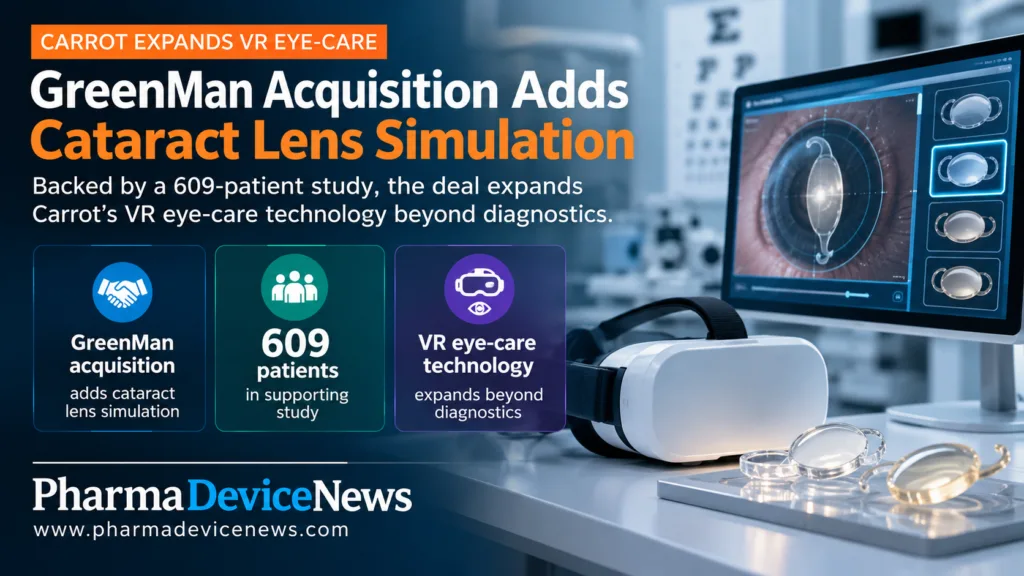
What did the 609-patient InSightVR study reveal about advanced intraocular lens selection?
The most relevant published evidence supporting GreenMan’s commercial proposition comes from a multicentre study published in Patient Preference and Adherence in September 2026. The retrospective, non-randomized investigation evaluated 609 patients undergoing cataract assessment at five United States ophthalmology centres between June 2023 and October 2024. Of those participants, 289 received education using InSightVR, while 320 received conventional verbal counselling about their intraocular lens options.
The investigators reported that 165 patients in the virtual reality group selected advanced-technology intraocular lenses, representing 57.1% of the group. In the conventional counselling group, 91 patients selected these lenses, equivalent to 28.4%. The difference was statistically significant, with a reported p-value below 0.001, indicating a strong association between the educational approach used and subsequent lens selection within the studied population.
The findings are commercially relevant because advanced-technology lenses may offer additional visual functionality beyond conventional monofocal lenses, including correction of astigmatism or reduced dependence on spectacles at multiple distances. These lenses can involve additional patient expenditure and require more extensive consultation about expected visual performance and potential compromises. An educational tool that helps eligible patients understand those differences could influence both patient engagement and how cataract practices structure their preoperative counselling.
Nevertheless, the study does not establish that InSightVR caused the higher selection rate. Participants were not randomly assigned to education groups, and the investigators acknowledged potential selection bias, differences among centres and other limitations. Importantly, the study population comprised patients whom surgeons considered medically suitable for advanced-technology intraocular lenses, meaning the findings should not be generalized to all cataract patients regardless of ocular health.
The study also involved investigators with commercial interests in GreenMan Vision. Its published conflict-of-interest disclosures identify equity holdings in the company among several authors, including the two surgeon-founders. Those relationships do not invalidate the findings, but they reinforce the value of independent, prospectively designed research when evaluating whether the observed differences can be reproduced across healthcare settings.
The central clinical question is therefore broader than whether virtual reality increases advanced lens selection. A useful patient education tool should help people make decisions consistent with their medical suitability, visual priorities, financial circumstances and tolerance for potential optical side effects. Higher adoption of an advanced-technology lens is not, by itself, evidence that patients received better care or achieved superior postoperative vision.
Can InSightVR accurately predict how patients will see after cataract surgery?
InSightVR’s clinical concept is based on presenting a personalized approximation of postoperative visual experiences rather than guaranteeing a particular visual result. The platform uses biometric measurements to demonstrate how different lens approaches may affect near, intermediate and distance vision, including situations where glare and halos may be noticeable. It can also simulate monovision strategies by representing different focal targets for each eye, giving patients an opportunity to consider the compromises involved before making a lens decision.
The 2026 study provides preliminary evidence that patients found this approach useful. Approximately 88% of surveyed virtual reality users reported that the simulation improved their understanding of differences between lens options, while a further 10% indicated that it provided some additional understanding. The researchers also reported that 83.6% of participants found the headset easy or very easy to use, suggesting that many older cataract patients could engage with the technology in the participating clinical environments.
At approximately three months following surgery, 90% of surveyed virtual reality participants who had selected advanced-technology lenses reported that their actual vision was similar to the simulation. This result is relevant to patient expectation management, particularly because discrepancies between anticipated and experienced vision can contribute to dissatisfaction after cataract surgery. However, the finding came from a postoperative survey subset rather than objective validation across the entire 609-patient population.
The research obtained postoperative questionnaire responses from 198 patients, including 107 who had received virtual reality education and 91 who had received conventional counselling. Patient satisfaction was generally high in both groups, and the investigators reported a numerical difference in satisfaction scores among advanced-lens recipients that did not reach statistical significance. Consequently, the study cannot establish that InSightVR improves visual acuity, reduces postoperative complications or produces superior clinical outcomes.
The accuracy question is particularly important because simulated optical experiences cannot account perfectly for every factor influencing an individual patient’s postoperative vision. Corneal irregularities, retinal disease, ocular surface conditions, neuroadaptation and the final refractive outcome can influence how a person experiences an implanted lens. A simulation may therefore be valuable for explaining likely trade-offs while remaining an approximation rather than a clinical prediction of the exact result.
Future studies comparing patient expectations with standardized postoperative visual measurements would provide stronger evidence of predictive utility. Such research could examine whether simulation-based counselling improves informed understanding, reduces decisional regret or identifies patients whose preferences are better served by conventional lens choices. These endpoints would help establish the technology’s patient-centred value independently of its relationship with advanced-lens selection.
Why does cataract lens counselling create a significant commercial opportunity for Carrot?
Cataract surgery involves the replacement of the eye’s natural lens with an artificial intraocular lens, creating an important decision about how vision will be optimized following the procedure. Conventional monofocal lenses remain widely used, while toric, multifocal, extended-depth-of-focus and adjustable options can address additional refractive requirements in appropriately selected patients. The availability of these alternatives creates demand for detailed preoperative discussions about visual goals, spectacle dependence, potential side effects and additional costs.
The American Academy of Ophthalmology advises that lens choice should consider the patient’s activities, existing ocular conditions and preferences concerning near and distance vision. Multifocal and certain extended-depth-of-focus designs can introduce optical compromises, including glare, halos and reduced contrast sensitivity, which may be particularly relevant to people who frequently drive at night. Other eye conditions, including some forms of glaucoma and retinal disease, can further influence whether an advanced lens is appropriate.
Within this environment, digital simulation could become an additional component of the consultation process. Patients may find it easier to understand differences between lens technologies when they are presented through familiar activities rather than technical descriptions alone. For practices, a standardized educational experience may also help ensure that relevant lens options and their limitations are discussed consistently across clinical teams.
The commercial attraction for Carrot lies partly in its existing relationships with more than 2,500 clinics, according to the company’s reported operating figures. These relationships include independent practices and larger eye-care networks, potentially creating opportunities to introduce InSightVR to customers already familiar with its headset-based technology and support infrastructure. However, an installed base of diagnostic customers should not be treated as a confirmed customer base for cataract simulation, particularly because not every clinic has the same surgical referral activity or patient population.
There is also a potential opportunity for Carrot to deepen its relationships with cataract surgeons and practices that have different priorities from customers primarily using visual field testing. The existing diagnostic platform is associated with recurring software and equipment services, while the acquisition could introduce additional consultation-oriented functionality. Carrot has not disclosed how InSightVR will be priced within its future commercial offering or whether it will operate as a separate subscription, bundled feature or alternative licensing arrangement.
The transaction’s financial terms remain undisclosed, including the purchase price and any associated earnout or contingent consideration. Neither company has provided acquisition-related revenue expectations or quantified cost savings from the proposed integration. As a result, the near-term commercial significance is best understood as an expansion of capabilities and potential distribution reach rather than an immediately measurable financial contribution.
What must Carrot resolve before InSightVR becomes part of an integrated eye-care platform?
Integrating the two technologies will involve more than combining their respective software interfaces or placing additional applications on a headset. Carrot’s current platform is designed to measure visual function and support clinical interpretation, while InSightVR provides a simulated educational experience intended to assist discussion of possible surgical outcomes. These are different functions with distinct clinical requirements, user interfaces and evidence considerations.
Carrot has indicated that existing InSightVR systems, customer workflows and support arrangements will continue unchanged during the transition. This approach may help preserve continuity for established users while allowing the acquiring company to develop a more unified offering. The eventual integration will still need to address how patient biometric information is transferred, which devices support the software and whether the simulated experience remains consistent across hardware configurations.
Patient data management will be another consideration because personalized simulations rely on information obtained during clinical assessment. Carrot already promotes interoperability with electronic health records and medical imaging workflows, including structured data exchange and automated reporting. Extending these capabilities into individualized lens simulation may simplify data handling, but the company will need to ensure appropriate safeguards governing data access, compatibility and information security.
Clinical governance is equally relevant. A diagnostic technology designed to assist clinicians in assessing visual function should not be treated as interchangeable with a simulation intended to support patient education. Any additional claims concerning clinical performance, predictive accuracy or autonomous decision-making would need appropriate supporting evidence and regulatory consideration where applicable.
The October announcement did not identify a new United States Food and Drug Administration marketing authorization for an integrated diagnostic and lens simulation product. Nor did it establish that the acquired simulation software can replace a surgeon’s assessment or determine which intraocular lens should be implanted. The expected role remains supportive, with professional evaluation and individual clinical circumstances determining the suitability of available lens options.
How could the acquisition influence patient education and revenue strategies in ophthalmology?
The transaction introduces an important distinction between technologies that improve clinical decision-making and technologies that increase the adoption of higher-priced medical products. InSightVR’s observational study identified a substantial difference in advanced lens selection, which may attract commercial interest from ophthalmology practices seeking more effective patient counselling. Nevertheless, the clinical value of the technology should be assessed through the quality of patient understanding and preference alignment rather than the financial value of the lenses selected.
A patient who understands the trade-offs associated with multifocal or extended-depth-of-focus lenses may reasonably decide that a conventional monofocal lens better suits their requirements. Another patient may become more comfortable choosing an advanced lens after experiencing simulated differences in near vision or astigmatism correction. Both outcomes can represent successful education when the final choice is clinically appropriate and reflects an informed preference.
For clinics, the system could support a more structured division of responsibilities between technicians, counsellors and surgeons. GreenMan has previously indicated that the simulation experience generally requires approximately five to ten minutes and can be delivered during existing stages of a cataract evaluation, including dilation time. However, consultation duration and staffing efficiencies were not formally measured in the published retrospective study, so those potential benefits remain operational propositions rather than established outcomes.
The broader strategic opportunity is to make immersive education a routine part of ophthalmology workflows without creating additional complexity for staff or patients. This may be particularly relevant to larger clinical networks seeking consistent approaches to patient communication across multiple locations. Adoption will depend on usability, training, equipment costs, support reliability and the confidence clinicians place in the fidelity and limitations of the simulations.
What happens next for Carrot and GreenMan InSightVR after the October 2026 acquisition agreement?
Carrot and GreenMan are presenting their technologies at the American Academy of Ophthalmology’s 2026 annual meeting in New Orleans, scheduled for October 10 to 12. Carrot is exhibiting at booth 2409, while GreenMan is demonstrating InSightVR at booth 4142, providing an opportunity for ophthalmology professionals to evaluate the existing systems and discuss the planned integration. The demonstrations represent product showcases rather than confirmation that the acquisition has closed or that a unified commercial platform is already available.
Carrot Chief Executive Officer Jeremy Barlow has positioned the agreement as an extension of the company’s strategy beyond measuring vision toward helping patients understand potential future visual experiences. GreenMan Chief Executive Officer Matt Larson has similarly indicated that the proposed combination could expand the reach of InSightVR while preserving the implementation and support capabilities relied upon by current customers. Both positions reflect management’s commercial objectives, with execution dependent on completing the transaction and delivering the planned integration.
The next measurable corporate milestones will include confirmation of the acquisition’s completion, disclosure of the integrated product configuration and information on customer access and pricing. Clinically, independent prospective research could clarify whether simulation-based education consistently improves understanding, expectation alignment and satisfaction compared with standard counselling. Evidence that these improvements can be achieved without encouraging inappropriate lens selection would be particularly relevant to surgeons, patients and healthcare administrators.
Carrot’s proposed acquisition of GreenMan Vision therefore represents a move into a different stage of the ophthalmic care pathway, supported by an established diagnostic customer base and an emerging body of research concerning immersive cataract education. The existing 609-patient study provides encouraging evidence of an association between virtual reality counselling and patient decisions, but it does not establish causal improvements in postoperative outcomes or independently validate the predictive accuracy of the simulations. The acquisition’s longer-term significance will depend on whether Carrot can integrate the technology into routine clinical workflows while generating stronger evidence that patients make better-informed lens decisions.