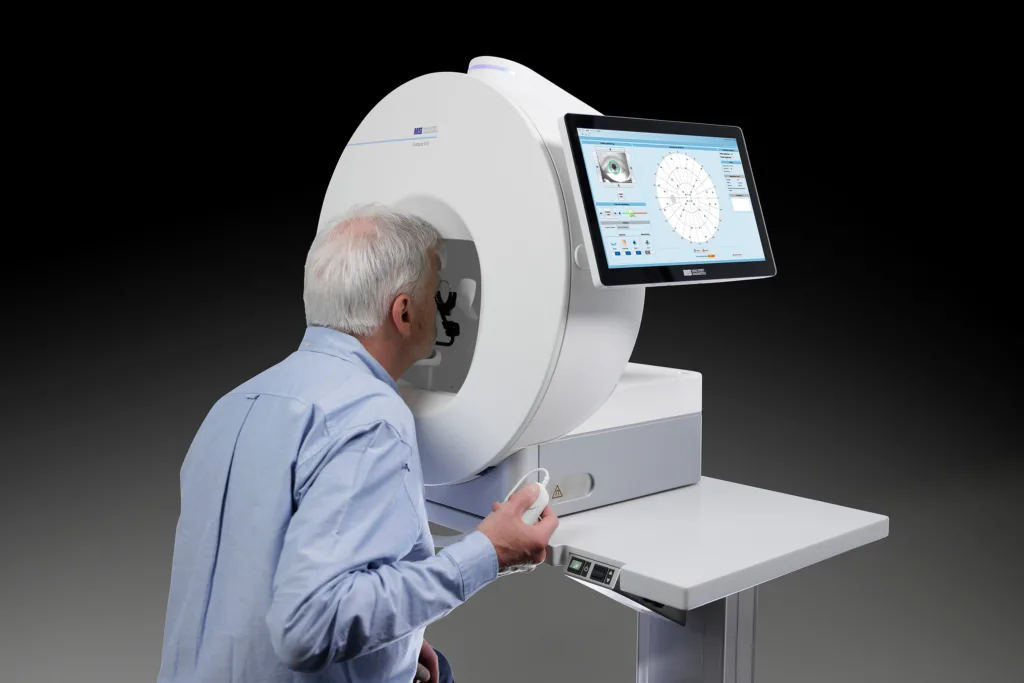
Haag-Streit USA and Marco Lombart, an Advancing Eyecare company, have announced the October 10, 2026, US launch of the Octopus 910, a full-field projection perimeter designed to support glaucoma assessment through automated examination setup, patient guidance and visual field progression analysis. The device is making its American debut at the American Academy of Ophthalmology 2026 Annual Meeting in New Orleans, with its broader international launch scheduled for January 2027.
The Octopus 910 introduces an updated approach to conventional visual field testing by combining established perimetry functions with motorized trial lens positioning, automated patient alignment, active eye tracking and digital guidance. Haag-Streit is also emphasizing the ability to import historical Humphrey Field Analyzer data, a commercially relevant capability for ophthalmology practices that have accumulated years of patient testing records on existing equipment. Marco Lombart, which serves as the exclusive US distributor for Haag-Streit’s Octopus perimetry range, will support the launch through its national sales, training and service network.
The development comes at a time when ophthalmology equipment manufacturers face increasing pressure to demonstrate advantages beyond diagnostic specifications alone. Glaucoma monitoring depends on repeated assessments over many years, making examination consistency, reliable progression analysis and preservation of historical testing data important considerations when practices replace diagnostic equipment. Although Haag-Streit has described several expected workflow advantages, the launch announcement does not provide comparative clinical performance results establishing that the Octopus 910 improves diagnostic accuracy, reduces test-retest variability or shortens examinations relative to competing instruments.
Why is improving visual field testing consistency important for glaucoma management?
Glaucoma presents a distinctive challenge for ophthalmic diagnostics because clinicians must determine whether changes in visual function reflect genuine disease progression or normal variation between examinations. Standard automated perimetry remains a central component of monitoring, alongside intraocular pressure assessment and structural evaluation of the optic nerve and retinal nerve fiber layer. However, visual field measurements depend on patient attention, fixation stability, understanding of instructions and the consistency of examination conditions.
A patient may produce different visual field results across successive visits without experiencing a corresponding change in the underlying disease. Fatigue, incorrect refractive correction, positioning problems and fluctuations in test responses can introduce uncertainty, particularly when visual sensitivity is already substantially reduced. Consequently, improvements that reduce avoidable examination variability could be useful even when the underlying diagnostic methodology remains largely unchanged.
The Octopus 910 addresses several of these operational factors through a combination of automated positioning and examination guidance. According to Haag-Streit, the instrument is designed to reduce dependence on manual setup while supporting more reproducible measurements across repeated examinations. The clinical value of these features will depend on whether their contribution can be demonstrated under routine practice conditions, particularly among patients who find conventional perimetry challenging.
The distinction between measurement consistency and diagnostic accuracy is important. A more comfortable or automated examination may help produce usable data, but that does not automatically establish superior sensitivity for detecting early glaucoma or identifying progression. Evaluating the Octopus 910 therefore requires separating the practical advantages of examination automation from evidence that it changes clinical decisions or improves longitudinal assessment.
How do Stimulus V testing and progression analysis support different stages of glaucoma?
Haag-Streit is positioning the Octopus 910 as an instrument suitable for assessing glaucoma across a broad spectrum of disease severity. Its analytical functions include Cluster Analysis, Stimulus V testing and Polar Analysis, providing different approaches to evaluating visual field abnormalities and their relationship to structural damage. The company’s product information also identifies a G-Pattern intended to support examination of the central visual field and macular region.
Stimulus V testing is particularly relevant in advanced glaucoma, where conventional smaller stimuli may become difficult for patients to detect as visual sensitivity declines. A larger stimulus can permit useful threshold measurements in areas where sensitivity to smaller stimuli has become severely reduced. This can help preserve opportunities for functional assessment, although changing stimulus size also changes the measurement characteristics and requires appropriate interpretation of longitudinal results.
The broader scientific rationale is supported by earlier perimetry research, although that evidence should not be confused with validation of the newly introduced device. A prospective cross-sectional study involving 126 patients and 170 eyes with advanced glaucoma compared size III and size V testing using the Octopus 900. The study found that the larger stimulus produced higher measured mean sensitivity, but the average test duration was approximately 6.40 minutes with size V compared with 3.32 minutes for size III.
These findings illustrate why the choice of test strategy involves balancing the amount of usable information against examination duration and patient tolerance. They also demonstrate why a feature associated with advanced glaucoma assessment should not automatically be described as faster or more accurate across every disease stage. The Octopus 910 incorporates the relevant testing capability, but its own performance must be assessed independently rather than inferred from research involving an earlier instrument.
Polar Analysis and Cluster Analysis address a different aspect of glaucoma monitoring by helping clinicians interpret patterns of visual field damage. Such tools can assist in identifying regional abnormalities and examining the relationship between functional loss and structural findings. Their usefulness depends on the quality of the underlying measurements, the appropriateness of the analytical methods and the clinician’s interpretation of changes over time.
Can automated positioning and active eye tracking improve the reliability of glaucoma examinations?
The Octopus 910’s most visible operational changes involve reducing the number of manual adjustments required before and during visual field testing. Its motorized trial lens holder, automated patient positioning, integrated occluder and simplified chin and forehead rest are intended to make examination preparation more consistent. By standardizing several elements of setup, the instrument could reduce opportunities for positioning mistakes or inconsistent operator practices.
The motorized trial lens holder is particularly relevant because visual field examinations require appropriate refractive correction for the testing conditions. Incorrect correction or lens placement can affect the results, while lens-rim interference may introduce abnormalities unrelated to the patient’s underlying visual function. Haag-Streit’s Autovertex feature is designed to help reduce the likelihood of lens-rim artifacts, potentially addressing one source of misleading results.
Active eye tracking provides another layer of examination support by monitoring eye movements during testing. Combined with digital voice guidance and status-light alerts, it is intended to help patients remain engaged while allowing examiners to recognize problems that may compromise measurement quality. Such functionality could be valuable in high-volume ophthalmology settings where multiple technicians conduct examinations across patients with different levels of visual impairment and familiarity with perimetry.
Nevertheless, visual field testing remains a subjective examination requiring active patient participation. Eye tracking cannot eliminate fatigue, misunderstanding, inconsistent response behavior or all other factors that influence measured sensitivity. The clinical question is whether the combined automation features reduce unusable examinations, repeat testing or longitudinal measurement variability by a meaningful amount.
For practices, even modest improvements in examination consistency could have operational value if they reduce unnecessary retesting or the time required to prepare patients. However, the launch materials do not quantify reductions in setup duration, technician intervention or repeat examinations. Those measures would be especially useful in establishing whether the new technology delivers advantages beyond a more streamlined user experience.
Why could Humphrey Field Analyzer data import become a major purchasing consideration?
One of the Octopus 910’s commercially important features is its ability to import visual field information from the Humphrey Field Analyzer, a widely established platform manufactured by Carl Zeiss Meditec. Glaucoma management frequently involves comparing examinations conducted over extended periods, making the preservation of historical data a significant consideration when diagnostic equipment is upgraded or replaced. An instrument that allows practices to access prior measurements could reduce some of the operational disruption associated with changing systems.
The value of historical data extends beyond recordkeeping. Glaucoma progression is assessed through patterns of change across successive examinations, with clinicians seeking to distinguish genuine deterioration from expected measurement fluctuations. Access to earlier fields can therefore provide essential clinical context when interpreting a newly acquired test.
Haag-Streit says the Octopus 910 can incorporate historical Humphrey visual field data and support progression review within a single platform. This capability may make it easier for practices to consider equipment from a different manufacturer without abandoning access to established testing histories. It is also relevant for clinics receiving referrals from other providers, where visual field records may originate from different equipment ecosystems.
However, importing measurements from another device does not necessarily make the underlying results directly interchangeable. Perimeters can differ in stimulus presentation, testing algorithms, normative databases, calibration characteristics and the calculation of summary indices. Research comparing different visual field technologies has shown that apparently similar global measurements can coexist with meaningful differences in sensitivity at individual test locations.
The practical effectiveness of the Octopus 910’s data import functionality will therefore depend on how historical information is displayed, analyzed and incorporated into progression assessments. Clinicians will need to understand whether imported results are suitable for direct numerical comparison, require additional interpretation or are primarily intended to provide historical context. A smooth data-transfer process would be commercially attractive, but clinical confidence in cross-platform progression analysis is a separate requirement.
What clinical evidence is needed to establish whether Octopus 910 improves testing reliability?
The October 2026 announcement identifies several design features intended to improve examination quality, but it does not present a comparative clinical study specifically validating the Octopus 910 against another perimeter. No device-specific figures are provided for diagnostic sensitivity, specificity, test-retest repeatability, examination duration or the frequency of unreliable examinations. Consequently, claims about improved reliability and efficiency remain principally manufacturer-described product capabilities rather than quantified clinical advantages established by the launch disclosure.
A meaningful clinical evaluation would examine how the device performs among patients representing different stages of glaucoma, including individuals with severe visual field loss. Repeated testing would be needed to measure variability and determine whether automation improves consistency under comparable clinical conditions. Comparisons should account for examination duration, testing strategy, patient experience and the influence of technicians with different levels of expertise.
Clinical utility also extends beyond producing technically consistent measurements. The more consequential question is whether improved examination quality enables clinicians to recognize progression more confidently, reduces unnecessary repeat testing or changes management decisions appropriately. Demonstrating such benefits would require study designs that evaluate the relationship between technical performance and clinical practice rather than relying exclusively on device specifications.
The regulatory distinction also deserves precision. Haag-Streit’s October announcement describes a US product launch and planned international commercial expansion, rather than announcing a new United States Food and Drug Administration clearance or approval decision. It does not provide a device-specific regulatory decision date or detailed regulatory classification, so those details should not be inferred from the launch itself.
How will Octopus 910 compete with established Humphrey visual field testing systems?
The Octopus 910 enters a market where established equipment ecosystems and clinician familiarity can influence purchasing decisions as much as individual technical features. Carl Zeiss Meditec’s Humphrey Field Analyzer 3 offers established testing strategies, including SITA Faster, as well as Guided Progression Analysis for monitoring changes across repeated visual field examinations. Its existing clinical workflows and historical data compatibility represent competitive considerations for practices evaluating alternatives.
Haag-Streit is responding with a combination of full-field examination capabilities, automated setup and support for importing Humphrey data. The positioning suggests an emphasis on comprehensive glaucoma assessment and examination consistency rather than competing exclusively on test speed. That approach could appeal to clinics seeking broader examination functionality while retaining access to existing diagnostic histories.
However, the automation features introduced with the Octopus 910 are not sufficient by themselves to establish technological superiority over competing platforms. Other manufacturers have developed automated alignment, refractive correction tools, progression analysis software and faster testing protocols. Meaningful differentiation will depend on how these capabilities perform together in everyday examinations, particularly when measured against the functionality already available in established instruments.
The competitive environment is also evolving as manufacturers explore alternative approaches to visual field assessment, including head-mounted and virtual reality-based devices. Haag-Streit’s own AAO 2026 exhibition materials introduce the Octopus 650 as a virtual reality perimetry product, illustrating that the company is developing different instrument formats within its portfolio. The Octopus 910 follows the conventional full-field projection approach while emphasizing intelligent examination support.
These developments create a broader competitive test for ophthalmic diagnostics. Conventional instruments must justify their space, acquisition cost and maintenance requirements through dependable clinical performance and practical workflow value. Newer device formats may offer greater flexibility, but they must establish comparable measurement reliability and suitability for longitudinal glaucoma monitoring before they can be considered substitutes in all clinical settings.
What will determine Octopus 910 adoption among US ophthalmology and optometry practices?
Commercial adoption of the Octopus 910 will depend on factors extending beyond the specifications presented at AAO 2026. Practices considering a new perimeter must evaluate equipment acquisition costs, training requirements, available examination space, software integration, technical support and the financial implications of replacing an established instrument. Haag-Streit has not disclosed public pricing or a detailed sales forecast for the new model in its launch announcement.
For glaucoma-focused clinics, capital purchasing decisions are closely connected to expected examination volumes and the operational requirements of repeated patient testing. A device that reduces setup time or avoids unnecessary repeat examinations could provide economic value, but such savings would need to be demonstrated against the purchase price and ongoing operating costs. The availability of dependable maintenance and technical assistance also becomes important because equipment downtime can disrupt scheduled diagnostic services.
Reimbursement is another consideration, although it should not be confused with the device’s commercial launch status. Visual field testing is an established ophthalmic diagnostic procedure, but payment depends on applicable coding, coverage criteria, medical necessity and payer requirements. Purchasing a new perimeter does not independently establish additional reimbursement or guarantee improved financial returns for a practice.
The potential operational advantage of the Octopus 910 is therefore best examined through total cost of ownership rather than equipment specifications alone. Evaluation may include the time required for staff training, the reliability of software integration, the speed of examination preparation and the frequency of tests requiring repetition. These factors could determine whether the instrument offers an economically attractive upgrade for an established glaucoma service.
Patient experience may also influence adoption, particularly where clinics manage older patients or individuals who find prolonged examinations difficult. Automated positioning, simplified head support and digital guidance could improve the testing experience for some patients. However, practice-level evidence will be needed to establish whether these features materially improve patient tolerance or completion rates across representative populations.
Why is Marco Lombart’s distribution and service network important to the US launch?
The partnership with Marco Lombart provides Haag-Streit with an established route to the US ophthalmic equipment market. As part of Advancing Eyecare, Marco Lombart offers instrument distribution, equipment consultation, training and ongoing service support. Its role in the Octopus 910 launch extends beyond introducing the product to potential customers because diagnostic equipment purchases often involve installation, workflow adaptation and continuing technical assistance.
According to the announcement, the distributor will support availability of the Octopus 910 to eye care professionals across the United States through its existing national network. This infrastructure may help Haag-Streit engage practices that require hands-on demonstrations or assistance transitioning from older perimetry systems. The company’s presence at AAO 2026 provides an initial opportunity to demonstrate the equipment directly to ophthalmologists and other eye care professionals.
Advancing Eyecare’s US sales president, Jocelyn Hamilton, indicated that the organization’s training and service capabilities would support practices integrating the new instrument. Haag-Streit USA’s sales and marketing vice president, Andrew Jones, similarly positioned the launch around combining comprehensive glaucoma assessment with more automated examination support. Both statements reflect the companies’ commercial expectations rather than independently established evidence of improved clinical outcomes.
The international timetable adds another dimension to the launch strategy. Haag-Streit previously previewed the Octopus 910 at the September 2026 European Society of Cataract and Refractive Surgeons congress in London, ahead of its American commercial introduction. The company now plans a wider global launch in January 2027, indicating a staged introduction rather than a simultaneous worldwide rollout.
Successful expansion will depend on more than completing these scheduled launch events. Regional availability, service arrangements, training capacity and country-specific commercial requirements will influence how quickly the instrument reaches additional practices. The announcement does not disclose manufacturing volumes, initial orders or confirmed installation numbers, leaving the scale of early market demand unquantified.
Which post-launch milestones will show whether Octopus 910 delivers meaningful clinical and commercial value?
The Octopus 910’s introduction establishes Haag-Streit’s updated position in the US visual field testing market, but several measurable outcomes remain important to its longer-term development. Early clinical evaluations could clarify whether automated positioning and active eye tracking reduce examination variability or improve the proportion of usable tests. Comparative information on examination duration would also help determine whether the instrument improves overall workflow efficiency when its different glaucoma testing strategies are considered.
The practical performance of historical Humphrey data import may prove especially consequential for practices considering a change of equipment supplier. Evidence showing reliable data migration, accessible progression histories and clinically interpretable cross-platform assessments would strengthen the commercial argument for replacing an established system. Without that confidence, clinics may continue to place substantial value on maintaining continuity within their existing equipment ecosystem.
The January 2027 global launch represents the next scheduled commercial milestone, while the development of a meaningful installed base will depend on subsequent purchasing and implementation decisions. Pricing, customer adoption figures, independent performance evaluations and longer-term service experience would provide a clearer basis for assessing the product’s market position. These outcomes are not established by its American debut, regardless of the technological capabilities described at launch.
For Haag-Streit, the opportunity is to demonstrate that greater automation can improve the practical quality of a diagnostic procedure that remains central to glaucoma care. The Octopus 910 brings together comprehensive visual field testing, intelligent patient guidance and support for existing examination histories, but the credibility of its competitive positioning will ultimately depend on repeatable clinical performance and successful integration into routine ophthalmology practice.