Affinia Therapeutics has highlighted its investigational AFTX-201 gene therapy and the Phase 1/2 UPBEAT clinical trial at the Heart Failure Society of America 2026 Annual Scientific Meeting, advancing a programme designed to address the genetic cause of BAG3-associated dilated cardiomyopathy. The October 9, 2026 announcement outlined preclinical evidence of restored cardiac function in an animal model and the ongoing North American clinical development programme, but it did not report human efficacy results.
The presentation marks an important transition for the Waltham, Massachusetts-based biotechnology company as it seeks to translate a genetically targeted approach to inherited heart failure into clinical evidence. AFTX-201 uses an engineered adeno-associated virus, or AAV, capsid to deliver a functional BAG3 gene to heart tissue through a single intravenous infusion. Affinia believes its proprietary delivery technology can achieve meaningful cardiac gene transfer at substantially lower doses than conventional AAV-based approaches, although the clinical relevance of that potential advantage remains to be established.
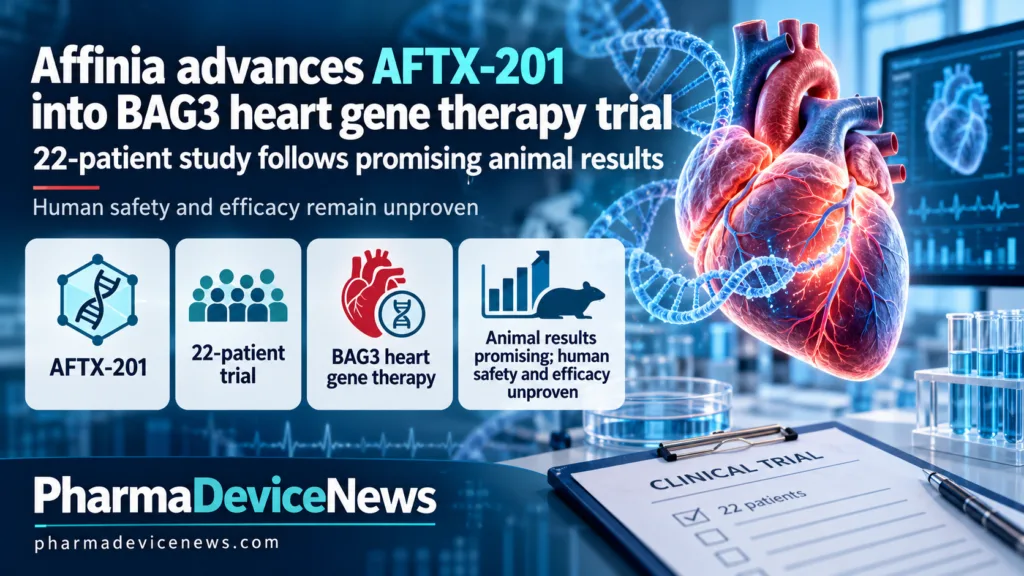
The UPBEAT study is now recruiting adults with genetically confirmed BAG3-associated dilated cardiomyopathy across participating institutions in the United States and Canada. The registered trial targets approximately 22 participants and places its primary emphasis on safety and tolerability during the first 52 weeks following treatment, with additional assessments intended to explore biological activity and early indications of clinical benefit. Its results will be critical in determining whether Affinia’s promising animal findings can be reproduced in humans without unacceptable treatment-related risks.
For the cardiovascular gene therapy field, the development addresses a fundamental challenge that existing heart failure medicines cannot fully resolve. Guideline-directed medical treatment can improve outcomes in patients with reduced cardiac function, but it does not correct the underlying BAG3 mutation responsible for this inherited form of cardiomyopathy. A successful gene replacement approach could eventually introduce a different therapeutic strategy, although the available evidence remains preliminary and the treatment is not approved for clinical use.
Why does BAG3-associated dilated cardiomyopathy represent a significant unmet medical need?
BAG3-associated dilated cardiomyopathy is an inherited cardiac disorder involving mutations in the BAG3 gene, which encodes the Bcl-2-associated athanogene 3 protein. BAG3 contributes to the structural integrity and normal functioning of cardiac muscle cells, including processes involved in maintaining protein quality and cellular resilience under mechanical stress. Disease-causing variants can reduce the availability of functional BAG3 protein, contributing to impaired heart muscle performance and progressive deterioration in ventricular function.
Patients with BAG3-associated dilated cardiomyopathy may develop enlargement of the heart’s chambers, reduced pumping efficiency and symptomatic heart failure, sometimes relatively early in adult life. Disease severity and progression vary between individuals, but affected patients can experience substantial limitations in physical activity and an increased risk of advanced heart failure. The condition also illustrates why identifying a specific genetic cause can be important when evaluating inherited cardiomyopathies.
Affinia estimates that BAG3-associated dilated cardiomyopathy affects more than 70,000 people across the United States, Canada, the European Union and the United Kingdom. The company has also indicated that almost one-quarter of affected patients may require heart transplantation despite current treatment, although these figures should be understood as company-reported disease-burden estimates rather than outcomes established across every genetic and clinical subgroup. The seriousness of the condition provides a strong rationale for developing therapies directed at its molecular mechanism.
Existing heart failure management may include established medicines, implantable cardiac devices and advanced interventions when clinically indicated. These approaches remain important components of care, but they do not replace the missing or insufficient functional BAG3 protein within cardiac muscle cells. Affinia’s programme is intended to address that molecular deficiency, rather than solely managing the downstream consequences of impaired heart function.
What do Affinia’s preclinical AFTX-201 results reveal about restoring cardiac function?
The scientific foundation for AFTX-201 comes from preclinical studies examining whether delivery of a functional BAG3 gene can improve cardiac performance after disease has already developed. At the American Society of Gene and Cell Therapy 2026 Annual Meeting in May, Affinia reported findings from BAG3-haploinsufficient mice, an experimental model in which reduced functional BAG3 expression produces abnormalities resembling important features of the human disease. The company said a single intravenous dose of AFTX-201 restored measured cardiac function and corrected structural abnormalities eight weeks after administration.
The effective dose reported in the mouse experiments was 9 × 10¹¹ vector genomes per kilogram of body weight. Affinia also observed cardiac transgene expression from 14 days through 140 days after dosing, covering the reported duration of that animal investigation. The observations support the biological rationale for gene replacement and suggest that the delivered genetic material can remain active beyond the immediate treatment period.
Separate investigations in non-human primates demonstrated cardiac gene transfer and transgene expression lasting up to six months. Affinia reported that the experimental doses selected for UPBEAT produced cardiac gene transfer in non-human primates of a magnitude comparable to that observed at the effective dose in its mouse model. These findings helped inform clinical dose selection, but comparable gene transfer between animal species does not establish that the same degree of cardiac functional improvement will occur in humans.
The company also conducted a preclinical head-to-head experiment comparing AFTX-201 with a matched BAG3 gene construct delivered using a conventional AAVrh74 capsid. At the evaluated dose, AFTX-201 restored cardiac function in BAG3-haploinsufficient mice, whereas the matched conventional-capsid construct did not produce the same result. This provides support for Affinia’s delivery technology under those experimental conditions, although it cannot establish clinical superiority over other investigational cardiac gene therapies.
The October Heart Failure Society of America presentation reinforces the programme’s translational development rather than introducing evidence of successful treatment in human participants. The distinction is essential because outcomes in genetically engineered mice do not capture the complete biological complexity of human cardiomyopathy. Human disease can involve different stages of cardiac remodeling, variable residual protein function, background treatments and immune responses that affect how gene therapy performs.
How could Affinia’s engineered AAV capsid improve cardiac gene delivery at lower doses?
AFTX-201 incorporates a fully human, full-length BAG3 transgene packaged within Affinia’s proprietary ATC-0187 capsid, an engineered AAV delivery vehicle designed to target cardiac tissue efficiently. The capsid determines important aspects of how the therapeutic genetic material enters cells and reaches the intended tissue. Affinia’s strategy focuses on increasing the efficiency of cardiac gene transfer so that sufficient BAG3 protein can potentially be produced without requiring unusually high systemic vector doses.
The company estimates that its engineered delivery approach could enable doses approximately five to ten times lower than those associated with conventional capsids such as AAV9 and AAVrh74 in relevant investigational cardiac gene therapy approaches. This proposed difference is commercially and clinically important because systemic AAV treatment introduces considerations involving vector exposure, immune responses, manufacturing requirements and dose-related toxicity. However, the numerical dose advantage remains a company-reported development proposition and should not be interpreted as evidence of greater clinical safety or efficacy.
Cardiac gene delivery presents particular technical challenges because an intravenously administered vector must reach the heart while also circulating through other organs. The quantity of vector reaching cardiomyocytes, its distribution within cardiac tissue and its persistence after administration can influence the biological effect. Delivery efficiency is therefore central to determining whether a single infusion can produce enough functional BAG3 protein to alter disease progression.
Lower vector dosing could offer a manufacturing advantage if the treatment can generate adequate therapeutic activity at reduced quantities of material. AAV production is technically demanding, and the amount of vector required for each patient can influence manufacturing throughput and potential treatment cost. Yet these advantages depend on demonstrating that lower doses remain biologically effective in humans and that manufacturing efficiencies translate into a commercially viable finished product.
AAV-based gene replacement is also distinct from directly editing the patient’s existing BAG3 mutation. AFTX-201 is designed to introduce a functional gene capable of expressing BAG3 protein, not to correct the original DNA sequence within the patient’s chromosomes. The durability of that expression and its ability to influence long-term disease progression remain central questions for clinical development.
What will the 22-patient UPBEAT Phase 1/2 trial measure during its first year?
The UPBEAT study, registered as NCT07426419, is a multicenter, open-label Phase 1/2 investigation incorporating dose exploration followed by dose expansion. Its estimated enrolment is 22 adults with BAG3 mutation-associated dilated cardiomyopathy, and all participants are assigned to receive AFTX-201 as a single intravenous infusion. The design does not include a randomized placebo or active-treatment control group, reflecting the study’s early emphasis on establishing safety and investigating preliminary biological activity.
The primary outcome is the number of participants experiencing treatment-emergent adverse events and serious adverse events during the first 12 months after administration. Secondary and exploratory assessments include pharmacodynamic measurements and preliminary clinical efficacy evaluations, with longer-term safety observation planned over five years. This structure allows investigators to investigate whether the treatment produces the intended biological effects while identifying potential safety concerns that may emerge after systemic AAV exposure.
The registered eligibility criteria include adults aged 18 to 70 years with a truncating BAG3 mutation, dilated cardiomyopathy and a left ventricular ejection fraction below 45%. Participants must have New York Heart Association Class II or III heart failure symptoms, indicating established functional limitations. The protocol also requires elevated N-terminal pro-B-type natriuretic peptide, or NT-proBNP, with thresholds that differ according to cardiac rhythm.
These criteria select a genetically defined population with measurable cardiac dysfunction rather than including all individuals who carry BAG3 variants. The distinction is important because a pathogenic mutation does not necessarily produce identical disease severity or progression in every person. The study’s results will therefore be most directly applicable to participants matching its clinical and genetic characteristics.
The UPBEAT programme includes participating institutions in the United States and Canada, with registered recruiting locations including Houston Methodist Hospital, the University of Miami Hospital and Clinics, Saint Luke’s Hospital in Kansas City and the Montreal Heart Institute. The multicenter approach is relevant for a rare genetic disorder because identifying eligible participants can be difficult when patients are dispersed across specialized cardiovascular care networks. Geographic access and genetic diagnosis may influence recruitment speed, particularly when candidates must meet multiple cardiac and molecular eligibility requirements.
Importantly, recruitment status does not establish that participants have already received AFTX-201 or that human treatment outcomes are available. Affinia has not disclosed a human efficacy dataset in the October conference announcement. The programme remains at the stage where investigators must establish tolerability, biological exposure and early functional evidence before broader clinical conclusions become possible.
Which heart function and biomarker measurements could establish early evidence of AFTX-201 activity?
The UPBEAT clinical design includes several assessments intended to evaluate whether the delivered BAG3 transgene reaches the intended tissue and produces a measurable biological response. The Heart Failure Society of America trial abstract identifies BAG3 protein measurements from endomyocardial biopsy samples among the pharmacodynamic investigations. Such measurements could provide more direct evidence of cardiac target engagement than changes in circulating biomarkers alone.
The trial also incorporates cardiac magnetic resonance imaging and echocardiography to evaluate cardiac structure and function. These techniques can assess measures such as ventricular dimensions, pumping performance and other characteristics relevant to dilated cardiomyopathy. Serial evaluations may help investigators determine whether cardiac remodeling stabilizes or improves following treatment, although changes from baseline in a small uncontrolled study cannot independently establish causation.
Cardiopulmonary exercise testing provides another dimension by assessing functional exercise capacity rather than relying exclusively on cardiac imaging. Heart failure can affect physical performance, quality of life and daily activities in ways that are not fully captured by a single imaging measurement. Combining physiological assessments with imaging and biomarker data may therefore offer a more comprehensive early picture of treatment-associated changes.
The interpretation of these outcomes will require particular care because UPBEAT lacks a randomized comparator. Participants may continue to receive established heart failure care, and clinical measurements can change over time for reasons unrelated to an investigational treatment. A consistent pattern across BAG3 expression, cardiac structure, functional capacity and biomarkers would strengthen the rationale for further development, but larger controlled evidence may still be necessary to establish treatment benefit.
Durability will be equally important. Even if AFTX-201 increases BAG3 protein expression during early follow-up, the relevant clinical question is whether that effect persists sufficiently to influence the progressive cardiac abnormalities associated with the disease. The planned five-year follow-up should help characterize longer-term outcomes, although the precise evidence needed for regulatory approval will depend on subsequent discussions with authorities.
What safety questions must AFTX-201 resolve before cardiac gene therapy can advance?
Systemically delivered AAV gene therapies require careful safety assessment because the vector can reach tissues beyond the intended target and interact with the immune system. Potential concerns across the broader AAV therapeutic class include liver injury, immune-mediated reactions, complement activation and other treatment-related complications. These are considerations relevant to the technology and should not be interpreted as adverse events already observed in AFTX-201-treated patients.
Affinia has reported encouraging nonclinical tolerability findings from mouse and non-human primate investigations. The company said it observed no treatment-related mortality or significant adverse effects in the reported studies, including no elevations in liver function tests or evidence of complement activation in the non-human primate assessments. Notably, those animal findings were obtained without prophylactic immunosuppression, although they do not establish that similar supportive treatment will be unnecessary in human clinical use.
The transition into people with symptomatic heart failure introduces additional complexity. Participants may have compromised cardiac function, existing medical conditions and limited physiological reserve, making the consequences of treatment-related complications potentially more significant. The independent safety oversight and staged dose-exploration design are therefore important features of the early clinical programme.
Pre-existing immunity to the delivery capsid represents another practical consideration. The registered UPBEAT criteria exclude individuals with positive neutralizing antibodies to ATC-0187, reflecting the potential for pre-existing immune responses to interfere with gene delivery. Such eligibility restrictions can influence the proportion of genetically eligible patients who may ultimately qualify for treatment.
The duration of follow-up also reflects the long-term uncertainties associated with genetic medicines. A one-time administration may produce prolonged biological activity, but that characteristic requires extended monitoring for delayed adverse events and persistence of therapeutic effects. Long-term follow-up will therefore be essential to understanding whether the treatment’s potential benefits can be sustained with an acceptable safety profile.
How do FDA Fast Track and orphan drug designations affect AFTX-201’s development pathway?
Affinia has secured several regulatory milestones supporting clinical development of AFTX-201. The United States Food and Drug Administration accepted the company’s Investigational New Drug application in February 2026, permitting advancement into the planned clinical programme. The agency subsequently granted Fast Track and Orphan Drug designations, while the European Medicines Agency granted orphan designation and Health Canada authorized the UPBEAT clinical trial application.
These decisions recognize different aspects of the development programme and should not be confused with marketing approval. Investigational New Drug clearance allows clinical investigation under applicable requirements, while Fast Track designation is intended to facilitate development and regulatory interactions for treatments addressing serious conditions with unmet medical needs. Orphan designation provides potential development incentives for eligible rare disease therapies but does not establish efficacy or guarantee approval.
For Affinia, these milestones are useful because clinical development of rare-disease gene therapies may require substantial regulatory engagement on dosing, safety monitoring, endpoints and manufacturing. The company can use the emerging UPBEAT evidence to inform discussions regarding later-stage development requirements. However, the FDA has not announced approval of AFTX-201, and no regulatory decision establishing clinical efficacy has been reported.
The ultimate development pathway will depend on the quality of the human evidence. Early signals of BAG3 expression or cardiac functional improvement may help refine subsequent studies, but they cannot automatically substitute for an adequate demonstration of clinical benefit. Regulators will also consider the treatment’s safety profile, dose selection, intended population and manufacturing consistency when assessing any future marketing application.
Could AFTX-201 face competition from other BAG3 gene therapy programmes?
Affinia is operating within an increasingly active field of genetically targeted cardiovascular therapeutics. Alexion Pharmaceuticals, part of AstraZeneca, is developing ALXN2350 in a Phase 1/2 programme for BAG3-associated dilated cardiomyopathy. Rocket Pharmaceuticals is also investigating RP-A701, an AAVrh74-based gene therapy designed to deliver a functional BAG3 gene, through an early-stage clinical programme.
These programmes reflect growing interest in addressing inherited cardiomyopathy through direct genetic intervention rather than relying exclusively on conventional heart failure management. Although they share the broad therapeutic objective of increasing functional BAG3 activity, the candidates differ in vector design, clinical development strategies and potentially their delivery characteristics. Their emerging evidence packages will need to be evaluated individually.
Affinia’s principal differentiation claim concerns its engineered cardiotropic capsid and the possibility of achieving therapeutic gene transfer at lower vector doses. Its preclinical comparison with a conventional AAVrh74 construct provides useful experimental support for that strategy, but it does not establish superiority over Rocket Pharmaceuticals’ RP-A701 or Alexion Pharmaceuticals’ ALXN2350. No direct clinical comparison between these investigational therapies has been demonstrated.
The relatively small populations enrolled in early BAG3 trials will also limit the reliability of comparisons based on isolated efficacy signals. Differences in baseline ventricular function, disease duration, mutation characteristics, concomitant treatments and measurement methods can materially influence observed outcomes. Consequently, a larger numerical improvement in one programme would not necessarily demonstrate superior efficacy over another candidate studied in a different population.
For Affinia, the competitive opportunity will depend on whether its delivery technology produces a clinically meaningful combination of safety, cardiac gene expression and functional benefit. Progress by other companies could also help clarify the broader biological potential of BAG3 gene replacement. However, positive findings from one investigational therapy cannot independently establish the performance of another product using a different capsid or treatment protocol.
Can Affinia manufacture AFTX-201 at commercial scale if clinical development succeeds?
Manufacturing is a strategically important component of Affinia’s programme because systemic gene therapy can require substantial quantities of AAV vector. Affinia has developed a proprietary production approach intended to improve vector yields and support the manufacture of its engineered capsids. The company previously reported transferring its AFTX-201 process to Forge Biologics for Good Manufacturing Practice production supporting clinical development.
At the American Society of Gene and Cell Therapy meeting in May 2026, Affinia reported manufacturing harvest titers exceeding 6 × 10¹⁵ vector genomes per liter. The company described these results as evidence of a high-yield process and suggested that production at scales ranging from 50 to 250 liters could eventually support commercial demand involving thousands of patients annually. These are company-reported manufacturing findings and potential capacity projections, not confirmation that approved commercial supply already exists.
The combination of higher manufacturing yields and lower intended treatment doses could be commercially valuable if both characteristics are preserved through development. A therapy requiring fewer vector genomes per patient may allow a given manufacturing run to support more treatment courses. Nevertheless, the actual cost of goods will depend on factors including purification recovery, quality testing, batch success rates, final formulation and production scale.
Manufacturing consistency is particularly important when the biological activity of a product depends on the interaction between its capsid and target tissue. Changes in process conditions must not compromise vector quality, potency or other critical attributes. The company’s clinical manufacturing achievements provide a foundation for development, but further validation and regulatory review would be required before commercial-scale production could be established.
Affinia is privately held, so publicly traded company share-price performance cannot be used to measure a direct market response to the HFSA announcement. The commercial significance of the programme remains tied to future clinical and regulatory milestones rather than near-term product revenue. Additional financing requirements, licensing opportunities or strategic partnerships may become relevant as the company progresses toward larger studies, although no specific new transaction was disclosed in the October announcement.
What will determine whether AFTX-201 can progress beyond early clinical testing?
The next significant milestones for Affinia will involve participant dosing, selection of a suitable clinical dose and the emergence of interpretable safety and biological activity data from UPBEAT. The registered study anticipates primary completion in December 2028, although that date is an estimate rather than a confirmed results announcement. Actual reporting timelines will depend on recruitment, participant follow-up, dose decisions and the availability of analyzable data.
Early assessment of adverse events will be especially important because investigators are administering a systemic AAV therapy to patients with established cardiac dysfunction. Evidence that the treatment can be delivered and tolerated at the planned doses would support continued development, while evidence of BAG3 expression in cardiac tissue could provide direct confirmation of the intended biological mechanism. These findings would help determine whether the preclinical rationale is translating into humans.
Clinical efficacy will require a separate level of interpretation. Improvements in left ventricular ejection fraction, ventricular structure, exercise capacity or biomarkers could provide encouraging preliminary signals, particularly if accompanied by evidence of sustained BAG3 protein expression. However, the absence of a randomized control arm and the limited sample size mean that early changes would need careful evaluation before any claim of established disease modification.
The broader strategic question is whether engineered AAV delivery can make genetic treatment of heart muscle disease sufficiently effective and manageable for wider clinical development. Affinia’s results in mice suggest that restoration of functional BAG3 can influence cardiac abnormalities after disease onset, providing a rationale for the UPBEAT investigation. The company’s manufacturing programme and regulatory designations have helped establish the development infrastructure, but they do not resolve the central uncertainty around clinical benefit.
AFTX-201 therefore enters an important period in which its scientific promise must be tested against the realities of human cardiovascular disease. The most consequential evidence will not be another demonstration of improved cardiac function in animals, but reliable human data showing acceptable safety, successful target engagement and a credible signal of sustained cardiac improvement. Whether the UPBEAT programme can produce that combination will determine how far Affinia’s BAG3 gene replacement strategy can progress toward a potential treatment for inherited dilated cardiomyopathy.