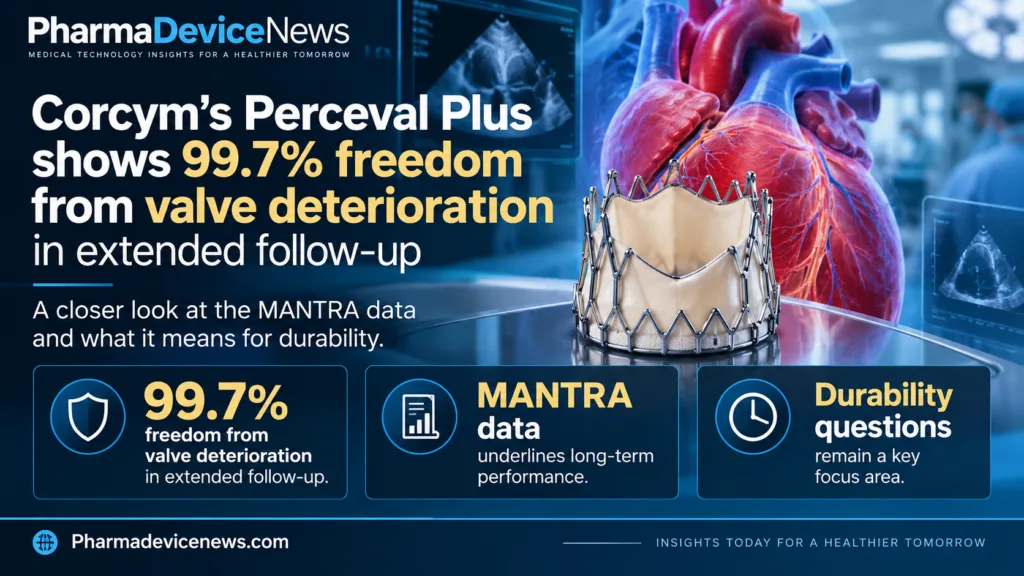
Corcym, an Italy-headquartered medical device company specialising in cardiac surgery, reported on October 9, 2026, that its Perceval Plus sutureless aortic heart valve demonstrated encouraging durability, functional outcomes and procedural safety in an international registry analysis involving 708 patients treated at 45 centres. The findings, presented at the 40th European Association for Cardio-Thoracic Surgery annual meeting in Barcelona, included 99.7% freedom from structural valve deterioration across a reported three-to-seven-year follow-up interval, 96.6% freedom from aortic valve reoperation across a four-to-seven-year interval, and a 3.7% permanent pacemaker implantation rate at 30 days. The results provide additional post-market evidence for a surgical bioprosthesis designed to facilitate aortic valve replacement without conventional permanent anchoring sutures.
The analysis forms part of MANTRA, Corcym’s ongoing prospective, multicentre, international registry examining the safety and performance of its cardiac surgery devices in routine clinical practice. The latest presentation extends the available evidence for Perceval Plus and its proprietary FREE tissue treatment, which was developed to address mechanisms associated with biological valve calcification. Although the findings suggest favourable intermediate-term performance, the announcement does not provide the number of patients remaining under observation at each follow-up interval, limiting how precisely the reported event-free estimates can be interpreted.
The development arrives as cardiac surgery continues to adapt to expanding transcatheter aortic valve implantation and growing interest in minimally invasive and robotic procedures. Perceval Plus occupies a distinctive position because it combines surgical removal of the diseased valve with a collapsible, self-expanding prosthesis designed to simplify implantation. Its clinical and commercial relevance will depend increasingly on evidence that the device delivers durable haemodynamic performance while supporting surgical approaches that reduce procedural complexity and recovery burden.
What do the MANTRA registry results reveal about Perceval Plus valve durability?
Structural valve deterioration is a central concern for biological aortic valve replacements because tissue degeneration can eventually compromise valve function and require another intervention. Biological prostheses may develop leaflet calcification, thickening, tearing or other structural changes that produce stenosis, regurgitation or both. Their long-term performance is therefore an important consideration when surgeons and patients select an initial valve replacement strategy.
Corcym reported 99.7% freedom from structural valve deterioration across the three-to-seven-year follow-up interval described in the latest analysis. The company also reported 96.6% freedom from aortic valve reoperation across the four-to-seven-year interval, indicating that relatively few valve reoperations were recorded within the reported observation period. These measures address related but different clinical outcomes because structural deterioration can develop without immediate reoperation, while repeat intervention may sometimes be required for reasons other than intrinsic tissue degeneration.
The results are encouraging for an established device platform undergoing continued post-market evaluation. However, the reported percentages should not be interpreted as demonstrating that 99.7% of all 708 patients remained free from deterioration for a full seven years. The announcement does not disclose the complete numbers at risk, confidence intervals, event counts or censoring patterns needed to establish the precision of the longest-term estimates.
The distinction becomes especially relevant because the MANTRA registry began enrolling patients in 2021, although its protocol also permits the incorporation of longer-term Perceval Plus follow-up data transferred from the earlier SURE-AVR registry. This helps explain how observations extending beyond the newer registry’s own enrolment history may be included within the broader dataset. Nevertheless, the proportion of patients contributing observations near seven years remains important for assessing how confidently the reported durability estimates can be extended across the treated population.
How does the 708-patient study strengthen the clinical evidence beyond earlier Perceval Plus results?
The latest analysis represents a substantial expansion of the clinical experience previously published from MANTRA. In June 2024, investigators reported outcomes for 328 patients treated with Perceval Plus at 29 international institutions, providing an early assessment of procedural safety, haemodynamic performance and quality of life. The October 2026 update covers 708 patients across 45 centres, broadening the observational population while introducing longer follow-up data.
The earlier peer-reviewed analysis described patients with a mean age of 71.9 years and a mean EuroSCORE II of 2.9, reflecting a population with varying predicted operative risks. Minimally invasive approaches were used in 44.2% of patients, while 40.8% underwent concomitant procedures. This diversity matters because surgical valve performance must be evaluated across different procedural circumstances rather than only in carefully selected patients undergoing isolated valve replacement.
The 2024 findings included a 30-day mortality rate of 1.8%, no reported early reinterventions and a permanent pacemaker implantation rate of 4.0%. Mean aortic valve pressure gradients declined from 46.2 mmHg before surgery to 10.1 mmHg at 30 days, indicating substantial relief of obstruction following valve replacement. Investigators also reported little or no moderate-to-severe paravalvular or central valve leakage during the early assessment period.
The newly disclosed 3.7% pacemaker implantation rate is broadly consistent with the earlier 4.0% finding, although the figures come from different analysis populations. The larger dataset offers greater practical relevance than a small single-centre series, particularly because participating hospitals may differ in surgical technique and experience. However, the new findings remain observational, and the absence of a randomised comparator prevents firm conclusions about superiority over other surgical bioprostheses.
MANTRA’s ongoing design offers a further opportunity to strengthen the evidence base. The study plans long-term follow-up extending to ten years, enabling investigators to examine outcomes as additional patients complete annual assessments. Consistent collection of valve deterioration, reoperation, haemodynamics and adverse-event data will become increasingly important as the population accumulates longer exposure to the implanted devices.
Why is the 3.7% permanent pacemaker implantation rate important for sutureless aortic valves?
Permanent pacemaker implantation is a relevant procedural outcome because aortic valve replacement can affect the heart’s electrical conduction system. The anatomical structures responsible for transmitting electrical signals are located close to the aortic annulus, where replacement valves are positioned. Pressure or injury affecting these structures can produce conduction disturbances that sometimes require permanent pacing.
Sutureless and self-expanding surgical valves introduce particular considerations because their supporting frames interact with surrounding anatomical structures after deployment. Implantation depth, valve sizing, annular anatomy and the handling of native valve calcification can influence the risk of conduction abnormalities. The ability to implant a valve without multiple permanent anchoring sutures does not eliminate these factors.
Corcym’s reported 3.7% permanent pacemaker implantation rate at 30 days provides a useful contemporary measure of early procedural safety within the registry. It also suggests consistency with the earlier MANTRA findings, which documented pacemaker implantation in 13 of 328 patients. The findings are relevant to surgeons considering whether a sutureless approach offers an acceptable balance between simplified implantation and the risk of postoperative conduction complications.
Nevertheless, the available summary does not provide detailed information about baseline conduction disorders, pacemaker indications, implantation depth or the relationship between procedural technique and pacing requirements. These factors can substantially influence comparisons between devices and institutions. A patient population with more pre-existing conduction disease may experience different outcomes from one in which such conditions are relatively uncommon.
Pacemaker rates are also sensitive to hospital protocols and clinical decision-making. Differences in the duration of postoperative observation and thresholds for implantation can affect reported outcomes even when the underlying device performance is similar. Consequently, the 3.7% figure is an important safety observation but does not establish a comparative advantage against conventional sutured valves or transcatheter devices.
What do the quality-of-life improvements show about recovery after Perceval Plus implantation?
The registry also provides information about functional recovery after aortic valve replacement, an outcome that matters alongside survival and device durability. Corcym reported that 96.3% of assessed patients were classified in New York Heart Association functional class I or II at 30 days following surgery. More than 95% of assessed patients reportedly maintained class I or II status at three years, suggesting sustained improvement in functional status among those contributing follow-up data.
New York Heart Association classification measures the extent to which heart disease limits physical activity. Class I describes patients without limitation of ordinary physical activity, while class II indicates relatively mild limitations. Movement into these categories after aortic valve replacement is clinically relevant because severe aortic valve disease can cause breathlessness, fatigue and reduced exercise capacity.
Patient-reported outcomes provide an additional perspective. Mean Kansas City Cardiomyopathy Questionnaire-12 scores increased from 59.6 before surgery to 72.8 at 30 days, followed by 85.4 at one year. The 25.8-point difference between baseline and one year indicates a substantial improvement in average reported health status among the assessed participants.
Similarly, the mean visual analogue scale score from the EQ-5D-5L health-status assessment increased from 65.2 at baseline to 72.7 at 30 days and 79.3 at one year. These results suggest that patients reported improvements extending beyond immediate postoperative recovery. The consistency between functional classification and patient-reported health status adds useful context to the haemodynamic and durability findings.
However, improvements following valve replacement cannot be attributed exclusively to the Perceval Plus design. Relief of severe aortic obstruction itself can produce major improvements in symptoms and quality of life, regardless of which suitable replacement prosthesis is implanted. Without a comparative group, the registry cannot determine how much of the reported improvement is attributable to sutureless implantation, the valve’s tissue technology or the benefits expected from successful surgery generally.
Can FREE tissue treatment reduce biological heart valve calcification over the long term?
Perceval Plus incorporates Corcym’s FREE tissue treatment, an approach intended to address chemical and biological factors associated with calcification of bovine pericardial valve tissue. Conventional biological valve processing commonly uses glutaraldehyde to stabilise tissue, helping provide structural integrity and reduce biological degradation. However, residual aldehydes and phospholipids have been associated with pathways that contribute to calcium deposition and tissue degeneration.
Corcym developed FREE tissue treatment to address these two categories of potential calcification contributors. The company’s stated objective is to improve tissue resistance to degeneration while preserving the physical characteristics needed for reliable valve opening and closure. Perceval Plus also uses the LANCELOT manufacturing process, incorporating zero-pressure shaping and laser cutting of pericardial tissue.
These manufacturing features are relevant because biological valve performance depends partly on consistent tissue preparation, leaflet geometry and mechanical loading. Small differences in leaflet thickness, stress distribution and tissue treatment can influence valve movement and potentially affect long-term durability. Improving manufacturing consistency may therefore support more predictable device characteristics across production batches.
The extended MANTRA results provide supportive clinical observations for Perceval Plus valves incorporating the FREE treatment process. However, favourable deterioration rates alone do not establish that FREE is superior to other tissue-preservation technologies. Demonstrating that advantage would require appropriately designed comparative evidence involving sufficiently similar patient populations, implantation conditions and follow-up periods.
The question becomes increasingly important beyond the seven-year observation window. Biological valve degeneration can accelerate later in a prosthesis’s lifespan, particularly in younger recipients who may have greater cumulative mechanical exposure and different biological risk factors. Ten-year and longer-term assessments will therefore be important for determining whether the favourable intermediate-term performance persists.
How could Perceval Plus support minimally invasive and robotic aortic valve replacement?
The procedural design of Perceval Plus is central to its commercial differentiation. Conventional surgical aortic valve replacement typically requires placement of multiple sutures to secure the replacement prosthesis within the aortic annulus. Perceval Plus instead uses a collapsible, self-expanding supporting frame that anchors the valve without conventional permanent fixation sutures after the diseased valve has been surgically removed.
The approach is intended to simplify certain implantation steps and may be especially relevant when surgeons operate through smaller incisions. Minimally invasive access can reduce the available working space and make conventional suturing more technically demanding. A valve that can be collapsed, delivered and deployed through restricted access may support the broader adoption of less invasive surgical techniques.
However, sutureless implantation is still surgical aortic valve replacement and should not be confused with transcatheter aortic valve implantation. Patients generally undergo surgical excision of the diseased valve and placement of the replacement prosthesis under the conditions required for the operation. The technique retains important elements of cardiac surgery even when access is obtained through a limited incision.
Evidence from a separate prospective international registry analysis published in April 2026 provides useful context. That study examined 1,652 patients implanted with Perceval S or Perceval Plus and included a propensity-matched comparison of minimally invasive approaches. Investigators found that mini-thoracotomy was associated with shorter intensive care and hospital stays than mini-sternotomy, although cross-clamp and cardiopulmonary bypass times were longer with mini-thoracotomy.
These findings demonstrate why the benefits of less invasive surgery cannot be reduced to incision size alone. Different approaches involve tradeoffs relating to operative time, technical complexity, postoperative recovery and the experience of the surgical team. They also concern a broader Perceval population rather than exclusively the 708-patient Perceval Plus analysis, preventing direct attribution of those differences to the newer valve’s design.
At EACTS 2026, Corcym presented additional work involving robotic-assisted aortic valve replacement and fully robotic deployment of the Perceval platform. These presentations suggest continued investigation of sutureless technology in technically demanding surgical settings. Yet broader robotic adoption will depend on reproducible surgical outcomes, appropriate training, equipment availability and whether the clinical advantages justify additional programme costs.
How do the new data position Perceval Plus against transcatheter aortic valve implantation?
The treatment environment for severe aortic stenosis has changed substantially with the expansion of transcatheter aortic valve implantation, commonly referred to as TAVI. Transcatheter procedures allow selected patients to receive replacement valves without conventional open surgical implantation and have become increasingly important across a wider range of risk categories. This creates a different competitive environment for surgical valve manufacturers, which must demonstrate the continuing value of surgery in patients for whom both approaches may be considered.
The 2025 European Society of Cardiology and European Association for Cardio-Thoracic Surgery guidelines reflect this evolution. They recommend TAVI for suitable patients aged 70 years or older with tricuspid aortic valve stenosis when anatomical requirements are met, while surgical replacement remains recommended for patients younger than 70 years with low surgical risk. Other cases require individual assessment of anatomical characteristics, procedural risk and expected long-term outcomes.
Perceval Plus is relevant to the surgical portion of this treatment landscape rather than representing a direct transcatheter alternative. Its potential value lies in combining surgical management of the diseased native valve with a simplified prosthesis deployment technique. This may be particularly useful where surgery is preferred because of patient age, associated cardiac conditions, anatomy or the need for additional procedures.
Long-term durability is a central part of this discussion because treatment decisions increasingly consider the patient’s expected lifetime rather than only immediate procedural outcomes. A biological valve that performs reliably over many years may help preserve future treatment options, although eventual degeneration or reintervention cannot be ruled out. Surgeons must also consider the feasibility of subsequent valve-in-valve procedures and the anatomical consequences of the initial prosthesis selection.
The MANTRA findings support Perceval Plus performance within the population receiving surgical treatment, but they do not establish superiority over TAVI. The registry does not include a randomised transcatheter comparator, and differences in age, disease severity, anatomy and surgical risk would complicate comparisons with external studies. Any claims involving lower mortality, fewer complications or greater durability than transcatheter valves would require stronger comparative evidence.
What does the FDA approval history reveal about Perceval Plus regulatory status?
Perceval Plus is an established approved surgical valve technology rather than a newly authorised device entering the market following the October 2026 presentation. The United States Food and Drug Administration initially approved the Perceval Sutureless Heart Valve in January 2016 under the Premarket Approval pathway. In October 2020, the regulator approved a supplemental application introducing the Perceval Plus model, including changes to bovine pericardial tissue treatment and the inflow ring configuration.
The original Perceval indication covers replacement of diseased, damaged or malfunctioning native or prosthetic aortic valves. Subsequent regulatory supplements have addressed product design and manufacturing modifications, including changes to Perceval Plus production processes. These records distinguish its regulatory status from that of devices receiving their first marketing authorisation.
The October 2026 registry presentation does not represent a new FDA clearance or approval for Perceval Plus. Instead, it provides additional post-market evidence relevant to understanding the established device’s performance. Such information can support regulatory surveillance, clinical confidence and future product development, depending on the strength and completeness of the underlying data.
The regulatory distinction is particularly important because Corcym announced other product developments at the same conference. TriMemo and Memo 4D Curve, two devices in its valve repair portfolio, were introduced commercially following their recent FDA clearances and first-in-human procedures. These are separate devices with different intended uses and regulatory histories, and their clearances should not be confused with the existing Premarket Approval status of Perceval Plus.
Why is Corcym investing in valve repair technology alongside its sutureless replacement platform?
Corcym’s EACTS participation extended beyond the Perceval Plus presentation. The company announced the commercial introduction of TriMemo, a device developed for tricuspid valve repair, and Memo 4D Curve, a semi-rigid mitral annuloplasty device with an open configuration. These introductions broaden the company’s surgical repair portfolio while supporting its established business in valve replacement.
The strategy reflects the diversity of structural heart disease treatment. Some patients require replacement of a severely diseased valve, while others may be candidates for repair that preserves native tissue and anatomy. Supporting both categories allows a specialised manufacturer to participate in multiple surgical treatment pathways rather than relying on a single product segment.
Corcym was established in 2021 following the separation of the heart valve business of LivaNova and is backed by Gyrus Capital. The business operates internationally with a portfolio spanning surgical replacement and repair technologies. As a privately held company, Corcym does not have a publicly traded share price that can be used to assess the financial market’s immediate reaction to the MANTRA announcement.
The company’s broader strategy includes investment in minimally invasive and robotic surgery capabilities, along with surgical education and preoperative planning tools. Its CRIMSON artificial intelligence-assisted computed tomography platform is intended to support anatomical assessment and valve replacement planning. These capabilities could complement surgical device sales, although their individual commercial contributions and the extent of clinical adoption have not been disclosed.
For hospitals, the value of a broader integrated offering will depend on more than product availability. Surgical teams must assess device costs, training requirements, procedural results, access to specialised equipment and the practical advantages of incorporating new technologies into existing services. Strong clinical data for Perceval Plus may support surgeon confidence, but adoption decisions will remain dependent on local clinical and operational considerations.
What additional evidence is needed to establish long-term Perceval Plus performance?
The most important next milestone will be publication of more complete long-term results from MANTRA, including the number of patients contributing data at each follow-up interval. Detailed event counts, confidence intervals and information about patients lost to follow-up would make it possible to assess the precision of the reported durability estimates. Additional reporting on death as a competing event, reintervention causes and echocardiographic definitions would also improve interpretation.
An extended analysis of haemodynamic performance would be particularly valuable. Stable transvalvular gradients and limited paravalvular regurgitation are important indicators of prosthetic function, but the October announcement did not provide the full numerical trajectories needed to evaluate changes across all follow-up periods. Serial echocardiographic data could help establish whether early favourable performance is maintained consistently as the tissue valve ages.
Continued evaluation of conduction abnormalities and permanent pacemaker implantation would further strengthen the device’s safety profile. The currently reported 3.7% implantation rate is useful, but outcomes across surgical approaches, valve sizes and baseline patient characteristics could help explain which factors influence procedural risk. Such information may support more informed selection and implantation practices without implying that the valve itself eliminates conduction complications.
The prospect of ten-year follow-up is especially relevant for younger surgical candidates and patients expected to live long enough to face possible bioprosthetic degeneration. Longer observations would clarify whether the FREE tissue treatment is associated with sustained resistance to deterioration, while comparative studies could help establish whether any advantage extends beyond the performance of the broader Perceval platform. These questions have direct implications for lifetime treatment planning and the potential need for future valve interventions.
Corcym’s latest MANTRA analysis adds substantial observational evidence to the Perceval Plus clinical record, expanding the reported population to 708 patients and documenting encouraging structural durability, low early pacemaker implantation rates and improved patient-reported health status. The results are particularly relevant as surgeons evaluate how sutureless technology can support minimally invasive and increasingly robotic procedures while maintaining reliable valve function. The critical longer-term test will be whether complete, transparently reported follow-up confirms these favourable findings across a sufficiently large patient population and demonstrates how Perceval Plus performs against alternative surgical valve technologies over the full expected lifespan of a biological prosthesis.