SurGenTec, a privately held medical device manufacturer headquartered in Boca Raton, Florida, announced on October 8, 2026, that it had entered into an exclusive licensing agreement with Allevion Medical for the Vantage Lumbar Decompression Kit, a single-use surgical instrument system intended for lumbar spinal decompression procedures. The transaction gives SurGenTec exclusive rights to a technology designed to combine targeted bone removal, direct visualisation and disposable instrumentation, expanding its portfolio beyond spinal fixation and bone graft technologies. The device had already received United States Food and Drug Administration 510(k) clearance on March 12, 2026, meaning the agreement concerns rights to an existing cleared technology rather than a new regulatory authorisation.
The transaction comes as spine surgeons and healthcare facilities evaluate different approaches to treating lumbar spinal stenosis, a condition involving narrowing of spaces around spinal nerves that can cause leg pain, impaired walking and reduced mobility. Vantage is designed to facilitate laminotomy and laminectomy procedures using specialised instruments that allow surgeons to remove bone and soft tissue contributing to nerve compression. Its fully disposable configuration could also change the equipment requirements associated with selected procedures, although neither company has disclosed comparative clinical outcomes or independently quantified operating-room savings.
The licensing structure is important because SurGenTec has not announced an acquisition of Allevion Medical or disclosed a purchase price for the technology. The agreement establishes exclusive rights to Vantage, but the companies have not specified its duration, geographic scope, royalty arrangements or financial milestones. The immediate business significance is therefore portfolio expansion around an FDA-cleared device, while the extent of its commercial impact will depend on how successfully SurGenTec introduces the system to surgeons and healthcare facilities.
What does SurGenTec’s exclusive licensing agreement with Allevion Medical actually cover?
The agreement gives SurGenTec exclusive rights to Allevion Medical’s patented Vantage technology, which combines several instruments required to perform lumbar decompression through a minimally invasive approach. SurGenTec plans to position the system alongside its existing portfolio of spine surgery technologies, including facet fixation systems, sacroiliac joint fusion devices and bone graft delivery products. The combination expands the range of procedures the company can support without requiring it to develop an entirely new decompression system internally.
Vantage was originally developed by Allevion Medical, which announced FDA clearance in April 2026 following the regulator’s decision the previous month. The company designed the system around a structured procedural workflow supported by specialised instruments and disposable lighting components. Allevion Medical’s earlier announcement emphasised the system’s intended application in removing hypertrophic bone from spinal structures contributing to lumbar stenosis.
SurGenTec’s vice president of sales, Matt Marta, described the agreement as consistent with the company’s strategy of expanding minimally invasive spine treatment options. He indicated that Vantage would complement the existing portfolio by offering surgeons a disposable system intended to improve procedural precision and ease of use. Those expectations describe the company’s commercial rationale rather than independently demonstrated improvements in surgical outcomes.
The licensing model also leaves several transaction details unresolved publicly. Neither company disclosed whether SurGenTec will manufacture the instruments itself, source finished devices from Allevion Medical or use another manufacturing arrangement. The agreement likewise does not specify minimum purchasing commitments, territorial restrictions or responsibility for future product modifications, preventing a detailed financial assessment of the transaction.
How does Vantage perform lumbar decompression using direct visualisation and controlled bone removal?
Lumbar spinal stenosis commonly develops through degenerative changes affecting the vertebrae, facet joints, intervertebral discs and surrounding ligaments. Enlargement of bone around the facet joints and thickening of the ligamentum flavum can narrow the available space for spinal nerves, contributing to symptoms that may worsen during standing or walking. Surgical decompression aims to relieve that pressure by removing selected tissue while preserving sufficient structural integrity.
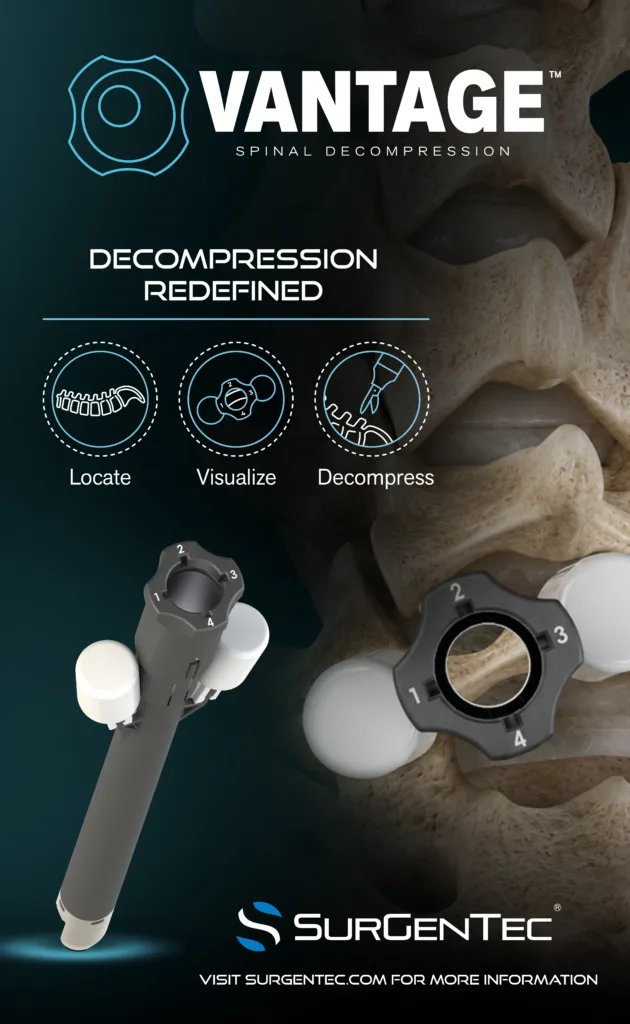
Vantage is designed around a three-stage procedural sequence involving locating the affected anatomy, establishing visual access and performing decompression. The system includes specialised instruments that allow surgeons to reach the target region and remove bone or soft tissue. According to SurGenTec, its instruments incorporate depth-control features and protective guards intended to reduce the risk of unintended contact with surrounding anatomical structures.
An important design feature is the integrated, single-use illumination system. The company says the lighting components allow physicians to visualise the operative field during tissue removal, supporting more controlled surgical manoeuvres. Direct observation may be particularly relevant when surgeons work through restricted access corridors near delicate neural structures.
The device also uses a working cannula intended to create a controlled access route for the instruments. This configuration could help surgeons perform selected decompression steps without the extent of tissue exposure associated with some traditional open procedures. However, the clinical advantages of any specific approach depend on the anatomy involved, the extent of decompression required and the surgeon’s experience.
Vantage is not an implanted device and does not stabilise the spine through fixation hardware. Its principal purpose is to facilitate the surgical removal of tissue contributing to compression. Patients with significant instability or other structural conditions may require additional procedures or a different surgical strategy, depending on their clinical circumstances.
What does the FDA’s March 2026 clearance establish about the Vantage system?
The FDA granted 510(k) clearance to the Vantage Lumbar Decompression Kit on March 12, 2026, under submission K252546. Allevion Medical was identified as the applicant, and the device was classified as a Class II product under the regulatory category for arthroscopes and related accessories. The agency determined that the system was substantially equivalent to an existing legally marketed predicate device.
The predicate identified in the regulatory submission was the ELID System developed by LESspine Innovations, cleared under K243774. Both systems comprise specialised instruments intended to support lumbar decompression procedures. The substantial equivalence determination established that the technological differences between Vantage and its predicate did not introduce different questions of safety and effectiveness within the applicable regulatory framework.
The cleared indication is broader than the spinal stenosis application emphasised in SurGenTec’s announcement. FDA documentation describes Vantage as a specialised set of surgical instruments intended for lumbar decompression procedures used in treating various spinal conditions. It also specifies that the instruments may be used with open, direct-visualisation or indirect-visualisation approaches, depending on the components and procedural technique selected.
This distinction is relevant because the company’s promotional emphasis on direct visualisation does not mean that every procedure performed with the cleared kit must use precisely the same visualisation method. The regulatory description establishes the system’s intended use and supported configurations, while the clinical technique remains dependent on the planned operation.
The FDA submission included biocompatibility assessments, sterilisation validation, packaging and shelf-life testing, cadaveric testing, particulate assessments and evaluations of instrument performance under physiological loading conditions. These investigations supported the substantial equivalence determination. The publicly available clearance summary does not report a prospective clinical trial establishing lower complication rates, faster recovery or superior pain relief compared with existing decompression systems.
Vantage is therefore FDA-cleared, not FDA-approved through a Premarket Approval application. The distinction matters because 510(k) clearance confirms that the device satisfies the applicable substantial equivalence standard for marketing, but it does not independently establish clinical superiority over competing surgical technologies.
Why could targeted bone removal matter for patients with lumbar spinal stenosis?
The clinical rationale for Vantage centres on the contribution of enlarged bone structures to narrowing of the lumbar spinal canal. In some patients, compression involves substantial bony overgrowth affecting the lamina and facet joints, alongside changes in surrounding ligaments. Removing sufficient obstructive tissue while preserving important anatomical structures is a central objective of decompression surgery.
Existing minimally invasive technologies use different methods to achieve this objective. Some concentrate on removing or reducing thickened ligament tissue, while other surgical systems allow broader bone and soft-tissue resection through endoscopic or tubular access. Vantage is positioned as an option for procedures in which targeted bone removal forms an important part of the decompression strategy.
That positioning is clinically plausible because lumbar stenosis is not a uniform anatomical condition. Two patients experiencing similar symptoms may have different combinations of ligament thickening, facet enlargement, disc changes and spinal instability. The appropriate surgical approach depends on identifying the structures responsible for neural compression rather than relying solely on the severity of symptoms.
The clinical literature supports decompression surgery as an established option for appropriately selected patients with symptomatic lumbar spinal stenosis. Guidance developed by the World Federation of Neurosurgical Societies recognises the effectiveness of decompression for moderate-to-severe symptoms or neurological deficits while acknowledging continuing debate over the most appropriate surgical techniques. Minimally invasive approaches may offer advantages in certain early recovery measures, but those findings cannot automatically be attributed to a newly introduced instrument system.
For Vantage, the critical clinical question will be whether surgeons can achieve adequate decompression using the system across the anatomical presentations for which it is selected. A limited incision or narrower working corridor is not inherently beneficial if it prevents sufficient removal of compressive tissue. Procedural efficiency must therefore be assessed alongside the completeness of decompression, neurological outcomes and the need for subsequent intervention.
Can Vantage improve surgical safety without compromising decompression effectiveness?
Spinal decompression takes place near nerve roots, the thecal sac and other sensitive structures, making control of surgical instruments particularly important. Potential complications include incidental dural tears, nerve injury, bleeding, infection and incomplete decompression. Device design can support procedural control, but complications are influenced by multiple factors, including anatomy, surgical technique and patient characteristics.
Vantage incorporates depth-control mechanisms and protective guards intended to help surgeons manage instrument movement during tissue removal. Its integrated illumination is also designed to improve visibility within the operative field. These features provide a reasonable engineering basis for investigating procedural safety, although their presence alone does not demonstrate a reduction in adverse events.
The FDA submission included cadaveric and mechanical performance evaluations, providing information about device function under controlled conditions. Such testing is relevant to establishing that instruments can perform their intended tasks and withstand anticipated stresses. However, cadaveric testing cannot reproduce every aspect of surgery in living patients, including bleeding, tissue response and postoperative healing.
The public announcement did not disclose rates of dural injury, nerve complications, blood loss, conversion to open surgery or repeat decompression procedures involving Vantage. It also did not identify a comparative clinical study evaluating those outcomes against established instrumentation. Consequently, claims that the system reduces complications or improves patient recovery remain design objectives rather than independently verified clinical advantages.
Surgeon training will be another important consideration. A structured procedural sequence may make instrumentation easier to understand, but successful surgery still requires anatomical knowledge and the ability to recognise when the planned decompression is incomplete or unsuitable. Clinical adoption will depend partly on how effectively SurGenTec supports surgeons learning the system and assessing its appropriate applications.
Could fully disposable spinal decompression instruments reduce hospital operating costs?
The commercial differentiation of Vantage extends beyond its surgical instrumentation. The system is supplied sterile and designed for single use, eliminating the need to clean and reprocess its components after a procedure. This model differs from conventional reusable surgical instrument sets, which typically require inspection, cleaning, sterilisation, inventory management and preparation before another operation.
Reusable instruments impose operational costs that may not be immediately visible within the purchase price of the equipment. Hospitals must maintain sterilisation infrastructure, track instrument availability and manage damaged or missing components. Procedures involving multiple instrument trays can also create additional preparation and turnaround requirements.
A self-contained disposable kit could simplify some of these activities. SurGenTec highlights the possibility of reducing instrument preparation and the logistical burden associated with reusable trays. The potential benefit may be particularly relevant for ambulatory surgery centres, where efficient equipment turnover and predictable procedure costs can influence purchasing decisions.
However, the absence of reprocessing requirements does not establish that disposable instrumentation is less expensive over the complete procedure. Hospitals must account for the per-case kit price, disposal expenses, supply contracts and any additional equipment required during surgery. Conventional instruments may also become economical when their acquisition and maintenance costs are distributed across many procedures.
The October announcement did not disclose Vantage’s selling price, comparative procedural costs or a hospital economic study. It also did not quantify reductions in operating-room preparation time or instrument processing expenses. Without these measurements, the claimed operational advantages remain plausible but unquantified.
Single-use technology introduces environmental considerations as well. Disposable surgical instruments can reduce reliance on repeated cleaning and sterilisation but generate additional waste and may require different material supply chains. Determining the overall environmental impact would require an appropriate lifecycle comparison rather than an assumption that either reusable or disposable equipment is inherently preferable.
How does the Allevion Medical agreement complement SurGenTec’s existing spine surgery portfolio?
SurGenTec has built its product portfolio around technologies intended to support less invasive orthopaedic and spinal procedures. Its offerings include facet fixation systems, sacroiliac joint fusion devices, synthetic bone graft materials and instruments designed for bone graft delivery. Adding Vantage introduces a decompression-focused technology to a portfolio previously concentrated more heavily on fixation, fusion and associated surgical products.
The timing follows several regulatory developments involving the company’s ION platform. In June 2026, SurGenTec announced FDA clearance for its ION-L Lumbar Facet Fixation System, intended for defined patients with degenerative disc disease who have failed conservative treatment. The company subsequently announced clearance of navigation instruments compatible with the system, expanding its procedural capabilities.
Decompression and fixation represent different surgical objectives, even though they may be considered within the broader management of degenerative lumbar disease. Decompression aims to relieve pressure on neural structures, while fixation technologies are intended to stabilise selected spinal segments. Having products in both categories could broaden SurGenTec’s relevance to spine surgeons and healthcare facilities performing different procedures.
Nevertheless, the licensing agreement does not establish that Vantage and ION-L have been validated as a combined treatment system. Each device has its own intended use and regulatory status, and their availability within a single manufacturer’s portfolio should not be interpreted as authorisation for every possible combination. Any integrated surgical strategy must remain consistent with the applicable indications and clinical evidence.
From a commercial perspective, the arrangement could allow SurGenTec to introduce Vantage through relationships already established with spine surgeons and distribution partners. Such relationships may reduce some of the barriers faced by a smaller technology developer entering the market independently. The company has not disclosed the number of hospitals expected to adopt Vantage or a revenue forecast associated with the licensing agreement.
Both SurGenTec and Allevion Medical are privately held, and the transaction does not provide a publicly traded share-price catalyst. No disclosed payment terms are available to assess the financial return to Allevion Medical or the capital commitment undertaken by SurGenTec. The agreement’s importance is therefore best assessed through its product strategy and subsequent commercial execution rather than an assumed transaction valuation.
What will determine whether Vantage gains traction in hospitals and ambulatory surgery centres?
SurGenTec’s next challenge is to translate Vantage’s cleared design into routine clinical use. The system is already featured in the company’s product portfolio, but the October announcement does not establish how many procedures have been performed, which institutions are using it or the scale of commercial sales. These measures would provide a clearer indication of market adoption than the execution of the licensing agreement alone.
Clinical evidence will be particularly important. Prospective studies reporting pain reduction, walking improvement, functional disability scores and the durability of decompression could help demonstrate whether Vantage performs as intended in appropriately selected patients. Rates of dural injury, neurological complications, reoperation and conversion to alternative surgical approaches would further inform the benefit-risk assessment.
Comparative procedural evidence could also strengthen the commercial argument. Measurements of operating time, instrument setup time, blood loss, hospital stay and total procedure cost would allow healthcare facilities to evaluate the system against established alternatives. A well-designed study should distinguish the effects of the instrumentation from differences in patient selection, surgeon experience and surgical approach.
SurGenTec will also need to establish reliable manufacturing and distribution arrangements for a product designed around single-use components. Disposable systems create recurring supply requirements, meaning hospitals must have confidence that the necessary kits will remain available in the appropriate configurations. Sterilisation validation, packaging integrity, inventory forecasting and quality control remain important even when the devices do not require reprocessing after use.
The licensing agreement provides SurGenTec with a technology that has already crossed the United States regulatory clearance threshold, potentially reducing the time needed to expand its commercial offering. Yet clearance and exclusive rights do not independently demonstrate surgeon acceptance, favourable purchasing economics or improved patient outcomes. The most meaningful evidence of success will emerge when Vantage’s procedural performance, clinical outcomes and operating costs can be assessed in routine practice.
The October 2026 transaction positions SurGenTec to participate more directly in lumbar spinal decompression through a differentiated disposable instrument platform. Vantage combines an established surgical objective with integrated illumination, controlled bone removal and a simplified equipment model, offering a potential alternative to some conventional instrumentation workflows. Its long-term commercial position will depend on proving that these engineering characteristics deliver practical benefits for surgeons and healthcare facilities while maintaining the clinical effectiveness and safety expected from established decompression procedures.