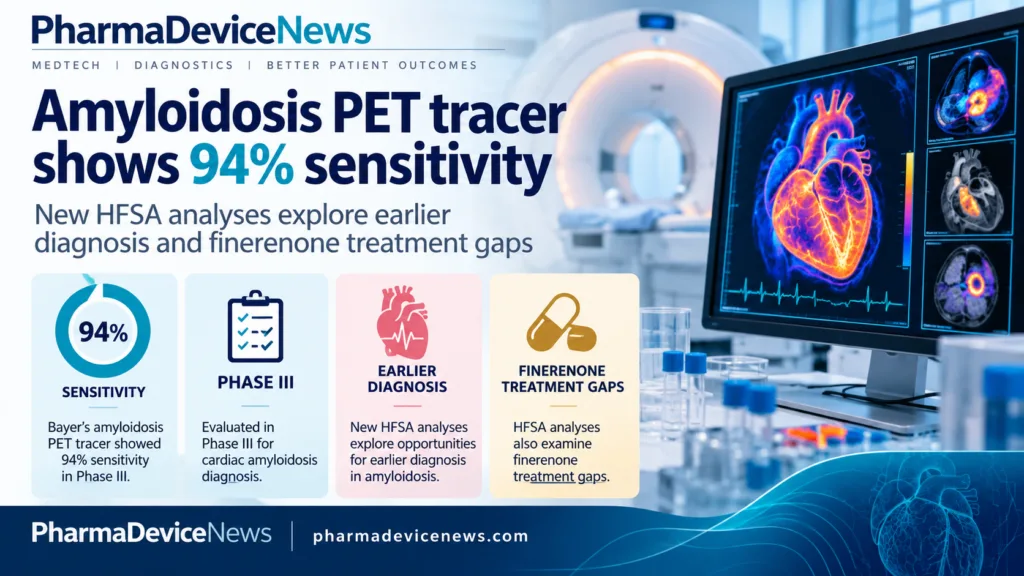
Bayer AG (XETRA: BAYN), the German pharmaceutical and life sciences company, announced on October 8, 2026, that it would present additional findings from its Phase III REVEAL cardiac amyloidosis imaging study alongside research examining heart failure treatment patterns and three ongoing clinical trials of finerenone at the Heart Failure Society of America annual scientific meeting in Phoenix, Arizona, from October 9 to 12. The programme includes a late-breaking post-hoc analysis investigating the potential of iodine 124 evuzamitide PET/CT imaging to detect cardiac amyloidosis earlier, building on previously published Phase III results demonstrating 94% sensitivity and 86% specificity for diagnosing the disease. The announcement also highlights Bayer’s effort to extend the clinical evidence supporting Kerendia, its approved non-steroidal mineralocorticoid receptor antagonist, into additional heart failure populations and treatment settings.
The imaging presentation is particularly relevant because cardiac amyloidosis can remain unrecognised for years while abnormal protein deposits progressively affect heart function. The REVEAL study, conducted at 18 United States centres, demonstrated that iodine 124 evuzamitide could identify cardiac amyloidosis with relatively high diagnostic accuracy in patients undergoing clinical investigation. However, the new conference analysis is exploratory, and Bayer’s October 8 announcement did not disclose numerical findings establishing how reliably the tracer identifies earlier-stage disease.
The finerenone presentations address a separate but commercially important question: how an established medicine can be evaluated across patients with different heart failure characteristics and treatment limitations. Bayer’s programme includes studies of early combination treatment with an SGLT2 inhibitor, patients hospitalised with worsening heart failure, and individuals unable to receive conventional steroidal mineralocorticoid receptor antagonists. These are ongoing investigations rather than newly completed efficacy studies, making their designs and the clinical gaps they address more significant than any immediate implication of additional treatment benefit.
Can Bayer’s iodine 124 evuzamitide PET scan detect cardiac amyloidosis before advanced heart damage?
Cardiac amyloidosis develops when abnormal proteins accumulate in heart tissue, interfering with the heart’s ability to relax and function normally. Two clinically important forms are transthyretin amyloidosis, or ATTR, and immunoglobulin light-chain amyloidosis, or AL, which arise from different underlying processes and require different treatment strategies. Patients may initially present with symptoms resembling more common forms of heart failure, including breathlessness, fatigue and reduced exercise tolerance, making timely recognition difficult.
Bayer has identified the potential for earlier diagnosis as a priority for its investigational molecular imaging programme. Iodine 124 evuzamitide is a radioactive diagnostic agent designed to bind amyloid deposits, enabling their visualisation using positron emission tomography combined with computed tomography. Unlike a medicine intended to remove amyloid deposits or improve heart function, the compound is being investigated specifically as a tool for identifying the presence of disease.
The latest Heart Failure Society of America presentation examines whether the tracer can detect earlier cardiac amyloidosis within the patient population evaluated in REVEAL. The analysis is post-hoc, meaning it examines the existing study dataset beyond the original primary analysis framework. Its interpretation will depend on how early disease was defined, how many patients met those criteria and whether diagnostic performance remained reliable in that subgroup.
Earlier detection is an attractive objective because increasingly specific treatments are available for different amyloidosis types. However, demonstrating that a scan identifies amyloid deposits in patients with less advanced disease is not equivalent to proving that earlier use of the scan improves survival or prevents heart failure progression. Those clinical consequences would require evidence connecting earlier identification with changes in management and subsequent patient outcomes.
What did the 170-patient Phase III REVEAL study establish about diagnostic sensitivity and specificity?
The principal REVEAL results were presented at the European Society of Cardiology Congress on August 30, 2026, and simultaneously published in JAMA. The investigator-initiated, prospective, multicentre, single-group study evaluated iodine 124 evuzamitide in adults undergoing investigation for suspected cardiac amyloidosis. Although 195 patients were enrolled, 170 were included in the reported efficacy analysis.
Participants received an intravenous dose of the investigational radiotracer, followed by PET/CT imaging approximately three to five hours later. Three experienced cardiac imaging physicians independently interpreted the scans while blinded to clinical diagnostic information. A separate group of amyloidosis specialists assessed the diagnosis using standard clinical investigations without access to the investigational PET results.
The study met its coprimary diagnostic performance endpoints. Based on agreement between at least two of the three imaging readers, iodine 124 evuzamitide demonstrated 94% sensitivity, with a 95% confidence interval of 85% to 98%, and 86% specificity, with a corresponding confidence interval of 77% to 92%. These results indicate that the tracer identified a high proportion of patients classified as having cardiac amyloidosis while correctly excluding disease in a substantial majority of patients without the condition.
The study also reported a positive predictive value of 85% and a negative predictive value of 94%. These measures are useful for understanding how frequently positive and negative imaging findings corresponded with the reference diagnosis within the investigated population. Nevertheless, predictive values depend on disease prevalence and the characteristics of patients undergoing testing, meaning the same values cannot automatically be expected in broader screening populations.
The findings provide a meaningful diagnostic evidence package, particularly because image interpretation was assessed by independent readers and compared against separately adjudicated clinical diagnoses. However, REVEAL was not a randomised comparison against another imaging test, and its reference standard relied on established clinical diagnostic procedures rather than tissue confirmation in every participant. The new early-detection analysis will need to be interpreted within those original methodological boundaries.
Why could an amyloid-targeted PET tracer offer advantages across ATTR and AL cardiac amyloidosis?
One of the potentially differentiating features of iodine 124 evuzamitide is its ability to image amyloid deposits associated with more than one disease subtype. Current diagnostic pathways often use bone-avid radiotracer scintigraphy to support a non-invasive diagnosis of ATTR cardiac amyloidosis under appropriately defined clinical and laboratory conditions. Diagnosing AL amyloidosis involves a different evaluation pathway because the underlying disease is associated with abnormal immunoglobulin light chains and may require tissue assessment.
The distinction is clinically consequential because the two forms of amyloidosis have different underlying mechanisms. ATTR amyloidosis involves abnormal transthyretin protein deposition, while AL amyloidosis arises from monoclonal light-chain production associated with a plasma cell disorder. Although both can affect the heart, identifying the underlying amyloid type is essential for determining the appropriate disease-specific management strategy.
In REVEAL, the investigators reported encouraging diagnostic performance across both subtypes. The majority-read sensitivity was 96% for ATTR cardiac amyloidosis and 95% for AL cardiac amyloidosis, while specificity was reported at 86% for each subtype analysis. These secondary results support further evaluation of the tracer across different disease mechanisms rather than restricting its potential relevance to transthyretin-related disease.
However, the ability to detect amyloid associated with either disease should not be confused with the ability to distinguish reliably between the two types using the scan alone. The published diagnostic performance findings concern the identification of cardiac amyloid involvement, while establishing the underlying amyloid subtype remains a separate clinical requirement. Any future diagnostic pathway incorporating iodine 124 evuzamitide would need to preserve appropriate laboratory testing, specialist assessment and tissue evaluation where indicated.
A PET tracer capable of identifying cardiac amyloid involvement across different subtypes could potentially simplify selected diagnostic investigations. Its practical value would be greatest where current testing produces inconclusive results or where clinicians suspect amyloidosis despite uncertain findings from conventional imaging. Demonstrating that benefit will require evidence of incremental diagnostic utility compared with existing diagnostic algorithms, not simply strong accuracy within a standalone study.
What safety and regulatory questions remain before iodine 124 evuzamitide can enter clinical practice?
Iodine 124 evuzamitide remains investigational and has not received marketing approval for any indication in any country. The compound has received Breakthrough Therapy designation from the United States Food and Drug Administration for PET imaging in patients with suspected or known cardiac amyloidosis. It has also received orphan drug designation in the United States and European Union for AL and ATTR amyloidosis.
These designations acknowledge the potential medical need addressed by the programme but do not constitute approval or establish that the product is ready for routine clinical use. Bayer previously indicated that it intended to discuss the REVEAL results and potential regulatory submissions with the FDA and other health authorities. The October conference announcement did not establish that an application had been submitted or accepted for regulatory review.
The safety findings from REVEAL provide useful information about single-dose administration. Among 170 patients who received the investigational tracer, 55 experienced at least one treatment-emergent adverse event during the reported 30-day observation period. Eleven participants experienced serious treatment-emergent adverse events that investigators considered unrelated to iodine 124 evuzamitide, while one event of fatigue was considered related to the tracer.
These findings support an initial tolerability assessment, but a radioactive diagnostic agent also requires evaluation of radiation exposure, preparation procedures and the practical requirements of imaging. The REVEAL protocol included potassium iodide administration before tracer injection and PET/CT imaging several hours later. Such requirements influence how the procedure could eventually be scheduled and integrated into existing nuclear cardiology services.
Commercial adoption would introduce additional considerations involving radiotracer manufacturing, isotope supply, specialised distribution, imaging equipment and reimbursement. Iodine 124 is not interchangeable with more commonly used PET isotopes, and dependable access to radiopharmaceutical production infrastructure will matter if the compound receives authorisation. Hospitals will need to evaluate diagnostic utility against procedural complexity and cost rather than relying solely on the reported sensitivity and specificity.
How does Bayer’s finerenone programme build on the successful FINEARTS-HF trial?
Alongside its molecular imaging research, Bayer is developing additional evidence for finerenone, marketed as Kerendia, across heart failure populations with different clinical characteristics. Finerenone is a non-steroidal mineralocorticoid receptor antagonist that blocks mineralocorticoid receptor activity associated with harmful cardiovascular and renal processes. Its established therapeutic effects provide a foundation for further investigation, although clinical benefits cannot automatically be extrapolated to every heart failure population.
The United States Food and Drug Administration approved Kerendia in July 2025 to reduce the risk of cardiovascular death, hospitalisation for heart failure and urgent heart failure visits in adults with heart failure and left ventricular ejection fraction of at least 40%. The decision was supported by the Phase III FINEARTS-HF trial, which evaluated finerenone against placebo when added to background therapy in patients with mildly reduced or preserved ejection fraction.
FINEARTS-HF demonstrated a statistically significant 16% relative reduction in the rate of the composite primary outcome of cardiovascular death and total worsening heart failure events. The reported rate ratio was 0.84, with a 95% confidence interval of 0.74 to 0.95 and a P value of 0.007. The findings were published in the New England Journal of Medicine, providing a substantial peer-reviewed evidence base for the approved indication.
The components of the primary endpoint require careful interpretation. Total worsening heart failure events were reduced in the finerenone group, but cardiovascular death alone did not demonstrate a statistically established reduction in the trial. The percentage of patients dying from cardiovascular causes was 8.1% with finerenone and 8.7% with placebo, with a hazard ratio of 0.93 and a confidence interval spanning no treatment difference.
Bayer’s newer studies are designed to answer questions that remain after FINEARTS-HF rather than repeating the same clinical investigation. They examine the initiation of treatment during hospitalisation, the use of combination therapy and the potential role of finerenone among patients unable to receive conventional steroidal mineralocorticoid receptor antagonists. None of the three trial-design presentations at HFSA establishes new clinical efficacy outcomes for these populations.
Can REDEFINE-HF establish the value of finerenone during hospitalisation for worsening heart failure?
REDEFINE-HF is a large, international, randomised, double-blind, placebo-controlled study investigating finerenone in patients hospitalised with acute decompensated heart failure and left ventricular ejection fraction of at least 40%. The trial has a planned enrolment of approximately 5,200 participants and is designed to evaluate clinical events following a period of worsening heart failure. Its outcomes include cardiovascular death and total heart failure events, including hospitalisations and urgent visits.
The hospitalisation setting is clinically important because patients admitted with worsening heart failure frequently face a substantial risk of subsequent deterioration and readmission. Initiating or optimising evidence-based treatment around this period may be valuable, but patients can also experience fluctuating kidney function, blood pressure and electrolyte concentrations. These factors make the timing and tolerability of treatment central to interpreting an intervention introduced during or shortly after acute illness.
REDEFINE-HF is intended to assess whether finerenone provides additional benefit within this higher-risk clinical context. It is also expected to generate information about adverse events, treatment discontinuation and patient-reported symptoms, including measures assessed using the Kansas City Cardiomyopathy Questionnaire. The study’s registered completion timeline extends into late 2027, although actual readout timing will depend on event accumulation and study execution.
The trial could expand understanding of when finerenone is most appropriately introduced in patients with mildly reduced or preserved ejection fraction. However, the original FINEARTS-HF findings cannot independently establish that treatment initiated during acute hospitalisation will produce the same balance of efficacy and safety. REDEFINE-HF must demonstrate its own results in the population and treatment conditions specified by its protocol.
Why is CONFIRMATION-HF testing finerenone alongside an SGLT2 inhibitor?
CONFIRMATION-HF examines an early, intensive treatment strategy combining finerenone with the sodium-glucose cotransporter-2 inhibitor empagliflozin in patients hospitalised with heart failure. The international, randomised, controlled study compares this combination approach with usual care and has a planned enrolment of approximately 1,500 participants. Unlike REDEFINE-HF, the study uses an open-label design, an important consideration when assessing outcomes influenced by clinical decision-making or patient-reported symptoms.
The rationale reflects the growing role of combination pharmacotherapy in heart failure management. Mineralocorticoid receptor antagonism and SGLT2 inhibition act through different biological pathways, creating a basis for investigating whether their early combined use provides additional clinical benefits. However, the effectiveness of individual therapies does not establish that simultaneous initiation is superior to an appropriately managed alternative treatment strategy.
CONFIRMATION-HF is designed to investigate clinical outcomes and treatment safety when the two medicine classes are introduced through a coordinated early management approach. The trial is relevant to questions about hospital discharge planning and the practical implementation of evidence-based treatment. Its results could help clarify whether a more intensive approach improves patient outcomes without creating unacceptable tolerability or treatment-management difficulties.
The comparison with usual care will require careful interpretation because background treatment may vary across hospitals and patients. Differences in the timing of medication initiation, treatment adjustments and follow-up intensity could influence observed outcomes. Until the study reports its findings, the combination remains an investigational treatment strategy within this trial rather than a demonstrated improvement over existing care.
Could FINALITY-HF establish a role for finerenone in patients unable to tolerate steroidal MRAs?
FINALITY-HF addresses a different population from the one covered by finerenone’s approved heart failure indication. The international, randomised, double-blind, placebo-controlled study is evaluating finerenone in patients with heart failure and reduced ejection fraction who are intolerant of, contraindicated for, or otherwise ineligible to receive steroidal mineralocorticoid receptor antagonists. Its planned enrolment is approximately 2,600 participants.
Steroidal mineralocorticoid receptor antagonists such as spironolactone and eplerenone are established components of treatment for selected patients with reduced ejection fraction. However, adverse effects and clinical characteristics can restrict their use, including elevated potassium, deterioration in kidney function, low blood pressure and certain hormone-related adverse effects. These limitations create a rationale for examining whether a non-steroidal alternative could provide useful cardiovascular protection in carefully defined patients.
FINALITY-HF is designed to evaluate clinical efficacy and safety, including cardiovascular death and heart failure events. Its importance lies in the possibility of generating evidence for patients whose treatment options are limited by difficulties with existing medicines. However, the trial’s investigation of finerenone does not imply that the drug is already approved for heart failure with reduced ejection fraction on the basis of this study.
The distinction is especially important because finerenone itself can cause hyperkalemia and worsening kidney function. A non-steroidal molecular structure does not eliminate the safety concerns associated with mineralocorticoid receptor antagonism, and patients unable to tolerate another drug in the class may still require careful assessment. The eventual results must therefore establish both clinical benefit and an acceptable safety profile within the population being studied.
What do Bayer’s real-world studies reveal about gaps in mineralocorticoid receptor antagonist treatment?
Two additional HFSA posters address real-world use of steroidal mineralocorticoid receptor antagonists in patients with heart failure. One examines factors associated with the use of these medicines after a new heart failure diagnosis, while the second evaluates treatment initiation and non-persistence among patients in the United States. Together, the studies focus on how established therapies are used outside the controlled conditions of randomised clinical trials.
These questions are relevant because the availability of effective medicines does not guarantee that eligible patients receive and continue treatment. Clinical decisions can be affected by kidney function, potassium measurements, other medicines, adverse effects and the frequency of follow-up required. Patient access, prescribing practices and health-system arrangements may also influence treatment initiation and persistence.
However, the studies are retrospective observational analyses rather than randomised trials of finerenone. Their findings may identify patterns and associations, but they cannot automatically establish why treatment was not started or why patients discontinued therapy. The October 8 announcement did not disclose the numerical results, preventing a detailed assessment of treatment initiation rates or persistence from the preview alone.
For Bayer, these analyses provide context for the populations being investigated in its ongoing finerenone programme. If the studies identify substantial gaps in conventional mineralocorticoid receptor antagonist use, those findings could help explain the clinical need for alternative treatment strategies. They would not independently demonstrate that finerenone resolves those gaps, which remains a question for clinical evidence and eventual treatment implementation.
How significant are Kerendia sales growth and cardiac imaging development for Bayer’s pharmaceutical business?
Kerendia is already an important growth contributor within Bayer’s pharmaceutical portfolio. During the first half of 2026, the company recorded approximately €603 million in Kerendia sales, compared with €344 million in the corresponding period of 2025. That represents reported growth of approximately 75.3%, reflecting strong commercial expansion as the medicine’s approved treatment opportunities developed.
Second-quarter sales reached approximately €329 million, compared with €183 million a year earlier. This growth contrasted with pressure on several older Bayer pharmaceutical products, including Xarelto and Eylea, which continued to face patent-expiry and competitive challenges. The performance illustrates why expansion of the clinical evidence for finerenone has strategic relevance beyond the individual conference presentations.
Bayer’s pharmaceutical division generated €4.458 billion in second-quarter 2026 sales, broadly in line with the previous year on a currency- and portfolio-adjusted basis. Growth from Kerendia and Nubeqa helped offset declines elsewhere in the portfolio, creating a more balanced revenue mix as older products faced competition. Further positive clinical data for finerenone could support longer-term commercial opportunities, but trial initiation and presentation of study designs do not establish future approval or revenue.
The amyloidosis imaging programme represents a different category of commercial opportunity. Bayer already operates a substantial radiology business, and an approved amyloid-targeted PET agent could potentially complement its existing diagnostic imaging products. However, commercialisation would require regulatory authorisation, dependable radiopharmaceutical supply, imaging-centre access and a reimbursement framework that recognises the clinical value of the test.
Bayer shares closed at €43.77 on Xetra on October 9, 2026, increasing approximately 2.77% during the session but remaining around 2.60% below their October 2 closing level. The conference announcement was issued after European trading hours on October 8, but the subsequent daily gain cannot be attributed specifically to the disclosure without stronger evidence. The broader investment significance of the HFSA programme lies primarily in the potential for future clinical and commercial development rather than an immediate financial contribution from the presentations.
What will determine whether Bayer’s cardiac amyloidosis and heart failure programmes deliver clinical value?
For iodine 124 evuzamitide, the immediate evidence question is whether the exploratory early-detection analysis demonstrates diagnostic performance in patients with less advanced cardiac amyloidosis. Detailed reporting of disease-stage definitions, subgroup sizes and diagnostic accuracy would help establish whether the findings add meaningful information beyond the already published REVEAL results. The next regulatory milestone will depend on Bayer’s discussions with health authorities and the subsequent submission and review of an application.
The clinical implementation question is equally important. A new imaging agent would need to demonstrate where it fits relative to existing scintigraphy, cardiac magnetic resonance imaging, laboratory testing and specialist diagnostic pathways. Wider use would also depend on whether the tracer can identify patients whose care would meaningfully change because of the new diagnostic information.
For finerenone, the decisive evidence will come from outcomes in REDEFINE-HF, CONFIRMATION-HF and FINALITY-HF. These studies address clinically distinct questions involving hospitalisation, combination treatment and patients unable to receive conventional steroidal mineralocorticoid receptor antagonists. Their results could clarify the appropriate use of finerenone across different heart failure settings, but each population requires independent assessment of efficacy and safety.
The October 2026 Heart Failure Society of America programme illustrates two different stages of Bayer’s cardiovascular development strategy. Iodine 124 evuzamitide has already produced positive Phase III diagnostic accuracy results and is being evaluated for its potential role in earlier disease recognition, while finerenone has an established approved heart failure indication and is undergoing further trials to address additional treatment questions. The most consequential developments will be evidence that improves diagnostic decisions, establishes clinical benefits in newly investigated patient groups and supports practical implementation within cardiovascular care.