Sarepta Therapeutics, Inc. (Nasdaq: SRPT), the Cambridge, Massachusetts-based developer of genetic medicines for rare diseases, announced on October 14, 2026, new preclinical findings showing that its investigational myotonic dystrophy type 1 treatment SRP-1003 reduced DMPK messenger RNA by up to approximately 80% in both the nuclear and cytoplasmic compartments of patient-derived muscle cells. The findings were presented at the 22nd Annual Meeting of the Oligonucleotide Therapeutics Society and provide additional evidence that the company’s targeted small interfering RNA platform can act inside the cell nucleus, where the primary molecular abnormalities associated with the disorder develop.
The research also demonstrated reductions in toxic nuclear RNA clusters, known as RNA foci, and correction of abnormal RNA splicing associated with muscleblind-like proteins. Sarepta used three complementary analytical approaches to investigate nuclear activity, including fractionated droplet digital polymerase chain reaction, RNA fluorescence in situ hybridization and RNAscope. In separate preclinical pharmacokinetic studies, SRP-1003 remained detectable across multiple muscle groups for up to 16 weeks following a single intravenous dose.
These findings address an important scientific challenge in myotonic dystrophy type 1, or DM1, because disease-causing RNA accumulates primarily inside the nucleus. A therapy that reduces the relevant transcript only in the cytoplasm may leave the central mechanism of the disorder insufficiently affected. Demonstrating nuclear activity and correction of downstream RNA processing therefore provides more informative evidence than measuring total cellular DMPK reduction alone.
However, the new 80% knockdown figure comes from preclinical experiments rather than patients enrolled in Sarepta’s ongoing clinical study. The company is separately investigating SRP-1003 in a randomized Phase 1/2 trial involving adults with DM1, with additional clinical data expected later in 2026. Whether the laboratory findings translate into sustained improvements in muscle strength, daily functioning or other disease manifestations remains unresolved.
Why is reducing DMPK RNA inside the nucleus critical in myotonic dystrophy type 1?
Myotonic dystrophy type 1 is an inherited neuromuscular disorder caused by an abnormal expansion of CTG nucleotide repeats within the DMPK gene. When the expanded gene is transcribed, it produces RNA containing excessive CUG repeats. These abnormal RNA molecules accumulate inside the nucleus and interfere with normal cellular processes.
A central mechanism involves the trapping of muscleblind-like proteins, particularly members of the MBNL family. These proteins normally help regulate RNA splicing, the process through which cells prepare genetic instructions for producing functional proteins. When abnormal DMPK RNA binds and sequesters MBNL proteins, the resulting disruption can affect numerous genes involved in muscle and other tissue functions.
The disorder is consequently more complex than a disease caused by the absence of one protein. Its effects arise partly from toxic RNA activity that interferes with the processing of many other genetic transcripts. This helps explain why DM1 can affect skeletal muscle, the heart, respiratory function, the digestive system and other organs.
Patients commonly experience progressive weakness, difficulty relaxing muscles after contraction, fatigue and daytime sleepiness. Cardiac conduction abnormalities and respiratory complications can also become clinically significant, making the condition a multisystem disease rather than an isolated muscle disorder. There is currently no approved treatment demonstrated to modify its underlying molecular progression.
Sarepta’s strategy is to reduce the DMPK RNA that initiates this pathological cascade. The scientific objective is that lowering the amount of toxic transcript will release sequestered MBNL proteins and permit more normal RNA processing. However, whether this correction produces measurable functional improvements in patients must be established clinically.
What does the new 80% DMPK knockdown result actually demonstrate?
The central experiment used myotubes derived from patients with DM1. These laboratory-grown muscle cells retain relevant disease-associated biological characteristics, allowing researchers to investigate the effects of an experimental treatment on DMPK RNA distribution. Sarepta reported that SRP-1003 produced dose-dependent reductions in DMPK messenger RNA in both the nuclear and cytoplasmic compartments.
The maximum observed knockdown reached approximately 80% in each compartment. This indicates that the treatment reduced measured DMPK RNA to roughly one-fifth of the comparison level under the relevant experimental conditions. It does not mean that 80% of patients responded or that muscle weakness improved by 80%.
The company also tested whether the findings could reflect contamination between the isolated cellular compartments. Investigators used established RNA controls to assess the purity of their nuclear and cytoplasmic fractions. The resulting measurements supported the interpretation that substantial DMPK reduction occurred within the nucleus itself.
A scrambled siRNA control did not produce the same knockdown, providing evidence that the observed effect was related to the intended sequence-specific activity of SRP-1003. This is important because nonspecific disruption of cell function could otherwise produce changes in RNA measurements without demonstrating a useful therapeutic mechanism.
Nevertheless, patient-derived myotubes are laboratory systems rather than complete human muscles. Drug exposure, cell behavior and intracellular distribution can differ substantially from conditions in patients. The 80% result therefore provides evidence of biological activity but cannot establish the magnitude of target reduction achievable at a safe clinical dose.
How did Sarepta confirm nuclear activity using three separate methods?
Sarepta’s research combined multiple analytical techniques to address the possibility that apparent nuclear effects were caused by indirect measurements or experimental artifacts. The first method involved compartment-fractionated droplet digital PCR, which measures the quantity of selected RNA transcripts after separating nuclear and cytoplasmic cellular material. This provided a direct assessment of DMPK RNA levels within the two compartments.
The second method used RNA fluorescence in situ hybridization, commonly known as RNA FISH. This technique allows investigators to visualize abnormal RNA accumulations within individual cells. Sarepta reported reductions in toxic nuclear RNA foci following treatment with SRP-1003.
The third method involved RNAscope, which enables visualization of specific RNA molecules in their cellular context. Unlike measurements that depend exclusively on separating cellular material, an in situ method can provide information while preserving important aspects of cellular structure. Combining these approaches strengthens the interpretation of the nuclear localization findings.
The significance lies in the consistency between the different types of evidence. Direct RNA measurements, visualization of nuclear foci and spatial detection of transcripts each address related but distinct questions. When their findings agree, they provide a stronger basis for concluding that the intended molecular effect has occurred.
However, using several methods does not automatically eliminate every experimental uncertainty. The reproducibility of the results across laboratories, cell models and exposure conditions will remain relevant. Human clinical measurements are also needed to determine whether similar biological effects occur in treated patients.
Why is correction of abnormal RNA splicing more important than RNA knockdown alone?
One of the most informative findings involved the correction of MBNL-dependent mis-splicing in an experimental DM1 model. This result matters because abnormal RNA splicing lies downstream of the toxic DMPK transcript and contributes directly to the disease mechanism. Demonstrating improvement in that process suggests that the intervention affects more than an isolated laboratory biomarker.
In the reported experiments, researchers used a surrogate siRNA in a mouse model expressing a pathogenic human DMPK transgene. Treatment reduced nuclear DMPK RNA and produced dose-dependent correction of abnormal splicing patterns. RNA sequencing provided evidence of changes in the processing of transcripts regulated by MBNL proteins.
The use of a surrogate molecule is an important qualification. It means that the specific experiment demonstrating the splicing correction did not necessarily evaluate the identical clinical drug construct used in the patient-derived myotube experiments. The results support the underlying RNA-silencing mechanism but should not be combined into a claim that every measured effect occurred with the same molecule in the same model.
The biological interpretation is nevertheless meaningful. If toxic nuclear DMPK RNA is reduced, MBNL proteins may become less sequestered and better able to perform their normal regulatory functions. Correction of selected splicing abnormalities is consistent with that expected consequence.
However, normalized RNA splicing does not automatically establish restored muscle strength or improved cardiac and respiratory function. DM1 affects many tissues and biological pathways, and different manifestations may respond differently to treatment. Clinical development must establish which molecular changes are associated with outcomes that matter to patients.
What did the animal studies reveal about DMPK knockdown in different muscles?
Sarepta evaluated SRP-1003 in the DMSXL mouse model of DM1, which carries human disease-associated genetic material. In that model, treatment reduced toxic nuclear RNA foci in skeletal muscle, diaphragm and myocardium. The company also reported significant reductions in human and mouse DMPK messenger RNA.
These findings are relevant because DM1 affects more than the limb muscles commonly assessed during neurological examinations. Respiratory muscle dysfunction can contribute to breathing difficulties, while cardiac involvement can create serious conduction disturbances. Evidence of biological activity in several muscle groups may support further investigation of a treatment’s systemic potential.
However, the observed reductions in a mouse model do not establish that SRP-1003 will improve respiratory capacity or prevent cardiac complications in people. Tissue distribution and effective drug exposure can differ across species, and an animal model cannot reproduce every feature of human disease progression.
The company also conducted separate pharmacokinetic studies demonstrating measurable SRP-1003 exposure in multiple upper- and lower-body muscle groups for up to 16 weeks after a single intravenous dose. This finding supports the possibility of sustained tissue exposure, which may influence the design of future dosing schedules.
Detectable drug exposure should not be equated with sustained therapeutic activity throughout the same period. The duration of DMPK suppression, correction of splicing abnormalities and clinical benefit must be measured separately. A favorable tissue distribution profile is useful, but dose selection will still depend on human pharmacokinetic and pharmacodynamic evidence.
How does SRP-1003 reach skeletal muscle using the alpha-v beta-6 integrin pathway?
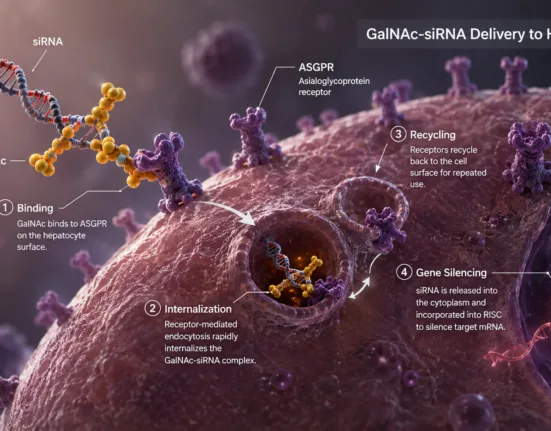
SRP-1003 combines an RNA interference therapeutic component with a ligand designed to interact with alpha-v beta-6 integrin. The delivery technology originated within Arrowhead Pharmaceuticals’ targeted RNA interference platform and was subsequently licensed to Sarepta. Its objective is to improve uptake of the siRNA into relevant cells and tissues.
Small interfering RNA medicines work by directing cellular mechanisms to recognize and degrade specific RNA sequences. This can reduce production of proteins or other biological effects associated with an unwanted transcript. In DM1, Sarepta is targeting DMPK RNA to interfere with the process that produces toxic nuclear accumulations.
Delivering an siRNA into skeletal muscle is challenging because circulating RNA molecules can be degraded or fail to enter the intended cells in sufficient quantities. The alpha-v beta-6 integrin-targeting component is designed to facilitate tissue uptake and improve drug exposure. Its role is therefore related to delivery, while the siRNA sequence determines the intended genetic target.
The latest experiments investigate what happens after the medicine enters cells. Evidence of nuclear knockdown addresses an additional barrier beyond reaching muscle tissue. Sarepta is seeking to demonstrate that the combination of tissue delivery and intracellular RNA silencing can influence the compartment where DM1 pathology begins.
The approach also raises questions about selectivity and prolonged exposure. DMPK is a normal gene with biological functions, and the consequences of reducing its expression over extended periods require appropriate evaluation. Future safety studies must assess whether the intended reduction in toxic RNA can be achieved without unacceptable effects on normal tissues.
What have the first human SRP-1003 findings shown so far?
Sarepta reported its first clinical findings from the SRP-1003 programme on March 25, 2026, alongside early data from a separate RNA interference candidate targeting facioscapulohumeral muscular dystrophy. The company described dose-dependent drug exposure in muscle and early biomarker activity, with no dose-limiting safety signals identified in the evaluated cohorts at that time. Most reported adverse events were mild or moderate.
These findings provided initial evidence that the delivery approach could achieve measurable muscle exposure in humans. However, the March disclosure did not establish that patients experienced improved muscle strength, reduced myotonia or sustained functional benefit. Early drug distribution and biomarker results remain distinct from clinical efficacy endpoints.
SRP-1003 is being investigated in a randomized, placebo-controlled Phase 1/2 study involving adults aged 18 to 65 years with DM1. The trial includes single-ascending-dose and multiple-ascending-dose stages designed to characterize safety, tolerability, pharmacokinetics and pharmacodynamic activity. These components can help identify an appropriate dose and schedule for further development.
The study also evaluates disease-associated molecular markers and selected functional measures. The interpretation of these assessments will depend on participant numbers, baseline characteristics, exposure duration and the ability to distinguish drug-related changes from normal variability in symptoms. Small early-stage cohorts are not sufficient to establish long-term disease modification.
Sarepta expects to disclose additional clinical findings later in 2026. Those results will be especially important for determining whether the nuclear effects observed in laboratory models can also be detected in treated patients.
How does SRP-1003 fit into Sarepta’s broader Arrowhead collaboration?
Sarepta obtained rights to SRP-1003, formerly known as ARO-DM1, through a global licensing and research agreement with Arrowhead Pharmaceuticals. The transaction closed in February 2025 and covers several investigational RNA interference programmes targeting rare genetic diseases affecting muscles, the central nervous system and the lungs.
The original agreement involved a $500 million upfront cash payment and a $325 million investment in Arrowhead shares. It also provided for additional fixed payments, development-related milestones and potential future royalties. These amounts concern the broader collaboration rather than the value of SRP-1003 alone.
The DM1 programme has already triggered substantial milestone consideration through its clinical progress. Arrowhead earned a $100 million milestone in 2025 after the first specified enrollment target was achieved, followed by a further $200 million milestone later that year. The payments reflect development progress under the agreement rather than commercial sales or a successful treatment outcome.
Other Sarepta programmes using related technology include SRP-1001 for facioscapulohumeral muscular dystrophy, SRP-1002 for idiopathic pulmonary fibrosis and SRP-1004 for spinocerebellar ataxia type 2. These candidates target different molecular pathways, so their efficacy and safety must be demonstrated independently.
The strategic value of the collaboration lies in expanding Sarepta’s therapeutic approaches beyond its established Duchenne muscular dystrophy business. However, the associated research commitments and milestone payments also create financial obligations during development. Positive laboratory results may strengthen confidence in the platform without establishing the future commercial return.
What clinical challenges remain before SRP-1003 could become a disease-modifying treatment?
The first challenge is to establish the level of DMPK RNA reduction that can be achieved safely in human muscle. The approximately 80% preclinical knockdown provides a biological reference point but should not be treated as a dose-selection target already validated in patients. Clinical measurements will need to determine whether meaningful target suppression is reproducible across different individuals.
Another challenge concerns the relationship between RNA splicing correction and functional improvement. DM1 symptoms can arise from dysfunction in skeletal muscle, cardiac tissue, respiratory muscles and other organs. A treatment that improves molecular markers in sampled skeletal muscle may not produce equivalent effects in every affected tissue.
The duration of treatment will also matter. DM1 is a chronic genetic disorder, and an RNA-silencing medicine would generally be expected to require an appropriate long-term administration strategy rather than permanently correcting the underlying DNA mutation. Safety during repeated dosing, changes in tissue exposure and the persistence of molecular effects will therefore need careful evaluation.
Clinical endpoints may include changes in myotonia, muscle strength, functional capacity and patient-reported disease burden. Each measure captures a different aspect of the disorder, creating a need for study designs capable of identifying meaningful changes despite substantial variation between patients. Longer follow-up will be necessary to determine whether treatment slows disease progression.
Regulatory approval would ultimately require an adequately supported benefit-risk profile. The presence of a convincing molecular mechanism can guide development and provide biological evidence, but it cannot replace demonstration of clinically meaningful treatment effects.
Why could the nuclear knockdown findings influence future RNA therapy development?
One of the broader scientific implications concerns the ability of targeted RNA interference therapies to affect transcripts located primarily inside the cell nucleus. RNA interference is commonly discussed in relation to cytoplasmic RNA degradation, while disorders involving nuclear RNA accumulation present additional biological challenges. Sarepta’s data suggest that its approach can influence these nuclear disease mechanisms under the evaluated experimental conditions.
This observation could be relevant to other genetic conditions involving abnormal RNA processing or toxic nuclear transcripts. However, the effectiveness of a particular siRNA depends on its target sequence, delivery chemistry, tissue distribution and intracellular behavior. The results from SRP-1003 cannot establish that the same approach will work in every disease involving nuclear RNA.
The strongest aspect of the latest evidence is the combination of molecular measurements and downstream functional biology. Sarepta demonstrated reduced DMPK RNA, fewer nuclear RNA foci and correction of abnormal splicing in relevant preclinical systems. Together, these observations provide a more complete mechanistic picture than a single RNA knockdown measurement.
The principal limitation is that the experiments do not establish clinical improvement in patients. The company has already reported initial human delivery and tolerability findings, but a direct demonstration of sustained therapeutic benefit remains outstanding. The next clinical update will be important for connecting the preclinical mechanism with measurements obtained during actual treatment.
Sarepta’s October 2026 OTS presentation strengthens the biological rationale for SRP-1003 by addressing a key obstacle in myotonic dystrophy drug development: reducing toxic RNA within the nucleus rather than only affecting circulating drug exposure or cytoplasmic transcripts. The reported 80% knockdown and correction of MBNL-dependent splicing represent meaningful preclinical evidence of target activity.
The more consequential question is whether those molecular effects can be reproduced at tolerable doses and maintained long enough to improve the lives of people with DM1. The ongoing Phase 1/2 trial will begin to address that uncertainty, including whether nuclear DMPK suppression produces changes in disease-related biomarkers and functional outcomes. Until human efficacy is demonstrated, SRP-1003 remains an investigational treatment supported by encouraging mechanistic evidence rather than a clinically validated disease-modifying therapy.