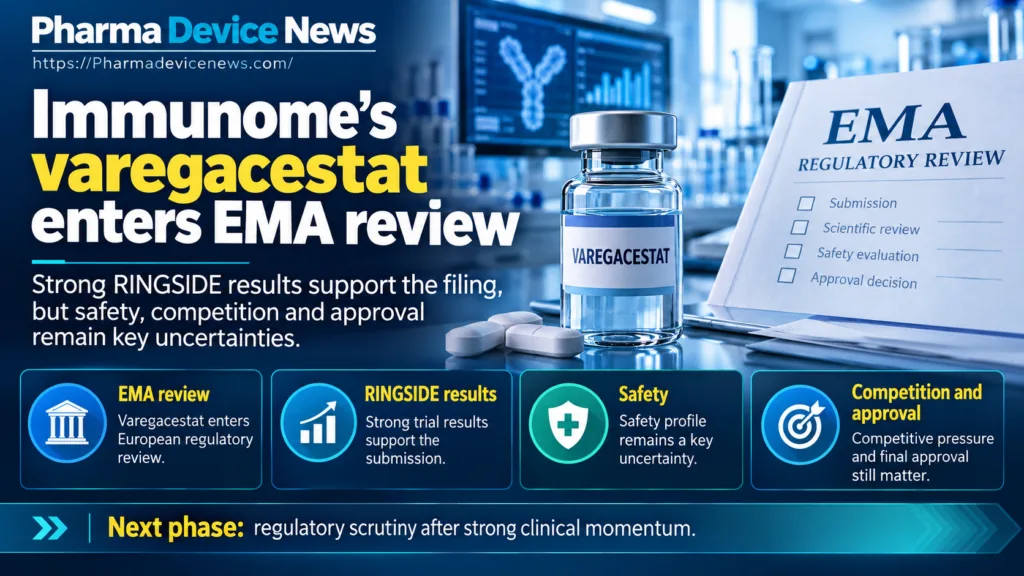
Immunome, Inc. (NASDAQ: IMNM) has secured validation from the European Medicines Agency for its marketing authorisation application covering varegacestat, an investigational once-daily oral gamma secretase inhibitor for adults with desmoid tumours. Announced on October 30, 2026, the regulatory milestone allows the application to enter formal scientific review after the Phase 3 RINGSIDE trial demonstrated an 84% reduction in the risk of disease progression or death compared with placebo.
The validation represents an important step in Immunome’s efforts to commercialise varegacestat across major international markets. The company already has a US New Drug Application under review, with the Food and Drug Administration targeting April 28, 2027 for a regulatory decision. Together, the two processes create a potential path towards approvals in the United States and European Union, subject to the respective authorities’ assessments.
However, EMA validation confirms that the submitted application is sufficiently complete to enter the review process. It does not establish that the medicine is safe and effective for approval, and it does not authorise commercial sales in Europe. Immunome must also prepare for a competitive treatment landscape because nirogacestat, another oral gamma secretase inhibitor, has already received European approval for selected adults with progressing desmoid tumours.
Why is EMA validation an important milestone for Immunome’s varegacestat regulatory strategy?
The European Medicines Agency has confirmed that Immunome’s application can proceed through the centralised marketing authorisation procedure. This allows the agency’s scientific committees to assess the submitted clinical, nonclinical and manufacturing evidence. The process ultimately determines whether the medicine should receive a positive scientific opinion supporting potential European authorisation.
Under the centralised procedure, the Committee for Medicinal Products for Human Use evaluates the application and makes a recommendation concerning the medicine’s benefit-risk profile. A positive opinion would be forwarded to the European Commission, which is responsible for issuing the final centralised marketing authorisation. The initial validation step does not prejudge either outcome.
The standard scientific assessment involves up to 210 active review days, excluding periods when the evaluation clock is stopped while the applicant responds to questions. This means the calendar timeline may extend beyond the nominal active review period. Immunome has not announced a specific European Commission decision date for varegacestat.
Clay Siegall, president and chief executive officer of Immunome, has positioned the validation as an important milestone in expanding international availability. Management believes the Phase 3 results provide a substantial foundation for regulatory review. Nevertheless, the company must satisfy the agency’s assessment of efficacy, safety, product quality and the proposed treatment population.
The European development is commercially relevant because desmoid tumours can require long-term management involving specialist oncology and multidisciplinary care. A positive regulatory decision could make varegacestat available across European Union member states under the authorised conditions. However, market authorisation would still be followed by country-specific pricing, reimbursement and access processes.
What did the Phase 3 RINGSIDE trial demonstrate about varegacestat and desmoid tumour progression?
The global Phase 3 RINGSIDE trial was a randomised, double-blind, placebo-controlled study involving 156 patients with progressing desmoid tumours. Participants received varegacestat at a dose of 1.2 mg once daily or placebo until disease progression or another protocol-defined treatment endpoint. The primary efficacy measure was progression-free survival assessed through blinded independent central review.
The trial met its primary endpoint, demonstrating a hazard ratio of 0.16 for disease progression or death compared with placebo. This corresponds to an estimated 84% relative reduction in the risk of experiencing one of those events during the observation period. The difference was statistically significant, with a reported p-value below 0.0001.
The magnitude of the result is notable because desmoid tumours can be locally aggressive and cause substantial morbidity despite their inability to metastasise in the way malignant cancers do. However, the 84% figure should not be interpreted as meaning that 84% of patients were cured or that the disease was eliminated in every participant. A hazard ratio describes the relative risk of events over the observed period rather than an absolute probability of cure.
The study also met its key secondary endpoints, strengthening the evidence beyond progression-free survival alone. Objective tumour responses, changes in tumour volume and patient-reported pain outcomes all favoured the investigational treatment. These multiple findings provide a more comprehensive picture of clinical activity than a single imaging endpoint.
Nevertheless, the treatment’s suitability for routine care depends on its full benefit-risk profile. Desmoid tumours can follow variable natural histories, and some patients may be managed through active surveillance rather than immediate systemic treatment. The eventual authorised indication and clinical positioning will therefore be important.
How significant was the 56% objective response rate reported with varegacestat?
The RINGSIDE trial reported a confirmed objective response rate of approximately 56% among patients receiving varegacestat, compared with 9% in the placebo group. These responses were evaluated through blinded independent central review using RECIST version 1.1. The difference was statistically significant, with a p-value below 0.0001.
An objective response requires a defined degree of tumour shrinkage under established assessment criteria. It is therefore distinct from stable disease, in which a tumour does not demonstrate sufficient change to qualify as progression or response. The observed response rate indicates that a substantial proportion of patients experienced measurable reductions in tumour burden.
The study also investigated three-dimensional tumour volume changes. In an exploratory analysis, the median best change in tumour volume was a reduction of 83% with varegacestat, compared with an increase of 11% in the placebo group. These findings suggest that the investigational medicine may produce considerable changes in tumour size beyond the conventional unidimensional response assessment.
However, volume reduction and RECIST response rate describe different outcomes and should not be combined into one efficacy measure. The 83% figure was a median best volume change, not the proportion of patients whose tumours disappeared. Its interpretation also depends on the timing and frequency of imaging assessments.
For patients with desmoid tumours, substantial shrinkage may be clinically relevant when the lesion is associated with pain, pressure on surrounding structures or loss of function. However, the relationship between tumour reduction and symptom improvement varies according to anatomical location and other clinical factors. This makes the trial’s pain and functional assessments particularly important.
Why do pain relief and physical function matter as much as tumour shrinkage in desmoid disease?
Desmoid tumours are also known as aggressive fibromatosis or desmoid-type fibromatosis. They are locally invasive soft tissue tumours that do not ordinarily spread to distant organs, but they can affect muscles, nerves, blood vessels and other important structures. Their consequences can include persistent pain, restricted movement, deformity and, in some cases, serious organ-related complications.
The principal goal of treatment is therefore not always limited to reducing tumour dimensions on imaging. Patients may require relief from symptoms that affect everyday activity, sleep and quality of life. A medicine producing tumour shrinkage without meaningful improvement in patient wellbeing might offer a more limited practical benefit.
In RINGSIDE, varegacestat demonstrated statistically significant improvement in the patient-reported worst pain intensity measure at week 12. Immunome reported that a clinically meaningful difference was already evident at the first assessment in week four. This suggests that symptom improvement may emerge before the full extent of tumour response becomes apparent.
Additional exploratory findings presented at the European Society for Medical Oncology Congress in October 2026 examined outcomes through week 48. On the GODDESS TSS-5 symptom measure, the least-squares mean change from baseline was negative 1.50 with varegacestat, compared with positive 0.59 for placebo. Lower scores indicated reduced symptom burden.
Physical function also favoured the investigational treatment in the reported exploratory analysis. The PROMIS Physical Function measure improved by 3.90 points with varegacestat, while the placebo group declined by 3.04 points. These findings support further evaluation of whether treatment benefits extend beyond radiographic changes, although exploratory analyses must be interpreted within their statistical limitations.
What safety findings could influence the EMA’s assessment of varegacestat?
Safety is a critical component of the European review because gamma secretase inhibitors affect biological pathways involved in several normal physiological processes. Gamma secretase participates in the processing of proteins associated with Notch signalling, which has functions in cellular differentiation and tissue maintenance. Inhibiting this pathway can therefore produce effects beyond the intended antitumour activity.
The most common adverse event reported with varegacestat in RINGSIDE was diarrhoea, affecting 82% of treated participants. Other frequently reported events included fatigue in 44%, rash in 43%, nausea in 35% and cough in 34%. Immunome stated that approximately 95% of reported adverse events were grade 1 or 2, indicating that most individual events were classified as mild or moderate.
However, the distribution of event severity should not obscure more consequential treatment-related findings. The Phase 3 conference abstract reported grade 3 or 4 adverse events in 57% of varegacestat-treated patients, compared with 17% receiving placebo. Adverse events led to dose reductions in 80% of the active-treatment group and 9% of placebo recipients.
Treatment discontinuation is another important consideration. Adverse events caused discontinuation in approximately 20% of patients receiving varegacestat, compared with 7% in the placebo group. These findings indicate that managing tolerability will be important in clinical practice if the medicine receives approval.
The full regulatory evaluation will need to consider whether the demonstrated efficacy justifies these adverse effects in the proposed population. That assessment will include the severity and reversibility of events, the need for dose modifications and the consequences of prolonged treatment. The favourable efficacy results do not eliminate the importance of these safety questions.
Why could ovarian toxicity become a major issue in the clinical positioning of varegacestat?
Ovarian dysfunction is a recognised safety concern with the gamma secretase inhibitor class. This is particularly relevant in desmoid tumour treatment because the condition can affect adults of reproductive age. Potential effects on menstruation, hormonal function and fertility may therefore influence treatment selection and counselling.
The RINGSIDE Phase 3 analysis reported ovarian toxicity in 20 of 36 premenopausal women receiving varegacestat, representing approximately 56% of that subgroup. At the time of the reported assessment, the events had resolved in 11 of the 20 affected patients, or 55%. These findings demonstrate that ovarian effects occurred frequently, although the long-term consequences require further assessment.
The risk should not be minimised simply because some cases resolved. For patients considering pregnancy or concerned about reproductive health, even potentially reversible ovarian dysfunction can be clinically important. The need for counselling, monitoring and possible treatment adjustments will depend on the final authorised prescribing information.
Earlier dose-finding research also identified ovarian-related adverse events across different varegacestat regimens. A Phase 2 study published in the Journal of Clinical Oncology reported such events in 12 of 23 women of childbearing potential, with half unresolved at the last follow-up covered by that analysis. These findings reinforce the relevance of reproductive safety across the development programme.
The EMA will assess the available information alongside the drug’s therapeutic benefit and potential risk-management requirements. Immunome has not yet received final European labelling, so definitive prescribing recommendations for varegacestat cannot be established from the current announcement.
How will varegacestat compete with Ogsiveo after European approval?
A major commercial consideration is that varegacestat would not enter a European market without an approved gamma secretase inhibitor. The European Commission authorised Ogsiveo, containing nirogacestat, in August 2025 for adults with progressing desmoid tumours who require systemic treatment. The product is associated with SpringWorks Therapeutics, now part of Merck KGaA, Darmstadt, Germany.
Ogsiveo’s existing authorisation establishes a relevant treatment alternative and creates a more demanding competitive environment for Immunome. Clinicians and healthcare systems will need to consider the clinical profiles of the available medicines, including response, symptom relief, dosing, tolerability and the practical requirements of prolonged treatment. Payer assessments may also consider the costs and consequences of managing adverse events.
Varegacestat has demonstrated strong efficacy in RINGSIDE, but those results cannot be used to establish superiority over nirogacestat through a simple comparison with another clinical trial. Patient characteristics, study design, follow-up and statistical methods may differ materially. A direct comparative study would provide stronger evidence of relative effectiveness.
The ovarian toxicity findings are particularly relevant because reproductive effects have also been identified with gamma secretase inhibition more broadly. However, the occurrence of similar types of adverse events does not establish that the medicines have identical safety profiles. A reliable comparison requires sufficiently comparable evidence.
Commercial differentiation may therefore involve several factors rather than efficacy alone. Dose administration, treatment interruptions, side-effect management, specialist familiarity and reimbursement could all influence prescribing. Immunome will need to demonstrate value to clinicians and payers within a market where a disease-specific oral treatment option is already available.
What does US regulatory progress add to Immunome’s international commercial opportunity?
The FDA accepted Immunome’s New Drug Application for varegacestat in July 2026 and assigned a target action date of April 28, 2027. The application seeks authorisation for treatment of adults with desmoid tumours and is supported by the Phase 3 RINGSIDE results. The US review is separate from the European process, even though the two applications rely on much of the same clinical evidence.
A favourable FDA decision could provide Immunome with an important initial commercial market. However, the target action date is a review milestone rather than a guarantee of approval. The agency may require additional information, impose specific labelling restrictions or take other regulatory action depending on its assessment.
The European validation broadens the company’s regulatory exposure but also increases the requirements associated with potential commercial preparation. Launch activities could involve specialist education, distribution planning and country-specific market access work. These activities may require investment before revenue is generated.
Immunome’s financial position provides context for its ability to undertake those preparations. At June 30, 2026, the company reported $520 million in cash, cash equivalents and marketable securities. Management expected its available resources to support planned operations into 2028, although actual funding requirements will depend on development and commercial activities.
The company’s broader pipeline includes antibody-drug conjugates and an investigational radioligand therapy, creating additional capital demands beyond varegacestat. Consequently, commercial readiness must be balanced against continued spending on earlier-stage programmes. Positive regulatory outcomes would increase the importance of capital allocation and execution.
How did Immunome shares perform after the EMA validation announcement?
Immunome shares closed at $18.21 on October 30, 2026, down 0.44% from the previous session’s $18.29 closing price. Trading occurred within a daily range of $17.82 to $18.98, demonstrating intraday movement despite the relatively small closing change. Approximately 1.27 million shares traded during the session.
The modest decline should not be interpreted as evidence that investors rejected the European development. The validation was largely procedural following previously disclosed positive RINGSIDE results, meaning some of its significance may already have been anticipated. Share performance also reflects broader market conditions, financing expectations and developments across Immunome’s pipeline.
The company’s market valuation remains sensitive to the prospect of approval and commercialisation. Varegacestat is one of its most advanced clinical assets, while several additional programmes remain in early clinical development. Regulatory setbacks or delays could therefore affect expectations even if the underlying Phase 3 efficacy findings remain favourable.
The key distinction for investors is between regulatory progress and revenue-generating approval. EMA validation moves the application into scientific assessment, but it does not resolve competitive positioning, reimbursement or commercial execution. The next major US milestone is the April 28, 2027 FDA target action date, while European review will proceed on its own timetable.
What will determine whether varegacestat becomes a commercially successful desmoid tumour treatment?
The first requirement is successful completion of regulatory review. Immunome must satisfy the FDA and European authorities that the medicine’s benefits outweigh its risks in the proposed population. The strong progression-free survival and response findings provide an important foundation, but the safety and manufacturing evidence must also support approval.
The second requirement is clear clinical positioning against existing options. Ogsiveo is already authorised in Europe, and physicians have experience with several approaches to managing desmoid tumours. Varegacestat will need to establish a practical role based on its overall clinical profile, not simply on comparisons of isolated efficacy figures.
Reproductive safety, gastrointestinal adverse events and the frequency of dose adjustments will be important in that assessment. Patient-reported improvements in pain and function could strengthen the clinical case, particularly when treatment decisions involve long-term quality of life. However, a favourable benefit-risk profile for one patient may not apply equally across the entire population.
The third requirement is commercial access. European marketing authorisation, if granted, would not automatically establish reimbursement across every national healthcare system. Pricing agreements, clinical guidelines and local treatment pathways will influence uptake.
Immunome has achieved a meaningful regulatory milestone by securing EMA validation of its varegacestat application. The Phase 3 evidence demonstrates substantial efficacy in progressing desmoid tumours, while the safety findings and existing competition create equally important development and commercial considerations. The next decisive step will be whether regulators conclude that the medicine offers an acceptable benefit-risk profile and authorise its use.