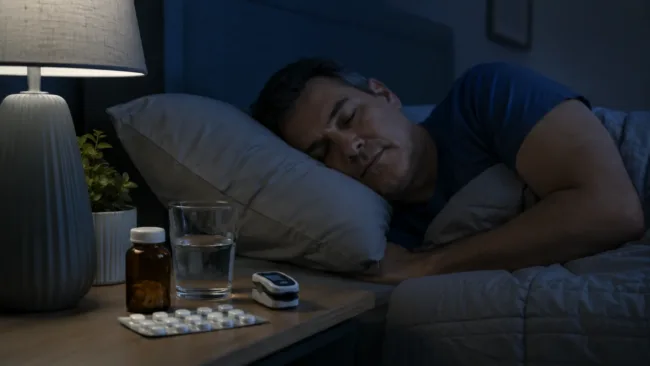
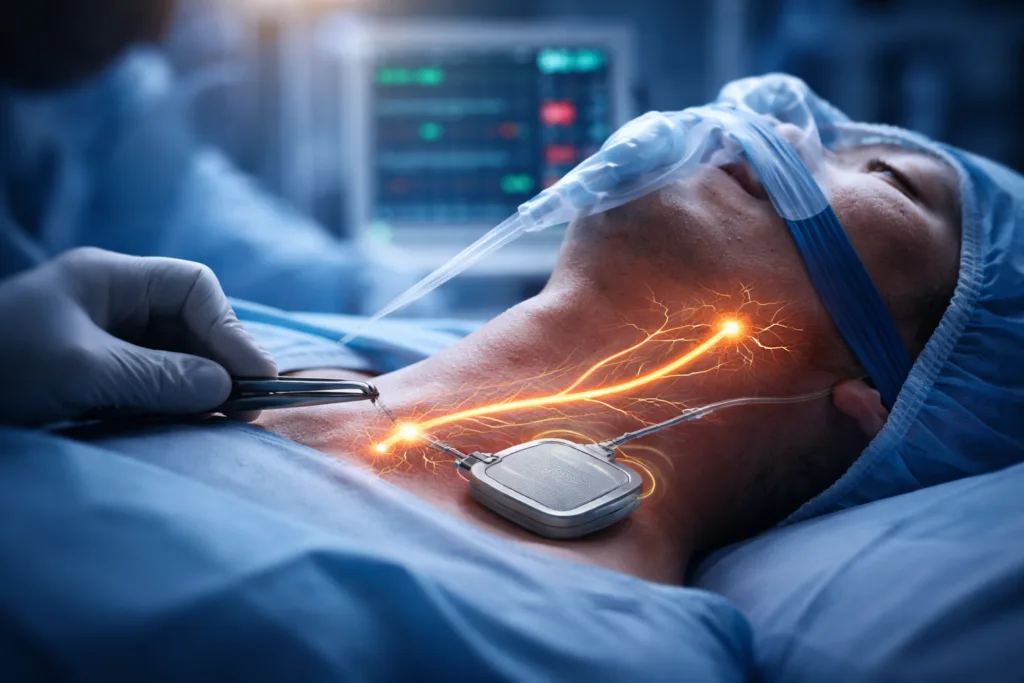
LivaNova PLC has received U.S. Food and Drug Administration premarket approval for the aura6000 System, a proximal hypoglossal nerve stimulation device intended for adults with moderate to severe obstructive sleep apnea who are unable to tolerate or have failed positive airway pressure therapy, with approval supported by outcomes from the OSPREY randomized controlled trial.
How removing anatomical restrictions could expand the real-world addressable population for implantable sleep apnea devices
The most consequential aspect of this approval is not simply the addition of another hypoglossal nerve stimulation device to the market but the removal of a long-standing anatomical restriction that has historically shaped patient selection. By clearing a system without contraindication related to complete concentric collapse, the regulatory decision signals a willingness to broaden eligibility criteria that had previously constrained adoption of implantable therapies.
In practical terms, this change has the potential to expand the addressable population beyond the subset of patients who meet strict anatomical screening thresholds. Clinicians tracking sleep apnea treatment pathways have long viewed drug-induced sleep endoscopy and related exclusion criteria as a bottleneck, both in terms of workflow complexity and patient attrition. Eliminating this requirement could simplify referral pathways and reduce friction between diagnosis and intervention, potentially accelerating uptake among patients who fail or reject continuous positive airway pressure earlier in their treatment journey.
However, expanding eligibility raises immediate questions about clinical consistency. Broader inclusion criteria may increase variability in patient outcomes, particularly in populations previously excluded due to anatomical considerations. The durability of response across these subgroups will likely become a focal point for post-market evaluation.
Why the OSPREY trial design and endpoints will be scrutinized beyond headline efficacy outcomes
The OSPREY randomized controlled trial supporting the approval provides a level of evidentiary rigor that aligns with expectations for implantable device approvals. Its randomized, controlled structure and inclusion of both objective measures such as apnea-hypopnea index and oxygen desaturation index and patient-reported outcomes suggest a comprehensive approach to demonstrating clinical benefit.
Yet the trial design also introduces interpretive challenges. While reductions in apnea-hypopnea index and oxygen desaturation index are widely accepted endpoints in sleep apnea research, their translation into long-term cardiovascular or metabolic benefit remains an area of ongoing debate. Industry observers note that while such endpoints are sufficient for regulatory clearance, they do not fully resolve questions about long-term disease modification.
The responder rate observed at 12 months, defined by both relative and absolute improvements in apnea-hypopnea index, aligns with prior neuromodulation studies. However, clinicians will likely examine subgroup analyses closely, particularly for patients with higher body mass index or more severe baseline disease. The inclusion of patients at risk of complete concentric collapse adds relevance but also increases the need for detailed stratified data to understand where the therapy performs most consistently.
How this approval reframes competition among hypoglossal nerve stimulation platforms
The hypoglossal nerve stimulation market has been characterized by a limited number of approved systems with relatively similar mechanisms of action but differing patient selection criteria and procedural workflows. By positioning the aura6000 System as a more inclusive option, LivaNova PLC is effectively shifting the competitive axis from pure efficacy to accessibility and ease of use.
Existing systems have built clinical credibility but remain constrained by screening requirements that limit scalability. The new approval introduces the possibility that referral patterns could change, with sleep specialists considering implantable options for a broader range of patients earlier in the treatment continuum. This could have downstream implications for both device manufacturers and providers, particularly if procedural volumes increase.
At the same time, the absence of direct comparative trials leaves open questions about relative performance. Without head-to-head data, differentiation will likely depend on a combination of clinical outcomes, procedural simplicity, patient selection flexibility, and long-term safety profiles. Regulatory watchers suggest that comparative effectiveness studies may eventually be required to clarify positioning in an increasingly competitive space.
What this signals about evolving regulatory tolerance for broader patient inclusion in device trials
The approval reflects a broader shift in regulatory thinking toward inclusivity in clinical trial populations. Historically, device trials have often prioritized homogeneity to minimize variability and demonstrate clear efficacy signals. In contrast, the inclusion of patients at risk of complete concentric collapse suggests a move toward more representative trial populations that better reflect real-world clinical practice.
This approach carries both opportunities and risks. On one hand, it enhances the external validity of trial results and supports broader clinical applicability. On the other hand, it increases the complexity of interpreting outcomes, particularly when variability in patient response becomes more pronounced. Regulators will likely rely heavily on post-market surveillance to ensure that expanded eligibility does not compromise safety or effectiveness.
The decision may also influence future device development strategies, encouraging manufacturers to design trials that capture a wider spectrum of patient characteristics rather than focusing narrowly on ideal candidates.
Why adoption will hinge on reimbursement alignment and procedural scalability rather than approval alone
Regulatory clearance establishes the foundation for commercialization, but adoption of implantable sleep apnea devices depends heavily on factors beyond clinical performance. Reimbursement remains a central determinant, particularly given the higher upfront cost of neurostimulation compared with non-invasive therapies.
Payers have historically approached implantable sleep apnea therapies with caution, requiring robust evidence of cost-effectiveness and long-term benefit. The broader eligibility profile of the aura6000 System could strengthen the value proposition if it demonstrates reductions in downstream complications associated with untreated sleep apnea. However, real-world evidence will be necessary to support these claims and secure consistent reimbursement coverage.
Procedural scalability is another critical consideration. Implantation requires specialized surgical expertise and follow-up care, which can limit the number of centers capable of offering the therapy. Health systems will need to evaluate whether increased demand justifies investment in training and infrastructure, particularly in regions where access to sleep surgery expertise is limited.
How next-generation device features could determine long-term competitiveness in neurostimulation for sleep apnea
LivaNova PLC’s parallel development of a next-generation system introduces a forward-looking dimension to the approval. Features such as MRI compatibility, remote configuration, and extended battery life address practical limitations that have historically influenced both patient and clinician preferences.
MRI compatibility is particularly significant, as the inability to undergo imaging has been a deterrent for some patients considering implantable devices. Remote configuration capabilities could improve patient management by enabling more flexible and responsive therapy adjustments, while longer battery life reduces the need for replacement procedures.
However, the transition to a next-generation platform introduces execution risk. Regulatory approval for additional features is not guaranteed, and the timing of product upgrades must be carefully managed to avoid disrupting the adoption of the current system. Clinicians may hesitate to adopt a first-generation device if a more advanced version is expected in the near term.
What clinicians and regulators will monitor as real-world data begins to emerge
The post-market phase will be critical in determining whether the theoretical advantages of broader eligibility translate into consistent clinical outcomes. Clinicians will be watching for variability in response across different patient subgroups, as well as the incidence of adverse events related to implantation and long-term device use.
Regulators will likely focus on safety signals that may not have been apparent in the controlled environment of a clinical trial. The expansion into previously excluded populations increases the importance of real-world evidence in validating both efficacy and safety.
Industry observers also highlight the need for longitudinal data to assess whether improvements in apnea-hypopnea index and oxygen desaturation index lead to meaningful reductions in cardiovascular risk and other long-term complications. Without such data, the broader clinical value of the therapy may remain partially unresolved.
Why this approval represents a strategic inflection point for neurostimulation in sleep medicine rather than a standalone product milestone
The approval of the aura6000 System represents a broader inflection point in the evolution of neurostimulation as a therapeutic modality in sleep medicine. By challenging established patient selection paradigms and emphasizing inclusivity, LivaNova PLC is attempting to reposition implantable therapies as a more mainstream option rather than a niche alternative.
This shift aligns with a growing recognition that non-adherence to continuous positive airway pressure remains a persistent challenge in sleep apnea management. Expanding the availability of alternative therapies could address this gap, but only if the new approach delivers consistent outcomes across a diverse patient population.
At the same time, the strategy introduces new uncertainties. Broader eligibility increases the complexity of patient management and may expose limitations that were not evident in more selective trials. The balance between accessibility and consistency will therefore be a central theme in evaluating the long-term impact of this approval.
Ultimately, the success of the aura6000 System will depend on the interplay between clinical performance, regulatory oversight, reimbursement dynamics, and technological evolution. The approval establishes a new baseline for what is considered acceptable in patient selection for implantable sleep apnea devices, but the extent to which this translates into sustained clinical and commercial success remains to be seen.