Artivion, Inc. has reported first-quarter 2026 revenue growth and exercised its option to acquire Endospan after U.S. Food and Drug Administration premarket approval of the NEXUS Aortic Arch System. The move gives the cardiac and vascular surgery specialist a broader position in aortic arch disease, even as the medical device manufacturer lowered its full-year 2026 revenue and adjusted EBITDA outlook.
Why Artivion’s Endospan acquisition changes the aortic arch growth story
Artivion’s decision to move forward with the Endospan acquisition is the strategic centerpiece of the update, because it links a near-term regulatory milestone with a longer-term portfolio ambition. The NEXUS Aortic Arch System gives Artivion an FDA-approved device in a complex segment of aortic disease where treatment options remain technically demanding and commercially specialized. For a company already focused on aortic disease, surgical sealants, On-X mechanical heart valves and preservation services, the acquisition is not a diversification play. It is a deeper bet on a narrowly defined cardiovascular specialty where clinical credibility, surgeon training and institutional adoption can matter more than broad sales reach.
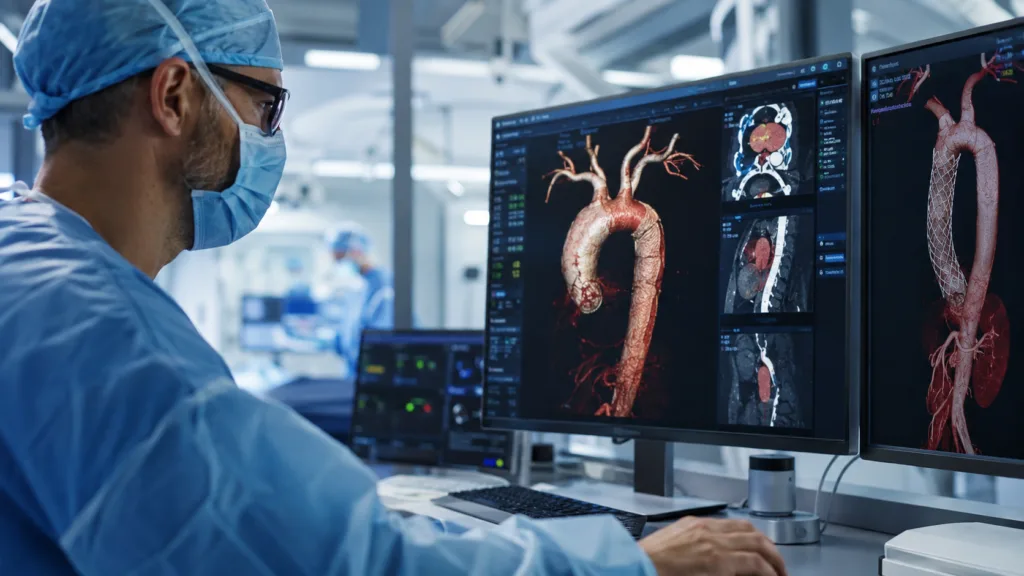
That focus is important because aortic arch repair is not a mass-market device category. It involves high-acuity patients, complex anatomy, specialist centers and a slower adoption curve than many hospital-based products. The commercial prize lies in building a portfolio that can serve surgeons across different aortic arch scenarios, rather than relying on a single device to carry growth. Artivion’s broader narrative now rests on AMDS, NEXUS and the future Arcevo LSA program, which together could give it a more complete aortic arch offering if regulatory, clinical and commercial milestones continue to align.
The risk is that the NEXUS approval does not immediately translate into material revenue. Artivion expects U.S. NEXUS sales to be negligible in 2026 as inventory is built and hospital value analysis committee approvals are secured ahead of a planned January 1, 2027 commercial launch. That timing matters for investors and industry observers because the deal adds strategic optionality before it adds visible sales momentum. In other words, Artivion has strengthened its future product map, but the financial benefit will require patience, clean execution and successful adoption in a conservative hospital procurement environment.
What the Q1 2026 results reveal about Artivion’s operating momentum
Artivion’s first-quarter revenue of $116.3 million, up 18% on a GAAP basis and 12% on a non-GAAP constant currency basis, shows that the underlying business still has meaningful momentum. Adjusted EBITDA rose 26% to $22.1 million, and the medical device manufacturer moved to GAAP net income of $1.4 million, compared with a small net loss in the prior-year period. For a mid-cap medical technology company trying to scale a specialized cardiovascular portfolio, that shift toward profitable growth is not cosmetic. It gives Artivion more room to pursue acquisitions, invest in clinical programs and support product launches without relying only on external enthusiasm.
The mix of growth also matters. Stent grafts, On-X mechanical heart valves and preservation services all delivered year-over-year gains, while BioGlue posted more modest growth. The On-X performance is particularly relevant because mechanical heart valves remain a competitive and mature category, yet Artivion is positioning On-X as a share-gaining asset among patients under the age of 65. Preservation services also continue to provide a recurring, clinically embedded business line that supports the overall portfolio beyond device launches.
However, the headline growth does not erase the unevenness inside the quarter. Artivion stated that first-quarter performance fell short of its constant currency expectations due to transient factors, while later market commentary highlighted weaker-than-expected stent graft results, international softness and the timing of AMDS starter set sales in the United States. That is the central tension in the story. The company is growing, profitable and strategically clearer, but the revenue base is still exposed to timing issues, regional volatility and product-specific adoption rhythms.
Why the lowered 2026 guidance matters more than the Q1 beat
The most important investor signal is not the first-quarter growth rate, but the lowered full-year outlook. Artivion now expects 2026 revenue of $480 million to $496 million, representing 7% to 11% adjusted constant currency growth compared with 2025 adjusted revenue. The previous range was $486 million to $504 million, representing 10% to 14% growth. The adjusted EBITDA outlook was also lowered to $100 million to $107 million, compared with the earlier range of $105 million to $110 million.
That reset changes how the market is likely to interpret the quarter. On one hand, first-quarter revenue, profitability and adjusted EBITDA show that Artivion is not facing a broad operational breakdown. On the other hand, a guidance cut so early in the fiscal year raises the burden of proof for management’s argument that the softer factors are temporary. Investors tend to forgive one-off timing issues when the next-quarter recovery is visible. They are less forgiving when softness touches international markets, stent graft momentum and launch timing at the same time.
The share-price reaction reflects that unease. Artivion shares closed at $25.95 on May 8, 2026, after opening at $27.31 and trading as low as $19.16 during the session, indicating that investors were digesting the weaker outlook alongside the strategic Endospan announcement. The muted-to-negative reaction is understandable. The Endospan transaction may improve the long-term aortic arch story, but the 2026 model now carries lower revenue expectations, lower adjusted EBITDA expectations and incremental Endospan-related expenses.
How NEXUS, AMDS and Arcevo LSA could define Artivion’s next growth phase
The strategic upside for Artivion is that aortic arch disease could become a more coherent platform opportunity rather than a collection of individual product bets. NEXUS gives the U.S.-based medical device manufacturer an approved system for aortic arch disease, including chronic aortic dissections. AMDS provides another growth lever, with management highlighting stronger-than-expected reordering behavior within AMDS accounts. Arcevo LSA, if successfully developed and approved, could further expand the portfolio into adjacent use cases.
This matters because complex cardiovascular device markets often reward companies that can offer a procedural ecosystem. Surgeons and hospitals may prefer suppliers that can support different anatomies, procedural approaches and clinical scenarios, particularly when training and support are critical to adoption. A broader arch portfolio could also improve Artivion’s relevance with specialist centers and strengthen its competitive position against larger cardiovascular device players that may have greater scale but less focused exposure to this niche.
The limitation is that a portfolio strategy is only as strong as its weakest execution point. Regulatory approvals, physician training, reimbursement coverage, inventory readiness, hospital purchasing approvals and clinical comfort all need to move in sequence. A planned U.S. commercial launch for NEXUS in 2027 means Artivion has a defined runway, but it also means there is time for delays, competitive responses or slower-than-expected institutional uptake. In high-complexity medical device markets, the distance between regulatory approval and commercial acceleration can be longer than investors prefer.
What clinicians and hospitals will watch before adoption broadens
Clinicians are likely to focus on where NEXUS fits into current treatment pathways for aortic arch disease and which patient populations are best suited for the system. Aortic arch disease is not a simple device substitution market. Treatment decisions can depend on anatomy, urgency, surgical risk, center experience and the availability of alternative open or endovascular approaches. For NEXUS to gain traction, Artivion will need to show not only that the device has regulatory clearance, but that it can be integrated safely and predictably into real-world hospital practice.
Hospitals will evaluate the system through a different lens. Value analysis committees will consider clinical need, procedural economics, inventory requirements, training burden and reimbursement alignment. Artivion has already signaled that these approval processes will shape the 2026 timeline, which is why the company does not expect meaningful U.S. NEXUS revenue until 2027. That is a practical and credible assumption, but it also highlights why the acquisition is unlikely to rescue near-term guidance.
For clinicians and hospital administrators, the unresolved question is whether a complete aortic arch portfolio can reduce procedural complexity or simply add another layer of device selection. Artivion’s advantage is focus. Its challenge is proving that focus translates into measurable clinical and operational value for centers treating complex aortic disease.
Investor sentiment turns cautious despite a stronger long-term portfolio
Artivion’s investment case now has two competing narratives. The bullish version is that the medical device manufacturer is building one of the most specialized aortic disease portfolios in the market, with Q1 profitability, double-digit revenue growth, a stronger product pipeline and a strategically important FDA-approved asset through Endospan. The cautious version is that guidance has been lowered, NEXUS revenue will not meaningfully contribute this year, and the company must absorb deal-related expenses while proving that stent graft softness is temporary.
The May 8 trading reaction suggests that investors are prioritizing the cautious version for now. That does not mean the Endospan acquisition lacks value. It means the market is asking a harder question: can Artivion convert clinical and regulatory progress into durable, visible revenue growth fast enough to justify the added complexity?
Artivion has made a strategically logical move, but not a risk-free one. The Endospan acquisition strengthens its identity as an aortic disease specialist and could make the company more defensible over the long term. However, the lowered 2026 outlook makes execution the only story that matters from here. If AMDS reorder trends continue, NEXUS launches cleanly in 2027 and stent graft performance stabilizes, the guidance reset may look like a temporary detour. If not, investors may treat the Endospan deal as another promising asset waiting for proof.