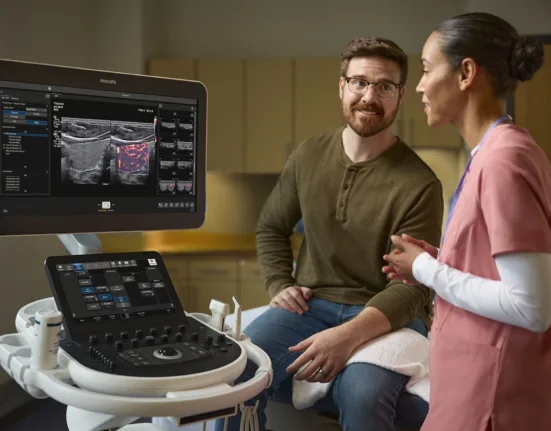
Royal Philips has received U.S. Food and Drug Administration 510(k) clearance for Elevate Plus, an AI-enabled upgrade for its EPIQ Elite and Affiniti ultrasound systems. The clearance adds advanced imaging, automated workflow features and integrated decision support for general imaging ultrasound, placing Philips deeper into the push to make artificial intelligence part of routine diagnostic workflows rather than a separate add-on.
Why does Philips’ Elevate Plus clearance matter for the future of ultrasound workflows?
The importance of Elevate Plus lies in where artificial intelligence is being placed inside the diagnostic imaging workflow. Ultrasound is one of the most widely used imaging modalities because it is relatively accessible, portable, radiation-free and useful across many clinical settings. Yet it remains highly operator-dependent, which means image quality, measurement consistency and exam time can vary significantly across sonographers, sites and patient volumes.
Philips is targeting that variability directly. Elevate Plus is not being positioned as a standalone AI product that sits outside the scan room. It is being embedded into the EPIQ Elite and Affiniti systems, which means automation can support the user during routine imaging rather than after the exam has moved into a separate reporting workflow. That distinction matters because the biggest efficiency gains in ultrasound often come from reducing friction during acquisition, measurement and interpretation, not only from improving downstream reporting.
The unresolved question is whether these gains will be large and consistent enough across real-world settings. AI tools may perform well in controlled evaluations, but hospitals and imaging centres operate with mixed staff experience, variable patient anatomy, time pressure and different clinical protocols. The FDA clearance gives Philips a stronger regulatory footing in the United States, but adoption will depend on whether users experience measurable reductions in repeat scanning, measurement variability and exam duration without compromising clinical confidence.
How could AI automation reduce the burden on sonographers and imaging departments?
Elevate Plus addresses a pressure point that imaging departments know too well: demand keeps rising while skilled staff remain constrained. Ultrasound teams are expected to handle high volumes across abdominal imaging, breast imaging, thyroid assessment and other routine examinations. In this environment, even small workflow improvements can matter if they reduce the number of manual steps required per scan.
Auto Measure Abdomen is especially relevant because abdominal ultrasound measurements can be time-consuming and user-dependent. Automating routine measurement steps can reduce keystrokes, improve reproducibility and help less experienced users follow consistent measurement placement. For high-volume departments, that could translate into faster throughput and fewer avoidable repeat scans. For sonographers, it may reduce repetitive cognitive and manual workload during dynamic exams.
The limitation is that automation does not eliminate the need for expert scanning technique. Ultrasound image quality still depends on probe positioning, patient preparation, body habitus, acoustic windows and the operator’s ability to recognise when the image is inadequate. AI can assist measurement placement and workflow standardisation, but it cannot fully solve the variability created before the image is captured. Philips’ challenge will be to show that Elevate Plus supports sonographers without creating overreliance on automated outputs.
What does on-cart Koios decision support change for breast and thyroid ultrasound?
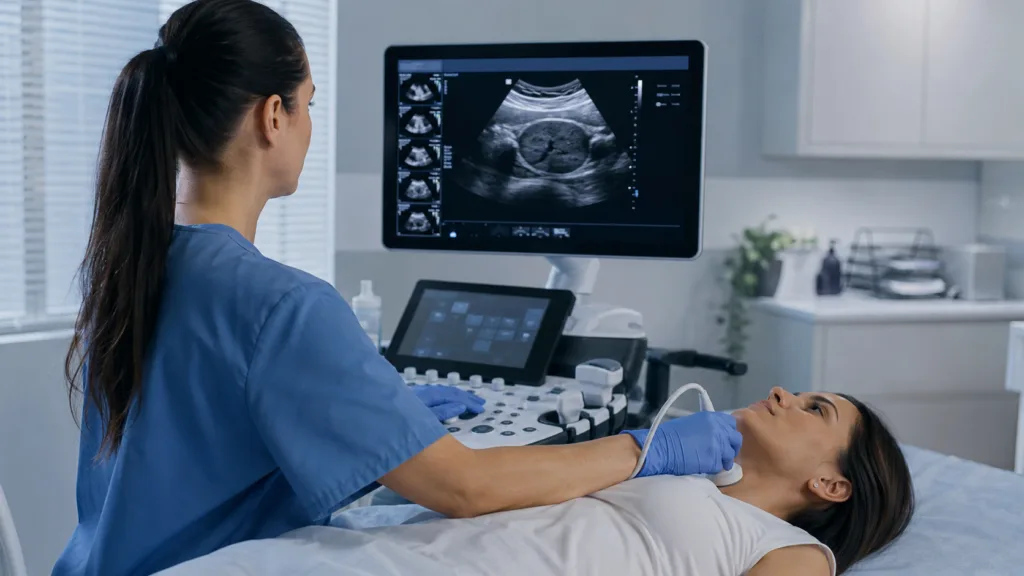
One of the more strategically important elements of Elevate Plus is the integration of Koios AI decision support directly onto Philips ultrasound systems. Decision support that was previously available away from the cart is now positioned closer to the point of care, enabling clinicians to classify breast lesions and thyroid nodules during the ultrasound workflow. That matters because moving AI into the live clinical environment can reduce delays between imaging, assessment and documentation.
In breast and thyroid ultrasound, classification consistency is a major issue. Suspicious lesions and nodules require structured risk assessment, and variability in interpretation can influence follow-up imaging, biopsy decisions and patient anxiety. Integrated AI support may help standardise risk assessment by aligning image interpretation with large pathology-informed datasets and established reporting categories. For clinicians, the value lies not only in speed, but in having a second layer of structured support during decision-making.
The risk is that decision support must be understood as support, not diagnosis by automation. Breast and thyroid imaging decisions involve clinical history, lesion morphology, prior imaging, patient risk factors and physician judgment. If AI outputs are treated as definitive rather than contextual, the risk of misclassification or inappropriate escalation remains. Adoption will therefore depend on training, governance and clear accountability for how AI recommendations are used within clinical protocols.
Why does this clearance show Philips is prioritising platform upgrades over single-device replacement?
Elevate Plus is commercially interesting because it reinforces a platform-upgrade model. Instead of relying only on new hardware cycles, Philips is adding software, AI automation and imaging enhancements to existing flagship ultrasound systems. That matters for hospitals because capital equipment budgets are under pressure, and many providers prefer technology pathways that extend the value of installed systems rather than requiring complete replacement.
The platform approach can make AI adoption more practical. A hospital that already uses EPIQ Elite or Affiniti may see Elevate Plus as a workflow and capability upgrade, not a disruptive procurement event. Remote updates, modular improvements and security enhancements can also help health systems keep systems current while reducing operational disruption. In medical imaging, this kind of lifecycle strategy is increasingly important because AI capabilities evolve faster than hardware replacement cycles.
The unresolved commercial question is how Philips packages, prices and supports these upgrades. Hospitals may welcome AI-enabled workflow improvement, but they will still evaluate total cost, service terms, integration effort and staff training requirements. If the upgrade is perceived as easy to deploy and visibly useful, adoption could strengthen. If implementation requires complex workflow redesign or unclear return on investment, uptake may be slower despite the regulatory clearance.
How does Elevate Plus fit into the broader shift toward AI-enabled diagnostic imaging?
Elevate Plus reflects a broader industry transition from AI as a specialist tool to AI as embedded clinical infrastructure. Early imaging AI often focused on narrow detection tasks or separate post-processing applications. The next phase is more operational. Health systems want tools that reduce variability, improve throughput, support quality and fit into existing workflows without forcing clinicians to leave their normal environment.
Ultrasound is a logical target for this shift because it is both widely used and highly variable. Unlike computed tomography or magnetic resonance imaging, ultrasound relies heavily on real-time human acquisition. That makes the modality especially attractive for AI-assisted standardisation. If automation can help users obtain consistent images and measurements faster, it may improve both productivity and diagnostic reliability.
The limitation is that ultrasound AI must operate in a messy clinical reality. Different operators may scan differently. Patients may be difficult to image. Departments may use different protocols. AI tools must be robust enough to support these variations while remaining transparent enough for clinicians to trust. Philips’ regulatory clearance is a milestone, but the real test will be performance across hospitals, outpatient centres, community clinics and mixed-experience teams.
What regulatory and clinical questions remain after FDA 510(k) clearance?
FDA 510(k) clearance confirms that the technology met the regulatory threshold for substantial equivalence and allowed U.S. marketing, but it is not the same as proving transformative clinical outcome benefit. For Elevate Plus, the next layer of evidence will likely come from clinical adoption, workflow studies, quality metrics and user experience in routine practice. Hospitals will want to know whether the system reduces scan time, repeat imaging and measurement variability in their own environments.
Regulators and health systems will also focus on AI governance. Imaging AI introduces questions about software updates, data provenance, model performance, cybersecurity, interoperability and post-market monitoring. Because Elevate Plus is tied to established ultrasound platforms, Philips may benefit from an installed base and existing service infrastructure. However, integrated AI also raises expectations for performance transparency and ongoing validation.
The risk is that regulatory clearance can create a perception that AI tools are fully settled products. In reality, clinical AI needs continuous oversight. Imaging departments will need protocols for when to accept, adjust or override automated measurements and decision support outputs. Philips must support not only product deployment, but also the clinical governance framework that helps hospitals use the technology safely and consistently.
Why could this matter commercially for Philips after years of portfolio pressure?
For Philips, Elevate Plus fits into a wider effort to sharpen its health technology portfolio around diagnosis, image-guided therapy, monitoring and informatics. The Dutch health technology group has spent recent years under investor scrutiny because of operational challenges, regulatory issues and portfolio restructuring. Against that backdrop, AI-enabled imaging upgrades offer a cleaner growth narrative because they connect installed hardware, software value and workflow efficiency.
Philips’ U.S.-listed shares recently traded at $26.11, leaving the group with a market capitalisation of roughly $24.4 billion. That valuation reflects a business still rebuilding investor confidence while competing against major imaging rivals such as GE HealthCare Technologies, Siemens Healthineers and Canon Medical Systems. Elevate Plus will not define Philips’ investment case by itself, but it supports the company’s argument that its imaging platforms can evolve through software and AI rather than depend solely on equipment replacement cycles.
The risk is that investors may view many imaging AI announcements as incremental unless they translate into measurable revenue, stronger margins or competitive share gains. Philips must demonstrate that Elevate Plus can help defend its ultrasound installed base, support premium positioning and create recurring or upgrade-driven value. In other words, the clearance is strategically useful, but commercial proof still depends on adoption.
How could Elevate Plus influence competition in ultrasound and radiology AI?
Philips is not alone in trying to turn ultrasound into a more AI-assisted modality. Competitors across imaging equipment, software and specialty AI are pursuing automation, lesion characterisation, workflow standardisation and reporting support. The competitive advantage will not come from AI branding alone. It will come from how well the AI fits into the scan, the reporting pathway and the purchasing logic of health systems.
By integrating AI features directly into EPIQ Elite and Affiniti, Philips is trying to make the ultrasound console itself more intelligent. That could be more defensible than offering a separate AI application, because it strengthens customer stickiness around the platform. If users become accustomed to automated measurements, on-cart lesion support and workflow tools inside Philips systems, switching costs may rise.
The limitation is that open ecosystems are also gaining importance. Hospitals often prefer interoperability across vendors, imaging archives and reporting systems. If AI features are too tightly tied to one equipment platform, health systems may weigh convenience against flexibility. Philips will need to balance proprietary platform value with the interoperability expectations of modern radiology and enterprise imaging teams.
What should hospitals and imaging leaders watch as Elevate Plus rolls out?
Hospitals should watch whether Elevate Plus produces measurable operational benefits in routine use. The most meaningful indicators will include reduced exam time, fewer repeated measurements, fewer repeat scans, improved consistency across users and stronger confidence among newer sonographers. These practical metrics may matter more to administrators than abstract claims about AI advancement.
Clinical leaders should also examine how the technology performs across patient populations and use cases. Abdominal, breast and thyroid imaging each involve different levels of complexity and different consequences for measurement or classification variability. A tool that improves one workflow may not deliver the same value everywhere. Implementation should therefore be measured, protocol-driven and supported by local quality review.
The risk is that AI adoption becomes fragmented if departments deploy tools without training, auditing or workflow integration. Elevate Plus may help standardise scanning, but only if teams standardise how they use the tool. The strongest deployments will likely be those where imaging leaders treat AI as part of clinical operations, not as a feature switched on after installation.
Could Philips’ Elevate Plus clearance mark a practical turning point for ultrasound AI?
Elevate Plus may not be a dramatic single-product breakthrough, but it could represent something more useful: a practical step toward making AI part of routine ultrasound operations. In healthcare technology, the most important advances are not always the flashiest. Sometimes they are the tools that quietly reduce variability, save minutes, support staff and make standard exams more reproducible.
For clinicians, the appeal is straightforward. Ultrasound workloads are rising, skilled staff are stretched and consistency matters. For Philips, the clearance strengthens a platform strategy that uses AI to extend the value of installed systems and deepen customer reliance on its imaging ecosystem. For hospitals, the key question is whether the technology produces operational and diagnostic value that can be seen in day-to-day workflows.
The balanced view is that Elevate Plus is a meaningful regulatory and commercial milestone, but not the end of the evidence journey. Its impact will depend on real-world performance, training, governance and measurable workflow improvement. If those pieces align, Philips could help move ultrasound AI from a promising concept into the ordinary machinery of diagnostic care.