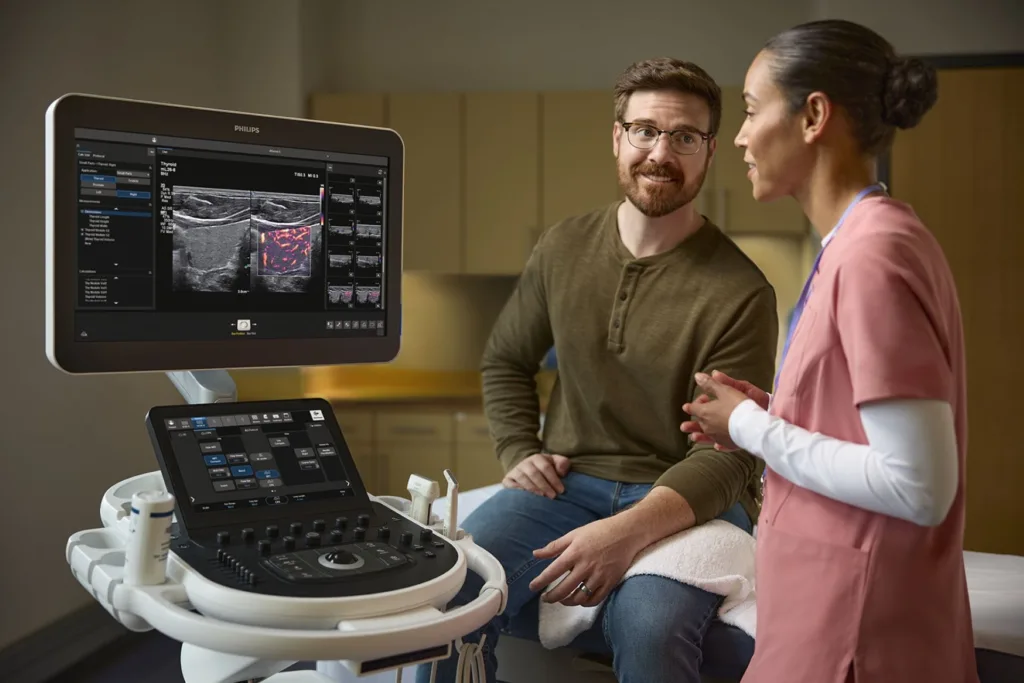
Royal Philips has launched the Alturion ultrasound system, an AI-powered diagnostic imaging platform built for high-volume clinical environments and cleared for use in the United States and Europe. The system combines advanced ultrasound imaging, AI-enabled workflow tools, Elevate Plus measurement automation, a compact design, transducer compatibility with EPIQ Elite and Affiniti systems, and connected support capabilities at a time when radiology and ultrasound teams are under pressure to scan more patients with fewer experienced operators.
Why Royal Philips’ Alturion launch matters for high-volume ultrasound departments facing capacity pressure
The significance of the Alturion launch is not that Royal Philips has added another ultrasound machine to its portfolio. It is that the Netherlands-based health technology group is aiming directly at one of the biggest operational pain points in diagnostic imaging: the gap between rising scan demand and limited sonographer capacity. Ultrasound remains one of the most widely used imaging modalities because it is real-time, radiation-free, comparatively accessible, and useful across abdominal, vascular, obstetric, emergency, musculoskeletal, and procedural settings. The problem is that ultrasound quality and throughput still depend heavily on operator skill, exam standardization, and workflow discipline.
Alturion enters that environment with a proposition centered on consistency and efficiency rather than only image quality. The confirmed development gives Philips a lower-friction expansion point within its ultrasound ecosystem, especially for hospitals and imaging centers that already use EPIQ Elite or Affiniti systems. By offering a familiar interface, compatible transducers, AI-powered abdominal measurements, and connected workflow support, Royal Philips is trying to make the platform easier to absorb into existing departments instead of forcing a disruptive equipment transition. That is commercially important because imaging departments rarely buy devices purely on specifications. They buy around staffing pressure, training time, room utilization, capital budgets, and workflow bottlenecks.
The unresolved question is whether AI workflow automation can materially improve real-world productivity without introducing new dependency, oversight, or training burdens. Imaging teams are not short of digital promises. They are short of time. If Alturion reduces repeat scanning, speeds routine measurements, and helps standardize exams across mixed-experience teams, the platform could be useful. If the AI tools require too much adjustment, produce inconsistent confidence across patient types, or fail to fit local protocols, the value proposition could narrow to another premium workflow feature rather than a department-level productivity lever.
What Alturion changes for ultrasound standardization and where AI still has limits
The clinical relevance of Alturion sits in the attempt to reduce variability across routine ultrasound exams. Ultrasound has always carried a degree of operator dependence because probe positioning, anatomy recognition, measurement technique, image optimization, and documentation can vary between users. AI-assisted tools can help automate measurements, streamline acquisition, and support reproducibility, particularly in exams where standardized measurements are repeated frequently. That is why abdominal ultrasound automation is a practical starting point rather than a flashy one. It targets a real daily workload.
The broader context is that imaging providers are trying to move AI from experimental add-on to embedded workflow utility. Radiology AI adoption has often been strongest when tools save time, reduce manual steps, or help prioritize work without asking clinicians to overhaul their habits. Alturion’s integration of Elevate Plus suggests that Royal Philips is treating AI not as a standalone diagnostic oracle but as an operational support layer inside the ultrasound console. That is likely the more realistic route for near-term adoption. Clinicians do not want a black box in the room. They want fewer clicks, fewer rescans, fewer avoidable delays, and more consistent documentation.
The limitation is that automation does not eliminate the need for expert judgment. AI-enabled measurements must still be reviewed in clinical context, and ultrasound remains sensitive to patient body habitus, acoustic windows, anatomy variation, artifacts, and operator technique. A system can support reproducibility, but it cannot fully standardize every exam because patients are inconveniently human. That is not a flaw in Alturion specifically. It is a reminder that AI ultrasound devices will be judged less by marketing language and more by how gracefully they perform in the messy reality of everyday scanning.
How the connected ecosystem strategy could help Royal Philips defend imaging share
Royal Philips’ strongest commercial angle may be ecosystem continuity. Alturion shares a common interface and compatible transducers with EPIQ Elite and Affiniti, two established ultrasound platforms in the Philips portfolio. That matters because hospitals and imaging centers make equipment decisions around fleet management, training burden, service contracts, asset utilization, and clinician familiarity. A new system that fits into an existing ecosystem can be easier to justify than a device that requires separate accessories, different training pathways, and isolated support infrastructure.
The confirmed launch also reinforces Royal Philips’ broader strategy in connected imaging. Compatibility with Collaboration Live gives the system a tele-ultrasound dimension, enabling remote support, training, and consultation. This is relevant for health systems trying to extend advanced imaging capability beyond major academic centers. Smaller hospitals, outpatient sites, and frontline care environments may have equipment but not always immediate expert support. Remote collaboration can help bridge that gap if connectivity, workflow integration, and reimbursement models support routine use.
The risk is that ecosystem strength can become less decisive if competitors offer more open, lower-cost, or more flexible alternatives. Ultrasound buyers increasingly evaluate vendor lock-in, cybersecurity, cloud connectivity, software upgrade paths, and long-term total cost of ownership. Royal Philips can benefit from a coherent connected platform, but hospitals may push back if the system economics feel too proprietary or expensive. In medical imaging, integration is a selling point until procurement teams decide it looks like dependence.
Why regulatory clearance and CE certification support adoption but do not guarantee demand
Alturion’s U.S. Food and Drug Administration 510(k) clearance and CE mark certification give Royal Philips access to two major regulated markets, which is a meaningful commercial foundation. For hospitals, regulatory clearance removes a basic adoption barrier and supports procurement confidence. For clinicians, it indicates that the system has cleared the required safety and performance pathway for market entry. For a device manufacturer, dual-market availability also helps coordinate launch strategy across large health systems operating in multiple regions.
The context, however, is that 510(k) clearance usually demonstrates substantial equivalence rather than the kind of de novo clinical transformation claim associated with breakthrough technologies. That means Alturion’s adoption case will depend on operational evidence, user experience, and measurable workflow benefit rather than regulatory novelty. Hospitals will ask whether the system reduces exam time, improves consistency, supports less experienced operators, reduces repeat imaging, and improves room throughput. Those questions are commercial, not merely regulatory.
The limitation is that healthcare budgets remain constrained. Imaging departments may want AI-powered ultrasound systems, but capital equipment purchases compete with scanners, monitors, software, staffing, maintenance, and broader digital infrastructure. Royal Philips will need to show that Alturion delivers value across clinical, operational, and financial dimensions. A device that scans well is necessary. A device that helps a hospital run better is what gets budget committees interested.
What investors should read into Royal Philips’ medical imaging signal
Royal Philips’ share reaction around the launch was not dramatic, which is understandable for a diversified health technology company with multiple business lines and a market capitalization far larger than any single ultrasound product announcement. The U.S.-listed shares recently traded at $27.58, within a 52-week range of $23.85 to $33.44, suggesting that investors are still balancing product innovation against broader execution, margin recovery, regulatory history, litigation-related overhangs, and competitive pressure in global medtech.
The investor significance of Alturion is therefore cumulative rather than immediate. Royal Philips has been trying to strengthen its position in diagnosis and treatment through imaging innovation, AI-enabled workflow tools, and connected care infrastructure. Alturion fits that story because it addresses a practical hospital need and extends the company’s ultrasound platform rather than creating a disconnected product line. If the system supports steady uptake, it could contribute to imaging portfolio resilience and recurring service or upgrade opportunities over time.
The risk is that AI-enabled imaging has become a crowded field. Investors may no longer reward announcements simply because they contain artificial intelligence language. They want evidence of growth, margin contribution, customer retention, and differentiation. Royal Philips has a credible installed base and product portfolio, but competitors in ultrasound and diagnostic imaging are also embedding automation, decision support, and remote connectivity into their systems. The market will judge whether Alturion strengthens Philips’ competitive position or simply keeps the company level with the rest of the field.
What clinicians, procurement teams and industry observers will watch after launch
Clinicians will watch whether Alturion improves the practical experience of routine ultrasound scanning. The most important measures may not be the most glamorous ones. Exam setup time, measurement consistency, screen visibility, ergonomic comfort, transducer switching, image optimization, reporting workflow, and remote support usability could shape adoption more than a single AI feature. Sonographers are highly practical users. If the system makes their day easier, they will notice quickly. If it adds complexity, they will notice even faster.
Procurement teams will focus on total cost of ownership, compatibility with existing Philips systems, service support, software upgrade strategy, training needs, and how the system compares with rival ultrasound platforms. Hospitals with existing EPIQ Elite and Affiniti footprints may find the transducer compatibility and common interface attractive. Institutions evaluating vendor consolidation may also view Alturion as part of a wider Philips imaging stack. However, buyers will still want proof that connected features and AI workflow tools translate into measurable throughput or quality gains.
The sector assessment is that Alturion is a strategically sensible launch for Royal Philips because it targets a real operational bottleneck in diagnostic imaging rather than chasing AI novelty for its own sake. The product’s success will depend on whether hospitals see enough workflow value to justify investment and whether clinicians trust the automation in daily use. If Royal Philips can demonstrate consistent productivity gains, easier onboarding, and reliable imaging performance across high-volume settings, Alturion could become a useful addition to its ultrasound portfolio. If the benefits remain difficult to quantify, adoption may be slower despite regulatory clearance and strong brand familiarity.