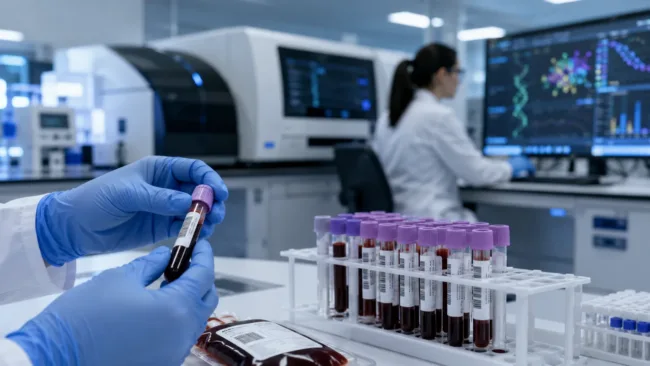
Volta Labs has launched the Twist Fast Hyb App for Twist Bioscience’s Fast Hybridization Kit on the Callisto Sample Prep System, expanding automated access to Twist Bioscience’s hybrid capture portfolio for next-generation sequencing workflows. The launch gives research and clinical laboratories a walk-away route for hybridization-based target enrichment, a technically demanding step used in comprehensive cancer profiling, whole exome sequencing and other targeted sequencing applications.
Why does automated Twist Fast Hyb on Callisto matter for laboratories trying to scale target enrichment workflows?
The significance of the Twist Fast Hyb App is not that it introduces a new sequencing chemistry from scratch, but that it moves an established fast hybridization workflow into a more automated operating model. Target enrichment is a pressure point in next-generation sequencing because it sits between library preparation and sequencing output, where inconsistency in handling, washing, bead manipulation and temperature control can alter downstream performance. By bringing Twist Bioscience’s Fast Hybridization Kit onto Volta Labs’ Callisto Sample Prep System, the U.S.-based genomics automation specialist is trying to reduce the manual variability that still makes hybrid capture difficult to industrialise across busy laboratories.
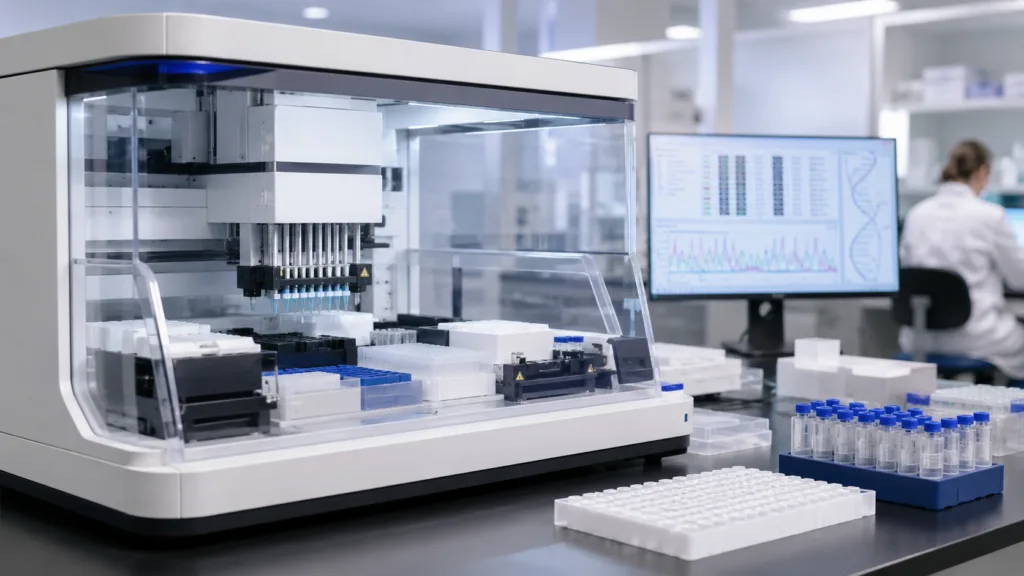
That matters because many laboratories have already pushed sequencing capacity forward, but sample preparation remains a stubborn bottleneck. A sequencer can only deliver value if upstream workflows feed it with libraries that are sufficiently enriched, uniform and reproducible. Hybrid capture-based enrichment is particularly important for applications such as comprehensive cancer profiling and whole exome sequencing because these workflows need reliable capture of selected genomic regions rather than broad, untargeted sequencing alone. When laboratories have to repeat runs, troubleshoot uneven coverage or manage operator-to-operator differences, the cost problem is not only labour. It can also become a reagent, sequencing capacity and turnaround-time problem.
The unresolved question is how broadly the automated workflow will perform outside controlled validation settings. Volta Labs has indicated comparable sequencing performance to manual preparation across quality-control measures such as Fold-80, coverage uniformity and AT/GC dropout. Those metrics are meaningful because they speak to enrichment balance and the ability to avoid losing difficult genomic regions. However, adoption will still depend on how individual laboratories validate the workflow across their own panels, sample inputs, batching patterns and quality systems. In clinical laboratory environments, especially those supporting oncology workflows, automation is only valuable if it improves consistency without forcing a compromise on validated performance.
What is genuinely new in Volta Labs’ latest Callisto expansion and what remains incremental?
The genuinely new element is the availability of Twist Bioscience’s fast hybridization workflow as an automated app on Callisto, joining the previously available Twist Standard Hyb v2 App. That gives laboratories using Callisto a more complete Twist Bioscience hybrid capture menu on a single automated platform. The distinction is important because standard hybridization and fast hybridization serve different operational needs. Standard workflows can remain attractive when laboratories prioritise established overnight processes, while fast hybridization can support tighter turnaround when laboratories need same-day movement from enriched library preparation toward sequencing.
The incremental element is that the underlying target enrichment chemistry is not being positioned as a newly discovered clinical technology. Twist Bioscience already offers fast and standard hybridization options, while Volta Labs already positioned Callisto as a platform for automated next-generation sequencing sample preparation. The change is the integration of a faster hybridization workflow into the automated app menu. In practical terms, that can still be commercially meaningful because laboratories often adopt technology not only when chemistry improves, but when workflow friction falls enough to make implementation realistic at scale.
The limitation is that app-menu expansion does not automatically translate into broad market conversion. Laboratories already using manual Twist Bioscience workflows may evaluate the new app differently from laboratories that have invested in other automation systems or alternative enrichment chemistries. Some users may see the strongest value in reduced hands-on time and scheduling flexibility. Others may ask whether the capital cost, consumable economics and platform fit justify a move away from existing liquid-handling systems. In this sense, Volta Labs’ launch is best understood as an operational scaling move, not a standalone clinical breakthrough.
How could the Twist Fast Hyb App affect turnaround time, staffing and sequencing economics?
The commercial logic behind the Twist Fast Hyb App is straightforward: if target enrichment can move from overnight hybridization toward same-day turnaround without degrading key quality metrics, laboratories gain more control over scheduling. This can matter in oncology profiling, inherited disease research, translational studies and other high-throughput sequencing settings where time-sensitive workflows compete for staff, instruments and batching windows. Walk-away automation also changes how laboratories use skilled personnel. Instead of assigning staff to repetitive manual steps, laboratories may be able to redirect expertise toward assay oversight, data review, troubleshooting and quality management.
The economic context is equally important. Next-generation sequencing cost is not only about the price of sequencing runs. It also includes labour, failed or repeated runs, underused sequencer capacity, reagent waste and delayed reporting. If automation reduces variability in enrichment and shortens workflow timing, the benefit may show up as improved throughput discipline rather than dramatic per-sample cost reduction on day one. Industry observers tracking laboratory automation generally view that distinction as central because diagnostic and research laboratories rarely change workflows just for convenience. They change workflows when operational consistency supports better capacity planning.
The risk is that same-day capability can be oversold if laboratories treat speed as the only metric. In target enrichment, faster hybridization must still preserve adequate coverage of difficult regions, maintain uniformity across GC-rich and GC-poor targets, and work reliably across different panel sizes and sample types. Laboratories running broad exome workflows may have different performance expectations from teams running focused oncology panels. That means the most important adoption evidence will not be the existence of automation alone, but the repeatability of performance across real-world sample diversity.
Why is hybrid capture automation still difficult despite wider adoption of NGS platforms?
Hybrid capture remains difficult because it combines biochemical precision with mechanical repetition. The process requires controlled hybridization, careful bead handling, washing and amplification steps, all of which can introduce variability if handled inconsistently. Unlike some simpler preparation steps, target enrichment has a direct relationship with downstream coverage quality. Small differences can affect how evenly genomic regions are captured, whether difficult targets are represented and how much sequencing depth is wasted on off-target reads.
This is why Volta Labs’ focus on digital fluidics and temperature-controlled automation is strategically relevant. The Callisto Sample Prep System is being positioned as a platform that can automate DNA and RNA extraction, library preparation and target enrichment across major sequencing workflows. For laboratories, the appeal is not merely fewer pipetting steps. It is the possibility of more standardised execution across runs and operators. That standardisation becomes more valuable as laboratories grow from small research volumes into higher-throughput translational or clinical workflows.
The unresolved issue is whether laboratories will prefer dedicated application-specific automation or broader, more configurable liquid-handling platforms. Callisto’s app-based model may be attractive for laboratories seeking simplified deployment and predefined workflows. However, large genomics centres often value flexibility, customisation and integration with existing laboratory information systems. The more regulated or high-throughput the environment, the more scrutiny there will be around change control, documentation, service support and compatibility with existing quality-management processes.
What does this launch mean for Twist Bioscience’s NGS applications strategy?
For Twist Bioscience, the launch strengthens the usability of its next-generation sequencing applications portfolio by making its fast hybridization workflow more accessible through automation. Twist Bioscience’s business is built around synthetic DNA capabilities and workflow tools that serve diagnostics, therapeutics, industrial, agricultural and research markets. In its fiscal 2026 second quarter, Twist Bioscience reported record revenue of $110.7 million, with NGS Applications revenue growing to $57.4 million. That financial backdrop makes automation partnerships more strategically relevant because NGS Applications is already a major revenue contributor rather than a peripheral product category.
The integration with Volta Labs also supports a broader market trend in which reagent providers need automation partners to reduce barriers to adoption. A strong chemistry portfolio can still face friction if implementation requires specialised hands-on expertise. By giving laboratories an automated route for both standard and fast hybridization workflows, Twist Bioscience can make its enrichment products easier to standardise in laboratories that value reduced manual burden. That can be especially relevant for customers managing panel-based sequencing, exome sequencing and cancer-related workflows.
The risk for Twist Bioscience is that automation partnerships do not eliminate competitive pressure in target enrichment. Other enrichment chemistries, amplicon-based approaches and established automation ecosystems continue to compete for laboratory budgets. Twist Bioscience’s advantage will depend on whether customers see a compelling combination of performance, coverage uniformity, ease of implementation and workflow economics. The public-market angle is also worth watching. Twist Bioscience Corporation shares were trading at $76.72 at last check on June 12, 2026, with a market capitalisation of about $4.46 billion. The stock’s positive intraday move suggests supportive sentiment, but investors are likely to judge the longer-term value of launches like this through revenue growth, margin expansion and progress toward profitability.
How should clinical and translational laboratories assess the limits of this workflow?
Clinical and translational laboratories are likely to assess the Twist Fast Hyb App through a validation lens rather than a marketing lens. The central question is whether automated fast hybridization can maintain expected assay performance across the samples and panels each laboratory actually uses. For comprehensive cancer profiling, that may include challenging tumour samples, variable DNA input, formalin-fixed paraffin-embedded material and complex panel designs. For whole exome sequencing, laboratories may focus more heavily on breadth of coverage, uniformity and difficult genomic regions.
The clinical context makes this especially sensitive. Target enrichment quality can influence downstream variant detection, but automation itself does not create clinical validity. It can support more consistent execution of a validated workflow, yet each laboratory still needs to establish performance within its own regulatory and quality framework. In regulated testing environments, implementation may require documentation, verification, staff training and possibly updates to standard operating procedures. That process can slow adoption even when the technical case is persuasive.
The limitation is that the launch does not resolve every upstream and downstream challenge in sequencing workflows. Sample quality, extraction method, library input, bioinformatics pipelines and reporting requirements all remain important. A faster enrichment step can shorten one part of the workflow, but total turnaround still depends on the full chain from specimen intake to data interpretation. Laboratories that treat the app as a complete solution to turnaround pressure may be disappointed. Laboratories that view it as one way to reduce variability in a broader workflow redesign may extract more value.
Could Volta Labs’ app-based model influence the next phase of genomics automation?
Volta Labs’ broader opportunity is to make sample preparation automation feel less like a custom engineering project and more like a deployable application ecosystem. The Twist Fast Hyb App fits that direction because it adds another defined workflow to Callisto rather than asking laboratories to build every protocol manually. If the platform can keep adding validated or well-characterised applications across extraction, library preparation and target enrichment, Volta Labs could become more relevant to laboratories that want automation without the heavy method-development burden associated with open-ended liquid handlers.
That model has clear appeal in a market where sequencing demand continues to rise but skilled laboratory labour remains constrained. Push-button automation is attractive when it reduces training intensity, shortens hands-on time and limits process drift between operators. For laboratories running multiple workflows, an app menu can also simplify switching between use cases. The launch of Twist Fast Hyb alongside Twist Standard Hyb v2 therefore gives Callisto users more flexibility without forcing a single enrichment timetable.
The risk is that app ecosystems must keep pace with laboratory diversity. Genomics laboratories often use varied sample types, panel designs, sequencers, reagent preferences and throughput models. An app that works well for one workflow may not satisfy another without modification. Volta Labs will need to prove that its app-based approach can scale across enough commercially meaningful workflows while maintaining the reliability that laboratories expect from production environments. Service infrastructure, reagent availability, platform uptime and support responsiveness will matter as much as the technology itself.
What should industry observers watch next after the Twist Fast Hyb App launch?
The next phase to watch is customer adoption evidence. Product availability is a useful milestone, but the more important signals will be laboratory case studies, performance data across different panels, adoption by high-throughput genomics centres and evidence that automation reduces repeat runs or improves turnaround discipline. Industry observers will also watch whether Volta Labs expands similar automated hybrid capture options with other reagent providers or deepens its relationship with Twist Bioscience across additional NGS workflows.
For Twist Bioscience, the key question is whether automation support can help convert technical product strength into stickier customer relationships. If laboratories standardise around Twist Bioscience enrichment workflows through automated systems, switching costs can rise. That could support recurring reagent revenue, particularly if customers use the workflow across cancer profiling, exome sequencing and other targeted applications. However, the same logic means customers will scrutinise long-term economics carefully before committing. Automated workflows must justify themselves not only scientifically, but operationally and financially.
For Volta Labs, the launch adds credibility to Callisto as a platform for complex NGS sample preparation, but it also raises expectations. The more the Boston-based genomics automation firm positions Callisto as a walk-away solution for difficult workflows, the more laboratories will expect robust performance across demanding use cases. The Twist Fast Hyb App gives Volta Labs a sharper story in target enrichment automation. The real test will be whether laboratories see it as a workflow convenience or as a meaningful route to more scalable, consistent and economically disciplined sequencing operations.