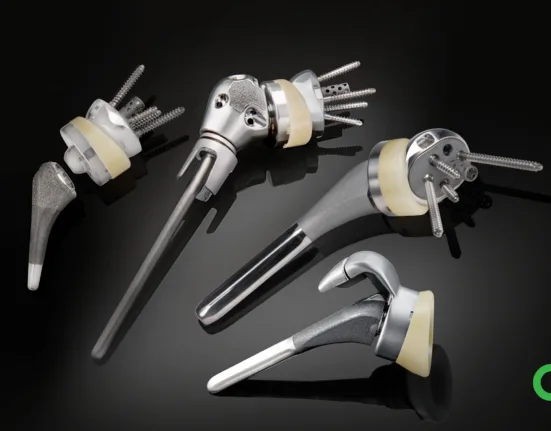
Advita Ortho has acquired three patent applications from Bauer Innovations covering proposed shoulder arthroplasty technologies intended to support the development of new glenoid baseplates for patients with severe bone loss undergoing revision reverse total shoulder arthroplasty. The transaction expands the intellectual property surrounding Advita Ortho’s Equinoxe Shoulder System, but it does not represent the acquisition of a completed implant, a regulatory clearance or clinical evidence for a new commercial product.
The company said the acquired concepts could be used to develop a next-generation revision glenoid baseplate for central vault defects and uncontained glenoid defects, two anatomically demanding situations in which surgeons may struggle to obtain secure fixation. Advita Ortho is positioning the prospective system as an off-the-shelf alternative capable of addressing a wider range of defect shapes and sizes without relying exclusively on standard implants, structural bone grafting or fully customised components. Financial terms, patent application numbers, filing jurisdictions and a product-development timetable were not disclosed.
The strategic logic is stronger than the immediate commercial impact. Advita Ortho has acquired potentially useful design rights at an early stage, giving its engineers an opportunity to integrate those concepts into an established shoulder platform. The clinical, engineering and regulatory work required to convert those applications into a cleared and routinely used device, however, remains ahead.
Why does the patent acquisition matter for difficult revision shoulder procedures?
Revision reverse shoulder arthroplasty can be substantially more complex than a primary replacement because removing a previous implant may leave limited or irregular glenoid bone available for fixation. Bone loss may already have resulted from implant loosening, osteolysis, infection, prior reaming, fracture or the original disease process. Once the central vault or peripheral rim has been compromised, a standard circular baseplate may not achieve sufficient contact with native bone.
That matters because the glenoid baseplate provides the foundation for the reverse shoulder construct. Poor initial fixation, inadequate screw purchase, implant malposition or continued bone loss can increase the risk of loosening and mechanical failure. Surgeons therefore need to reconstruct the defect while also restoring an appropriate joint line and achieving enough stability for biological fixation.
A 2026 systematic review and meta-analysis examining severe glenoid bone loss in revision shoulder arthroplasty identified 40 studies involving 656 patients. The review found that custom glenoid implants produced the largest reported improvements in several functional and pain measures across the included literature, although the authors also emphasised the need for longer-term evaluation of implant survival. The analysis highlights both the potential of advanced reconstruction technologies and the limitations of the evidence base, which remains dominated by relatively small and heterogeneous studies rather than large comparative trials.
Advita Ortho’s acquisition is therefore aimed at a genuine clinical problem. The unresolved question is whether the resulting design can offer enough flexibility for highly variable defects while retaining the manufacturing simplicity, inventory availability and surgical familiarity associated with an off-the-shelf implant.
What clinical problem is the proposed glenoid revision baseplate trying to solve?
Glenoid defects are not uniform. A contained central defect may leave an intact peripheral rim but insufficient bone within the vault, while an uncontained defect may involve loss of the glenoid wall or rim. Combined defects can extend into surrounding scapular structures and leave few reliable trajectories for screw fixation.
Traditional options include eccentric reaming, structural bone grafting, metallic augments, alternative baseplate positioning and patient-specific implants. Each approach involves trade-offs. Reaming can remove additional bone and medialise the joint line. Bone grafting can restore bone stock, but graft preparation, fixation, incorporation and resorption add technical and biological uncertainty. Custom implants can address unusual anatomy, although they require patient-specific imaging, design work, manufacturing and preoperative coordination.
Recent evidence illustrates the challenge. A 2026 retrospective study of 29 revision reverse shoulder arthroplasty procedures using bulk femoral-head allograft for severe glenoid defects reported meaningful improvements in patient-reported outcomes. It also recorded glenoid-sided complications in 10.3% of patients, with two baseplate failures requiring further revision. The study reported all-cause implant survival of 93.1% at two years and 90.9% at five years, but its single-surgeon design and limited cohort prevent broad conclusions about comparative effectiveness.
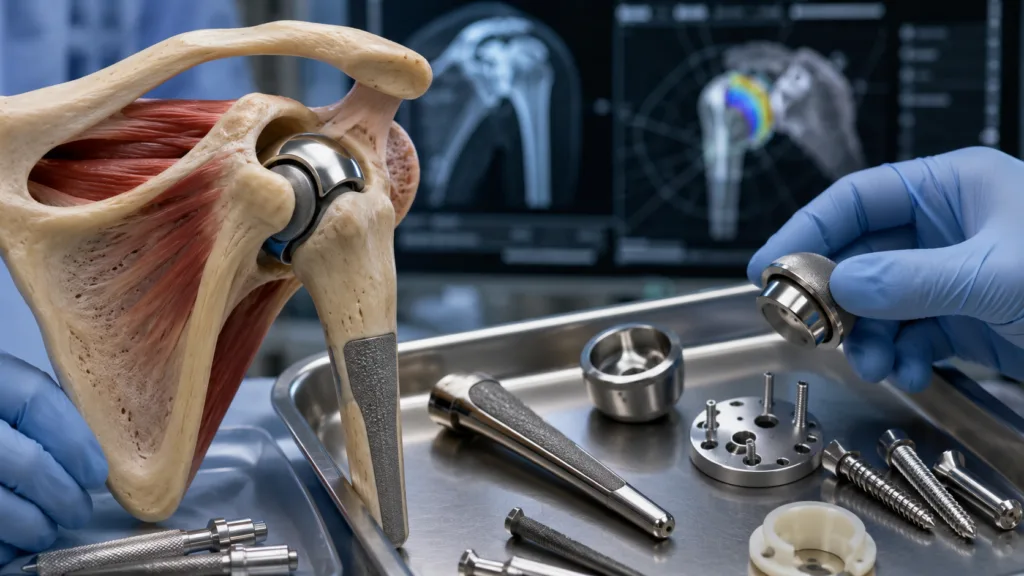
The Bauer Innovations concepts appear intended to give surgeons another option between conventional reconstruction and a completely custom implant. Greg Bauer indicated that his surgical experience had exposed the need for an intermediate solution capable of managing defects that were too demanding for standard components and grafts but did not necessarily require a patient-specific device. Advita Ortho has not disclosed the detailed claims of the applications, so the precise geometry, fixation mechanisms, modularity and instrumentation cannot yet be independently assessed.
Can an off-the-shelf system bridge the gap between bone grafting and custom implants?
An adaptable off-the-shelf revision system could offer several practical advantages. Hospitals could maintain commonly required components in inventory, surgeons could use familiar instrumentation, and procedures might avoid the design and manufacturing interval associated with a custom implant. A modular range could also permit intraoperative adjustment when the actual bone defect differs from preoperative imaging.
Those advantages depend on the system providing meaningful flexibility without becoming excessively complex. More component combinations can expand reconstructive options, but they can also increase inventory requirements, training demands and the possibility of selection or assembly errors. The product would need to provide reliable fixation across different defect patterns while remaining sufficiently straightforward for surgical teams to adopt.
Off-the-shelf augmented baseplates already have clinical support in selected settings. A 2026 retrospective cohort of 25 patients undergoing revision to reverse shoulder arthroplasty with augmented baseplates reported improvements in elevation, external rotation, pain and functional scores at a mean follow-up of 2.7 years. One patient experienced radiographic baseplate mechanical failure, while instability and periprosthetic humeral fractures were also recorded. The study was classified as Level IV evidence, which means the results are encouraging but cannot establish superiority over grafting, custom implants or other revision strategies.
Evidence from primary reverse shoulder arthroplasty has also suggested that augmented baseplates can preserve more bone than standard baseplates in certain anatomical configurations. A 2024 laboratory study reported substantially less reamed bone volume with a 10-degree wedge augment, although biomechanical measurements on prepared specimens do not demonstrate clinical durability or improved patient outcomes.
Advita Ortho will therefore need to show not merely that the new components fit a broader range of defects, but that the final system achieves stable fixation, reproducible placement and acceptable complication rates in real revision procedures.
How does the acquisition strengthen the existing Equinoxe Shoulder System strategy?
The transaction is not an isolated entry into shoulder arthroplasty. Advita Ortho owns the Equinoxe Shoulder product line, which was established before the company’s formal launch in November 2025. Advita Ortho said at launch that it had taken ownership of several established orthopaedic platforms, including Equinoxe Shoulder, alongside hip, knee, ankle, navigation and surgical-intelligence technologies.
The Equinoxe Reverse Shoulder System has a regulatory and commercial history dating to the original United States Food and Drug Administration 510(k) clearance in February 2007. Subsequent Equinoxe clearances have included superior augmented glenoid plates, superior-posterior augmented baseplates, small reverse shoulder components and the Central Screw Baseplate System. A further Equinoxe Shoulder System clearance was recorded in April 2026, with Exactech listed as the applicant and Advita Ortho as the regulatory correspondent.
Advita Ortho has reported that more than 250,000 Equinoxe reverse shoulder procedures have been performed worldwide since 2007. It has also highlighted approximately 15 years of clinical use for augmented reverse shoulder baseplates. Those figures are company-reported and do not establish the performance of the newly acquired concepts, but they indicate that any future revision baseplate could enter an existing surgeon, distribution and instrumentation ecosystem rather than being launched as a standalone platform.
Platform compatibility could become commercially important. A revision solution that works with established Equinoxe components may reduce the number of entirely new instruments, implants and training processes required by hospitals. It may also allow Advita Ortho to defend and expand its installed shoulder base by offering surgeons a more complete pathway from primary replacement through complex revision.
What evidence supports augmented baseplates, and where do the limitations remain?
The broader literature supports the rationale for reducing unnecessary bone removal and improving baseplate contact in patients with glenoid deformity. Augmented baseplates can compensate for selected defects while preserving more native bone than aggressive reaming. They may also help restore the joint line and provide more favourable implant positioning.
Clinical evidence is nevertheless fragmented. Patient populations differ according to whether the procedure is primary or revision surgery, the severity and location of bone loss, implant design, graft use, surgeon experience and follow-up duration. Outcomes from standard augments cannot automatically be applied to a new revision system designed for central vault loss or large uncontained defects.
A 2022 meta-analysis of primary reverse shoulder arthroplasty found that both bone grafting and augmented baseplates produced favourable functional outcomes in patients with glenoid bone loss. The augmented-baseplate group had lower reported complication and revision rates, although the evidence related predominantly to primary rather than revision procedures and cannot prove that the same advantage would occur in more destructive revision defects.
The proposed Advita Ortho system will ultimately need its own evidence. Bench testing may evaluate fixation strength, micromotion, screw trajectories, fatigue resistance and failure under cyclical loading. Cadaveric studies could assess placement, defect coverage and surgical access. Clinical studies will be needed to examine implant survival, loosening, instability, fracture, infection, nerve injury, re-revision and patient-reported outcomes over meaningful follow-up.
Why are patent ownership and product development only the beginning of the pathway?
A patent application protects a proposed invention only to the extent that claims are eventually allowed and enforceable. The United States Patent and Trademark Office notes that filing and examination fees do not guarantee that a patent will be granted. Claims can be rejected, narrowed or amended during examination, particularly when examiners identify prior art or question whether the claims are novel and non-obvious.
Advita Ortho has not identified the three applications or clarified whether they are provisional, non-provisional, domestic or international filings. It is consequently impossible to assess their current examination status, remaining patent term, geographic coverage or overlap with existing shoulder implant intellectual property.
Patent ownership also does not provide regulatory permission to market a medical device. It gives the owner potential exclusionary rights over the claimed invention, but it does not establish safety, performance, manufacturability or freedom to commercialise the product under medical-device regulations.
Advita Ortho must still translate the intellectual property into a final implant design, define its intended use, verify compatibility with the Equinoxe system and complete the necessary testing. Design controls, risk analysis, materials assessment, sterilisation validation, packaging, manufacturing validation and usability work may all be required before a regulatory submission can be completed.
What regulatory and commercial milestones will determine whether the concept reaches surgeons?
The eventual United States regulatory pathway will depend on the final design, technological characteristics and intended indication. Existing reverse shoulder baseplates have generally entered the market through the 510(k) pathway, but Advita Ortho has not confirmed whether it expects to use a new 510(k), supplement an existing system strategy or pursue another route.
A submission would need to demonstrate substantial equivalence to an appropriate predicate if Advita Ortho uses the 510(k) pathway. A design that introduces sufficiently different technological characteristics or new questions of safety and effectiveness could require additional evidence or a different regulatory strategy. Regulatory clearance would apply only to the specified components and indications included in the decision, not to every potential defect or revision scenario envisioned by the patent applications.
Commercial adoption would present a separate test. Revision shoulder procedures are technically demanding and often concentrated among specialist surgeons and referral centres. Advita Ortho would need to establish surgeon training, procedural guidance, defect-classification criteria and inventory configurations that allow hospitals to deploy the system predictably.
Procurement teams are also likely to examine whether the system reduces dependence on custom implants, shortens preparation time, limits graft requirements or lowers the cost of complex revision episodes. Those advantages remain hypothetical until the company discloses the final design and produces comparative clinical and economic evidence.
The most meaningful next milestones will be the identification of the product-development programme, publication of the patent applications, prototype or preclinical disclosures, a confirmed regulatory submission and first clinical use. Until then, the transaction should be viewed as an intellectual-property and portfolio-building move rather than a clinical or commercial product milestone.
Advita Ortho has acquired a potentially valuable route into one of shoulder arthroplasty’s most difficult reconstruction problems. The acquisition fits the company’s strategy of extending the established Equinoxe platform into increasingly complex procedures, but its significance will depend on execution. The decisive test will be whether Advita Ortho can turn three patent applications into a manufacturable, regulator-cleared revision system that offers surgeons genuine intraoperative flexibility without sacrificing fixation, workflow simplicity or long-term implant durability.