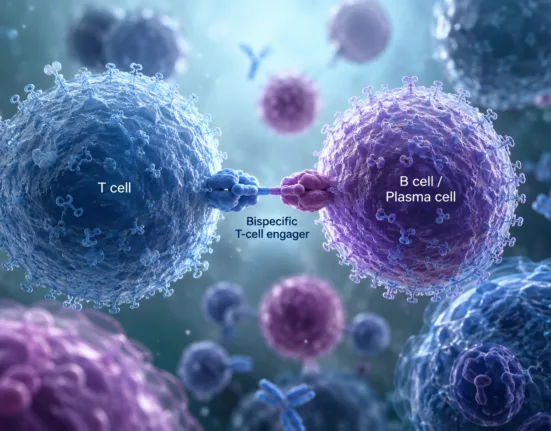
Antengene Corporation Limited will present the first preclinical data for ATG-207, its alpha-CD3-TGF-beta bifunctional fusion protein, at the 2026 European Congress of Rheumatology in London. The program is being developed for T cell-driven autoimmune diseases, with early studies showing TGF-beta receptor III-biased binding, T cell receptor downregulation, regulatory T cell induction, efficacy in an experimental autoimmune encephalomyelitis model and lower proinflammatory cytokine release than an unbiased alpha-CD3-TGF-beta fusion protein control.
Why Antengene’s ATG-207 data could matter for the next wave of autoimmune biologics
The more important point is not simply that Antengene Corporation Limited has another preclinical autoimmune asset entering scientific visibility. The bigger signal is that the Hong Kong-listed biotech firm is trying to move beyond broad immune suppression toward engineered immune recalibration, a field where many developers are searching for ways to restore tolerance without exposing patients to unacceptable infection risk, cytokine toxicity or chronic systemic immunosuppression.
ATG-207 sits in that tension. The fusion protein is designed around two biologically powerful but clinically delicate levers: CD3 modulation and TGF-beta signaling. CD3 targeting can alter T cell activation, while TGF-beta biology has long been associated with immune regulation and regulatory T cell generation. Pairing the two mechanisms in a bifunctional fusion protein creates a conceptually attractive autoimmune approach, because it aims to dampen pathogenic T cell activity while promoting immune tolerance. However, the same biology also explains why regulators and clinicians will want a large safety margin before drawing any translational conclusions from early data.
This makes the preclinical package important but still incomplete. Preferential binding to TGF-beta receptor III and lower cytokine release versus an unbiased control suggest that Antengene Corporation Limited is trying to engineer selectivity into a mechanism that could otherwise become difficult to dose safely. The unresolved question is whether that selectivity remains meaningful in human disease settings, where immune cell populations, inflammatory tone, tissue distribution and chronic dosing dynamics are far more complex than in controlled preclinical systems.
How ATG-207 differs from conventional autoimmune treatment strategies now in use
Current autoimmune drug development has largely been dominated by cytokine blockers, B cell-directed therapies, JAK inhibitors, T cell co-stimulation modulators and broad immunosuppressants. These approaches have changed outcomes across several inflammatory diseases, but they often manage immune activity rather than reset the underlying immune imbalance. That leaves room for new strategies that target immune tolerance more directly, especially in conditions where autoreactive T cells are central to disease biology.

ATG-207 appears to be aimed at that gap. By combining alpha-CD3 activity with TGF-beta-linked immune regulation, Antengene Corporation Limited is positioning the molecule as a potential immune tolerance therapy rather than a conventional anti-inflammatory agent. The preclinical finding that ATG-207 induced regulatory T cells in vitro is therefore central to the story, because regulatory T cells are a major mechanism through which the immune system restrains pathological self-reactivity.
The limitation is that regulatory T cell induction is not automatically equivalent to disease-modifying efficacy in patients. Clinicians tracking autoimmune innovation will want to know whether the regulatory T cells induced by ATG-207 are stable, functional and durable under inflammatory disease conditions. They will also want to understand whether the molecule acts in a disease-selective manner or whether systemic immune modulation could create unwanted consequences over repeated dosing cycles. That is where the program must eventually move from elegant mechanism to clinically testable differentiation.
What the EULAR 2026 preclinical package reveals about Antengene’s autoimmune ambitions
The EULAR 2026 presentation gives Antengene Corporation Limited a platform to show that its autoimmune work is not limited to the ATG-201 program licensed to UCB. That matters commercially because the UCB transaction gave Antengene’s autoimmune platform external validation and improved investor visibility, but a single licensed asset does not establish a durable autoimmune franchise. ATG-207 is therefore a pipeline breadth signal as much as a scientific signal.
The comparison with ATG-201 is also instructive. ATG-201 is a CD19 x CD3 bispecific antibody aimed at B cell-related autoimmune diseases, while ATG-207 is focused on T cell-driven autoimmune disease biology. Together, the programs suggest that Antengene Corporation Limited is trying to build a modular immune redirection and immune regulation platform across distinct autoimmune mechanisms. That could improve strategic optionality if multiple immune cell compartments prove targetable using related engineering principles.
However, platform credibility in autoimmune disease is harder to build than in oncology, where accelerated development logic can sometimes be supported by tumour response signals and high unmet need. Autoimmune diseases often require longer follow-up, carefully selected endpoints, placebo-controlled designs and strong chronic safety data. ATG-207 may strengthen Antengene’s scientific narrative, but the program will need a clear indication strategy before industry observers can judge whether it is a platform asset, a partnering candidate or a long-cycle internal development project.
Why lower cytokine release is central to the commercial logic of ATG-207
The cytokine release component of the preclinical data is especially important because CD3-targeting biology has a well-known safety challenge. Engaging T cells can produce powerful immune effects, but excessive immune activation may trigger inflammatory cytokine release. For an autoimmune therapy, where patients may require repeated or chronic treatment and may not have immediately life-threatening disease, tolerance for acute immune toxicity is far lower than in late-stage oncology.
Antengene Corporation Limited’s comparison between ATG-207 and an unbiased alpha-CD3-TGF-beta fusion protein control is therefore more than a technical detail. It goes to the heart of whether a bifunctional CD3 and TGF-beta approach can be made clinically usable. Lower proinflammatory cytokine release in human whole blood assays and in mice suggests that molecular design may be reducing one of the most obvious development risks associated with CD3 biology.
The caution is that cytokine release assays are useful early screens, not definitive clinical safety evidence. Regulators will still need to see dose escalation behavior, immune pharmacodynamics, reversibility, off-target effects, tissue exposure and repeat-dose toxicology. The bar will be particularly high if Antengene Corporation Limited targets chronic autoimmune indications where patients and physicians already have multiple approved options. In that setting, a new therapy must show not only efficacy but also a safety and convenience profile that justifies changing treatment behavior.
How the experimental autoimmune encephalomyelitis model supports the thesis but limits the conclusion
The use of a mouse surrogate molecule in an experimental autoimmune encephalomyelitis model adds disease-relevant evidence to the ATG-207 story. That model is commonly used to study immune mechanisms linked to central nervous system inflammation and T cell-mediated autoimmunity. A therapeutic effect in this setting supports the hypothesis that the mechanism can translate from cell-based immune modulation into an in vivo disease model.
The commercial relevance is that autoimmune drug investors and pharmaceutical partners generally want to see more than receptor binding and cell signaling data. In vivo efficacy gives the program a more complete preclinical rationale and helps Antengene Corporation Limited argue that ATG-207 is not merely a mechanistic construct. It also allows the biotech firm to begin discussing disease selection in a more concrete way, especially across conditions where pathogenic T cells are central drivers.
Still, the model does not settle the translational question. Experimental autoimmune encephalomyelitis is not the same as human multiple sclerosis or any other clinical autoimmune condition. Many therapies that perform well in preclinical autoimmune models face setbacks when human disease heterogeneity, background medications, biomarker variability and endpoint sensitivity enter the picture. ATG-207’s next credibility step will depend on whether Antengene Corporation Limited can connect mechanism, biomarkers and indication selection in a way that supports a rational first-in-human strategy.
What regulators and clinicians will need to see before ATG-207 can look clinically persuasive
Regulatory watchers are likely to focus first on the safety package, because ATG-207 combines immune modulation mechanisms that could have broad biological consequences. TGF-beta signaling is deeply involved in immune homeostasis, fibrosis, tissue repair and cellular regulation. That broad biology makes it therapeutically interesting but also developmentally sensitive. A molecule that deliberately engages this pathway must show that its activity is controlled, targeted and dose-manageable.
Clinicians will look for a different but related set of answers. They will want to know which autoimmune diseases are most biologically suited to ATG-207, whether the therapy could be used alone or in combination, how rapidly immune markers change and whether any effect could persist after dosing stops. In autoimmune disease, convenience and durability matter. A therapy that requires complex administration, intensive monitoring or prolonged safety precautions may struggle unless it delivers clearly superior outcomes.
The most important future questions will therefore concern indication choice, biomarker design, dose schedule and patient selection. If Antengene Corporation Limited chooses an indication with strong T cell biology, measurable immune biomarkers and clear unmet need, ATG-207 could enter the clinic with a more focused development thesis. If the initial strategy is too broad, the program risks becoming scientifically interesting but clinically hard to interpret.
Why Antengene’s public market story remains tied to platform validation, not one poster
For Antengene Corporation Limited, ATG-207 arrives at a time when investor attention is already trained on the broader pipeline. The UCB licensing agreement for ATG-201 gave the biotech firm a visible external validation event, with upfront economics and substantial potential milestone value. That deal helped support the idea that Antengene’s immune-engaging platform could attract global pharmaceutical interest beyond its internal development priorities.
The stock story, however, remains volatile. Antengene shares traded lower in Hong Kong on June 3 despite the EULAR-related disclosure, after having moved sharply around prior platform and licensing news. That split between scientific progress and daily share price movement is typical for development-stage biotechnology companies. Investors may welcome fresh preclinical evidence, but they usually wait for clinical entry, human pharmacodynamic data or partnership activity before materially repricing early autoimmune assets.
This makes ATG-207 a strategic signal rather than an immediate valuation event. The program strengthens Antengene’s autoimmune narrative and could increase partnering interest if the preclinical differentiation is supported by further data. Yet it does not remove the core risks attached to early biologics development: translational uncertainty, manufacturing complexity, clinical trial design, dosing safety and the need to compete against entrenched autoimmune therapies with established physician familiarity.
What industry observers are likely to watch after the ATG-207 EULAR presentation
The next watchpoint is whether Antengene Corporation Limited provides a clear development timeline for ATG-207. A preclinical EULAR presentation can sharpen scientific visibility, but the program will need defined movement toward investigational filing readiness, toxicology work and clinical indication selection. Without those milestones, the asset could remain in the category of promising platform science rather than investable clinical development.
Industry observers will also track whether ATG-207 remains wholly internal or becomes part of Antengene’s broader partnering strategy. The UCB deal created a reference point for how external pharmaceutical companies may view Antengene’s autoimmune assets. If ATG-207’s mechanism continues to show differentiated safety and immune tolerance potential, it could become attractive to larger immunology players seeking next-generation approaches beyond cytokine blockade and B cell depletion.
The risk is that the field may demand more precision than the current data can provide. Autoimmune therapy is crowded, and new entrants must explain why they are safer, more durable, more convenient or more disease-modifying than existing options. ATG-207 has an intriguing biological rationale, but its real test will begin when Antengene Corporation Limited shows whether controlled CD3 and TGF-beta fusion biology can move from preclinical promise to human autoimmune disease with a safety profile that clinicians can trust.
Why ATG-207 is strategically interesting but still early
ATG-207 is strategically interesting because it points toward a broader shift in autoimmune drug development: away from blunt immune suppression and toward immune system reprogramming. If Antengene Corporation Limited can demonstrate that the molecule induces useful regulatory immune effects while avoiding excessive cytokine activation, the program could become a meaningful addition to the emerging tolerance therapy landscape.
The caution is equally important. This is still preclinical data, and the leap from in vitro assays and mouse models to human autoimmune disease is substantial. The most credible interpretation is that ATG-207 improves Antengene’s platform story and gives the field a new mechanism to watch, but it does not yet establish clinical differentiation. The molecule now needs disciplined development, strong safety controls and a carefully chosen first indication. In autoimmune drug development, clever biology opens the door. Human data decides whether anyone walks through it.