Aravax has received United States Food and Drug Administration Fast Track designation for PVX108, its investigational peptide-based immunotherapy for peanut allergy, giving the Australian-founded biotechnology company a potentially more interactive regulatory pathway as it approaches a pivotal clinical inflection point. PVX108 is being evaluated in an international Phase 2 trial involving children and adolescents in the United States and Australia, with key data expected later in 2026. Unlike oral peanut immunotherapies that administer controlled quantities of peanut allergen, PVX108 comprises seven synthetic peptides selected from major peanut allergens and is intended to act on allergen-specific T cells without containing whole peanut proteins or allergen extracts. The distinction could become clinically important if the ongoing study demonstrates that this targeted approach can meaningfully increase patients’ tolerance to accidental peanut exposure while maintaining the encouraging safety profile observed during Phase 1 development. Fast Track status does not establish that PVX108 is effective or approvable, but it signals that the Food and Drug Administration considers peanut allergy a serious condition and sees sufficient potential in the programme to permit closer regulatory engagement.
Aravax Chief Executive Officer Pascal Hickey said the designation should allow the company to communicate more frequently with the regulator as PVX108 advances. He indicated that the company sees an unmet need for treatments that are safer, more convenient and potentially capable of modifying the underlying allergic response rather than simply managing exposure risk. Those claims will ultimately depend on controlled clinical results, particularly the food-challenge outcomes and safety findings from the ongoing Phase 2 study.
What does FDA Fast Track designation mean for Aravax and PVX108?
The Food and Drug Administration’s Fast Track programme is intended to facilitate the development and review of therapies targeting serious or life-threatening conditions for which there is an unmet medical need. The designation can provide more frequent meetings and written communications with the agency, potentially allowing clinical-development, manufacturing and regulatory issues to be identified earlier than under a conventional interaction schedule.
PVX108 could also become eligible for Rolling Review, under which sections of a future marketing application may be submitted as they are completed instead of waiting for the entire application package. Fast Track products may qualify for Priority Review or Accelerated Approval, but only when the relevant statutory and evidentiary requirements are independently satisfied. Fast Track designation itself therefore does not shorten every remaining stage automatically, guarantee an accelerated review or indicate that the agency has accepted the company’s efficacy assumptions.
For Aravax, the practical value may lie in obtaining earlier feedback on the design of later-stage trials. Food-allergy studies can be operationally demanding because they require carefully controlled oral food challenges, specialist clinical sites and robust procedures for monitoring allergic reactions. If Phase 2 results support further development, discussions with the Food and Drug Administration will need to address the magnitude and durability of desensitisation, the most appropriate clinical endpoint, the target population, dosing duration and the safety evidence required before a Phase 3 programme can support registration.
The designation also arrives before Aravax has disclosed the decisive Phase 2 efficacy data. This creates both an opportunity and a reality check. Regulatory access may improve development efficiency, but the value of that access will depend on whether PVX108 produces a clinically convincing improvement in peanut tolerance.
How does the PVX108 peanut allergy immunotherapy work?
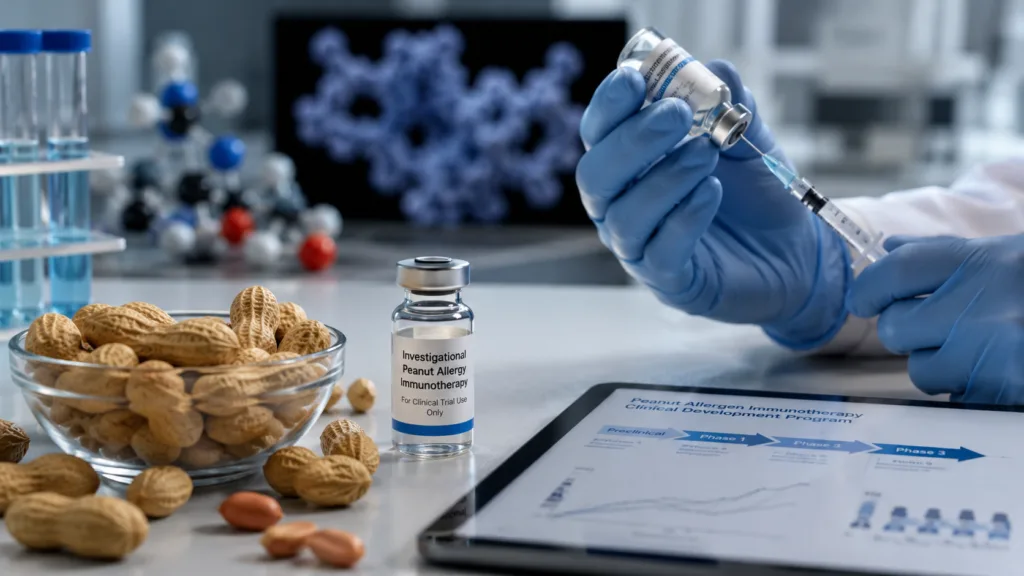
PVX108 consists of seven proprietary synthetic peptides representing immunodominant T-cell epitopes derived from major peanut allergens. The peptides are designed to target peanut-reactive T cells and retrain the immune response while avoiding the parts of whole peanut proteins that can activate mast cells and basophils and trigger immediate allergic reactions.
That mechanism separates PVX108 from allergen immunotherapies that expose patients to increasing or maintenance quantities of the substance responsible for the allergy. Aravax administers PVX108 through intradermal injections approximately once every four weeks, without the dose-escalation process used by some allergen-containing treatments. The company believes this could reduce the treatment burden and the risk of therapy-induced systemic allergic reactions, although comparative clinical evidence will be needed before those potential advantages can be established.
The therapeutic objective is not to make it safe for patients to consume peanuts freely. The more realistic development goal is to raise the amount of peanut protein required to provoke clinically significant symptoms, thereby reducing the likelihood that trace contamination or accidental exposure will cause a severe reaction.
This distinction is central to interpreting peanut allergy trials. A treatment can provide meaningful protection even when patients must continue following a peanut-avoidant diet and carrying rescue medication. The key clinical question is whether the additional exposure threshold is large enough, durable enough and consistently achieved across the treated population to change everyday risk.
What did the Phase 1 PVX108 clinical trial show?
The published first-in-human study evaluated PVX108 in peanut-allergic adults through a randomised, double-blind, placebo-controlled design. Forty-six participants received active treatment and 21 received placebo, while the repeat-dose cohort received six doses over 16 weeks and was monitored through week 21. Researchers also conducted exploratory immunological assessments before treatment, at week 21 and 18 months after treatment.
The study reported that PVX108 produced negligible activation of peanut-sensitised basophils in preclinical testing. In the clinical portion, investigators reported no treatment-related hypersensitivity events or adverse events of clinical concern. Mild injection-site reactions were the principal events that occurred more frequently among PVX108 recipients than placebo recipients.
Exploratory testing also identified changes within the peanut-reactive T-cell population that researchers interpreted as evidence of durable immune modulation. These findings supported the proposed mechanism, but the study was not designed to prove that PVX108 protected patients during real-world peanut exposure.
That limitation is important. Phase 1 established a rationale for continued development and generated an encouraging tolerability signal, but immunological biomarker changes cannot substitute for clinical efficacy. The Phase 2 programme must show that the observed T-cell modulation translates into an increased threshold of peanut exposure during controlled food challenges.
What is the Phase 2 AVX-201 peanut allergy trial testing?
The AVX-201 Phase 2 study is evaluating PVX108 in children and adolescents aged four to 17 years with physician-diagnosed immunoglobulin E-mediated peanut allergy. The randomised, double-blind study is expected to include approximately 90 participants receiving PVX108 or placebo.
Participants receive 12 intradermal injections at four-week intervals, with oral peanut challenges conducted before and after treatment to assess changes in clinical reactivity. Individual participation extends for approximately 18 to 20 months, reflecting the treatment period, food-challenge assessments and follow-up required to examine safety and the durability of any treatment effect.
The international trial is fully enrolled and is operating under an Investigational New Drug application at sites in the United States and Australia. Aravax expects to report key data later in 2026.
The oral food-challenge results will be the most consequential part of the readout. Investors, clinicians and prospective development partners will look beyond whether the trial technically meets its endpoint. They will examine the proportion of patients reaching meaningful exposure thresholds, the distribution of responses, the severity of symptoms during challenges, rescue-medication use and whether efficacy is balanced by a low rate of treatment-related reactions.
Durability will also matter. A therapy administered monthly may be commercially attractive if it provides sustained protection with manageable clinical supervision. Its value proposition would be less clear if immune tolerance declines rapidly when treatment stops or if continued injections are required indefinitely without evidence of lasting disease modification.
How would PVX108 differ from Palforzia and Xolair?
The United States peanut allergy treatment landscape already includes Palforzia, a peanut allergen powder used as oral immunotherapy to mitigate allergic reactions following accidental exposure. Palforzia requires an initial dose-escalation phase, subsequent up-dosing and continued maintenance treatment. It contains peanut allergen, carries a risk of anaphylaxis and must be used alongside a peanut-avoidant diet. The authorised age range was expanded in 2024 to allow initiation in children aged one through 17 years.
Xolair, or omalizumab, provides another option. The Food and Drug Administration approved the antibody in 2024 to reduce allergic reactions, including anaphylaxis, following accidental exposure to one or more foods in adults and children aged one year and older with immunoglobulin E-mediated food allergy. Patients receiving Xolair must still avoid their relevant allergens, and the medicine is not an emergency treatment for acute reactions.
PVX108 is attempting to create a different therapeutic profile. Its peptide components are intended to alter peanut-specific T-cell activity without exposing patients to intact allergenic proteins. This could theoretically reduce the frequency of treatment-induced allergic reactions and eliminate complicated dose escalation.
However, PVX108 remains substantially less clinically validated than either approved option. Palforzia has completed the regulatory efficacy and safety programme required for approval, while Xolair has established efficacy across multiple food allergies. Aravax must demonstrate that the convenience and safety suggested by its platform are accompanied by a sufficiently strong clinical benefit.
The eventual commercial question will not simply be whether PVX108 works. Physicians and payers will compare its protection, administration requirements, durability, age eligibility, monitoring burden and cost with established therapies and emerging food-allergy programmes.
Could peptide immunotherapy change the treatment of food allergies?
PVX108 is based on the idea that immunotherapy can be made more precise by separating the immune-modifying portions of an allergen from components associated with immediate allergic activation. If that concept works in a controlled paediatric trial, it could support development beyond peanut allergy.
Aravax has said its platform may be applied to additional food allergens. A successful Phase 2 study could therefore validate not only one drug candidate but also a broader peptide-development approach. The platform opportunity is particularly relevant because many patients have allergies to more than one food, and creating allergen-specific therapies through a repeatable peptide-selection process could give the company several future development paths.
Nevertheless, each allergen would likely require its own peptide design, manufacturing package and clinical evidence. Platform validation would not remove the need for indication-specific trials, and immune responses may differ considerably between peanut, tree nuts, milk, egg and other common allergens.
Manufacturing consistency will also be scrutinised as development advances. Although synthetic peptides can offer greater molecular precision than complex allergen extracts, Aravax will need to demonstrate reliable production, stability, potency and comparability at commercial scale.
What are the main risks facing the PVX108 clinical programme?
The most immediate risk is that the Phase 2 study may confirm safety without demonstrating enough efficacy. Avoiding treatment-induced allergic reactions would be valuable, but physicians are unlikely to adopt a chronic injectable therapy unless it meaningfully raises the quantity of peanut patients can tolerate.
Patient-to-patient variability could also complicate the results. Peanut allergy involves diverse immune profiles, baseline sensitivities and clinical histories. A strong response in a subgroup may not be sufficient for a broad indication unless Aravax can identify reliable biomarkers or selection criteria.
The design of any Phase 3 programme represents another challenge. Later trials would probably require a larger paediatric population, geographically diverse sites, standardised food challenges and enough follow-up to assess durability. These requirements can increase development costs and extend timelines even with Fast Track interactions.
Aravax is privately held and raised US$42 million in a Series B financing to advance the programme. As PVX108 moves toward Phase 3 development, the company could require additional capital, a licensing agreement or a strategic pharmaceutical partner with global clinical, regulatory and commercial infrastructure.
Expert view: Why the Phase 2 results matter more than the Fast Track label
The Fast Track designation is a credible regulatory milestone, but the forthcoming Phase 2 data remain the event that will determine the programme’s direction. The Food and Drug Administration has not concluded that PVX108 is safe, effective or superior to existing treatments. Instead, the agency has provided Aravax with a framework for closer engagement because the candidate addresses a serious condition and may offer a differentiated approach.
PVX108’s scientific proposition is persuasive. Targeting T-cell epitopes while excluding whole allergenic proteins could address one of the central weaknesses of conventional allergen immunotherapy: treatment itself can provoke the reactions it is intended to prevent. The Phase 1 safety results support that hypothesis, but they do not yet demonstrate clinical protection.
A positive Phase 2 result would need to show more than a statistically favourable endpoint. The treatment must deliver a meaningful increase in tolerated peanut exposure across a credible proportion of participants, with limited systemic reactions and an administration schedule acceptable to children, caregivers and allergy clinics.
Should those elements align, Aravax could emerge as an important participant in the next generation of food-allergy therapeutics. If efficacy is modest, Fast Track status will not rescue the programme. The late-2026 readout will therefore reveal whether PVX108 is primarily an elegant immunological concept or a realistic competitor capable of reshaping peanut allergy treatment.