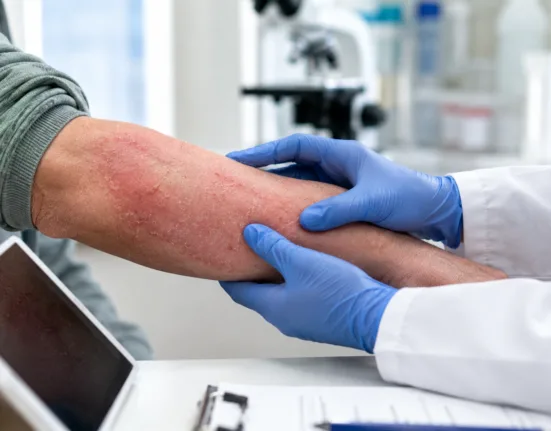
Celldex Therapeutics, Inc. (Nasdaq: CLDX) has produced two successful Phase 3 trials for barzolvolimab, moving its mast-cell-depleting antibody significantly closer to becoming a new treatment for chronic spontaneous urticaria. EMBARQ-CSU1 and EMBARQ-CSU2 both met their primary endpoints and every key secondary endpoint across the two tested dosing regimens, with almost identical reductions in disease activity across independent studies involving a combined 1,939 patients. Celldex now plans a Biologics License Application submission to the United States Food and Drug Administration in 2027 while patients continue treatment through Week 52.
The topline numbers are difficult to dismiss clinically. At Week 12, patients receiving 150 mg every four weeks experienced mean reductions of 20.2 points on the seven-day Urticaria Activity Score in both Phase 3 trials, compared with placebo reductions of 10.7 points in EMBARQ-CSU1 and 11.4 points in EMBARQ-CSU2. The 300 mg dose administered every eight weeks produced reductions of 20.5 and 19.7 points, respectively, and every primary comparison produced a p-value below 0.00001.
More important for patients than the average score change may be the proportion who became completely symptom-free. Between 42.1% and 45.7% of barzolvolimab-treated patients achieved a UAS7 score of zero at Week 12, meaning no hives and no itch during the measurement period, compared with 9.3% to 12.6% on placebo. By Week 24, complete-response rates increased further to between 45.1% and 54.0% depending on dose and study, while placebo response remained between 15.4% and 17.6%.
That would normally look like a straightforward biotechnology success. The stock market disagreed with the simplicity of that interpretation: Celldex shares closed September 22 at $33.26, down 12.22% from the previous session despite the dual Phase 3 wins. The reaction does not negate the clinical results, but it shows that barzolvolimab had entered the readout carrying expectations high enough that merely successful Phase 3 data were not necessarily sufficient to expand its valuation.
Why is chronic spontaneous urticaria still difficult to control despite several approved therapies?
Chronic spontaneous urticaria is driven by recurrent activation of mast cells in the skin, producing itchy wheals, hives and, in many patients, angioedema without a reliably identifiable external trigger. Standard treatment begins with H1 antihistamines, yet a substantial proportion of patients continue experiencing symptoms even when antihistamine doses are increased. Novartis has estimated that approximately 1.7 million people in the United States live with CSU and that more than half remain symptomatic despite antihistamine treatment.
The advanced-treatment landscape has improved materially. Xolair, or omalizumab, has been approved in the United States for antihistamine-refractory chronic urticaria since 2014 and works primarily by targeting immunoglobulin E. Dupixent, or dupilumab, was approved for adults and adolescents with antihistamine-refractory CSU in April 2025 and expanded to children aged two to 11 in April 2026, while Novartis’ oral BTK inhibitor Rhapsido, or remibrutinib, received FDA approval for adults in September 2025.
Barzolvolimab is therefore approaching a market that is no longer therapeutically empty. Celldex must establish not merely that the drug works, but that directly targeting mast cells produces enough additional benefit to earn a place alongside established injectable biologics and a newer oral targeted medicine.
The Phase 3 programme was designed with that competition in mind. Celldex deliberately enrolled patients who had previously received or become refractory to advanced therapies, allowing the company to test whether the drug retains activity where established biological approaches no longer adequately control disease.

What makes barzolvolimab fundamentally different from Xolair, Dupixent and Rhapsido?
Most current targeted CSU therapies interfere with signals that activate mast cells or with inflammatory pathways downstream of immune activation. Barzolvolimab goes closer to the cellular source by binding KIT, a receptor highly expressed on mast cells and essential to their survival and function. Celldex designed the humanized monoclonal antibody to inhibit KIT strongly enough to reduce mast-cell populations rather than simply suppress one mediator released after mast cells become activated.
That gives the programme a distinctly different biological proposition. Xolair reduces IgE-driven mast-cell activation, Dupixent inhibits IL-4 and IL-13 signalling associated with type 2 inflammation, and Rhapsido inhibits Bruton’s tyrosine kinase signalling involved in release of histamine and other inflammatory mediators. Barzolvolimab instead asks whether substantially reducing the cells responsible for releasing many of those mediators can provide deeper or more durable disease control.
The approach is potentially powerful because mast cells sit near the centre of CSU biology. It is also biologically more consequential than blocking one signalling pathway, which makes long-term safety and recovery of the mast-cell compartment important questions as treatment expands.
Celldex’s earlier Phase 2 work provided evidence that the effect can persist after dosing stops. The company reported complete responses in as many as 71% of patients during extended treatment and symptom-free responses in up to 41% seven months after the final barzolvolimab dose. Those findings helped establish the idea that suppressing mast-cell populations might produce effects that outlast immediate drug exposure, although the Phase 3 programme will provide the more important evidence for regulatory and commercial decisions.
Why are the complete-response numbers more important than the average UAS7 improvement?
An average reduction in UAS7 proves that disease activity changed across a treatment group, but patients do not experience disease as an average statistical score. Someone whose hives improve substantially but continue every week may value treatment very differently from someone who becomes entirely symptom-free.
Complete response, defined as UAS7 equal to zero, therefore creates an intuitive and demanding efficacy threshold. In EMBARQ-CSU1, 42.4% of patients receiving 150 mg every four weeks and 42.1% receiving 300 mg every eight weeks were completely free of itch and hives at Week 12, compared with 9.3% on placebo. EMBARQ-CSU2 produced corresponding response rates of 45.7% and 44.0%, compared with 12.6% for placebo.
The effect deepened with additional treatment. By Week 24, 54.0% of patients receiving the 150 mg regimen in EMBARQ-CSU2 had achieved complete response, while the corresponding figure reached 49.0% in EMBARQ-CSU1. The every-eight-week regimen also maintained high complete-response rates of 45.1% and 48.4%.
This depth of response could become the core of Celldex’s commercial argument because current guidelines increasingly emphasize complete disease control rather than partial improvement as the ideal treatment objective. The challenge is that Celldex itself describes the results as “best-in-disease,” and that remains a sponsor claim rather than a conclusion that can be established without appropriate head-to-head trials against Xolair, Dupixent or Rhapsido.
Why could the omalizumab-refractory data become barzolvolimab’s strongest commercial evidence?
The most strategically important subgroup may be patients whose CSU remains uncontrolled despite omalizumab. Xolair has been established in the condition for more than a decade, so physicians already know how to use it and insurers have built treatment pathways around it. A new injectable medicine therefore needs a particularly compelling reason to enter the sequence after or instead of an established biologic.
Barzolvolimab produced substantial complete-response rates even in patients classified as refractory to omalizumab. In EMBARQ-CSU1, 55.3% of omalizumab-refractory patients receiving barzolvolimab 150 mg every four weeks and 44.3% receiving 300 mg every eight weeks achieved UAS7 zero at Week 12, compared with 9.3% on placebo. EMBARQ-CSU2 produced complete responses of 41.7% and 46.4% across the two active-dose groups compared with 15.1% for placebo.
Those findings support a biologically coherent argument: failure of an IgE-directed treatment does not necessarily make direct mast-cell targeting ineffective. If that distinction holds up in detailed subgroup analyses, Celldex could initially obtain particularly strong uptake among patients who cycle through existing advanced therapies without reaching complete control.
The company has indicated that it sees barzolvolimab both as a potential treatment after other advanced agents and as an option earlier in patients with severe disease or significant angioedema. Whether payers support that broader positioning may depend heavily on pricing and on how regulators ultimately word the indication.
Could angioedema be the differentiator physicians notice most?
Hives attract much of the attention in CSU, but angioedema can be especially distressing because swelling may affect the lips, face, hands or other tissues and can be unpredictable. Patients with recurrent angioedema often experience significant anxiety and quality-of-life impairment even when other symptoms appear manageable.
Among EMBARQ participants who had angioedema at baseline, complete resolution at Week 12 occurred far more frequently with barzolvolimab than placebo. The 150 mg regimen produced AAS7 zero in 62.7% of affected patients in EMBARQ-CSU1 and 74.3% in EMBARQ-CSU2, compared with 33.8% and 33.7% on placebo. The 300 mg every-eight-week regimen produced corresponding rates of 66.3% and 66.2%.
That consistency across independent trials is notable because angioedema represents a clinically meaningful manifestation rather than merely another laboratory or composite endpoint. If Celldex can show durable control through Week 52, the drug may develop particular appeal among patients whose swelling remains inadequately managed by other approaches.
It also broadens the commercial narrative beyond hives. A treatment that controls several mast-cell-driven manifestations could support a stronger value proposition than one whose benefit appears confined primarily to itch reduction.
Does every-eight-week dosing give Celldex a commercial advantage?
The two barzolvolimab regimens performed remarkably similarly. Patients received either 150 mg every four weeks after a 300 mg loading dose or 300 mg every eight weeks after a 450 mg loading dose, and both schedules produced comparable primary and complete-response outcomes.
That creates an important potential advantage if regulators ultimately approve an eight-week maintenance interval. Rhapsido is taken orally twice daily, while injectable competitors have their own administration schedules. Treatment choice is not determined by frequency alone, but fewer injections can reduce patient burden and healthcare-resource use, particularly in a chronic disease that may require years of therapy.
The dosing flexibility could also help Celldex segment the market. Physicians may prefer more frequent treatment during difficult-to-control disease or choose the longer interval where efficacy appears comparable and convenience is particularly important.
The full data presentation will need to clarify whether certain subgroups respond better to one schedule and whether safety or pharmacodynamic differences emerge over longer treatment. At topline level, however, there is no obvious efficacy penalty attached to the every-eight-week regimen, which is commercially useful.
Why did Celldex shares fall after two successful Phase 3 trials?
The stock reaction is one of the most interesting elements of the story because the clinical programme did what a Phase 3 programme is supposed to do. Both trials met the primary endpoint, both doses succeeded, all key secondary endpoints were positive and efficacy deepened through Week 24. The company remains on track for a 2027 BLA submission.
Celldex shares nevertheless fell from $37.89 on September 21 to $33.26 on September 22, a decline of 12.22%, after an unusually volatile session in which the shares traded as high as $38.39 and as low as $30.39. More than 7.3 million shares changed hands, dramatically above typical recent daily volume.
One explanation raised in market commentary is that investor expectations had moved beyond simply requiring successful studies and toward even stronger complete-response numbers. Celldex’s previous Phase 2 programme had reported complete responses of up to 51% at Week 12 and up to 71% during longer treatment, potentially creating an unusually high benchmark before the pivotal data arrived.
Phase 2 and Phase 3 results should not be compared mechanically because the patient populations, sample sizes and placebo performance differ. The Phase 3 programme enrolled 1,939 patients across more than 500 sites in 43 countries, vastly larger than the earlier study and including substantial numbers of advanced-therapy-experienced patients. Replicating strong efficacy across that breadth arguably provides more meaningful evidence than achieving a higher response percentage in a smaller trial.
The share decline therefore looks more like a debate over valuation and expectations than evidence that the clinical programme failed. Investors had already assigned significant value to barzolvolimab, meaning a positive trial could still trigger selling if the numerical magnitude did not exceed optimistic assumptions.
Does Celldex have enough capital to commercialize barzolvolimab itself?
Celldex ended June 2026 with $717.6 million in cash, cash equivalents and marketable securities after raising approximately $323.8 million through an April public offering. The company reported a second-quarter net loss of $73.5 million and spent $67.5 million on research and development during the quarter, with higher expenses driven partly by barzolvolimab trials and manufacturing.
Management believes existing resources can fund currently planned operations through 2028. That provides meaningful runway for the 2027 BLA process and allows Celldex to continue building commercial capabilities without immediately needing another financing solely to reach a regulatory decision.
Commercialization will nevertheless increase spending. Celldex has already reported higher general and administrative costs linked partly to barzolvolimab commercial planning, and a launch would require sales, medical affairs, market access, distribution and post-marketing infrastructure.
The company therefore has a strategic choice familiar to late-stage biotechnology businesses: build an independent commercial organization and retain more product economics, or partner with a larger pharmaceutical company capable of deploying an established immunology sales force. Celldex’s public comments indicate it is preparing to become a commercial-stage company, suggesting independence remains the current path.
Is chronic spontaneous urticaria only the first test of a much larger mast-cell platform?
Barzolvolimab’s ultimate value may depend on whether direct KIT inhibition works beyond CSU. Celldex is already running Phase 3 studies in cold urticaria and symptomatic dermographism, both diseases in which inappropriate mast-cell activation plays a central role. It is also studying the antibody in atopic dermatitis and has considered additional mast-cell-driven diseases.
The broader platform thesis received both encouragement and a warning in 2026. Barzolvolimab demonstrated profound mast-cell depletion in a Phase 2 prurigo nodularis study but failed the study’s primary efficacy objective, showing that removing mast cells does not automatically translate into clinical benefit in every inflammatory skin condition.
That failure makes the CSU Phase 3 results more scientifically informative. They show that the KIT strategy can generate strong clinical efficacy where mast cells appear central to disease biology, while the prurigo nodularis result suggests Celldex will need to select future indications according to mechanism rather than simply extending development across every itchy inflammatory disorder.
If cold urticaria and symptomatic dermographism also succeed, barzolvolimab could become a multi-indication mast-cell franchise. If efficacy remains concentrated largely in CSU and closely related urticarias, the product can still be commercially substantial, but the platform value would be more focused.
What will determine whether barzolvolimab changes the CSU treatment sequence?
The regulatory pathway now looks materially less risky than it did before September 22 because two large independent Phase 3 trials have reproduced the therapeutic effect. The remaining clinical programme must establish longer-term safety and durability through Week 52, after which Celldex expects to pursue its FDA filing in 2027.
The commercial question is more complicated. Xolair has more than a decade of physician familiarity, Dupixent brings an established multi-disease immunology franchise, and Rhapsido offers oral targeted treatment without routine laboratory monitoring. Barzolvolimab must therefore earn its place through depth of response, activity after other treatments fail, angioedema control, dosing convenience and an acceptable long-term safety profile.
Its strongest argument may be deceptively simple: a large proportion of patients stopped having hives and itch entirely. Across two trials, roughly four in ten patients were already completely symptom-free by Week 12, and in one regimen and trial that proportion climbed above one in two by Week 24. The drug also continued working in patients refractory to omalizumab and produced substantial complete resolution of angioedema.
Those outcomes explain why the programme remains clinically compelling even after the share-price decline. Celldex has demonstrated that directly targeting the mast cell itself can produce deep disease control across the largest Phase 3 programme yet conducted in antihistamine-refractory CSU. The stock market’s disappointment tells a different story: investors had already priced in something close to extraordinary.
Barzolvolimab no longer needs to prove that it works in chronic spontaneous urticaria. The next question is harder and much more commercially important: does it work deeply enough, conveniently enough and safely enough to change where physicians place Xolair, Dupixent and Rhapsido in the treatment sequence?