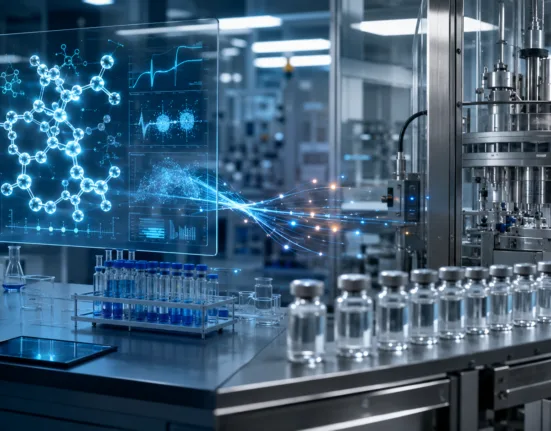
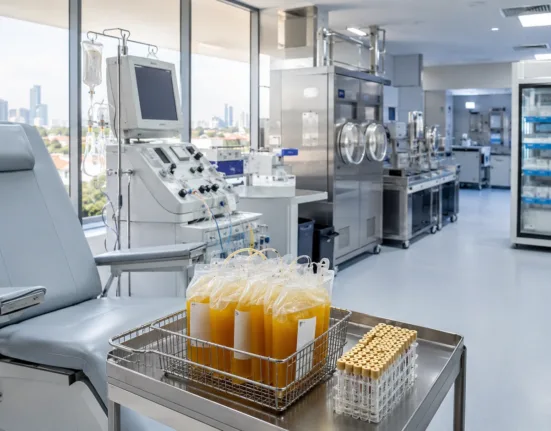
Autonomous laboratories are moving biopharma research away from a model built around manual experimental execution and toward one in which scientists increasingly design questions, govern data quality, interpret machine-generated outputs, and decide which biological hypotheses deserve escalation. The shift is being driven by the convergence of laboratory robotics, artificial intelligence, cloud-connected instruments, electronic lab notebooks, high-throughput screening systems, and closed-loop experimentation platforms that can design, run, analyse, and refine experiments with less day-to-day human handling. Public research and industry disclosures now suggest that the real story is not whether robots will replace scientists, but whether pharmaceutical companies can retrain researchers fast enough to use autonomous labs without creating new risks around reproducibility, model bias, data governance, and regulatory trust. Deloitte’s 2025 R&D Lab of the Future Survey found that only 11% of surveyed biopharma R&D executives said their organisations had reached a fully predictive lab environment, which means the autonomous lab race is still early, uneven, and full of expensive potholes.
The strongest case for autonomous labs is straightforward: drug discovery has become too complex, too data-heavy, and too slow for traditional laboratory workflows to carry alone. Mitsui and Company Global Strategic Studies Institute described pharmaceutical laboratory automation as an evolution from mechanisation to automation and ultimately autonomy, with researchers expected to move toward higher-value work such as hypothesis generation and data analysis as AI increasingly helps explore, design, execute, and analyse experimental conditions. That is a polite way of saying the pipette is losing cultural power, while the research question is becoming the crown jewel.
Why closed-loop experimentation could become the new operating system for biopharma research teams
The defining feature of autonomous labs is the closed loop between design, make, test, and analyse. In a traditional laboratory workflow, researchers may design an experiment, manually run or supervise it, wait for results, analyse outcomes, and then decide what to test next. In a self-driving laboratory, software agents and robotic systems can propose experimental conditions, trigger automated execution, capture instrument outputs, analyse results, and recommend the next round of experiments. Human researchers remain involved, but their role shifts from carrying out every step to supervising the scientific logic and validating whether the machine’s next move is worth trusting.

Nature Synthesis recently described RoboChem-Flex, a modular self-driving laboratory platform that combines custom hardware with Python-based software and Bayesian optimisation strategies for autonomous reaction optimisation. The platform was designed to support fully autonomous closed-loop operation as well as human-in-the-loop configurations, and it was validated across six chemistry case studies including photocatalysis, biocatalysis, thermal cross-couplings, and enantioselective catalysis. While this is chemistry-focused rather than a full clinical drug development engine, it points directly to where biopharma discovery is heading: fewer isolated experiments, more adaptive workflows, and more dependence on high-quality machine-readable experimental data.
For biopharma companies, that matters because early discovery failure is often not caused by a shortage of experiments, but by poor experimental prioritisation, inconsistent data capture, and slow iteration. Autonomous labs could compress experimental cycles, reduce manual variability, and make negative results more useful by feeding them back into predictive models. The commercial implication is equally important. A company that can learn faster from failed screens may not only identify better candidates, but also stop weaker programmes before they consume medicinal chemistry, toxicology, manufacturing, and clinical resources.
How AI agents and laboratory robotics are shifting researchers from execution to orchestration
The phrase “autonomous lab” can sound like science fiction until it is broken down into workflow economics. Robots handle repetitive liquid handling, sample movement, assay preparation, and instrument interaction. Artificial intelligence models help select targets, design molecules, predict binding, optimise reaction conditions, and interpret complex biological or chemical readouts. Data platforms provide the memory layer, preserving experimental context so that future models can learn from what actually happened in the wet lab.
Insilico Medicine recently announced LabClaw, described by the company as a laboratory autonomy system intended to work with its LifeStar2 automated laboratory and coordinate workflows across target discovery, compound screening, automated experimental execution, data analysis, and report generation. The announcement is a company disclosure and should be treated as such, but it is still useful as a marker of how AI-native drug discovery firms are positioning the next phase of lab automation. The important detail is not the branding. It is the claimed movement from “instruction execution” toward “autonomous coordination,” because that is where the researcher’s job description begins to change.
In this model, the biopharma researcher becomes less of a hands-on operator and more of a scientific conductor. They define the experimental objective, specify acceptable constraints, interrogate model assumptions, review outliers, and decide whether an AI-suggested path is biologically meaningful or merely statistically tempting. This creates a new premium on scientists who understand both biology and computational reasoning. The researcher who can challenge an algorithm’s recommendation may become more valuable than the researcher who only knows how to run the assay the algorithm has just optimised.
Why data governance may decide which autonomous biopharma labs actually create value
The uncomfortable truth is that autonomous labs are only as good as the data infrastructure behind them. A robotic system can generate more data, but more data is not automatically better data. If the experimental metadata are incomplete, assay conditions vary across sites, ontologies are inconsistent, or negative results are not captured properly, autonomous labs can simply industrialise confusion at impressive speed. That is not innovation. That is a very expensive way to make bad decisions faster.
Deloitte’s survey data showed that 53% of surveyed R&D executives reported increased laboratory throughput after lab modernisation initiatives, while 45% saw reduced human error, 30% reported greater cost efficiencies, and 27% noted faster therapy discovery. However, Deloitte also found that 31% of respondents still described their R&D labs as digitally siloed, while 34% had reached a connected stage with centralised data and some automation. This gap between modernisation ambition and predictive-lab maturity explains why autonomous labs remain more of a strategic transformation than a plug-and-play technology upgrade.
For researchers, the implication is blunt. Data stewardship is becoming a core scientific skill, not an administrative chore. Experimental notes, assay context, reagent provenance, instrument calibration, cell line history, model versioning, and failed-run documentation all become part of the discovery engine. In an autonomous lab, sloppy metadata can mislead future experiments just as surely as a contaminated sample can spoil a current one.
What autonomous labs mean for regulatory trust in AI-supported drug development
Regulators are not expected to approve a drug because an autonomous lab found it interesting. They will still ask familiar questions: What evidence supports safety, efficacy, quality, and manufacturing control? How was the model used? Was the model’s output verified? Was the dataset representative? Was the context of use clearly defined? The United States Food and Drug Administration’s 2025 draft guidance on artificial intelligence to support regulatory decision-making for drug and biological products focuses on the use of AI to generate information or data intended to support regulatory decisions regarding safety, effectiveness, or quality.
That means autonomous labs may create regulatory advantage only when their outputs are traceable, validated, reproducible, and explainable within a defined context of use. A closed-loop platform that generates elegant results but cannot document how decisions were made will face friction. Conversely, a system that captures every experimental condition, model recommendation, human override, and analytical result could strengthen regulatory submissions by making the discovery and development record more auditable.
This is where the researcher’s role becomes even more important. Scientists will need to act as translators between machine-generated experimentation and regulatory-grade evidence. They will need to explain why a model’s recommendation was accepted, why another was rejected, and how automated results were confirmed through appropriate orthogonal methods. The autonomous lab may run through the night, but the accountable scientific judgment still has a human signature.
Why pharmaceutical companies may treat autonomous labs as a pipeline productivity strategy
The commercial argument for autonomous labs sits inside the broader productivity crisis in pharmaceutical research and development. Companies are under pressure to replenish pipelines, manage patent cliffs, improve capital efficiency, and reduce the cost of failed programmes. Laboratory modernisation is therefore not just an operational upgrade. It is increasingly a pipeline strategy.
McKinsey has argued that agentic artificial intelligence could act as a semi-autonomous partner across drug development, improving speed, efficiency, and quality, and potentially allowing more trials with the same resources while cutting trial durations by as much as 12 months. That claim applies more broadly to drug development workflows rather than autonomous wet labs alone, but it reflects the same strategic logic: biopharma companies are trying to convert AI from a productivity tool into a portfolio acceleration system.
Recent deal activity also shows that large pharmaceutical companies are willing to pay for AI-enabled discovery capabilities. Reuters reported in February 2026 that Takeda Pharmaceutical Company Limited entered a multi-year partnership with Iambic Therapeutics valued at more than $1.7 billion to use artificial intelligence for small-molecule drug design in oncology and gastrointestinal diseases. Reuters also reported that Iambic’s platform is linked to automated lab capabilities that the company says can shorten parts of the drug development timeline, although such claims will ultimately need to be proven through clinical and regulatory outcomes, not partnership headlines.
Could autonomous labs make biopharma researchers more important rather than less relevant?
The fear that autonomous labs will deskill research is understandable, but probably too simplistic. In routine experimental execution, automation will reduce the need for repetitive manual work. In scientific decision-making, however, autonomy may increase demand for researchers who can ask better questions, design stronger validation strategies, and recognise when a model is optimising the wrong thing.
The researcher of the autonomous lab era will likely need a hybrid skill set: domain biology, assay design, statistical literacy, computational fluency, data governance awareness, and regulatory intuition. Medicinal chemists may spend more time defining optimisation objectives and reviewing AI-generated structures. Cell biologists may focus more on assay relevance, biological context, and translational validity. Clinical researchers may need to understand how preclinical AI-generated evidence should, or should not, influence trial design.
The cultural shift may be harder than the technical shift. Laboratories have long treated hands-on experimental skill as a marker of credibility. Autonomous labs will challenge that hierarchy. The best scientist may not be the person who can run the most experiments, but the person who knows which experiment the machine should not run.
What happens next as autonomous labs move from early adoption to biopharma infrastructure
The next phase will likely separate demonstration platforms from enterprise-grade autonomous research systems. Academic and startup platforms can prove that closed-loop experimentation works in defined settings. Large pharmaceutical companies will need something harder: validated, secure, interoperable, compliant, scalable autonomous infrastructure that works across discovery chemistry, biology, translational science, and eventually process development.
The winners may not be the companies with the flashiest robots. They may be the organisations that connect automation to proprietary data assets, standardised workflows, high-quality metadata, and researchers trained to govern AI outputs. Deloitte’s assessment that proprietary wet-lab data quality, breadth, and accessibility could become a durable competitive advantage is especially relevant here. If foundation models become commoditised, the differentiator will be the experimental feedback loop that a company alone can generate.
The expert view is that autonomous labs will not remove the scientist from biopharma research. They will remove some of the slower, more repetitive, and less informative parts of laboratory work. That is good news only for organisations prepared to redesign roles, incentives, governance, and training. Otherwise, they risk buying autonomy as theatre while leaving the underlying science workflow unchanged. Very shiny robots, same old bottlenecks. That movie has played before.
What autonomous labs mean for biopharma researchers
- Autonomous labs are shifting biopharma researchers from manual experiment execution toward hypothesis design, AI supervision, data interpretation, and evidence governance.
- Closed-loop experimentation could accelerate discovery by allowing robotic systems and AI models to design, run, analyse, and refine experiments faster than traditional workflows.
- The biggest value driver is not automation alone, but the feedback loop between wet-lab outcomes and predictive models.
- Data governance is becoming a core research capability because autonomous labs depend on complete metadata, reproducible workflows, and machine-readable experimental context.
- Only a small share of biopharma organisations currently appear to have fully predictive lab environments, which means most companies remain in the early stages of transformation.
- Regulatory trust will depend on whether AI-supported experimental outputs are traceable, validated, reproducible, and linked to a clearly defined context of use.
- Researchers may become more important, not less, if they can challenge AI recommendations, design validation strategies, and connect machine outputs to biological meaning.
- Large pharmaceutical companies are treating AI-enabled discovery and automation as a pipeline productivity strategy rather than a narrow lab efficiency upgrade.
- The next competitive divide may be between companies that merely automate tasks and companies that build autonomous research systems around proprietary, high-quality wet-lab data.
- Autonomous labs will reward biopharma teams that combine scientific judgment, computational literacy, regulatory discipline, and cultural adaptability.