Baxter International Inc. has issued an urgent medical device correction for certain Volara System single-patient use circuits after identifying a risk that air and medication may leak from the nebulizer cup during therapy. The U.S. Food and Drug Administration has flagged the matter as a potentially high-risk device issue, with the concern centred on ineffective nebulized medication delivery, possible patient desaturation, and respiratory deterioration in vulnerable users.
Why does the Baxter Volara System alert matter for respiratory device safety?
The Baxter Volara System alert matters because it sits in one of the most sensitive areas of medtech risk: respiratory support delivered in acute care and home care settings. Devices used for secretion mobilization, lung expansion therapy, pulmonary atelectasis management, and supplemental oxygen support are often used by patients whose breathing status can deteriorate quickly. A leakage issue in such a system is not merely a product-performance problem. It can affect oxygenation, medication delivery, and the reliability of therapy that patients and clinicians may depend on.
The confirmed development is that affected Volara patient circuits may experience leakage from the nebulizer cup during therapy, particularly if the cup is damaged or not properly engaged after medication is added. That raises two connected safety concerns. First, patients may receive less medication than intended, reducing or eliminating the pharmacological benefit of prescribed nebulized therapy. Second, leaks in the breathing circuit can affect delivered tidal volume, creating risk of reduced oxygenation or hypoventilation.
The limitation is that the public alert does not describe a mass injury event. Baxter has reported one serious injury and no deaths associated with the issue as of the company’s May 21 customer communication. However, the FDA’s early alert classification signals that the regulator sees the potential risk as serious enough to warrant public attention before the full recall review is complete. For hospitals, home care providers, distributors, and respiratory therapy teams, that means the story is less about headline severity today and more about preventing a preventable device-use failure from becoming a broader patient safety problem.
What does the Volara patient circuit issue reveal about home respiratory care risk?
The Volara issue highlights how home respiratory care can carry hospital-level safety stakes without hospital-level supervision. Baxter’s Volara System can be used in acute care settings for adults and children over age two, and in home care settings for adults and children over age five. That home care dimension is important because patients or caregivers may be responsible for assembly, inspection, medication loading, and day-to-day troubleshooting outside continuous clinical oversight.
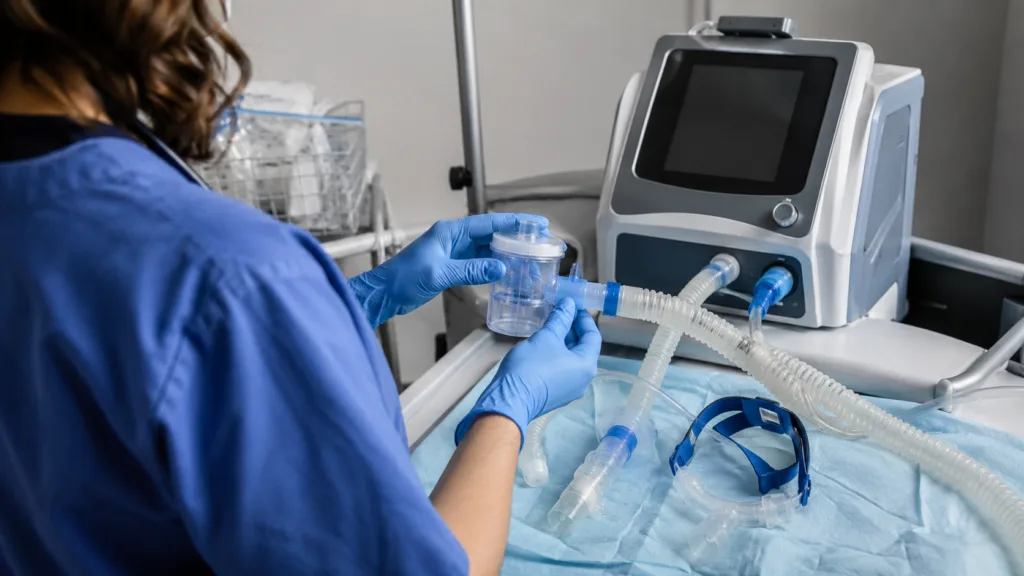
This creates a usability challenge. A nebulizer cup that must be fully and securely locked during assembly sounds straightforward in a controlled clinical environment. In real-world home care, however, patients may be fatigued, anxious, physically limited, visually impaired, distracted, or caring for a child with respiratory vulnerability. Caregivers may also be managing multiple devices and medication routines. A product that depends on correct repeated assembly needs instructions, design cues, training, and safeguards that work under imperfect conditions.
The risk is especially pronounced for pediatric patients receiving therapy at home. A child relying on airway clearance or lung expansion therapy may have limited ability to recognize ineffective treatment or communicate early distress. If leakage reduces medication delivery or oxygenation, deterioration may appear as coughing, shortness of breath, mucus retention, airway inflammation, infection risk, or reduced oxygen levels. The alert therefore reinforces a wider medtech lesson: home-use devices must be evaluated not only for engineering performance, but for how reliably patients and caregivers can use them under pressure.
How could ineffective nebulized therapy affect vulnerable respiratory patients?
The clinical concern is that a damaged or improperly locked nebulizer cup may cause medication leakage and ineffective delivery of prescribed therapy. Mechanical effects from the Volara System may still occur in some circumstances, but if less medication reaches the lungs, the intended pharmacological benefit may be reduced or lost. For patients using nebulized therapy to control inflammation, open airways, manage secretions, or prevent respiratory decline, that gap can matter.
In respiratory care, partial treatment failure may be difficult to spot early. A patient may complete a therapy session and believe treatment was delivered, while the actual medication dose reaching the lungs was inadequate. Over repeated sessions, reduced drug delivery could contribute to worsening symptoms, increased airway inflammation, mucus retention, mucus plugging, infection risk, prolonged coughing, or worsening shortness of breath. These are not abstract risks for patients already using assisted respiratory therapy.
The unresolved issue is how often such leakage occurs in daily use and how reliably inspection prevents it. Baxter has advised customers to inspect the nebulizer cup before each use, ensure it is full and securely locked during assembly, discontinue use if leakage is observed, and replace the patient circuit if necessary. That is a practical mitigation, but it places a meaningful burden on users and care teams. The stronger long-term question is whether instructions for use changes, design updates, distribution checks, or training reinforcement will be enough to reduce recurrence risk.
Why does this alert show the growing importance of usability engineering in medical devices?
The Volara patient circuit issue is a usability story as much as a hardware story. The problem described by Baxter and the FDA involves leakage associated with improper locking after medication is added to the nebulizer cup, as well as possible damage to the cup itself. That means the risk emerges at the interface between device design, user behaviour, component durability, and therapy workflow.
This is exactly where modern medical device quality systems are being pushed harder. Regulators increasingly expect manufacturers to anticipate foreseeable use errors, especially when devices are used by non-professional caregivers in home environments. A device may perform as designed in bench testing, but still create risk if assembly steps are easy to miss, tactile confirmation is unclear, visual indicators are insufficient, or troubleshooting depends on users noticing subtle leakage during therapy.
The limitation is that every home-use device must balance complexity and usability. Respiratory devices often include disposable circuits, medication reservoirs, tubing, oxygen connections, cleaning routines, replacement schedules, and therapy instructions. Adding more warnings does not always improve safety if users become overwhelmed. Baxter’s next challenge is therefore not just to communicate the correction, but to make the safe-use pathway simple enough for repeated use in real homes and busy clinical settings.
How could this issue affect Baxter’s respiratory care reputation and market sentiment?
Baxter is a diversified medtech company, so one Volara patient circuit alert is unlikely to define its entire market story. The latest available trading data showed Baxter shares slightly higher, suggesting investors did not immediately treat the alert as a major company-wide financial shock. That is reasonable given the scale of Baxter’s broader business and the early nature of the device issue.
However, reputation in respiratory care is built on reliability. Products used in vulnerable patients must be trusted by respiratory therapists, home care providers, hospital procurement teams, distributors, physicians, patients, and caregivers. Even when injury reports remain limited, device corrections can create friction if customers worry about training burden, replacement logistics, documentation, patient calls, or increased monitoring needs.
The commercial risk is not only direct cost. It is operational confidence. If home care providers must spend more time educating users, replacing circuits, fielding patient concerns, or documenting corrective actions, the device becomes more burdensome to manage. Baxter can contain that risk by communicating clearly, ensuring adequate replacement circuit supply, updating instructions effectively, and demonstrating that the issue is understood and controlled.
Why are distributors and home care channels central to the correction?
The correction depends heavily on information reaching the right users. Baxter has directed dealers, wholesalers, distributors, resellers, and original equipment manufacturers that distributed affected products to notify their customers and continue distributing the communication until updated instructions are complete. That matters because medical device supply chains are often multilayered, especially for home respiratory care products that may move through durable medical equipment providers, home care companies, hospital discharge channels, and regional distributors.
In such a chain, a manufacturer’s letter is only the first step. The safety impact depends on whether the message reaches respiratory therapists, nurses, biomedical teams, home care coordinators, caregivers, and patients actually assembling the circuits. If any link in the chain fails, affected users may continue therapy without knowing what to inspect or when to replace the circuit.
The risk is that home care communication can be uneven. Patients may have moved, changed providers, discarded documents, or rely on caregivers who were not involved when the device was first supplied. The correction therefore tests not just Baxter’s manufacturing and labelling response, but the resilience of the entire respiratory device distribution network. For medtech companies, this is why post-market safety management increasingly requires traceability, channel discipline, and clear patient-level communication.
What regulatory questions will shape how the FDA handles the Volara issue?
The FDA is reviewing information about the potentially high-risk device issue and has indicated it will update the public as significant new information becomes available. That means the early alert may evolve as the regulator assesses the correction, injury reports, root cause, scope of affected devices, adequacy of customer communication, and whether further action is needed. Early alerts are designed to inform the public before a full recall classification process is complete, which is why the current signal carries weight even without a final enforcement classification.
Regulators will likely focus on whether the corrective actions are sufficient to prevent recurrence. They will also examine whether the instructions for use require updates, whether device design or packaging contributed to improper locking or damage, whether complaint handling captured the issue quickly enough, and whether patient risk differs by care setting or age group. Pediatric home use may receive particular attention because reduced oxygenation or ineffective therapy can become clinically serious quickly.
The unresolved question is whether inspection and replacement guidance will be enough. If the issue is mainly a user-assembly problem, clearer instructions and training may be appropriate. If component design contributes to repeated leakage or damage, regulators may expect stronger design-level mitigation. For Baxter, a contained correction would be preferable. A broader design or supply action would carry greater operational and reputational implications.
What should clinicians and home care teams do with this information?
Clinicians and home care teams should treat the alert as a prompt to tighten workflow around inspection and assembly. The practical safety message is that the nebulizer cup should be checked before each use, filled and locked securely during assembly, and discontinued if leakage is observed. If leakage persists or users are unsure whether therapy should continue, patients and caregivers should contact their healthcare provider or care team.
For respiratory therapists, the alert reinforces the importance of teach-back training. It is not enough to hand over written instructions. Patients and caregivers may need to demonstrate that they can identify the nebulizer cup, lock it properly, recognize leakage, know when to stop therapy, and understand when to replace the circuit. This is especially important in pediatric home care, where caregivers may be anxious and where small changes in respiratory status can escalate quickly.
The limitation is that PDN readers should not treat this article as individual patient guidance. Care decisions belong with clinicians and care teams familiar with the patient’s condition. The industry takeaway is broader: device corrections in home respiratory care must be translated into practical routines that patients and caregivers can actually perform.
What could go wrong if the correction is not executed well?
The first risk is continued ineffective therapy. If affected users do not receive or understand the correction, medication leakage could continue unnoticed. In respiratory patients, ineffective nebulization may not produce an immediate dramatic failure, but it can contribute to gradual worsening, especially in patients with secretion burden, airway inflammation, or oxygenation vulnerability.
The second risk is overcorrection or patient anxiety. Some users may stop therapy unnecessarily if they misunderstand the alert, potentially creating another safety concern. That is why communication must be balanced: inspect the cup, ensure proper locking, replace the circuit if leakage occurs, and involve the care team when there is uncertainty. Alarmist messaging can be as problematic as weak messaging if it disrupts necessary therapy.
The third risk is operational strain. Home care providers and distributors may need to contact customers, document notifications, manage replacement requests, and answer clinical questions. If supply or support is insufficient, the correction could create frustration among customers and patients. Baxter’s ability to provide clear instructions and adequate support will shape how disruptive the issue becomes.
What should medtech observers watch next?
Medtech observers should watch whether the FDA updates the alert with a formal recall classification, expanded injury data, root-cause details, or additional corrective measures. They should also watch whether Baxter updates the instructions for use, issues further customer communication, or changes component design or packaging. Those details will show whether the issue remains a manageable use-related correction or becomes a broader device-quality concern.
Hospital and home care leaders should watch how quickly affected circuits can be identified across inventories and patient homes. The product codes and unique device identifiers matter because they help trace specific affected products. In post-market safety, traceability is not paperwork. It is the mechanism that determines whether risk mitigation reaches the bedside and the home.
Investors should watch whether the matter remains contained. Baxter’s muted market reaction suggests the issue has not yet changed the company’s financial narrative. However, repeated respiratory device alerts, expanded injury reports, or costly corrective actions could alter sentiment. For now, the Volara issue is best understood as a targeted safety alert with meaningful clinical implications but limited immediate market shock.
What is the main takeaway from the Baxter Volara System alert?
The main takeaway is that the Baxter Volara System issue turns a seemingly small component problem into a serious respiratory care safety question. A nebulizer cup that leaks or is not properly locked can reduce medication delivery and potentially affect oxygenation, especially in vulnerable adults and children receiving therapy in acute or home care settings.
For Baxter, the priority is containment, communication, and confidence. The company must ensure that customers understand inspection and replacement steps, that affected users receive clear instructions, and that regulators are satisfied with the corrective approach. For clinicians and home care providers, the priority is practical execution: making sure patients and caregivers can use the device safely every time.
For the wider medtech sector, the story reinforces a simple but important lesson. As more complex therapy moves from hospitals into homes, device safety depends not only on engineering, but on usability, training, traceability, and post-market vigilance. The Volara alert is not just about one patient circuit. It is about whether respiratory technology can remain dependable in the real-world environments where patients increasingly receive care.