BayCare Health System has begun treating cancer patients using the MEVION S250-FIT Proton Therapy System at its US$33 million BayCare Proton Center on the campus of St. Joseph’s Hospital in Tampa, Florida. Announced by Mevion Medical Systems on 5 November 2026, the development makes BayCare the second clinical site worldwide to treat patients using the compact, upright proton therapy platform, following Stanford Medicine’s first treatment in June.
The milestone represents a significant step in the commercial deployment of a proton therapy system designed to fit within a room comparable in size to a conventional medical linear accelerator vault. The technology combines a fixed proton beam with rotating upright patient positioning, removing the need for the large rotating gantry traditionally associated with many proton therapy installations.
BayCare’s investment also provides a practical test of whether a more compact treatment configuration can make proton therapy accessible to additional regional hospital systems. However, smaller infrastructure requirements do not independently establish lower treatment costs, superior clinical outcomes or favourable reimbursement economics. Those questions will depend on patient selection, equipment performance, treatment volumes and operational experience.
How does BayCare’s new proton therapy centre expand cancer treatment in West Central Florida?
The BayCare Proton Center is located within the Fred J. Woods Radiation Therapy Center at St. Joseph’s Hospital in Tampa. It extends the health system’s existing oncology services, which include radiation treatment programmes at St. Joseph’s Hospital, Morton Plant Hospital in Clearwater, St. Anthony’s Hospital in St. Petersburg and Winter Haven Hospital.
BayCare invested approximately US$33 million in the new proton centre, including the addition of a treatment vault and associated infrastructure. That figure represents the announced centre investment and should not be interpreted as the standalone purchase price of the Mevion equipment.
The centre serves adults and children who may be appropriate candidates for proton therapy. BayCare had announced that the facility was open and accepting patients on 14 October 2026, while the subsequent November announcement confirmed that patients were receiving treatment using the new platform.
This distinction in the chronology is important. The October opening established the service’s availability, while the November milestone demonstrated that the installed system had progressed into clinical treatment delivery.
BayCare is a not-for-profit healthcare system operating 16 hospitals across West Central Florida. Integrating proton therapy into its existing oncology network may allow eligible patients to receive specialised radiation treatment without necessarily transferring their overall cancer care to a distant centre.
For regional health systems, the ability to deliver proton therapy within an established cancer service can be commercially and operationally important. It may support referrals from affiliated oncologists, consolidate treatment planning and reduce some of the coordination involved when patients are referred to independent proton therapy facilities.
However, the availability of a local system does not mean that every cancer patient will benefit from proton therapy. Radiation oncologists must assess the disease, treatment objectives and potential advantages relative to other available radiotherapy techniques.
The centre’s long-term clinical contribution will depend on how successfully BayCare identifies appropriate patients and integrates the technology into multidisciplinary cancer treatment pathways.
Why does the Mevion S250-FIT use a fixed proton beam and upright patient positioning?
Traditional proton therapy facilities commonly use large rotating gantries to direct beams towards tumours from different angles. These structures can require substantial building space, specialised shielding and considerable construction expenditure.
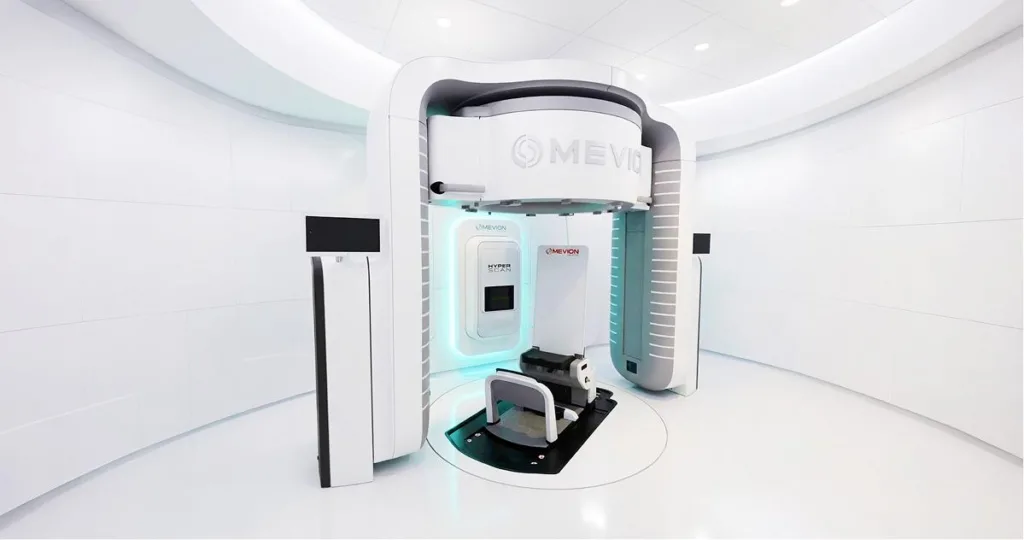
The MEVION S250-FIT takes a different architectural approach. It uses a compact accelerator and fixed proton beam, while Leo Cancer Care’s Marie positioning system rotates the patient to achieve the treatment geometry required by the plan.
The Marie platform provides 360-degree patient rotation with integrated CT imaging, allowing patients to be positioned and imaged in the upright treatment configuration. Mevion’s HYPERSCAN pencil beam scanning technology supports delivery of planned proton dose distributions.
The treatment planning component is provided through RaySearch Laboratories’ RayStation software. Together, these technologies form an integrated system in which imaging, positioning, planning and beam delivery must operate consistently.
Removing the rotating gantry reduces the spatial requirements associated with conventional installations. Mevion says the system can fit inside a standard linear accelerator-sized treatment vault, making it compatible with the infrastructure scale of many existing radiation oncology departments.
The distinction could become important for hospitals considering proton therapy but lacking the space required for a large dedicated facility. A compact configuration may provide a pathway for incorporating proton treatment into an established cancer centre rather than building a separate multiroom complex.
However, BayCare’s project still required a US$33 million investment and the construction of an additional treatment vault. The announcement therefore demonstrates deployment within a smaller room configuration, not the elimination of infrastructure costs.
There are also clinical and operational questions associated with rotating the patient rather than the beam. Treatment teams must ensure that patient anatomy, immobilisation, target alignment and internal organ position remain appropriately accounted for throughout planning and delivery.
The approach changes the engineering architecture, but the fundamental radiation oncology requirement remains unchanged: deliver the prescribed dose to the target while limiting exposure to surrounding healthy tissue.
What clinical advantages could seated proton therapy offer adults and children?
Proton therapy uses charged particles that deposit much of their energy at a controlled depth within tissue. Compared with conventional photon radiotherapy, this physical characteristic can reduce radiation exposure beyond the intended treatment region in appropriately planned cases.
Such dose distribution differences can be particularly relevant when tumours are located near sensitive structures. The potential clinical value depends on the anatomical site, treatment objectives and whether the reduction in normal tissue dose translates into meaningful benefits for the individual patient.
The Mevion system introduces an additional consideration through upright treatment positioning. Patients receive therapy while seated rather than lying on a conventional treatment table.
For some adults, a seated position may be more comfortable or easier to maintain. BayCare has highlighted the potential relevance for individuals with medical conditions that make lying flat difficult, including certain respiratory conditions.
Upright positioning may also offer practical advantages for selected paediatric patients, although comfort and treatment suitability must be evaluated individually. Children may still require specialised immobilisation, preparation or other clinical support depending on their age and ability to remain still.
BayCare’s medical director of radiation oncology, John Greskovich, has indicated that the upright system offers the treatment team additional positioning flexibility while maintaining the precision required for proton delivery.
However, the announcement does not provide comparative patient-reported outcomes demonstrating that seated treatment reduces discomfort, anxiety or sedation requirements relative to conventional systems.
Nor does it establish that upright proton therapy improves tumour control or long-term survival compared with other radiation techniques. Such outcomes would require appropriately designed clinical research and sufficient follow-up.
The clinical opportunity is therefore best described as greater positioning flexibility and access to a particular method of delivering proton therapy, rather than proof of a universally better treatment experience.
Does the Mevion S250-FIT have FDA clearance for clinical use?
The MEVION S250-FIT Proton Beam Radiation Therapy Device has received United States Food and Drug Administration 510(k) clearance. The FDA’s device database records an initial clearance decision dated 12 September 2025, together with a subsequent clearance decision on 25 March 2026.
The regulatory classification identifies the system as a medical charged-particle radiation therapy device. Its clearance provides a regulatory basis for marketing the device in the United States within the relevant intended use.
The distinction between clearance and approval is important. The 510(k) pathway involves a determination of substantial equivalence to an appropriate predicate device and should not be described as a premarket approval decision demonstrating superior patient outcomes.
Mevion has also disclosed that the S250-FIT is CE-marked under the European Union Medical Device Regulation. That provides a separate regulatory foundation for the applicable European market, subject to the precise certified intended use and other requirements.
These regulatory milestones support the manufacturer’s ability to market and deploy the system, but they do not establish that every proposed cancer indication is clinically superior when treated using the compact configuration.
Hospitals must still ensure that the installed equipment is appropriately commissioned, maintained and operated according to applicable radiation safety and quality assurance requirements.
The distinction between device clearance and clinical adoption is particularly relevant for capital-intensive medical technologies. Regulatory authorisation enables commercial activity, while actual use depends on hospital investment, qualified staff, treatment planning capabilities and patient demand.
BayCare’s first patient treatments therefore represent a commercial and operational milestone beyond the earlier regulatory decisions.
How will upright imaging and treatment planning affect radiation oncology workflow?
Proton therapy is sensitive to differences between the planned and actual position of tissues because beam range depends on the materials and anatomy through which particles travel. Changes in patient positioning or internal anatomy can therefore affect the delivered dose distribution.
The integrated CT imaging and upright positioning system are intended to support accurate treatment setup in the configuration used during irradiation. This is especially important when patient rotation changes the orientation of the body relative to the fixed beam.
Radiation oncologists and medical physicists must ensure that the planned dose distribution remains appropriate for the patient’s treatment position. Imaging protocols, immobilisation methods, patient movement and anatomical changes all require consideration.
Mevion’s compact system incorporates HYPERSCAN pencil beam scanning, allowing dose delivery to be shaped according to the approved treatment plan. The clinical effectiveness of this process depends on accurate planning, equipment calibration and reliable execution.
The RayStation software platform supports the planning workflow, while the Marie system provides the positioning and imaging components required for the upright configuration.
A hospital introducing this architecture must establish operational procedures suited to the interaction of the technologies. Staff training, quality assurance and contingency planning are important because an integrated system introduces dependencies between multiple hardware and software components.
For example, changes in patient position may require verification of anatomical alignment before dose delivery. Treatment teams also need processes for managing patients who cannot comfortably maintain the planned position throughout the treatment session.
Mevion has described the system as an approach that may allow greater integration of proton therapy into existing radiation departments. Whether it improves throughput or reduces treatment time will depend on actual clinical workflow, including patient preparation, imaging, verification and beam delivery.
The November announcement does not disclose BayCare’s treatment times, daily patient capacity or measured operational efficiency. Those figures will be important for assessing how the technology performs outside its initial installation environment.
Why could compact proton therapy change the economics of hospital radiation oncology?
Proton therapy has historically required substantial capital expenditure because of the size and complexity of accelerator installations, rotating gantries, shielding and supporting infrastructure.
A system designed for a conventional linear accelerator-sized vault may lower some infrastructure barriers, potentially making proton therapy more feasible for regional hospitals that could not accommodate a large dedicated facility.
The BayCare installation demonstrates that a multispecialty regional healthcare system can integrate the technology within an established cancer programme. Its US$33 million investment provides a concrete example of the financial commitment associated with this configuration.
However, the project cost should not be used as a direct comparison with every conventional proton facility. Total investment depends on whether existing infrastructure is reused, the number of treatment rooms, local construction requirements, equipment specifications and associated services.
A single-room installation may have lower initial infrastructure requirements than a large multiroom complex, but it can also have different capacity and utilisation characteristics. The number of patients treated each day influences the ability to spread fixed costs across clinical activity.
Hospitals must consider the full cost of ownership, including equipment maintenance, service contracts, staffing, clinical software, quality assurance and future upgrades. A smaller physical footprint does not necessarily reduce all these operating requirements.
Reimbursement adds another layer of uncertainty. Proton therapy coverage varies according to the patient’s diagnosis, clinical circumstances and payer requirements.
Medicare coverage policies generally examine whether the radiation dose to normal tissue can be meaningfully reduced and whether proton therapy is medically necessary for the specific clinical situation. Commercial insurance policies may apply additional criteria or prior authorisation requirements.
A hospital therefore cannot assume that every patient eligible for radiotherapy will qualify for reimbursed proton treatment. Referral patterns and payer decisions can materially influence utilisation and financial returns.
For BayCare, the commercial test will be whether the centre achieves sufficient medically appropriate patient volume while maintaining treatment quality and an economically sustainable service.
What does BayCare’s installation mean for Mevion Medical Systems and its technology partners?
BayCare is the second clinical site worldwide to treat patients using the S250-FIT platform, following Stanford Medicine Cancer Center’s first treatment on 4 June 2026.
Stanford’s installation established the initial clinical deployment of the compact upright configuration. BayCare’s subsequent treatment milestone extends that experience into a regional healthcare system, providing a different institutional setting in which the technology can be evaluated.
This progression is important for Mevion Medical Systems because medical technology adoption often depends on successful reference installations. Prospective hospital customers may want evidence that a system can be installed, commissioned and operated reliably in facilities with different layouts and clinical workflows.
The platform also represents a commercial opportunity for its technology partners. Leo Cancer Care supplies the upright positioning and imaging system, while RaySearch Laboratories provides the treatment planning software.
The manufacturers collectively benefit from demonstrating that their technologies can operate as an integrated clinical platform. However, each partner’s commercial contribution depends on its contractual arrangements, software licensing, service obligations and future installations.
Mevion has indicated that approximately a dozen additional S250-FIT programmes are in installation or planning across the United States, Europe and Asia. These projects should not all be treated as completed installations or revenue-generating treatment centres.
The company has not disclosed contract values, completion dates or financial terms for each programme in the November announcement. Consequently, the prospective installations indicate commercial interest but do not establish the precise value of Mevion’s order backlog.
The manufacturer is privately held, so the BayCare milestone does not have a directly observable impact on a publicly traded Mevion share price.
For RaySearch Laboratories, which is publicly traded in Sweden, the announcement provides evidence of another clinical deployment involving RayStation. However, the financial contribution of this particular installation has not been disclosed, making it inappropriate to infer a material earnings effect from the treatment milestone alone.
What must BayCare demonstrate before compact proton therapy becomes a wider hospital model?
BayCare’s first clinical treatments establish that the installed system has progressed beyond planning, construction and commissioning into patient care. The next phase will involve accumulating operational and clinical experience across appropriately selected adult and paediatric patients.
Patient positioning reliability, treatment accuracy, workflow consistency and quality assurance will be important measures of performance. The centre will also need to demonstrate that its staffing and service arrangements can support routine operations over time.
Clinical outcomes will take longer to assess. Proton therapy’s potential benefits depend on the type of cancer, anatomical location and individual treatment plan, while long-term toxicity and tumour outcomes require appropriate follow-up.
For hospitals evaluating similar installations, BayCare’s experience may provide useful information about construction requirements, treatment workflow and operating costs. However, a successful installation at one regional healthcare system does not automatically establish that the same economics apply elsewhere.
The broader adoption opportunity will depend on whether compact systems can achieve a sustainable balance between infrastructure expenditure, treatment capacity and reimbursed clinical demand.
Mevion Medical Systems has now demonstrated deployment at both an academic medical centre and a regional health system. That is a relevant step towards commercial maturity, but meaningful expansion will require additional completed installations and consistent operational performance.
BayCare’s US$33 million proton centre therefore represents more than the introduction of another radiotherapy device. It tests whether a substantially different system architecture can bring proton therapy into a broader range of hospitals while maintaining the planning precision, clinical quality and economic discipline required for routine oncology care.