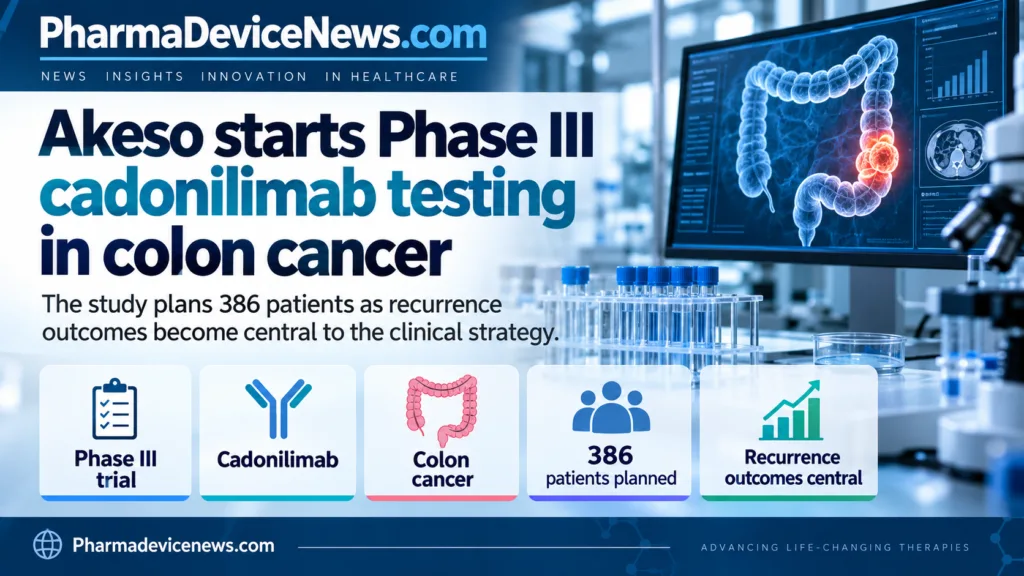
Akeso, Inc. (HKEX: 9926) announced on October 10, 2026, that the first patient has received cadonilimab in COMPASSION-40, a Phase III trial investigating the PD-1/CTLA-4 bispecific antibody before and after surgery for resectable microsatellite instability-high or mismatch repair-deficient colon cancer. The study advances cadonilimab into a curative-intent treatment setting where its clinical value will ultimately depend on whether early tumour responses translate into fewer recurrences and longer survival.
The development extends an established oncology product into a new investigational indication rather than introducing an entirely new therapeutic candidate. Cadonilimab already has marketing approvals in China for specified cervical and gastric cancer indications, while its use in resectable MSI-H/dMMR colon cancer remains under clinical investigation. Akeso describes COMPASSION-40, also designated AK104-313, as the thirteenth Phase III or registrational study within the drug’s broader development programme.
The central challenge is increasingly demanding because checkpoint immunotherapy has already produced substantial pathological responses in localised dMMR colon cancer. Emerging evidence from several development approaches suggests that this molecular subgroup can be particularly sensitive to immune intervention before surgery. Cadonilimab must therefore demonstrate more than encouraging tumour clearance if it is to establish a differentiated role within a rapidly developing treatment landscape.
How will Akeso’s COMPASSION-40 Phase III trial evaluate cadonilimab against postoperative chemotherapy?
COMPASSION-40 is designed as a randomised, open-label, multicentre Phase III study with an estimated enrolment of 386 patients. The registered population includes adults aged 18 to 75 with resectable stage IIB to III colon adenocarcinoma and confirmed MSI-H or dMMR status. Eligible participants must have an Eastern Cooperative Oncology Group performance status of zero or one and be considered suitable for curative-intent surgical resection.
The experimental arm receives cadonilimab monotherapy before and after surgery, while the control arm receives physician-selected adjuvant chemotherapy after surgery. The registered chemotherapy options include fluoropyrimidine-based treatment with agents such as capecitabine, fluorouracil and oxaliplatin, with calcium folinate included where appropriate. This design allows the trial to investigate a perioperative immunotherapy strategy against an established postoperative chemotherapy approach rather than against another checkpoint inhibitor.
Two primary outcome measures define the study’s central clinical questions. Pathological complete response assesses the absence of residual viable tumour in the primary tumour site and regional lymph nodes following treatment and surgery, while event-free survival measures the period from randomisation until disease progression, postoperative local or distant recurrence, or death from any cause. Overall survival, complete surgical resection, pharmacokinetics, immunogenicity and adverse events are among the additional measures.
The combination of pathological and time-to-event endpoints is particularly relevant to the regulatory interpretation of the trial. Pathological complete response provides relatively early evidence of antitumour activity, whereas event-free survival examines whether that activity translates into durable disease control. Because the experimental group receives treatment before surgery while the control group proceeds directly to postoperative therapy, interpretation of pathological response will also require attention to the trial’s prespecified statistical analysis.
The registration identifies China as the study location and Sun Yat-sen University Cancer Center among the participating institutions. Its recorded primary completion estimate is June 2030, with overall study completion estimated for March 2031. These remain planning dates rather than confirmed readout commitments, and the timing of meaningful survival evidence will depend on recruitment, follow-up and the accumulation of clinical events.
What do the earlier cadonilimab studies actually establish about MSI-H and dMMR colorectal cancer?
Akeso’s decision to advance cadonilimab into Phase III follows earlier clinical research demonstrating substantial pathological responses in biomarker-selected colorectal cancer populations. At the 2024 European Society for Medical Oncology Immuno-Oncology Congress, a Phase II study reported a pathological complete response rate of 84.6% and a major pathological response rate of 100% among 13 patients who underwent surgery. Those percentages correspond to 11 complete pathological responses and 13 major pathological responses in the reported surgical group.
The findings supported further investigation of cadonilimab as neoadjuvant monotherapy, but the small patient population limited conclusions about long-term efficacy and reproducibility. The study did not establish that cadonilimab prevented recurrence more effectively than standard postoperative treatment. Its pathological response findings also cannot independently establish that dual-target bispecific therapy is superior to other checkpoint blockade approaches.
Additional data presented at the 2026 American Society of Clinical Oncology Annual Meeting provide a more recent perspective. A separate single-arm, multicentre basket study evaluated perioperative cadonilimab in locally advanced MSI-H/dMMR gastric, gastroesophageal junction and colorectal cancers. In the colorectal cohort of 18 patients, investigators reported a pathological complete response rate of 66.7% and a major pathological response rate of 72.2%.
The same 2026 conference abstract reported 12-month overall survival, event-free survival and disease-free survival rates of 100% in that colorectal cohort, with a median follow-up of 12.6 months. These findings remain preliminary in their ability to establish durable benefit because the cohort was small, follow-up was limited and the study lacked a randomised comparator. The 66.7% complete response rate also comes from a different clinical study than the earlier 84.6% result, so the numerical difference should not be interpreted as evidence of declining treatment activity.
The progression from these exploratory datasets to COMPASSION-40 changes the evidentiary requirements substantially. A favourable Phase III result would need to be interpreted against the prespecified endpoints, statistical testing plan, safety findings and durability of clinical benefit. High pathological response rates remain scientifically encouraging, but they are not interchangeable with confirmed reductions in cancer recurrence or mortality.
Why could MSI-H and dMMR biology make dual checkpoint blockade relevant before colon cancer surgery?
Microsatellite instability-high and mismatch repair-deficient tumours develop abnormalities in the biological systems responsible for correcting DNA replication errors. These deficiencies can result in elevated mutation burdens and the generation of abnormal proteins that make cancer cells more recognisable to the immune system. The resulting tumour biology helps explain why checkpoint inhibitors have demonstrated clinically important activity in several MSI-H/dMMR malignancies.
Cadonilimab is designed to inhibit two immune checkpoint pathways through a single bispecific antibody. PD-1 blockade aims to restore the activity of T cells suppressed by tumour-associated immune signalling, while CTLA-4 inhibition targets another mechanism regulating T-cell activation. Akeso’s therapeutic hypothesis is that simultaneous blockade could strengthen antitumour immune responses during the period when the primary tumour remains present and after surgical removal.
The perioperative setting introduces considerations that are different from treatment of metastatic disease. Before surgery, the intact tumour may provide a source of tumour-associated antigens that supports immune recognition and activation. Following surgery, continued immune treatment is intended to address residual microscopic disease, although the incremental contribution of postoperative cadonilimab will require clinical evaluation.
This strategy is biologically plausible, but the existence of two checkpoint targets does not establish greater clinical benefit or lower toxicity than treatment with separate antibodies. The balance between intensified immune activation and immune-related adverse events remains relevant, particularly when therapy is administered to patients who may already be curable through surgery and established postoperative management. COMPASSION-40 will need to determine whether its proposed treatment sequence offers sufficient clinical value to justify the additional intervention.
How does Akeso’s colon cancer programme compare with the NICHE-2 immunotherapy evidence?
One of the most important reference points is NICHE-2, a Phase II study investigating neoadjuvant nivolumab plus ipilimumab in locally advanced mismatch repair-deficient colon cancer. Published results in the New England Journal of Medicine included 115 enrolled patients, of whom 113 underwent surgery within the prespecified safety window. Among 111 patients included in the efficacy analysis, investigators reported a pathological response rate of 98%, a major pathological response rate of 95% and a pathological complete response rate of 68%.
The study also reported grade 3 or 4 immune-related adverse events in 4% of patients, while no participants discontinued treatment because of adverse events. At the reported median follow-up of 26 months, no disease recurrences had been observed, although the three-year disease-free survival endpoint had not yet matured. These results provided important clinical evidence supporting the evaluation of short-course dual checkpoint blockade before surgery.
Cadonilimab differs structurally from the nivolumab and ipilimumab combination because its two checkpoint-targeting activities are incorporated into one bispecific molecule. That distinction may have implications for pharmacology, treatment administration and manufacturing, but it does not establish clinical superiority. Differences in disease stage, treatment schedule, patient selection, study design and follow-up also prevent reliable efficacy rankings based on the reported complete response percentages.
The more important competitive question is whether cadonilimab can produce a favourable balance of durable disease control, perioperative safety and treatment burden. As other checkpoint strategies accumulate longer follow-up, the evidence threshold for establishing a new perioperative regimen is likely to become more demanding. COMPASSION-40 therefore enters a treatment field where the biological rationale is increasingly well supported, but differentiation will depend on prospective comparative evidence.
How does the ATOMIC Phase III trial change the evidence landscape for postoperative immunotherapy?
The competitive environment extends beyond neoadjuvant checkpoint blockade. The Phase III ATOMIC study demonstrated that adding atezolizumab to postoperative chemotherapy improved disease-free survival in patients with resected stage III mismatch repair-deficient colon cancer. Its findings, published in the New England Journal of Medicine in March 2026, provide randomised evidence that immunotherapy can influence clinically meaningful recurrence outcomes in this biomarker-defined population.
ATOMIC enrolled 712 patients and compared modified FOLFOX6 chemotherapy plus atezolizumab with modified FOLFOX6 alone. After a median follow-up of 40.9 months, the published three-year disease-free survival rate was 86.3% in the atezolizumab combination group and 76.2% in the chemotherapy-only group. The reported hazard ratio of 0.50 indicated a statistically significant reduction in the relative hazard of recurrence or death.
Safety remained an important consideration. Grade 3 or 4 adverse events occurred in 84.1% of patients receiving atezolizumab plus chemotherapy compared with 71.9% receiving chemotherapy alone. The results established an efficacy benefit for the studied combination while also demonstrating that intensifying postoperative treatment can increase adverse-event burden.
ATOMIC and COMPASSION-40 address different clinical strategies, making direct comparisons inappropriate. ATOMIC investigated immunotherapy added to chemotherapy after surgery, while COMPASSION-40 is evaluating cadonilimab monotherapy before and after surgery against postoperative chemotherapy. However, ATOMIC strengthens the broader evidence base for checkpoint inhibition in early-stage dMMR colon cancer and makes durable disease-control outcomes especially relevant to future treatment development.
For Akeso, demonstrating pathological tumour clearance alone may not be sufficient to establish a compelling clinical position as competing approaches generate increasingly mature survival evidence. The strongest potential contribution would be a favourable event-free survival result accompanied by acceptable perioperative safety and a treatment schedule that can be implemented consistently. Whether the chemotherapy-free investigational strategy can achieve that combination remains unproven.
What safety and surgical risks will matter in perioperative cadonilimab treatment?
Immunotherapy administered before curative-intent surgery requires careful assessment of adverse events that could delay an operation, complicate recovery or interrupt subsequent treatment. PD-1 and CTLA-4 blockade can produce immune-mediated toxicities affecting organs such as the gastrointestinal tract, liver, lungs, endocrine glands and, less commonly, the heart. The frequency and severity of these complications cannot be inferred solely from the drug’s mechanism or from experience with different treatment regimens.
The 2026 American Society of Clinical Oncology basket-study abstract reported grade 3 or 4 adverse events during neoadjuvant treatment in two of the 18 colorectal patients, representing 11.1%. Adverse events of any grade occurred during neoadjuvant treatment in 17 patients, or 94.4%, with commonly reported events including rash, infusion-related reactions, anaemia and cough. No grade 5 adverse events were reported across the study’s two cohorts, although the limited sample sizes restrict conclusions about uncommon or delayed toxicities.
COMPASSION-40 will provide a larger population for examining treatment-related interruptions, surgical outcomes and longer-term tolerability. Its registered secondary measures include the R0 resection rate, which assesses complete surgical removal with microscopically negative margins. The study will also follow adverse events and clinically significant laboratory abnormalities over an extended observation period.
Safety evaluation will be especially important when pathological responses are favourable because patients may remain exposed to treatment after tumour removal. The duration of postoperative immunotherapy, tolerability over repeated cycles and relationship between additional exposure and recurrence prevention will influence the eventual clinical assessment. A successful efficacy result would still require a satisfactory benefit-risk balance in a population treated with curative intent.
Could cadonilimab’s existing approvals support a new commercial opportunity in colon cancer?
Cadonilimab has already progressed through several regulatory and commercial milestones in China. The National Medical Products Administration initially approved the drug in June 2022 for specified patients with relapsed or metastatic cervical cancer following platinum-based chemotherapy. Additional authorisations followed for first-line treatment of locally advanced unresectable or metastatic gastric or gastroesophageal junction adenocarcinoma in combination with chemotherapy in September 2024, and for a defined first-line cervical cancer regimen in May 2025.
Those authorisations establish cadonilimab as a marketed oncology medicine within its approved indications, but they do not extend to the resectable colon cancer population being studied in COMPASSION-40. Any future label expansion would require an appropriate regulatory application and evidence supporting the proposed treatment setting. Manufacturing experience and established commercial infrastructure may provide operational advantages, but neither substitutes for confirmatory clinical data.
Akeso’s broader commercial position has also strengthened. The company reported approximately RMB 1.80 billion in commercial drug sales revenue during the first half of 2026, representing year-on-year growth of 28.7%. It also reported approximately RMB 9.16 billion in cash, cash equivalents and other short-term financial assets, providing financial capacity across a diversified clinical development portfolio.
The figures relate to Akeso’s wider operations rather than potential revenue from the new colon cancer indication. Cadonilimab contributes to a commercial and development portfolio that also includes ivonescimab, the company’s PD-1/VEGF bispecific antibody. The scale of that portfolio means COMPASSION-40 should be assessed as one component of a broader strategy to establish multiple treatment uses for its immuno-oncology platforms.
Commercially, MSI-H/dMMR represents a molecularly defined subset rather than the entire colon cancer population. Its clinical relevance is substantial because a proportion of nonmetastatic colon cancers exhibit mismatch repair deficiency, but biomarker prevalence cannot be translated directly into obtainable sales. Disease stage, testing practices, treatment eligibility, competing clinical evidence, reimbursement decisions and the duration of therapy would all influence the eventual market opportunity.
What does Akeso’s latest share performance indicate about expectations for its expanding oncology pipeline?
Akeso shares closed at HK$109.10 on the Hong Kong Stock Exchange on October 9, 2026, rising 3.22% during the session. The stock gained approximately 2.15% over the five trading sessions ending that day, although movements during the period were uneven. Because the cadonilimab first-patient announcement was released on October 10, the preceding session’s performance should not be attributed to the new study disclosure.
The shares have been influenced by a broader sequence of clinical and commercial developments, particularly involving ivonescimab and cadonilimab. Akeso’s expanding Phase III portfolio provides multiple potential clinical catalysts, although additional trials also increase development spending and execution requirements. First-patient dosing is principally an operational milestone, not evidence that the probability of regulatory success has materially changed.
From a valuation perspective, the colon cancer programme is best characterised as a longer-duration pipeline opportunity rather than an immediate commercial event. The registered study timeline indicates that mature confirmatory evidence may take several years, while other Akeso programmes could generate more consequential results sooner. Its existing product revenue and liquidity provide greater financial flexibility than would be available to a biotechnology company dependent entirely on one investigational asset.
The eventual commercial significance of COMPASSION-40 will depend on whether cadonilimab establishes durable clinical benefit, secures authorisation for the relevant indication and achieves meaningful adoption in a field with increasingly competitive immunotherapy evidence.
Which clinical milestones will determine whether cadonilimab can advance toward perioperative colon cancer approval?
The immediate priority is enrolling the planned study population while maintaining consistent biomarker confirmation, surgical assessment and treatment delivery across participating centres. MSI-H and dMMR testing will be fundamental because the trial’s biological rationale and eligibility criteria are tied directly to those molecular characteristics. Variability in patient selection or treatment timing could complicate interpretation, particularly if early pathological responses differ across disease stages.
Pathological complete response findings could provide an earlier indication of treatment activity, but event-free survival will be essential to understanding whether the regimen changes clinically important outcomes. The relationship between the two measures will be particularly informative if tumour clearance appears favourable while recurrence events remain limited. Longer follow-up will also be necessary to evaluate overall survival and the durability of any observed benefit.
Regulatory expectations may evolve while the trial progresses as new evidence emerges from competing perioperative and adjuvant immunotherapy studies. In that environment, a statistically persuasive result will need to be accompanied by a clinically meaningful treatment effect, appropriate safety data and a clearly defined patient population. Regulatory acceptance of one endpoint or treatment strategy cannot be assumed from success in another study.
Akeso’s October 2026 announcement establishes that COMPASSION-40 has reached first-patient dosing, moving the programme into active Phase III clinical evaluation. Earlier cadonilimab studies have demonstrated substantial pathological responses in selected patients, but the pivotal trial has yet to establish whether the treatment reduces recurrence or improves survival compared with its control regimen. The defining test is whether perioperative cadonilimab can convert those early tumour responses into durable benefit while preserving the safety and surgical outcomes required in curative-intent colon cancer care.