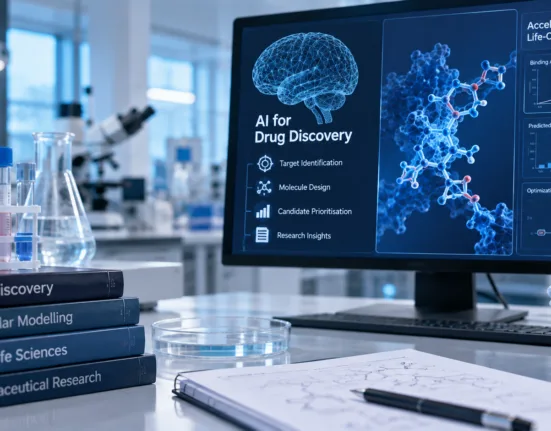
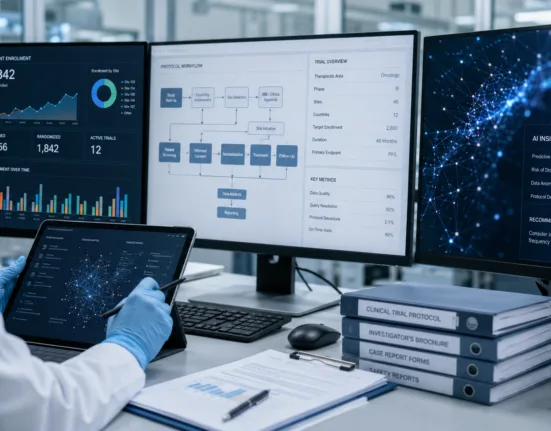
Generative artificial intelligence has spent the last several years helping scientists search literature, write code, interpret data and generate hypotheses. The next stage could be substantially more consequential: allowing the artificial-intelligence system to leave the computer screen, control laboratory hardware and perform physical experiments itself.
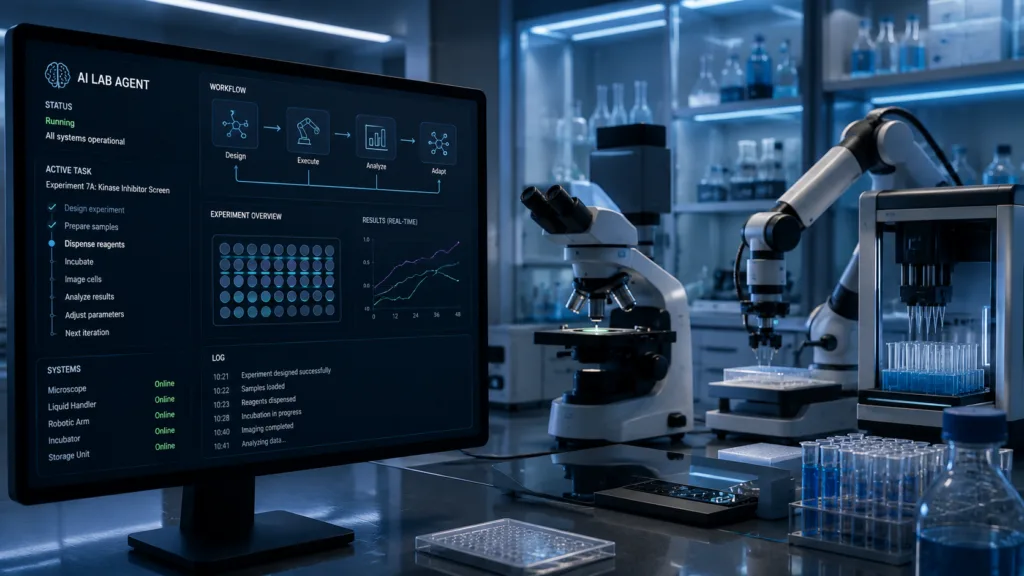
Anthropic has opened a research preview of the Model Hardware Standard, or MHS, a shared framework designed to let AI agents safely communicate with and operate programmable scientific and manufacturing equipment. The system can connect agents with instruments including microscopes, liquid handlers, robotic arms and laser systems, allowing software to coordinate several pieces of equipment, change experimental parameters and, in some cases, recover from hardware errors without a human scientist directly intervening.
The technology originated through collaboration between Anthropic and the Howard Hughes Medical Institute’s Janelia Research Campus. Anthropic is now testing the early specification with research and industrial partners before making it open source, while organizations associated with the work include scientific institutions and companies exploring applications ranging from biology to quantum computing.
What exactly can an AI agent do inside a physical laboratory?
A typical modern laboratory contains equipment from numerous manufacturers, often using proprietary software and different communication protocols. A scientist might prepare samples using one system, move them manually into another instrument, export results into a separate analysis package and then decide how to modify the next experiment.
Model Hardware Standard attempts to create a common communication layer between AI software and those machines.
Instead of building a bespoke integration for every microscope, robotic arm or liquid-handling platform, developers can theoretically expose device capabilities through one standardized interface. The AI agent can then determine which equipment is available, send instructions and receive experimental results.
Anthropic says integrations that can traditionally require weeks or months of engineering may potentially be reduced to hours or minutes under a standardized approach.
The more consequential capability is not simply remote control. The agent can reason about experimental progress and adjust parameters as new information arrives.
That creates the possibility of a closed loop: propose an experiment, run it, examine the result, modify the hypothesis and start the next experiment without waiting for a human scientist to return to the laboratory.
Could autonomous laboratories speed up drug discovery?
Drug discovery is filled with repetitive experimental cycles.
Scientists may test thousands of compounds, alter protein sequences, optimize reaction conditions, culture cells, measure biological responses and repeat unsuccessful experiments with slightly different parameters. Even when individual procedures are automated, deciding what should happen next often requires human interpretation.
An AI-controlled laboratory could potentially connect reasoning and automation into the same workflow.
Consider early antibody or protein development. An artificial-intelligence model might design candidate sequences, instruct a robotic liquid handler to prepare experiments, direct analytical equipment to measure binding and then use those results to generate the next design round.
Anthropic has separately reported that Claude models designed protein binders against 15 targets and achieved successful binding against 14, with individual-design success rates in some settings exceeding historical benchmarks cited by the company.
Combining that digital design ability with hardware control creates the possibility that future AI systems will not merely recommend molecules for scientists to test. They could test many of those molecules themselves.
Does this mean AI can replace laboratory scientists?
Not based on the current technology.
Scientific research includes far more than operating instruments. Researchers decide which questions are worth answering, evaluate whether an experimental design is biologically meaningful, identify hidden confounders, manage unexpected safety problems and interpret results within a much broader body of knowledge.
Physical laboratories also contain countless tasks that remain difficult to automate, including maintaining complex biological systems, handling unusual samples and troubleshooting failures that were never anticipated by software developers.
The more plausible near-term future is AI supervising highly automated portions of experimentation while human researchers define objectives and review critical decisions.
That model could still be transformative. A small research team might supervise several automated experiments running simultaneously rather than manually executing one experiment at a time.
The scientist becomes less of a machine operator and more of an experimental strategist.
Why could around-the-clock experiments matter so much?
Biological research frequently contains downtime that has little scientific value.
A machine may finish a run at 2 a.m., but the next experiment does not begin until a scientist arrives hours later. A measurement may reveal that one concentration is clearly ineffective, yet the instrument continues completing an entire predefined protocol because nobody is present to modify it.
An AI agent connected to the equipment could respond immediately.
Anthropic specifically describes autonomous, round-the-clock workflows in which agents can reason through experimental steps, alter parameters in real time and sometimes recover from hardware errors without intervention.
The resulting speed advantage compounds across repeated experimental cycles. Saving six hours once is minor. Saving six hours between hundreds of design-test-learn cycles could materially shorten parts of the research timeline.
This is why autonomous laboratories are attracting attention from pharmaceutical companies and biotechnology developers that spend years optimizing molecules before a candidate ever reaches human testing.
Could AI experiments reduce the cost of developing medicines?
Potentially, but the effect will depend on where automation is applied.
Drug research is expensive partly because many experiments fail and researchers must explore enormous biological and chemical search spaces. If artificial intelligence can prioritize more promising hypotheses and automation can test them faster, companies may be able to generate more information using the same laboratory infrastructure.
Automated laboratories can also increase instrument utilization. Equipment that normally sits idle overnight or between operator shifts could continue running.
The strongest economic benefit might therefore come from combining three layers: AI-generated hypotheses, automated physical experimentation and AI interpretation of the resulting data.
However, faster experiments do not eliminate later costs. Clinical trials, manufacturing, toxicology, regulatory submissions and commercialization remain enormously expensive.
An autonomous discovery laboratory might improve the front end of the pharmaceutical process without magically making drug development cheap.
What could go wrong when AI controls physical scientific equipment?
The safety problem becomes much more serious when an artificial-intelligence mistake can cause a physical action.
A language model producing an incorrect sentence is one thing. A model instructing laboratory equipment to use an incorrect reagent concentration, temperature, pressure or biological material can damage expensive hardware, invalidate months of work or create a genuine safety hazard.
This is one reason Anthropic is initially offering Model Hardware Standard as a limited research preview rather than immediately releasing it universally.
The company says the initial period will be used to develop safety evaluations and best practices for AI agents controlling physical hardware before broader open-source release.
Permission systems will be particularly important. A laboratory may allow an AI agent to change a microscope setting freely while requiring explicit human authorization before operating equipment involving hazardous chemicals or biological agents.
Physical AI therefore requires a hierarchy of authority rather than simply a connection protocol.
Does autonomous biology create biosecurity concerns?
Yes, and the issue will become increasingly important.
If AI can design biological molecules and then operate equipment capable of producing or testing them, the barrier between digital biological knowledge and physical experimentation becomes smaller.
That can accelerate beneficial research into medicines, diagnostics and fundamental biology, but it can also increase concern about misuse.
Anthropic has already invested heavily in biological safeguards for its AI systems, while MHS is being introduced with safety evaluation as a central part of the research preview.
Future laboratories may therefore need security models similar to computer systems, with identity verification, permission controls, detailed action logs and limits on the categories of experiments an AI agent is permitted to execute.
A key principle could be that an agent is capable of understanding more experiments than it is authorized to perform.
Could pharmaceutical laboratories become largely autonomous?
Parts of them probably will.
High-throughput screening, analytical chemistry, cell imaging, formulation optimization and certain molecular-biology workflows are particularly suited to automation because they involve repeatable procedures and large numbers of iterations.
Other research will remain substantially more human.
The likely architecture resembles an autonomous factory less than a fully independent robot scientist. AI systems may coordinate standardized instruments while scientists move between automated workflows, unusual experiments and higher-level biological interpretation.
Large pharmaceutical companies could build centralized facilities operating continuously, while biotechnology startups may gain access to cloud laboratories where an AI submits experiments to robotic infrastructure in another location.
That would change the economics of founding a biotechnology company because small teams would no longer necessarily need to build every laboratory capability themselves.
What happens to the scientific method when AI can run thousands of experiments?
Volume creates both opportunity and risk.
A system capable of testing thousands of hypotheses can discover relationships human scientists might never have prioritized. Yet enormous experimental volume also increases the chance of finding statistical coincidences that look meaningful but do not represent reproducible biology.
Autonomous laboratories therefore need rigorous experimental controls, replication and auditability.
Anthropic’s broader Claude Science initiative emphasizes auditable scientific outputs, which becomes even more important once AI-generated reasoning directly triggers physical experiments.
Every important result may eventually require a machine-readable record showing which model version generated the hypothesis, what instructions were issued, which equipment executed them, what raw data were collected and how subsequent decisions were made.
In that future, reproducibility could become more automated than it is today.
Will regulators eventually inspect AI-generated experiments used for drug approvals?
Almost certainly if such experiments become material to regulated product development.
The U.S. Food and Drug Administration already evaluates computerized systems, data integrity and automated manufacturing processes. AI-directed research will eventually raise questions about whether critical preclinical evidence can be trusted when experimental decisions were made dynamically by software.
Regulators may need to know which decisions were predetermined, which were generated autonomously and whether human review occurred before safety-critical actions.
Model version control will also become essential. A pharmaceutical company cannot reasonably validate one AI model and then silently replace it with a significantly different model halfway through a regulated study.
This could lead to a new category of regulated scientific infrastructure in which the AI agent itself becomes part of the validated experimental system.
What could autonomous laboratories look like by the 2030s?
A researcher may begin the day by asking an AI system what happened overnight.
The agent could report that it completed 240 protein-binding experiments, eliminated several unsuccessful designs, identified three promising candidates and automatically repeated the highest-performing result for confirmation.
The scientist might examine the evidence, reject one interpretation and authorize the next set of experiments.
Later, the same system could coordinate analytical chemistry equipment, microscopy and robotic liquid handling without the researcher manually programming each instrument.
That future is no longer purely speculative because the underlying pieces already exist separately: generative scientific reasoning, protein-design models, laboratory robotics and increasingly standardized hardware interfaces.
Model Hardware Standard attempts to connect those pieces.
What is the biggest unanswered question about AI scientists?
The hardest question is not whether AI can physically execute experiments. Laboratory automation has been doing parts of that for years.
The real question is how much scientific judgment can safely be delegated.
If an AI system can generate a hypothesis, design an experiment, operate the equipment, interpret the result and initiate the next experiment, the human scientist could eventually become a supervisor of an increasingly autonomous discovery process.
That could compress research cycles dramatically and allow laboratories to explore biological spaces far larger than any human team could test manually.
It could also produce failures at machine speed.
The future of autonomous science will therefore depend on building systems that are not merely intelligent enough to operate the laboratory, but disciplined enough to know when they should stop and ask a human.
For pharmaceutical research, that distinction may determine whether autonomous laboratories become one of the biggest productivity breakthroughs since high-throughput screening or simply another expensive layer of automation.