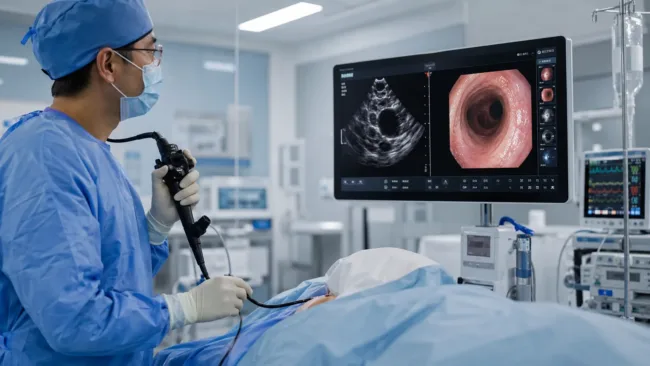
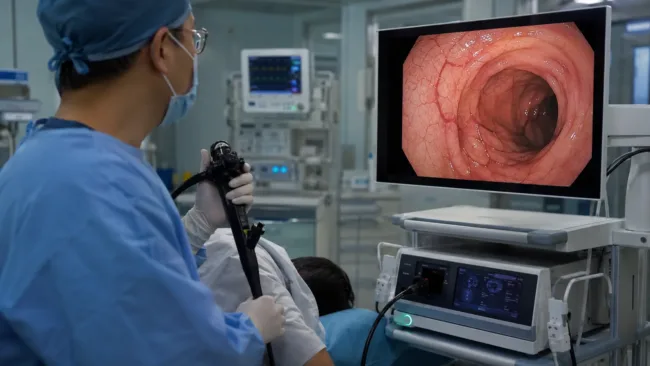
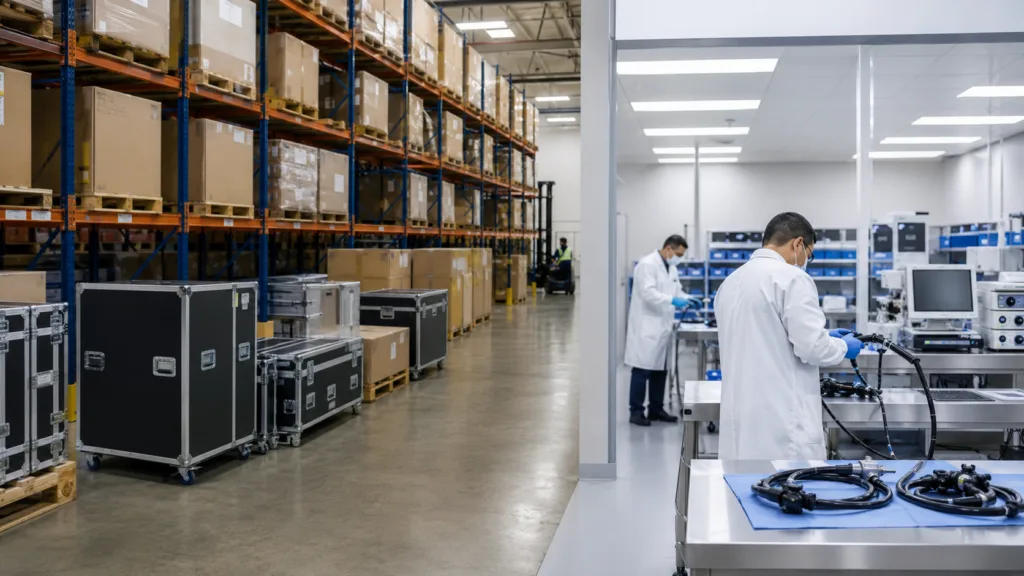
FUJIFILM Healthcare Americas Corporation has opened an 18,000-square-foot endoscopy warehouse in Fairfield, New Jersey, moving logistics operations away from Wayne to create additional space for a roughly 1.5 times expansion of its endoscopy service center. The Fairfield facility began operating in May 2026 and will support Fujifilm’s U.S. endoscopic imaging and therapeutic device portfolio, including the ELUXEO 8000 Endoscopic Imaging System and EG-840TP therapeutic upper gastrointestinal scope.
Why separating warehouse logistics from device servicing could improve endoscope uptime at scale
The significance of the Fairfield investment lies less in the warehouse itself than in the operational separation it creates. Warehousing, inventory handling and outbound logistics require a different physical layout and workflow from technical inspection, preventive maintenance and complex device repair. Moving inventory functions to Fairfield gives the Wayne operation more room to add technicians, repair stations, diagnostic equipment and work-in-progress capacity without forcing service activities to compete with storage requirements.
For hospitals and ambulatory endoscopy centers, that separation could translate into more predictable equipment availability. Flexible endoscopes are high-use assets that may require inspection or repair following leaks, channel damage, articulation problems, image deterioration or routine wear. When a device is unavailable, providers may have to rely on backup inventory, loaner scopes or schedule adjustments. A service center that can process higher volumes without developing a repair backlog can therefore support procedure continuity even when it does not directly change the clinical performance of the device.
However, additional floor space does not automatically guarantee faster turnaround. The operational benefit will depend on technician recruitment, training time, parts availability, diagnostic standardization and the transfer of inventory processes to Fairfield without creating new bottlenecks. Fujifilm has not disclosed current repair volumes, average turnaround times or the improvement it expects from the enlarged Wayne operation. Those omissions make the expansion strategically credible but leave its measurable customer impact unproven.
How the New Jersey expansion supports Fujifilm’s push into major U.S. hospitals
The investment arrives as Fujifilm seeks stronger growth in the United States, where switching endoscopy platforms can be a lengthy and institutionally complex decision. Large hospital systems evaluate more than image quality or scope specifications. They also examine service responsiveness, training support, compatibility across procedure rooms, equipment replacement plans and the disruption that could follow a platform transition.
Fujifilm has reported double-digit global endoscopy growth outside China and expects the United States to deliver its strongest regional expansion. The medical device manufacturer has also indicated that the EG-840TP therapeutic scope is helping it enter major hospitals that had not previously used Fujifilm endoscopy systems. Around 30% of U.S. facilities installing that therapeutic scope were described as new customers, suggesting that differentiated devices are beginning to open doors beyond the existing installed base.
That makes service capacity part of the sales proposition rather than an administrative function operating after the purchase. A hospital considering a new endoscopy platform is more likely to evaluate the supplier’s ability to maintain uptime across an entire fleet. The value of a clinically differentiated scope may be diluted if repairs take too long, replacement inventory is limited or service communication is inconsistent. By expanding Wayne while centralizing warehousing in Fairfield, Fujifilm is attempting to strengthen the infrastructure that must follow every new account win.
The unresolved issue is whether the service network can scale nationally at the same pace as U.S. adoption. A larger New Jersey center can increase central capacity, but customers located farther away may still be affected by transportation time, regional support availability and loaner logistics. The facility could improve the economics and consistency of Fujifilm’s service model, although the eventual customer experience will depend on the entire chain from device collection to repair, quality release and return shipment.
Why endoscopy service capacity matters as device portfolios become more clinically complex
Modern endoscopy platforms increasingly combine advanced visualization, therapeutic capabilities, ultrasound, software and artificial intelligence-assisted functions. Fujifilm’s portfolio extends across diagnostic gastroenterology, therapeutic procedures, endoscopic ultrasound and pulmonology. The ELUXEO 8000 platform and newer therapeutic scopes are intended to support a wider range of procedures than conventional visualization alone.
As the portfolio becomes more sophisticated, servicing also becomes more demanding. Repair technicians must preserve optical performance, mechanical articulation, channel integrity, electronic communication and compatibility with processors and accessories. A scope can appear externally intact while still requiring detailed inspection of internal components. The addition of more technologically complex devices may therefore increase both the value of manufacturer expertise and the time required to train technicians to a consistent standard.
There is also a regulatory distinction between routine servicing and remanufacturing. Servicing is intended to return a medical device to the original equipment manufacturer’s safety and performance specifications. Activities that significantly change performance, safety characteristics or intended use may instead be treated as remanufacturing and can bring different regulatory obligations. An expanded service operation consequently requires disciplined documentation, validated procedures and clear control over the scope of each repair.
Manufacturer servicing is separate from the cleaning and high-level disinfection performed by healthcare facilities, but the two areas intersect. Scope condition, internal channel integrity and validated repair processes can affect whether a reusable endoscope can be safely returned to clinical use and reprocessed as instructed. Poorly controlled repairs could create device performance or infection-control concerns, while unnecessary replacement of expensive components could increase ownership costs. Fujifilm will need to demonstrate that higher throughput does not weaken inspection depth or quality controls.
What the infrastructure move changes in competition with established endoscopy suppliers
The U.S. endoscopy market has long favored suppliers with broad installed bases, established clinician familiarity and mature service networks. These advantages reinforce one another. A large installed base creates more demand for training and repairs, while an extensive service organization reduces the perceived risk of buying additional systems. New product features can attract clinical interest, but infrastructure often determines whether that interest becomes a system-wide purchasing decision.
Fujifilm’s strategy appears to use differentiated therapeutic scopes as an entry point into hospitals that may already have relationships with other endoscopy vendors. The EG-840TP is designed to combine a slim profile with treatment capability and improved access to difficult anatomy. That type of differentiation can create an opportunity for evaluation in specialized procedures. Once a device enters a hospital, the supplier may gain a broader chance to demonstrate processors, imaging systems, additional scopes and support services.
The Fairfield and Wayne investments could help convert those initial placements into broader platform adoption. Procurement teams are more likely to expand a supplier relationship when technical support remains reliable after installation. Faster repair processing and more readily available inventory could also reduce the operational objections raised by clinicians who are comfortable with an incumbent system.
Even so, service expansion is unlikely to overturn entrenched purchasing patterns on its own. Hospitals may have multi-year capital plans, existing service contracts, standardized reprocessing workflows and large inventories of compatible equipment. Switching costs can remain high even when a competing device offers meaningful clinical advantages. Fujifilm must therefore prove that its combination of differentiated scopes, imaging performance and service support creates enough operational value to justify a broader transition.
Which execution risks could limit the commercial benefits of Fujifilm’s expansion
The first risk is workforce scalability. Endoscope repair requires specialized skills that cannot always be added as quickly as physical capacity. Hiring technicians is only the starting point. New employees must be trained on multiple device generations, quality procedures, documentation requirements and failure patterns before they can contribute fully to throughput. A larger service center operating with an inexperienced workforce could struggle to deliver the efficiency gains implied by the expansion.
The second risk involves inventory coordination between Fairfield and Wayne. Separating warehousing from repair operations may improve space utilization, but it also creates an additional handoff. Spare parts, replacement devices, accessories and completed repairs must move between locations with accurate tracking and minimal delay. Weak inventory visibility could leave technicians waiting for components even while the warehouse holds adequate stock. The commercial benefit will depend on whether Fujifilm can integrate ordering, repair planning and shipment data across both facilities.
A third concern is demand forecasting. Fujifilm is expanding capacity in anticipation of continued U.S. growth, but endoscopy capital purchasing can be affected by hospital budgets, procedure volumes, financing conditions and competitive responses. If equipment adoption grows more slowly than expected, the expanded infrastructure could operate below capacity. If adoption accelerates faster than planned, Fujifilm could still encounter service backlogs despite the additional space.
The medical device manufacturer has also not specified whether the expansion will materially increase loaner availability, regional field support or preventive maintenance capacity. Those services may be as important to customers as the physical repair process. The absence of published service targets means hospitals will need to assess performance through contract terms and operating experience rather than relying on the size of the facility alone.
What clinicians and procurement teams are likely to monitor after the expansion
Healthcare providers will likely focus on practical indicators such as repair turnaround, communication during service events, access to loaner devices and the proportion of scopes returned without repeat problems. These measures determine whether a service expansion produces clinical value. A faster average repair time is less meaningful if complex cases remain delayed or if device fleets require repeated shipment for unresolved faults.
Procurement teams may also compare service contract pricing, preventive maintenance provisions and uptime commitments across vendors. Fujifilm’s enlarged operation could support more competitive service agreements, but the medical device manufacturer has not outlined whether contract structures will change. The ability to offer predictable costs may become increasingly important as hospitals manage pressure on capital and operating budgets.
Clinicians will watch whether the operational expansion is followed by broader access to new endoscopy technologies. Fujifilm has been extending its portfolio across advanced imaging, therapeutic gastroenterology and pulmonology. A stronger service backbone could make hospitals more comfortable adopting devices that require specialized support. However, adoption will still depend on clinical utility, training requirements, compatibility with existing workflows and the strength of evidence behind individual products.
Industry observers are also likely to examine whether Fujifilm publishes evidence of improved service performance. Metrics such as turnaround reduction, technician capacity, spare-parts availability and customer retention would provide a clearer picture of whether the investment is delivering a competitive return. Without those indicators, the expansion remains an enabling move rather than proof of superior service.
Why this operational investment may matter more than the warehouse headline suggests
The Fairfield facility is an incremental infrastructure project, not a new clinical technology or regulatory milestone. Its strategic importance comes from the role service operations play in supporting every installed device. As Fujifilm attempts to gain U.S. endoscopy share through the ELUXEO 8000 platform and differentiated therapeutic scopes, its ability to maintain those systems may become as consequential as its ability to sell them.
The decision to move logistics out of Wayne suggests that Fujifilm expects service demand to rise alongside equipment adoption. Enlarging repair capacity before severe bottlenecks emerge can protect customer experience during growth. It can also signal to major hospital systems that the medical device manufacturer is willing to invest behind its U.S. installed base rather than treating service as a secondary function.
The investment still needs operational proof. Technician productivity, quality consistency, repair turnaround and national logistics will determine whether more space becomes better service. Fujifilm’s next challenge is therefore not opening the facility. It is showing that the expanded New Jersey network can convert physical capacity into measurable uptime, stronger customer retention and wider adoption across U.S. endoscopy departments.