LAZA Medical, Inc., a privately held medical technology developer backed by the Shifamed innovation platform, has announced a structured Series B financing round of up to $160 million led by GE HealthCare Technologies Inc. (NASDAQ: GEHC). Disclosed on November 4, 2026, the investment will support development of an artificial intelligence-powered robotic imaging system intended to improve guidance during complex cardiovascular interventions and reduce dependence on continuous manual ultrasound manipulation.
The financing also includes participation from existing investors Unorthodox Ventures, PA MedTech and AMED. LAZA is developing technology designed to construct a patient-specific three-dimensional model of the heart in real time using ultrasound information, with plans to combine that capability with robotic control of transoesophageal echocardiography equipment. Its broader objective is to provide clinicians with more consistent anatomical guidance throughout complex procedures.
The announcement follows a September 2025 milestone in which LAZA completed initial software-only testing during human cardiac procedures. The AI software operated alongside clinical workflows to enable retrospective assessment, but the complete robotic imaging system was not independently performing the procedures. The distinction matters because LAZA’s full platform remains investigational and is not approved for commercial sale in any country.
The transaction also strengthens GE HealthCare’s exposure to emerging technologies that could complement its established interventional imaging business. However, the companies have not disclosed the amount of financing available immediately, the conditions governing additional funding, LAZA’s valuation or GE HealthCare’s resulting ownership percentage. The headline amount therefore represents the maximum announced financing structure rather than a fully itemised cash investment.
Why is GE HealthCare leading LAZA Medical’s $160 million financing round?
GE HealthCare has an established presence in cardiovascular imaging, including ultrasound, fluoroscopy and systems used during complex interventional procedures. These technologies provide information that helps clinicians assess anatomy, position devices and monitor treatment. As procedures become more demanding, imaging performance increasingly depends on the ability to combine different information sources efficiently.
LAZA is developing technology intended to address some of these challenges through artificial intelligence and robotics. Its proposed system aims to improve image guidance by creating a continuously updated anatomical representation that clinicians can use during interventions. The approach could potentially reduce repeated manual adjustments and improve consistency across different procedural stages.
Jyoti Gera, chief executive officer of Cardiovascular and Interventional Solutions within GE HealthCare’s Advanced Imaging Solutions business, has identified better integration of imaging technologies as an important objective for future catheterisation laboratories. Management believes that more intuitive imaging could improve procedural workflows and support the development of increasingly sophisticated robotic interventions.
For GE HealthCare, participating in LAZA’s financing provides exposure to an emerging technology without requiring a disclosed acquisition of the company. The investment may also support closer technical and commercial collaboration. However, neither organisation has announced an acquisition, an exclusive distribution agreement or a confirmed product integration arising from the financing.
The strategic rationale is therefore stronger than the immediately measurable financial contribution. GE HealthCare is investing in a technology that could influence future imaging workflows, but its commercial value remains conditional on clinical validation and regulatory progress.
What do the structured Series B financing terms reveal about LAZA Medical’s capital position?
LAZA described its financing as a structured Series B round of up to $160 million. This wording is important because structured investments may involve multiple funding conditions, staged capital availability or other contractual arrangements. However, the announcement does not identify the specific structure governing LAZA’s transaction.
The company also does not disclose how much capital was received at the initial closing. Consequently, the maximum stated amount should not automatically be interpreted as cash already deposited in LAZA’s accounts. The timing and availability of additional funding remain undisclosed.
GE HealthCare led the financing, with participation from returning investors Unorthodox Ventures, PA MedTech and AMED. The inclusion of existing investors indicates continuing institutional support for the development programme. Nevertheless, the amount contributed by each investor and the resulting ownership distribution were not reported.
The company has not released a pre-money or post-money valuation. It is therefore impossible to determine reliably what percentage of LAZA GE HealthCare acquired or how the investment values the underlying imaging technology. Any calculation based on the full $160 million as an immediate equity investment would require assumptions not supported by the announcement.
The round was advised by Sidley Austin, which confirmed the structured financing arrangement and the participating investors. This provides additional transaction context but does not resolve the undisclosed commercial terms.
The financial significance lies in establishing a potentially substantial development funding framework. Its exact economic implications will depend on the conditions attached to the financing and how much capital ultimately becomes available.
How does LAZA Medical’s AI system create a real-time three-dimensional heart model?
LAZA’s central technology is software designed to generate a patient-specific three-dimensional representation of the heart using ultrasound data. The objective is to provide a continuously updated anatomical view during cardiac procedures, reducing reliance on clinicians mentally reconstructing three-dimensional relationships from multiple two-dimensional images.
Conventional echocardiography provides essential information about cardiac structures, but interpretation can depend heavily on probe position, imaging angle and operator expertise. During complex interventions, clinicians may need to repeatedly adjust ultrasound views to understand the relationships among valves, chambers and treatment devices.
LAZA’s AI software is intended to support this process by creating a digital heart model that updates during live imaging. This could potentially help procedural teams maintain spatial context as catheters and other devices move through the heart. However, the accuracy of the representation will depend on the quality of the underlying ultrasound data and the performance of the reconstruction algorithms.
The technology should not be confused with a fully autonomous diagnostic system. The company has not demonstrated that its software independently identifies every relevant anatomical abnormality or makes treatment decisions. Its intended role is to provide imaging assistance to clinicians who remain responsible for patient care.
The approach may be particularly relevant in procedures involving complex structural relationships. Nevertheless, a visually convincing three-dimensional model does not automatically establish that anatomical measurements are accurate enough for every clinical application. Validation against appropriate reference standards will therefore be essential.
What did LAZA’s September 2025 first-in-human study actually establish?
In September 2025, LAZA announced the completion of its first software-only evaluations during human cardiac procedures at a US medical institution. The milestone represented the first disclosed clinical use of its AI-generated heart model alongside actual procedures. The study was intended to support validation of the software’s image navigation capabilities.
Importantly, the software operated concurrently with live clinical cases while the procedures were performed through established clinical workflows. The generated information was intended for retrospective analysis and performance assessment. This was not a study in which LAZA’s complete robotic imaging system autonomously guided patient treatment.
The company identified this as an initial step towards future human evaluation of its integrated platform. Such a staged approach can help developers evaluate software accuracy before adding mechanical control functions. However, successful operation during a limited number of cases does not establish performance across different patients, anatomies or procedures.
LAZA did not disclose a patient count or detailed numerical accuracy results in the September announcement. It also did not provide comparative data showing reductions in procedure duration, imaging adjustments or operator workload. Those outcomes remain potential benefits rather than demonstrated clinical findings.
Firas Zahr, head of interventional cardiology at Oregon Health & Science University Hospital, participated in the initial software evaluation and has identified consistent anatomical context as a potential advantage during structural heart procedures. His experience supports the clinical rationale for the system, but it does not substitute for quantitative validation.
The next important development stage will involve integrating the software with robotic imaging hardware and evaluating the complete system under appropriate clinical oversight.
Why is robotic control of transoesophageal echocardiography an important part of LAZA’s strategy?
Transoesophageal echocardiography, commonly called TEE, uses an ultrasound probe positioned in the oesophagus to obtain detailed images of the heart. Because the oesophagus lies close to several cardiac structures, the technique can provide useful visual information during complex interventions. It is widely used in selected structural heart procedures.
However, obtaining appropriate views can require substantial operator expertise. The imaging specialist may need to manipulate the probe repeatedly as the procedure progresses, while coordinating with the interventional team. Maintaining suitable views during lengthy procedures can therefore be technically demanding.
LAZA intends to combine its AI-generated heart model with robotically assisted TEE control. The proposed architecture could allow imaging adjustments to be supported through automated or semi-automated functions. The longer-term objective is to make complex ultrasound guidance more consistent and less dependent on continuous manual manipulation.
However, the company has not disclosed the complete control architecture, the degree of intended autonomy or detailed safety mechanisms in the November announcement. These characteristics will be central to understanding how the system operates and how clinicians retain control.
Robotic movement of an internal ultrasound probe also introduces safety considerations. Probe positioning must avoid injury to the oesophagus and surrounding tissues, while imaging adjustments must remain appropriate for the patient’s anatomy. Software accuracy, mechanical force limits and reliable operator override functions will therefore be relevant development requirements.
The proposed system may eventually support more efficient imaging, but its safety and performance must be established through appropriate testing of the integrated platform.
How could intelligent imaging reduce workload in structural heart procedures?
Structural heart interventions often require coordination among interventional cardiologists, cardiac imaging specialists, anaesthesia teams and other professionals. Procedures involving heart valves or other complex anatomy may require continuous imaging to guide device positioning. The quality and availability of imaging expertise can influence procedural planning and execution.
A system that provides consistent anatomical guidance could potentially reduce some repeated imaging adjustments. It might also make it easier for teams to maintain a shared understanding of device position relative to cardiac structures. These advantages could be particularly valuable during technically demanding procedures.
However, the degree of workload reduction remains unquantified. LAZA has not demonstrated that its technology allows a hospital to operate safely with fewer imaging professionals or that it reduces the time needed for every procedure. Such claims would require prospective operational evidence.
The technology could also introduce new tasks involving setup, calibration and monitoring. Automated systems may simplify some activities while creating additional requirements for technical supervision. Hospitals will need to evaluate the complete workflow rather than assume that robotics automatically reduces staffing needs.
The most meaningful indicators would include imaging adjustment frequency, procedure duration, operator workload and the occurrence of imaging-related interruptions. Patient outcomes and complications would provide additional information about clinical value.
The commercial proposition therefore depends on demonstrating that the system improves practical care delivery, not merely that it can generate an advanced anatomical image.
Why does combining artificial intelligence with robotics create additional validation challenges?
AI-based imaging and robotic hardware introduce different types of risk. Imaging algorithms must accurately interpret incoming data, while mechanical systems must respond appropriately to commands. Integrating the two requires reliable communication and safeguards against errors.
A three-dimensional heart model may become inaccurate when ultrasound image quality deteriorates or important anatomical structures are obscured. If robotic movements depend on the resulting representation, errors in the model could influence equipment positioning. The system must therefore be designed to recognise uncertainty and respond safely when information is incomplete.
Latency is another important consideration. A representation intended to guide live cardiac procedures must update sufficiently quickly to remain relevant to the clinical situation. Delays between image acquisition, computational processing and physical response could reduce its usefulness.
Robotic assistance also requires a clearly defined relationship between automated functions and clinician control. Operators must understand what the system is doing, when intervention is necessary and how to stop or modify an action. These considerations are relevant to regulatory evaluation and clinical training.
The need for such safeguards does not mean LAZA’s system has demonstrated these problems. Rather, they represent technical and safety requirements that must be addressed before a complex robotic imaging platform can be introduced into routine care.
The company’s existing software-only human experience provides an initial development foundation, but the integrated device will require additional testing.
What is the regulatory status of the LAZA Medical System?
LAZA has explicitly stated that its imaging system remains under development and is not approved for commercial sale in any geography. This applies to the complete intelligent robotic imaging platform described in the financing announcement. The investment does not represent a regulatory authorisation or a new commercial launch.
The September 2025 software-only evaluation also should not be confused with clearance of the integrated device. Testing an AI model alongside clinical procedures provides development information but does not establish that the complete robotic system satisfies applicable regulatory requirements.
Future regulatory submissions will need to address the intended clinical use, software performance, mechanical reliability and appropriate risk controls. The exact evidence requirements will depend on the device configuration and proposed claims. The company has not identified a confirmed FDA submission timetable or decision date.
Additional clinical evaluation may be necessary to establish whether the platform performs consistently across different procedures and institutions. The scope of such studies will depend on regulatory discussions and the company’s development strategy.
LAZA also has not announced a confirmed commercial launch date, initial sales contracts or expected pricing. Consequently, the financing should be evaluated as support for an investigational medical technology rather than proof of near-term product revenue.
How does LAZA Medical fit within the Shifamed medical innovation platform?
LAZA is part of Shifamed, a medical technology innovation platform founded by entrepreneur Amr Salahieh. Shifamed focuses on developing technologies intended to address significant clinical and operational challenges. Its portfolio structure provides an environment for early-stage medical device engineering and company development.
The relationship can offer access to expertise in device design, product development and business strategy. Such resources may be valuable when a programme combines complex software, imaging and robotic hardware. However, the benefits depend on actual execution and cannot eliminate clinical or regulatory uncertainty.
Salahieh serves as LAZA’s founder and board chairman and has identified intelligent imaging as an important component of future catheterisation laboratory development. The company’s strategy is to use AI to improve anatomical guidance while creating a foundation for more advanced robotic assistance.
The investment from GE HealthCare represents an opportunity to work with an established medical technology manufacturer. Its scale and customer relationships could become commercially relevant if LAZA’s system eventually reaches the market. Nevertheless, the November announcement does not disclose a definitive manufacturing, distribution or acquisition arrangement between the companies.
The Shifamed relationship therefore provides development context, while GE HealthCare’s participation adds strategic and financial support. Both relationships may influence LAZA’s future opportunities, but the technology must still establish clinical value.
Does GE HealthCare’s LAZA investment connect with its new Allia Celeo imaging system?
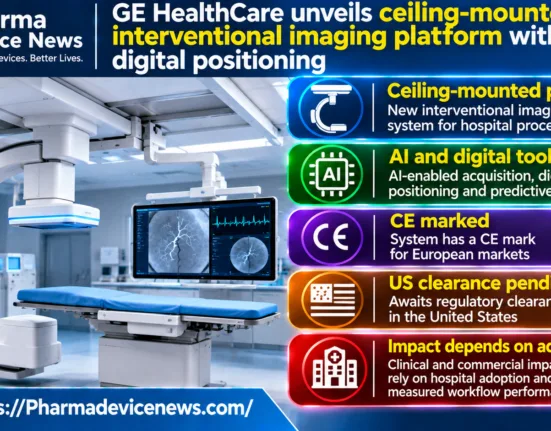
GE HealthCare recently introduced Allia Celeo, a ceiling-mounted interventional imaging system featuring AI-enabled image acquisition, digital positioning assistance and predictive service technology. The platform received European CE marking, while its US FDA submission remained pending at the time of the announcement. It forms part of GE HealthCare’s expanding advanced imaging portfolio.
LAZA’s technology addresses a related but distinct part of the clinical workflow. Allia Celeo focuses principally on an interventional imaging environment involving X-ray guidance and equipment positioning, while LAZA is developing AI-powered ultrasound reconstruction and robotic TEE assistance. Both reflect growing demand for more integrated imaging during complex cardiovascular procedures.
The potential complementarity is strategically interesting. Ultrasound provides detailed information about certain cardiac structures, while fluoroscopy offers a different view of catheters and implanted devices. Combining information from multiple modalities can help clinicians understand anatomy during structural heart interventions.
However, the companies have not announced that LAZA’s technology has been integrated into Allia Celeo. Neither has disclosed a product roadmap confirming a combined commercial system. It would therefore be speculative to describe the financing as establishing a specific integration or future bundled product.
The broader strategic conclusion is that GE HealthCare is investing in multiple approaches to improve interventional imaging. Whether these technologies eventually operate together will depend on future technical and commercial decisions.
What do GE HealthCare’s latest results and share performance suggest about the investment?
GE HealthCare reported third-quarter 2026 revenue of approximately $5.5 billion, an increase of 7.2% from the previous year. Organic revenue grew 6.2%, while organic orders increased 4%. The company also reported a backlog of $23.7 billion, reflecting demand across its established medical technology portfolio.
Its Advanced Imaging Solutions segment generated $3.873 billion in quarterly revenue, representing growth of 6.1%. Segment operating income reached $593 million, an increase of 15.8%. These figures provide context for GE HealthCare’s ability to invest in emerging technology while maintaining a large existing imaging business.
The company also reported adjusted earnings per share of $1.34, compared with $1.07 a year earlier. Management raised its full-year financial outlook following the results. However, the LAZA financing is not associated with a disclosed near-term revenue contribution or a quantifiable earnings forecast.
GE HealthCare shares closed at $85.81 on November 4, 2026, rising 6.38% from the previous session’s $80.66 close. The stock also traded significantly higher than its October 30 closing price of $76.57. The movement reflects strong recent market interest, although the financing announcement was issued after the regular November 4 trading session.
Consequently, the share-price increase should not be attributed to the LAZA investment. Investors were also assessing GE HealthCare’s stronger financial results and wider imaging strategy. The private financing is better understood as a longer-term strategic initiative than an immediate earnings catalyst.
What must LAZA demonstrate before robotic imaging can transform the catheterisation laboratory?
The first requirement is rigorous validation of the AI-generated heart model. Investigators must establish that the three-dimensional representation remains sufficiently accurate across different cardiac anatomies and imaging conditions. The model must also update reliably during live procedures.
The second requirement is safe integration with robotic control. Mechanical movement must be precise and responsive, with appropriate safeguards and clinician oversight. The complete platform must demonstrate that its functions can be used without introducing unacceptable procedural risks.
Clinical workflow performance will provide another important test. LAZA must show whether the technology reduces imaging adjustments, improves anatomical guidance or makes complex procedures more manageable. These benefits should be demonstrated through defined measures rather than general claims about efficiency.
Regulatory authorisation and commercial readiness will follow. The company will need to complete appropriate studies, establish manufacturing and quality systems, and demonstrate that healthcare providers can deploy the technology reliably. Pricing, training requirements and service support will influence eventual adoption.
The structured financing provides potential resources for this development process, but it does not remove technical and regulatory uncertainty. LAZA must convert a promising software milestone into evidence supporting a complete clinical device.
LAZA Medical has secured substantial strategic backing for an ambitious imaging technology intended to connect real-time ultrasound reconstruction with robotic assistance. GE HealthCare’s participation reinforces the growing importance of intelligent imaging within cardiovascular intervention, while the existing software-only human experience provides an initial clinical development foundation.
However, the amount of financing available immediately remains undisclosed, and the complete platform is not commercially authorised. The decisive milestones will be integrated system validation, clinical safety and measurable improvements in procedural workflow.
The opportunity is significant because advanced cardiac interventions increasingly require detailed, consistent imaging guidance. Whether LAZA can translate that demand into commercial success will depend on demonstrating that its technology improves care delivery safely and reliably, rather than simply adding another layer of automation to the catheterisation laboratory.