GE HealthCare Technologies Inc. is seeking United States clearance for StarGuide GX, a next-generation digital SPECT/CT system designed specifically around the changing demands of molecular imaging and theranostics. The device already holds a CE Mark and is now 510(k) pending with the United States Food and Drug Administration.
StarGuide GX uses GE HealthCare’s dual-sided cadmium zinc telluride detector architecture and is intended to image across low, medium and high photon energies. That range is strategically important because emerging radiopharmaceutical therapies increasingly involve isotopes whose imaging requirements differ substantially from conventional diagnostic nuclear medicine. GE HealthCare specifically highlights potential imaging of investigational alpha emitters including actinium-225.
The company says the platform is designed to deliver substantially higher volume sensitivity while maintaining spatial resolution, exchange collimation in under three seconds and use NVIDIA RTX computing to accelerate image reconstruction.
Those may sound like scanner specifications, but the commercial logic is broader. As targeted radiopharmaceuticals evolve from niche therapies into larger oncology franchises, healthcare systems need imaging infrastructure capable of determining where radioactive drugs travel, how much radiation reaches organs and tumours, whether treatment is working and how future doses should be planned.
Why does theranostics create a different imaging challenge?
Theranostics links diagnostic imaging with targeted radionuclide therapy. A molecular target can first be visualized using a radioactive tracer and then exploited therapeutically using a radionuclide capable of delivering damaging radiation to target-positive cells.
That approach makes imaging part of the treatment pathway rather than a separate diagnostic event. Physicians may need to confirm target expression before therapy, assess biodistribution afterward and estimate radiation dose delivered to tumours and normal organs.
SPECT/CT can play an important role in those workflows because many therapeutic radionuclides emit photons that can be detected and quantified. The challenge is that emerging isotopes span different energy levels, making traditional scanner designs less flexible.
StarGuide GX attempts to address that constraint by supporting a wider energy spectrum through dual-sided CZT detectors and rapidly selectable collimation. GE HealthCare describes the platform as capable of handling general-purpose SPECT while also supporting research involving emerging alpha emitters.
Why is Actinium-225 creating so much attention?
Alpha particles deposit large amounts of energy over very short distances. In targeted cancer therapy, that characteristic creates the possibility of killing tumour cells while limiting radiation exposure to surrounding tissue if the radiopharmaceutical reaches the intended target.
Actinium-225 has consequently become one of the most closely watched isotopes in next-generation radiopharmaceutical development. The field remains investigational across many indications, and practical challenges include isotope production, manufacturing, dosimetry and imaging.
Imaging alpha-emitting therapies can be technically difficult because the therapy itself may generate limited directly useful photons. Systems therefore need high sensitivity and sophisticated reconstruction methods to work with associated emissions and low-count data.
GE HealthCare’s decision to design StarGuide GX around this future suggests it expects alpha theranostics to become important enough that nuclear-medicine departments will want equipment capable of supporting research and eventual routine clinical workflows.
What does dual-sided CZT change compared with conventional SPECT?
Traditional gamma cameras often use sodium iodide scintillation crystals that convert incoming photons into light before electronic detection. Cadmium zinc telluride detectors convert gamma photons directly into electrical signals, potentially improving energy resolution and sensitivity.
GE HealthCare has spent more than 15 years developing internal CZT capabilities and says it maintains an integrated CZT supply and detector-production operation.
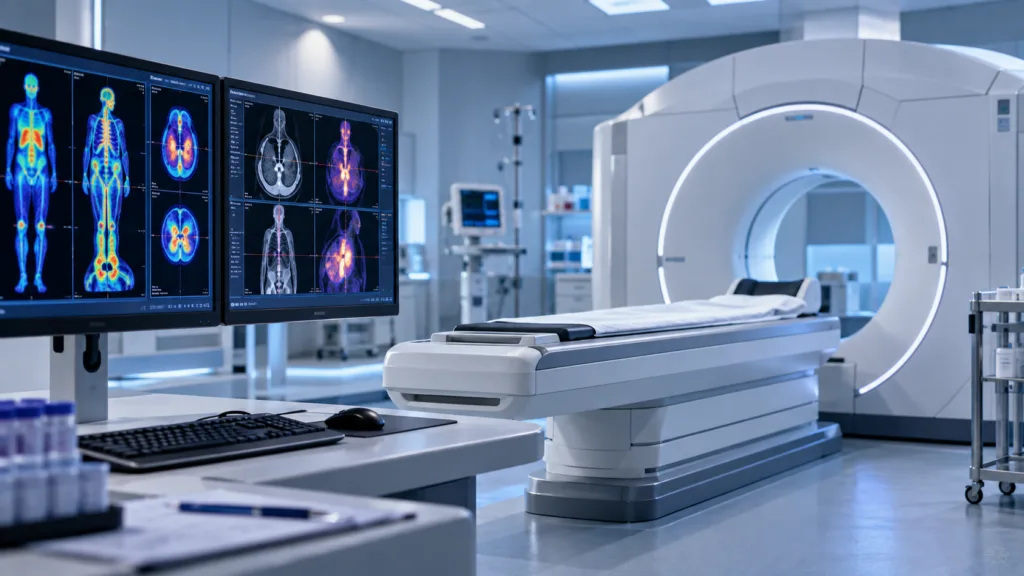
StarGuide GX goes further by using dual-sided CZT detector modules and tungsten collimators aligned with individual detector pixels. The system’s detectors rotate around the patient and move close to the anatomy being imaged, which can improve sensitivity and spatial performance.
The practical goal is to obtain useful quantitative images faster. GE HealthCare says the system is designed to deliver more than 2.5 times the sensitivity of specified comparator configurations on its product materials while preserving high resolution. Different company materials use somewhat different sensitivity comparisons, so those figures should be interpreted according to the specific configuration being compared rather than as a universal performance multiple.
Why does a three-second collimator change matter operationally?
A collimator determines which photons reach the detector and therefore needs to match the energy characteristics of the isotope being imaged. Conventional systems may require physical changes that consume time and create workflow burden.
StarGuide GX integrates two collimator options into each detector and can switch between them in under three seconds, according to GE HealthCare.
That becomes more valuable when departments image several isotopes during the same day. A nuclear-medicine service supporting technetium-based routine imaging, lutetium therapies and higher-energy or investigational radionuclides needs flexibility without repeatedly reconfiguring equipment.
Small workflow improvements can have large economic effects in imaging because scanner utilization determines how many patients a department can accommodate. Faster transitions, shorter acquisition times and quicker reconstruction can collectively increase throughput.
Could quantitative imaging become mandatory infrastructure for personalised radiopharma dosing?
Many radionuclide therapies are currently administered according to standardized activities or relatively simple dosing frameworks. More individualized approaches could use quantitative imaging to estimate tumour and organ absorbed dose, potentially helping physicians balance therapeutic effect against toxicity.
StarGuide GX incorporates software from GE HealthCare’s MIM Software portfolio, including tools supporting segmentation, treatment response assessment and voxel-based dosimetry.
That software layer may become increasingly important. A scanner capable of collecting high-quality data is only one part of a dosimetry workflow. Clinicians also need tools that identify organs, delineate lesions, calculate activity over time and transform images into clinically interpretable treatment information.
The broader business opportunity therefore extends from hardware into software and workflow. As theranostics matures, imaging companies may earn recurring value from analysis platforms rather than relying solely on capital-equipment replacement cycles.
Why does this matter strategically for GE HealthCare?
GE HealthCare generated $20.6 billion in revenue during 2025 and says approximately five million of its systems are installed globally. It also invested more than $1.7 billion in innovation when research, development and related engineering spending are combined.
In April 2026, the company combined Imaging and Advanced Visualization Solutions into a new Advanced Imaging Solutions segment with approximately $14.6 billion in annualized scale, bringing molecular imaging, CT, magnetic resonance, ultrasound and enterprise imaging into a more integrated structure.
Theranostics fits naturally inside that strategy because it connects scanners, radiopharmaceutical preparation, image analysis and treatment monitoring.
GE HealthCare has also highlighted strong demand for molecular imaging within its broader imaging business. Fourth-quarter 2025 materials specifically identified advanced imaging diagnostics and nuclear medicine as contributors to growth.
StarGuide GX therefore represents more than a product refresh. It positions GE HealthCare for a possible capital-investment cycle if hospitals expand nuclear-medicine departments to accommodate growing radiopharmaceutical treatment volumes.
Is FDA clearance the main remaining risk?
Regulatory clearance is necessary for U.S. commercialization, but it is not the only adoption barrier. StarGuide GX is currently 510(k) pending and cannot be marketed in the United States until the FDA completes its review.
After clearance, hospitals must still justify the capital expenditure. Many institutions already operate conventional SPECT/CT systems capable of performing routine nuclear-medicine studies.
A replacement decision becomes easier if theranostic volumes increase enough that older scanners create throughput or quantitative-imaging limitations. It becomes harder where radiopharmaceutical therapy remains low-volume.
The commercial curve may therefore follow drug adoption. Every successful radioligand launch potentially increases demand for scanners, hot-lab capacity, radiation-safety infrastructure, trained staff and dosimetry software.
Could imaging become the hidden bottleneck in the radiopharma boom?
Much of the investment excitement around theranostics has focused on drug developers, isotope suppliers and manufacturing capacity. Yet hospitals ultimately need physical infrastructure to deliver those therapies.
Patients must be evaluated, infused, imaged and monitored. Nuclear-medicine departments have finite scanners, technologists, physicians and radiation-controlled spaces.
If treatment volumes grow faster than infrastructure, waiting times and operational constraints could limit adoption even when drugs are clinically effective and reimbursed.
That makes GE HealthCare’s timing important. StarGuide GX is arriving while the industry is still building the next generation of radiopharmaceutical treatments rather than after every workflow has stabilized.
The system will still need to prove that its flexibility and quantitation justify replacement economics. But the underlying strategic bet is compelling: the radiopharmaceutical revolution will not be powered by radioactive drugs alone. Someone must measure where the radiation goes, and that may turn advanced SPECT/CT from a diagnostic department asset into essential treatment infrastructure.