
Medtronic plc has received United States Food and Drug Administration clearance for the LigaSure RAS Maryland jaw instrument for use with its Hugo robotic-assisted surgery system, expanding the instrument portfolio available to U.S. surgeons less than a year after Hugo itself entered the American market. The device can seal and cut vessels, thick tissue and lymphatics up to 7 millimetres in diameter, with Medtronic reporting approximately two-second vessel sealing while limiting thermal spread.
The clearance may appear incremental compared with approval of an entire surgical robot, yet it addresses one of the central competitive challenges facing newer robotic platforms. Surgeons do not operate with a robot in isolation. They depend on graspers, dissectors, staplers, vessel sealers, energy systems, imaging, software and procedural accessories that collectively determine what cases can be performed efficiently.
LigaSure arrives with a significant installed reputation. Medtronic says the technology has been used in more than 45 million procedures across more than 65 countries during approximately two decades of open and laparoscopic surgery. The new Maryland instrument is the first LigaSure product driven robotically.
That makes the clearance strategically important because Medtronic is not asking surgeons to trust an entirely unfamiliar energy technology. It is moving an established surgical tool into a robotic environment whose U.S. installed base is still being built.
Why does vessel sealing matter so much during robotic surgery?
Many operations require surgeons to separate tissue while controlling blood vessels and lymphatics. Conventional electrosurgical tools can coagulate and cut tissue, but advanced vessel-sealing devices are designed to create reliable seals with controlled energy delivery and reduced thermal damage to surrounding structures.
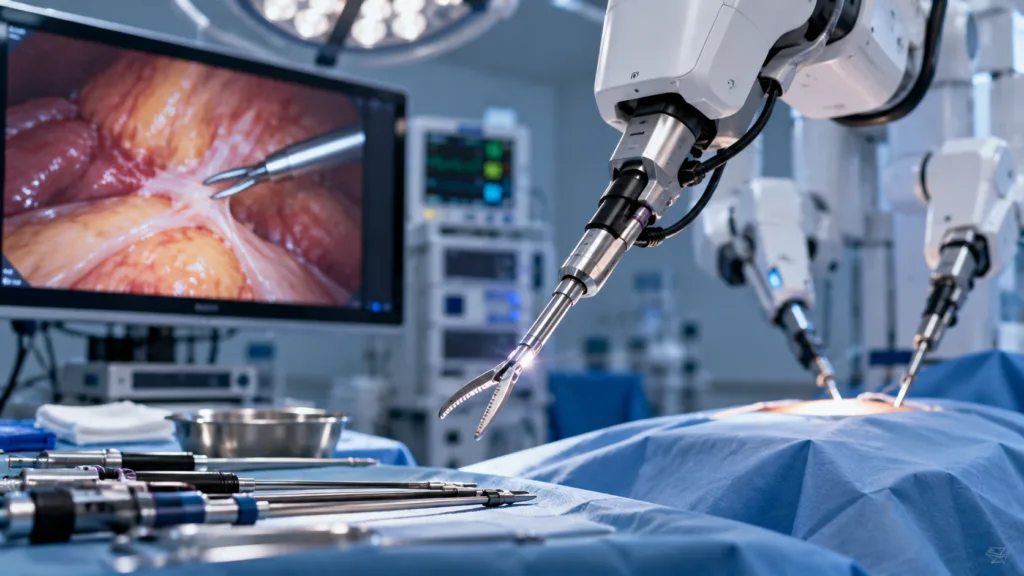
LigaSure has become familiar to surgeons across open and minimally invasive procedures partly because it combines grasping, dissection, sealing and cutting functions. Bringing that capability onto Hugo reduces the need to switch repeatedly between instruments during portions of a robotic operation.
The Maryland jaw configuration is designed for blunt dissection as well as sealing and cutting. Medtronic reports that it can handle vessels up to and including 7 millimetres and operate exclusively with the company’s Valleylab FT10 energy platform.
Workflow efficiency matters in robotic surgery because operating-room time is expensive. Every instrument exchange, docking delay or procedural interruption affects economics and can influence whether hospitals view robotic assistance as adding value or merely adding cost.
Why is Hugo still building its U.S. ecosystem after entering the market?
The FDA cleared the Hugo RAS system in December 2025 for adult minimally invasive urologic surgery. The regulatory decision followed the Expand URO clinical programme, which met performance goals for safety and effectiveness, although FDA documentation also noted device deficiencies and required continued post-market surveillance after system changes were introduced.
Medtronic began commercial U.S. cases in February 2026 and continues pursuing additional indications. The company submitted applications in June to extend Hugo into general and gynecologic surgery, markets that would significantly broaden the platform’s potential procedural volume.
Outside the United States, Hugo has been used across more than 35 countries and over 50 types of urologic, general and gynecological procedures, according to Medtronic.
That international experience helps, but the U.S. market presents a different competitive challenge because hospitals often already have deeply embedded robotic infrastructure, trained surgeons and established purchasing relationships.
Adding familiar instrumentation is therefore part of reducing the switching cost.
Why are surgical robots really ecosystem businesses?
A hospital purchasing a robotic system commits to far more than capital equipment. It trains physicians and operating-room teams, buys disposable instruments, signs service agreements, integrates data systems and potentially changes case scheduling.
This creates recurring revenue for manufacturers and significant stickiness after installation. A successful platform can generate years of instrument, accessory and service sales long after the initial robot is purchased.
For a challenger, however, incomplete instrumentation can limit procedural breadth even when the robot itself performs well. A surgeon who cannot access a preferred energy device or stapling technology may continue using an incumbent platform for certain procedures.
LigaSure therefore gives Medtronic an advantage few robotics start-ups possess: a large portfolio of surgical technologies developed before the robotic platform existed. The company can progressively adapt those products to Hugo rather than building every instrument from zero.
Can surgeon familiarity shorten Hugo’s learning curve?
The basic motion and workflow of robotic surgery still require training even when individual devices are familiar. LigaSure recognition nevertheless reduces one layer of uncertainty.
A surgeon who already understands how LigaSure behaves in laparoscopic procedures has prior expectations about tissue compression, sealing and thermal effect. Translating that familiarity into a robotic Maryland instrument may be easier than learning a completely different vessel-sealing technology alongside a new robotic platform.
Medtronic’s modular approach may reinforce that familiarity. Hugo uses independent cart-mounted robotic arms and an open console intended to keep surgeons visually connected to operating-room staff.
Whether those design choices translate into higher adoption will depend on hospital economics and clinical preference rather than engineering alone. Still, familiar instruments can make an unfamiliar robot feel less disruptive.
Why is Medtronic investing elsewhere in robotics while expanding Hugo?
The company has simultaneously invested $700 million in Cornerstone Robotics and entered a strategic partnership around the Sentire robotic platform for selected international markets. Medtronic has described Sentire as complementary to Hugo rather than a replacement.
That move shows how rapidly surgical robotics is fragmenting. Different hospitals may prefer different architectures, price points and procedure profiles, particularly outside high-income markets where conventional premium robotic systems remain difficult to justify economically.
Medtronic appears to be pursuing a portfolio strategy rather than assuming one robot architecture will dominate every geography and specialty.
Hugo remains the company’s principal internally developed soft-tissue platform, but access to another system can broaden market reach while reducing dependence on a single design.
Could AI become as important to Hugo as instruments?
Medtronic is also building its Touch Surgery digital ecosystem around robotic and laparoscopic procedures. Its Touch Surgery Aide platform uses NVIDIA-based computing and is intended to support real-time artificial-intelligence applications in the operating room.
The company has already received FDA clearance for an Instrument Exit Point application designed to identify specific procedural events in real time. The broader ambition is to connect surgical video, workflow analysis, training and decision support.
That combination illustrates where robotics competition may be heading. Mechanical precision becomes the foundation, while differentiated value increasingly comes from instruments, imaging, software and data.
A hospital may ultimately compare ecosystems according to how well they integrate energy delivery, stapling, visualization, AI-enabled workflow and analytics rather than simply asking which robotic arms move most elegantly.
What will determine whether LigaSure materially improves Hugo adoption?
The first answer will come from utilization. Medtronic needs surgeons already using Hugo to choose the LigaSure RAS instrument frequently enough that it improves procedural workflow and recurring instrument revenue.
The second is indication expansion. Vessel sealing becomes much more strategically important if Hugo enters general and gynecological surgery, where dissection and vessel control are central to a wider range of operations.
The third is hospital conversion. Medtronic must show that adding established surgical tools makes it sufficiently attractive for health systems to install Hugo alongside or instead of incumbent robotic platforms.
MassDevice reported that Medtronic management expects Hugo to pass 50,000 procedures globally by the end of the company’s current fiscal year. That target shows the company is moving from regulatory validation toward scaling utilization.
The LigaSure clearance therefore reveals something fundamental about the robotics business. Winning regulatory clearance for a robot opens the door, but surgeons perform procedures with instruments. Medtronic’s ability to translate decades of open and laparoscopic surgical technology into robotic tools may ultimately be as important to Hugo’s competitive position as the robot itself.


