
Aptitude Medical Systems Inc. has received United States Food and Drug Administration 510(k) clearance for its next-generation Metrix COVID Test and Metrix COVID Test Pro, moving the compact molecular platform from the emergency-use era into traditional FDA regulation. FDA records show the agency determined the devices substantially equivalent on August 7, 2026, classifying them as over-the-counter molecular SARS-CoV-2 tests using reverse-transcription loop-mediated isothermal amplification.
Aptitude announced the clearance publicly in September, saying the new version offers approximately three times greater analytical sensitivity than its earlier emergency-authorized product while delivering results about 30% faster. Metrix is cleared for both over-the-counter use and professional use in CLIA-waived environments.
That makes this less a story about whether another COVID test is needed and more a test of whether compact molecular diagnostics can survive the end of the pandemic emergency market. The United States is scheduled to terminate remaining COVID medical-device emergency-use declarations on December 26, 2026, forcing manufacturers that built products under EUA pathways either to obtain traditional authorization or leave parts of the market.
Aptitude has crossed that regulatory bridge with its core test. The company now needs to demonstrate that Metrix can become a durable multi-disease platform rather than a piece of pandemic-era hardware searching for a second life.
Why does traditional 510(k) clearance matter after years of emergency authorization?
Emergency Use Authorization allowed diagnostic developers to introduce SARS-CoV-2 tests rapidly when the pandemic created extraordinary public-health need. Those authorizations were always tied to an emergency framework rather than permanent commercial status.
Traditional FDA authorization requires manufacturers to establish an enduring regulatory basis for marketing. For Metrix, that process resulted in 510(k) clearance under the FDA’s over-the-counter molecular-testing category.
The distinction becomes commercially important as emergency declarations expire. Healthcare organizations want assurance that products they integrate into workflows will remain available rather than disappear when temporary pandemic rules end.
Traditional clearance also provides a stronger foundation for platform expansion because subsequent assays can build around validated instrumentation, manufacturing and user workflows.
The FDA lists Metrix among COVID-19 tests that have received traditional marketing authorization, alongside products from other molecular-diagnostics developers.
Why is RT-LAMP useful for decentralized molecular testing?
Most people associate high-quality molecular diagnostics with polymerase chain reaction laboratories. PCR is extremely sensitive and specific, but conventional systems can require expensive instruments, trained laboratory personnel and complex temperature cycling.
Loop-mediated isothermal amplification amplifies nucleic acids at a relatively constant temperature. Eliminating repeated thermal cycling can simplify instrumentation and shorten workflows while retaining molecular-level detection.
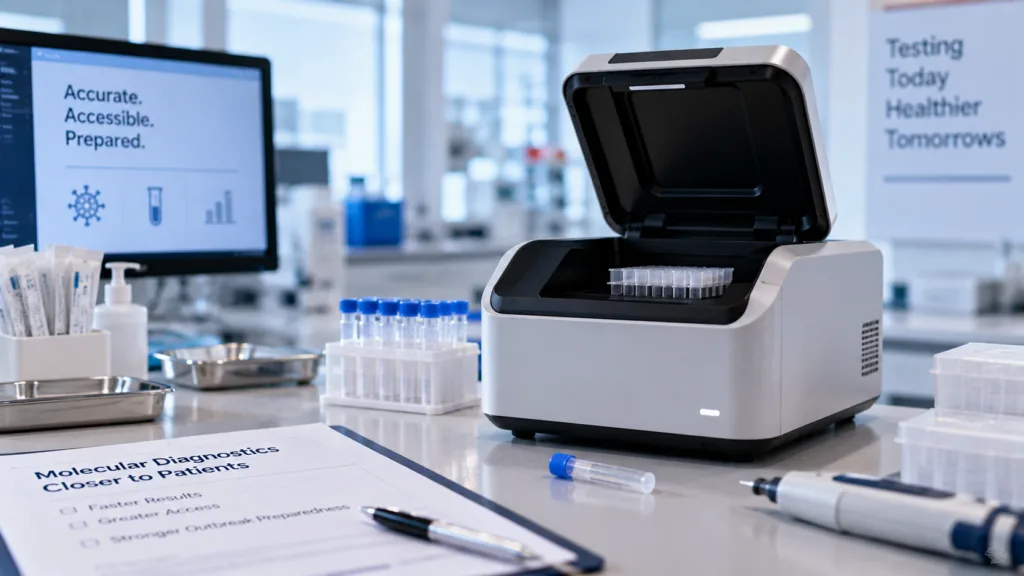
Aptitude uses RT-LAMP to detect SARS-CoV-2 RNA in a device small enough to support home or decentralized professional use. The company’s strategy is to bring molecular performance closer to where patients first seek care rather than sending every specimen into a central laboratory.
The practical value is speed. A highly accurate result returned during a patient visit can affect isolation decisions, prescribing, additional testing and infection-control measures immediately.
Why could urgent care be the most important market?
Urgent-care clinics sit between the simplicity of home testing and the complexity of hospital laboratories. They see large numbers of patients with respiratory symptoms and need actionable results quickly, but many centres cannot justify large high-throughput molecular platforms.
Aptitude says hundreds of clinics have adopted Metrix during the past year. The company designed the system specifically to address barriers including large instrument footprints, high upfront capital costs, fixed testing capacity and purchasing commitments associated with some conventional molecular systems.
That “one compact instrument, tests as needed” model can be attractive for distributed care sites whose daily volumes vary.
Economics remain crucial. Rapid antigen tests are inexpensive and simple, while centralized laboratories can offer highly efficient PCR at scale. Metrix must occupy the middle ground where higher molecular sensitivity is clinically valuable but conventional PCR infrastructure is impractical.
Why is COVID unlikely to be the final commercial destination?
Respiratory testing is seasonal and competitive. A device limited to one pathogen faces fluctuating demand and risks sitting idle for portions of the year.
Aptitude is therefore developing a broader menu. Its next-generation Metrix COVID/Flu Test is under FDA review for traditional 510(k) clearance, while additional programmes target respiratory syncytial virus, Streptococcus and sexually transmitted infections.
Menu expansion changes device economics. Once a clinic has adopted hardware and trained staff, each additional test increases utilization without requiring another instrument purchase.
The same principle has driven consolidation across laboratory diagnostics for decades. Instrument placement becomes strategically valuable because reagent and test revenue recur every time the machine is used.
For Aptitude, the challenge is reaching sufficient menu breadth before competitors lock decentralized clinics into alternative systems.
Could molecular testing replace antigen tests at the point of care?
Probably not universally. Antigen tests remain attractive because they are inexpensive, fast and require almost no equipment.
Molecular testing becomes more valuable when analytical sensitivity matters enough to justify extra cost or workflow. That can include symptomatic patients with an initially negative antigen result, high-risk patients where treatment decisions depend on confirmation or infectious diseases for which lower pathogen concentrations still have clinical relevance.
Aptitude’s roughly threefold analytical-sensitivity improvement therefore matters most if it changes real-world diagnostic yield without substantially increasing complexity.
Future comparative studies will need to demonstrate how Metrix performs across different viral loads, specimen types and stages of infection rather than relying only on laboratory detection limits.
Why did BARDA support the Metrix programme?
Development of the next-generation platform received federal support through the Biomedical Advanced Research and Development Authority. BARDA invests in technologies relevant to national preparedness, including diagnostics that could be deployed quickly during infectious-disease emergencies.
A decentralized molecular platform has obvious preparedness value because the same basic instrument architecture can potentially support tests for several pathogens. During future outbreaks, that could reduce dependence on central laboratory expansion if an assay can be developed and manufactured rapidly.
This is another reason the traditional 510(k) matters. A commercially sustainable platform maintained during non-emergency periods is more useful during the next outbreak than a device ecosystem that exists only while government emergency procurement remains high.
Can Metrix build a moat against much larger diagnostics companies?
Aptitude competes indirectly with companies possessing larger sales forces, deeper regulatory teams and broad infectious-disease menus. The FDA’s permanent COVID-test list already includes traditional molecular systems from multiple manufacturers.
Aptitude’s potential differentiation rests on footprint, ease of use, economics and flexibility rather than raw corporate scale.
Its partnership with Sekisui Diagnostics expands commercial distribution, reducing the need for Aptitude to build every sales channel independently.
The company can also benefit from the installed-base effect if clinics adopt Metrix before its menu broadens. Every successful placement makes future assays easier to sell.
That strategy works only if early devices prove reliable. Small diagnostic platforms live or die on cartridge failures, invalid rates, supply availability and workflow simplicity because clinics do not have specialized laboratory engineers standing nearby.
What happens when COVID EUAs end on December 26?
Aptitude says it does not expect product interruption and that previously distributed emergency-authorized Metrix products can continue to be used through their labelled expiration dates under FDA transition policies. The traditionally cleared next-generation product provides a pathway beyond the emergency framework.
The broader market transition could remove weaker products that never secured permanent authorization. That potentially benefits companies that invested early in traditional filings because healthcare providers will have a smaller pool of durable regulatory options.
At the same time, COVID demand is structurally different from 2020 or 2021. Permanent authorization does not recreate pandemic testing volumes.
The commercial value therefore depends on turning COVID into the first test on a wider platform rather than treating it as the entire addressable market.
Could decentralized molecular testing become a lasting post-pandemic legacy?
One lasting effect of the pandemic was that patients, pharmacies, urgent-care clinics and regulators became accustomed to diagnostic testing outside conventional central laboratories.
The next question is whether molecular technology can follow antigen testing into those settings without inheriting laboratory-level cost and complexity.
Metrix provides one attempt at that transition. It is handheld, traditionally cleared, compatible with OTC and professional workflows and supported by a development pipeline spanning respiratory and non-respiratory disease.
The important milestone is therefore not simply that Aptitude has another COVID test. It is that a technology originally accelerated by emergency demand has crossed into the permanent regulatory system.
If the company can populate Metrix with enough clinically useful assays, the pandemic may ultimately be remembered as the event that created the installed base rather than the market that defines it.
