Genmab A/S announced on June 10, 2026 that epcoritamab monotherapy and epcoritamab-based combination regimens produced high response rates in elderly patients with newly diagnosed diffuse large B-cell lymphoma, a population often unable to tolerate standard full-intensity chemotherapy. The data, drawn from the Phase 2 EPCORE DLBCL-3 trial and the Phase 1b/2 EPCORE NHL-2 trial, place the CD3xCD20 bispecific antibody more firmly inside the debate over how aggressive B-cell lymphoma should be treated when age, frailty and comorbidity narrow conventional options.
Why does epcoritamab’s elderly DLBCL data matter more than a typical response-rate update?
The significance of the Genmab A/S update lies less in the headline response rates and more in the treatment setting. Diffuse large B-cell lymphoma is an aggressive malignancy where curative intent treatment has historically relied on chemoimmunotherapy, particularly regimens built around anthracycline exposure. That creates a major clinical gap for elderly patients or patients with multiple comorbidities, because the very regimens most associated with durable disease control may be difficult or unsafe to deliver at full strength.
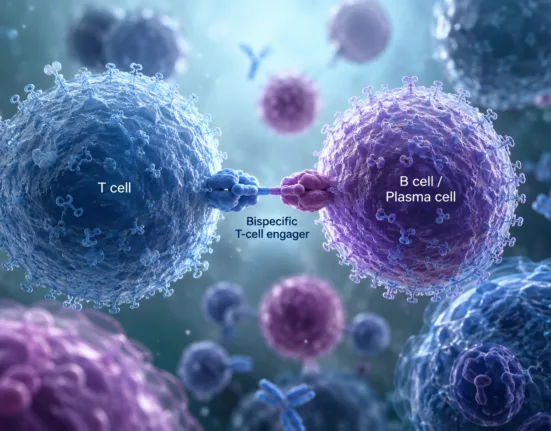
Epcoritamab is already part of the broader lymphoma treatment conversation as a subcutaneously administered T-cell engaging bispecific antibody targeting CD3 on T cells and CD20 on B cells. The genuinely new element in this dataset is not the mechanism itself, but the effort to move that mechanism into a first-line population that has fewer practical options. For clinicians, this matters because the elderly DLBCL setting often forces compromise between disease control and treatment tolerability. For industry observers, it matters because earlier-line use is where bispecific antibodies must prove they can move beyond rescue therapy and compete with entrenched treatment pathways.

The limitation is that high response rates in early or mid-stage trials do not automatically settle the clinical question. Elderly DLBCL is heterogeneous, and patients who are anthracycline-ineligible because of age or comorbidity may differ substantially in organ function, infection risk, performance status and treatment goals. That makes cross-trial comparisons especially fragile. The data are encouraging, but the commercial and regulatory value will depend on whether response depth translates into durable progression-free survival, acceptable safety in real-world frail patients, and a treatment model that community and academic centres can actually deliver.
What does the monotherapy signal reveal about treating anthracycline-ineligible patients?
The EPCORE DLBCL-3 monotherapy data are important because they test whether a chemotherapy-free bispecific strategy can generate meaningful responses in newly diagnosed CD20-positive large B-cell lymphoma patients who cannot receive anthracycline-based chemotherapy. In the trial, epcoritamab monotherapy produced an overall response rate of 67% and a complete response rate of 58% in evaluable elderly patients, with responses emerging relatively early and complete responses deepening over time in some patients who initially had partial response or stable disease.
That pattern is clinically relevant because anthracycline-ineligible patients often face a difficult trade-off. Less intensive regimens may be more tolerable, but they can also risk under-treating an aggressive cancer. A monotherapy approach that produces complete responses in this population could therefore provide a new therapeutic concept: using immune engagement as a backbone where conventional cytotoxic intensity is constrained. The fixed-duration design also matters, because indefinite therapy can be difficult for elderly patients, caregivers and treatment centres.
However, the safety profile keeps the analysis grounded. Cytokine release syndrome occurred frequently, immune effector cell-associated neurotoxicity syndrome was observed, infections were common and Grade 5 treatment-emergent adverse events were reported. Those findings do not erase the potential value of the regimen, but they make clear that chemotherapy-free does not mean risk-free. For adoption, the core question is not only whether epcoritamab can induce remissions, but whether the monitoring, step-up dosing, infection management and neurological surveillance requirements are manageable in the specific elderly population being targeted.
How could epcoritamab plus R-mini-CHOP change expectations for frail frontline DLBCL care?
The EPCORE NHL-2 Arm 8 combination data offer a different strategic angle. Epcoritamab plus rituximab and dose-attenuated cyclophosphamide, doxorubicin, vincristine and prednisone produced an overall response rate of 93% and a complete response rate of 86% in elderly newly diagnosed DLBCL patients ineligible for full-dose R-CHOP. The regimen also showed sustained minimal residual disease negativity and durable remissions over more than two years of follow-up.
This is commercially and clinically more disruptive than monotherapy in one important respect. Rather than replacing chemoimmunotherapy entirely, the combination approach attempts to improve a familiar reduced-intensity standard. R-mini-CHOP is already part of the elderly DLBCL treatment landscape, so adding epcoritamab to that framework may be easier for clinicians to conceptualise than adopting a fully chemotherapy-free strategy. The high complete response rate and two-year durability estimates suggest a potential route to improving outcomes without asking treatment centres to abandon conventional DLBCL logic altogether.
The risk is that combination therapy adds complexity at precisely the point where frail patients have the least physiological reserve. Grade 3 or higher neutropenia, serious infections and anaemia remain clinically meaningful concerns, especially during the first six cycles when epcoritamab is administered with R-mini-CHOP. A small, open-label cohort cannot fully answer whether the incremental efficacy justifies the added immune-engagement and myelosuppression burden. Future studies will need to clarify whether the combination improves outcomes over R-mini-CHOP alone in a way that is robust enough to change practice.
Why are minimal residual disease data useful but not enough on their own?
Minimal residual disease negativity is one of the more interesting features of both datasets because it points toward deeper biological control than visible radiographic response alone. In aggressive lymphomas, MRD dynamics can help clinicians understand whether early responses have molecular depth, and sustained negativity may support confidence that a regimen is doing more than producing temporary tumour shrinkage. For epcoritamab, high MRD negativity rates strengthen the argument that T-cell engagement may be active even in elderly patients with compromised baseline health.
From an industry perspective, MRD data can also help shape trial narratives. When a therapy is moving into earlier lines, response rate alone may be considered insufficient, particularly where existing regimens already cure a proportion of patients. MRD negativity gives Genmab A/S and AbbVie Inc. a more nuanced efficacy story, especially if future results connect molecular response with progression-free survival or overall survival. It may also support discussions around fixed-duration therapy, because molecular clearance could become part of the rationale for stopping treatment after a defined period.
The caution is that MRD is not a substitute for hard clinical outcomes. Regulators and payers will still want to understand survival, relapse patterns, hospitalisation burden, infection-related complications and quality-of-life trade-offs. In elderly DLBCL, a deep molecular response is valuable only if it comes with an acceptable safety and care-delivery profile. The next stage of evidence will need to show whether MRD negativity can help identify which patients benefit most, which patients remain vulnerable to relapse, and whether treatment intensity can eventually be personalised.
What regulatory and commercial questions still stand between data and practice change?
The regulatory path is not yet straightforward. Epcoritamab has established regulatory momentum in relapsed or refractory lymphoma settings, but first-line elderly DLBCL is a different evidentiary challenge. A label expansion in newly diagnosed disease would likely require stronger comparative evidence, particularly because frontline lymphoma treatment decisions carry curative intent for many patients. Open-label Phase 2 data can support clinical enthusiasm and trial expansion, but they rarely settle the standard-of-care question alone.
The recent broader history of epcoritamab in DLBCL also adds discipline to the interpretation. A late-stage study in relapsed or refractory DLBCL did not demonstrate a statistically meaningful overall survival improvement at the time of analysis, even though other efficacy signals were observed. That does not directly negate the elderly first-line data, because the populations, treatment lines and trial designs are different. It does, however, remind industry watchers that response depth and survival impact can diverge in lymphoma development, especially when subsequent therapies, patient frailty and disease biology complicate interpretation.
Commercial adoption would also depend on workflow. Subcutaneous administration is a practical advantage compared with more complex cell therapy logistics, but bispecific antibody use still requires structured monitoring for cytokine release syndrome, immune effector cell-associated neurotoxicity syndrome, cytopenias and infections. Hospitals and community oncology networks will need confidence that the regimen can be delivered safely outside highly specialised centres. Reimbursement discussions will also focus on whether earlier use reduces downstream treatment burden or simply adds another high-cost biologic layer to frontline care.
What should clinicians, regulators and industry observers watch next in epcoritamab’s DLBCL programme?
The most important next readout will be whether larger and more controlled datasets validate the signal seen in elderly newly diagnosed DLBCL. Clinicians will watch complete response durability, progression-free survival, overall survival, treatment discontinuations, serious infection rates and patient selection criteria. Regulators will look for evidence that the benefit is not merely numerically attractive but clinically durable and interpretable against relevant comparators.
For Genmab A/S, the strategic prize is clear. If epcoritamab can move credibly into earlier lymphoma treatment lines, the drug could shift from a later-line option into a broader backbone therapy across B-cell malignancies. That would strengthen the long-term value of the Genmab A/S and AbbVie Inc. oncology collaboration and place epcoritamab more directly inside frontline treatment algorithms. The elderly DLBCL population may be a logical beachhead because the unmet need is visible and the limitations of standard chemotherapy are well understood.
The unresolved question is whether the drug can balance efficacy ambition with elderly-patient reality. Frail patients need effective treatment, but they also need regimens that avoid preventable hospitalisation, infection burden and treatment-related decline. The Genmab A/S data move epcoritamab forward in that debate, but they do not close it. The next phase of development must show not only that the therapy can generate responses, but that it can improve the lived clinical course of patients who are least able to absorb treatment toxicity.