Some of the most striking recent autoimmune-disease results have come from technologies originally built to treat cancer. CD19-directed CAR-T therapies have produced prolonged drug-free remissions in small studies of severe systemic lupus erythematosus, systemic sclerosis and inflammatory myopathies, creating the idea that sufficiently deep removal of pathological B-cell populations can reset an immune system rather than merely suppress inflammation continuously. Bispecific T-cell engagers are now pursuing the same biological objective using an off-the-shelf antibody rather than genetically manufacturing a patient-specific T-cell product.
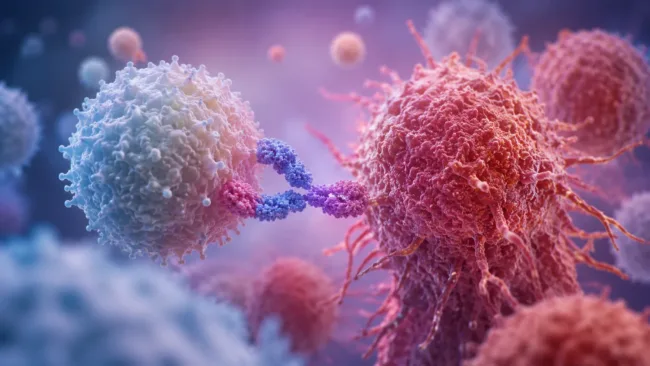
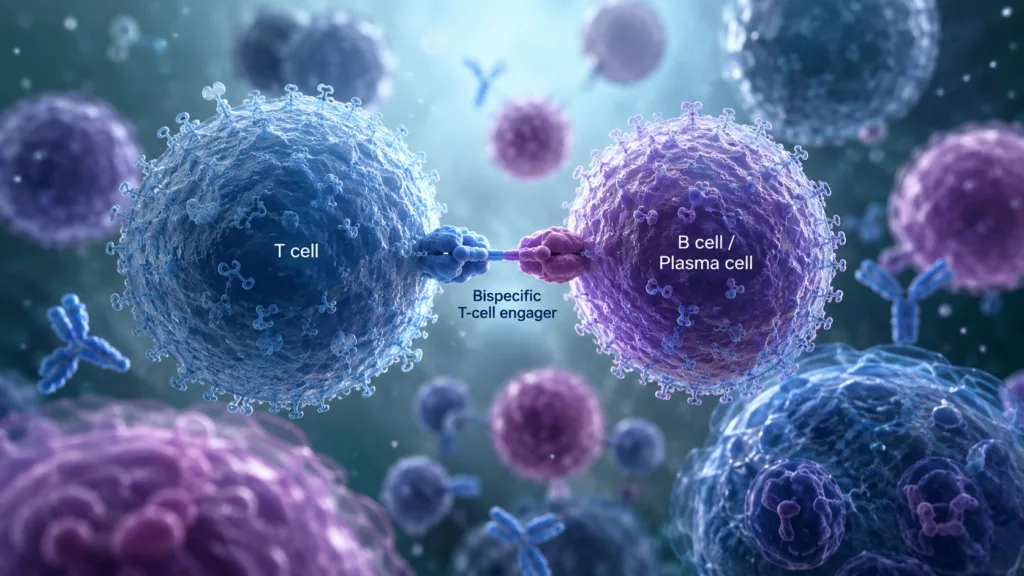
T-cell engagers contain binding domains capable of recognizing both a target on the pathogenic immune cell and CD3 on a T cell. The molecule physically recruits cytotoxic T cells to B cells or plasma cells and induces their destruction, borrowing a mechanism already validated in hematological oncology. Early autoimmune reports remain small, but the field is gaining attention because antibody-based TCEs could potentially provide deep cellular depletion while avoiding leukapheresis, individualized genetic engineering and lymphodepleting conditioning associated with CAR-T.
Why would destroying B cells help an autoimmune disease?
Many autoimmune disorders involve B cells that produce pathogenic antibodies, present antigen or help coordinate inflammatory immune responses. Therapies such as rituximab already deplete CD20-positive B cells and can improve several autoimmune diseases, establishing that B-cell reduction can be therapeutically useful. The limitation is that conventional CD20 antibodies may not remove every relevant B-cell compartment and generally do not directly eliminate long-lived plasma cells, which can continue producing disease-driving autoantibodies.
T-cell engagers can produce considerably deeper depletion because the recruited T cell actively kills the target cell. CD19-directed agents can attack a broader B-cell developmental range, while BCMA-directed TCEs can target antibody-producing plasma cells. This creates the possibility of selecting the target according to the biology of the autoimmune disease rather than treating every condition with the same generalized immunosuppression.
The objective is increasingly described as immune reset. If pathogenic memory B cells and autoantibody-producing populations are eliminated sufficiently deeply, the immune system may repopulate from less autoreactive precursors and potentially enter a prolonged remission after the therapeutic agent itself has been discontinued.
What has actually been observed in patients so far?
A 2026 Nature Medicine report described compassionate-use treatment of five patients with refractory antisynthetase syndrome using the CD19×CD3 T-cell engager blinatumomab and five patients with refractory systemic sclerosis using the BCMA×CD3 agent teclistamab. Blinatumomab produced rapid clinical, serological and histological improvement in myositis and stabilization of interstitial lung disease, while teclistamab was associated with improvements in skin fibrosis, stabilization of interstitial lung disease and resolution of tendon friction rubs in treated systemic-sclerosis patients.
The investigators also observed reductions in targeted immune-cell populations and autoantibody titers, providing biological evidence that the therapies were doing more than transiently suppressing symptoms. Maintenance rituximab was used to inhibit B-cell redifferentiation and support prolonged disease control in some patients.
Ten compassionate-use patients cannot establish efficacy, particularly because severe refractory cases are highly selected and there was no randomized control group. What the study demonstrates is feasibility: oncology-grade T-cell engagement can eliminate autoimmune-relevant cell populations and produce clinical improvements sufficiently substantial to justify prospective trials.
Why could a bispecific antibody be easier to scale than CAR-T?
CAR-T requires collection of the patient’s T cells, transport to a manufacturing facility, genetic modification, expansion, quality testing and return to the treatment center. The patient often receives lymphodepleting chemotherapy before infusion. This infrastructure is justified in life-threatening cancers but becomes more difficult to scale across autoimmune diseases affecting much larger populations.
A bispecific antibody is manufactured as a standardized pharmaceutical product and can be stored for use across many patients. There is no individualized cell-production delay, and dosing can be adjusted or discontinued if tolerability becomes problematic. Nature Reviews Immunology has highlighted this off-the-shelf availability, manufacturing simplicity and potentially more convenient delivery as major reasons TCEs are attracting autoimmune interest.
The trade-off is persistence. CAR-T cells can remain in the body for prolonged periods and continue suppressing target populations after one treatment course, whereas an antibody generally requires repeated exposure unless a relatively short course induces a sufficiently durable immune reset.
Why are cytokine release syndrome and infection still major obstacles?
Activating T cells against large populations of immune cells can release substantial quantities of inflammatory cytokines. In the Nature Medicine compassionate-use series, cytokine release syndrome reached Grade 3 in two patients with antisynthetase syndrome and occurred in all five systemic-sclerosis patients, while six of the 10 patients developed respiratory infections requiring antibiotics. No immune effector cell-associated neurotoxicity syndrome was reported.
These effects matter more when moving from end-stage cancer into chronic autoimmune disease because the acceptable toxicity threshold changes. A patient with organ-threatening lupus after failure of multiple therapies may accept substantial short-term risk in exchange for a chance at prolonged remission, while an individual with moderately active rheumatoid arthritis has numerous safer chronic treatment options.
That means the earliest commercial opportunities are likely to remain severe, treatment-refractory disease rather than broad first-line use. Dose optimization, step-up schedules, prophylaxis and treatment duration will be central to determining whether TCE toxicity can be reduced sufficiently for wider autoimmune populations.
How are CD19 and BCMA strategies biologically different?
CD19 is expressed across broad B-cell populations but is lost as cells mature into certain long-lived plasma cells. CD19-directed depletion can therefore remove naive and memory B cells and interfere with the cellular reservoir capable of generating new autoantibody-producing cells.
BCMA is enriched on plasma cells, making it appealing when long-lived antibody secretion is believed to be central to disease. A BCMA-directed TCE can attack cellular populations that may survive standard CD20 depletion, potentially explaining why a patient can remain ill despite rituximab yet respond when plasma cells are targeted more directly.
Future autoimmune regimens may consequently be selected according to which immune compartment is maintaining disease. Some conditions could require broad CD19 depletion, others plasma-cell targeting and some sequential strategies designed to remove both pathogenic production and the B-cell populations capable of rebuilding it.
Could T-cell engagers actually replace chronic immunosuppression?
That remains the transformative hypothesis rather than an established result. Most current autoimmune treatment involves repeated administration because the underlying immune dysfunction persists. A successful reset strategy would invert that model: apply an intensive finite therapy, deeply remove pathological immune populations and then allow a more normal immune repertoire to regenerate.
The economic and clinical consequences would be profound if durable drug-free remission became reproducible. Years of biologic therapy could potentially be replaced by a treatment episode, but upfront toxicity and treatment cost would become concentrated into a much shorter period.
Randomized studies, larger cohorts and long-term follow-up are now needed to determine whether the remarkable early responses reflect durable reprogramming or temporary depletion followed eventually by recurrent autoimmunity.
The cancer field taught medicine how to redirect T cells toward malignant B cells and plasma cells. Autoimmune researchers are now asking whether the same machinery can eliminate the cells responsible for attacking healthy tissue. The attraction is not simply a new immunosuppressive antibody; it is the possibility that an off-the-shelf biologic could approximate the depth of cellular reset seen with CAR-T without requiring a personalized cell factory for every patient.