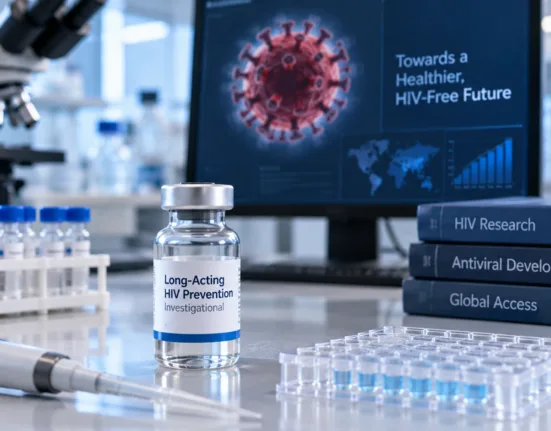
Gilead Sciences posted stronger first-quarter 2026 results as its HIV portfolio, led by Biktarvy, Descovy, and the long-acting prevention therapy Yeztugo, lifted product sales and pushed management to raise full-year revenue guidance. HIV product sales rose 10% year over year to $5.0 billion, while Biktarvy sales increased 7% to $3.4 billion and Descovy sales jumped 38% to $807 million, giving the U.S.-based biopharmaceutical group a stronger commercial start to 2026 than investors had expected.
Why Gilead’s HIV growth matters beyond a single strong quarter in 2026
The significance of Gilead Sciences’ first-quarter performance is not simply that HIV revenue grew. The larger signal is that the Foster City-based biopharmaceutical company is still extracting growth from a franchise many investors have long treated as mature. Biktarvy remains the anchor product, but the quarter also showed that prevention, pricing, demand, and treatment share can still move the needle in a category where payer pressure, generic exposure, and competitive innovation are constant strategic risks.
That makes the 10% HIV growth rate important because it suggests that Gilead Sciences is not only defending its legacy position but also widening the commercial base around prevention and long-acting therapy. Descovy’s performance was especially notable because it outpaced expectations and showed continued strength in pre-exposure prophylaxis, even as market attention has shifted toward Yeztugo as a newer twice-yearly injectable option.

The risk is that this growth may increase investor dependence on HIV rather than reduce it. A strong HIV quarter supports cash generation and guidance, but it also highlights the uneven progress of Gilead Sciences’ broader diversification strategy. When one therapeutic area is doing this much of the heavy lifting, every payer change, market access bottleneck, or competitive launch carries greater financial importance.
What Biktarvy and Descovy reveal about the durability of Gilead’s core franchise
Biktarvy’s continued growth matters because it remains one of the most commercially important HIV medicines globally and a central pillar of Gilead Sciences’ earnings base. The drug’s 7% year-over-year sales increase to $3.4 billion shows that demand and realized pricing remain supportive, even though the company also cited inventory dynamics as a partial offset.
For clinicians and payers, the continued strength of Biktarvy reflects the staying power of well-established single-tablet HIV regimens with broad prescriber familiarity. For industry observers, however, the more important point is strategic: Gilead Sciences is still able to grow a flagship asset in a market that is already highly penetrated. That is not easy in chronic disease categories where switching behavior can be conservative and where competitors often compete on tolerability, convenience, resistance profile, and payer contracting.
Descovy adds a different layer to the story. Its 38% growth to $807 million suggests that HIV prevention remains a major commercial lever, not just an adjacent category. The fact that Descovy outperformed expectations also complicates the narrative around Yeztugo because the newer injectable is not simply replacing older prevention products. Instead, Gilead Sciences now has to manage a more complex prevention portfolio where oral and long-acting options may expand the market but could also create internal competition over time.
Why Yeztugo could reshape HIV prevention, but adoption will not be automatic
Yeztugo is the more forward-looking piece of the quarter because it gives Gilead Sciences a long-acting HIV prevention platform at a time when adherence and convenience remain central barriers in pre-exposure prophylaxis. The product generated $166 million in first-quarter revenue and Gilead Sciences reportedly lifted its 2026 sales expectation for Yeztugo to $1 billion, a major step-up from earlier expectations.
The commercial case is straightforward. A twice-yearly injectable prevention option can address real-world adherence challenges that limit daily oral prevention strategies. That does not automatically mean rapid adoption across all settings. Clinics need workflow capacity, payers need reimbursement clarity, and patients need access pathways that do not create friction around administration, prior authorization, or out-of-pocket exposure.
This is where the launch risk becomes more visible. Long-acting therapies often look compelling clinically and commercially, but the market has to build around them. Industry observers will watch whether Yeztugo gains traction beyond large urban clinics and specialist settings, because a prevention product can only reach its full commercial potential if delivery infrastructure keeps pace with medical demand. A blockbuster forecast is impressive. Execution across fragmented U.S. care settings is the harder test.
Why Gilead’s raised revenue guidance is not the same as a clean earnings upgrade
Gilead Sciences raised its 2026 sales forecast to a range of $30.0 billion to $30.4 billion after the stronger first quarter, but the guidance update came with a major complication. The biopharmaceutical group also flagged a shift in adjusted annual earnings expectations tied to acquisition-related charges and financing costs, including deals involving Arcellx, Ouro Medicines, and Tubulis.
That split explains why the market reaction was not purely celebratory. Investors like revenue visibility, especially when it is backed by high-value HIV products. However, earnings quality matters just as much when a company is spending heavily to diversify its pipeline. Gilead Sciences is effectively asking investors to accept near-term profit pressure in exchange for broader long-term exposure across oncology and immunology.
The strategic question is whether these acquisitions can eventually reduce HIV concentration risk rather than simply add cost. Arcellx strengthens the cell therapy and oncology pipeline story, while other recent deals expand the company’s reach into newer therapeutic technologies. However, deal-driven diversification is only rewarded sustainably when clinical milestones, regulatory outcomes, and launch execution begin to support the investment case.
What oncology and cell therapy performance say about Gilead’s diversification challenge
Gilead Sciences’ non-HIV portfolio delivered a mixed signal in the first quarter. Trodelvy sales rose 37% to $402 million, showing continued oncology momentum, while cell therapy product sales declined 12% to $407 million amid competitive headwinds. Yescarta sales fell 14% to $332 million, and Tecartus sales declined 4% to $75 million.
This contrast matters because oncology is supposed to be one of Gilead Sciences’ long-term answers to its HIV dependence. Trodelvy’s growth supports that thesis, but the pressure in cell therapy shows how difficult it is to scale in crowded, specialized markets where competition, manufacturing complexity, treatment-site readiness, and reimbursement all shape adoption. Cell therapy remains scientifically important, but commercial predictability is still harder than it is in established chronic therapy markets.
For industry watchers, the broader message is that Gilead Sciences’ diversification strategy is moving in pieces rather than as a clean straight line. HIV is generating the financial base. Trodelvy is showing oncology traction. Cell therapy is facing pressure. Recent acquisitions are expanding optionality. The risk is that investors may see the story as too dependent on future pipeline validation while the present remains heavily anchored to HIV.
How investors are reading Gilead’s Q1 after the stock reaction
Gilead Sciences shares traded lower after the update, with the stock recently at $131.33, down about 2.1% from the previous close, despite the revenue and earnings beat. The market capitalization stood near $164.7 billion, reflecting a large-cap biopharma valuation still closely tied to HIV durability and pipeline confidence.
The stock reaction suggests investors are not questioning whether the first quarter was strong. They are questioning what kind of strength it represents. A quarter powered by HIV growth is valuable, but it does not fully answer whether Gilead Sciences can build a more balanced long-term growth model. That distinction is important because mature biopharma companies are often judged less on the latest beat and more on whether they can replace future revenue concentration before it becomes a problem.
Sentiment therefore looks cautiously constructive rather than euphoric. The HIV franchise is performing better than many mature-product skeptics would have expected, and Yeztugo gives Gilead Sciences a potentially important new prevention growth driver. However, acquisition charges, mixed oncology performance, and cell therapy pressure leave investors with a familiar question: how much of the company’s next valuation leg can come from outside HIV?
What clinicians, regulators, and industry observers will watch next
The next phase of the Gilead Sciences story will be shaped by three overlapping questions. The first is whether Biktarvy and Descovy can sustain demand and pricing strength while Yeztugo scales. The second is whether long-acting HIV prevention can expand the overall PrEP market rather than merely reshuffle share within Gilead Sciences’ own portfolio. The third is whether oncology and immunology investments can begin producing enough clinical and regulatory momentum to rebalance the company’s growth profile.
Clinicians will focus on access, adherence, and real-world usability, especially for long-acting HIV prevention. Regulators and payers will watch whether innovation in convenience is matched by clear population-level benefit and sustainable pricing. Investors will watch whether Gilead Sciences can convert the current HIV surge into a broader platform story rather than another quarter where the core franchise masks uneven progress elsewhere.
For now, the first quarter gives Gilead Sciences a stronger operating base than expected. The HIV franchise is not fading quietly. It is still driving revenue, guiding expectations higher, and giving the biopharmaceutical group room to invest. The unresolved issue is whether that room becomes a launchpad for a more diversified company or simply reinforces how central HIV remains to the Gilead Sciences investment case.