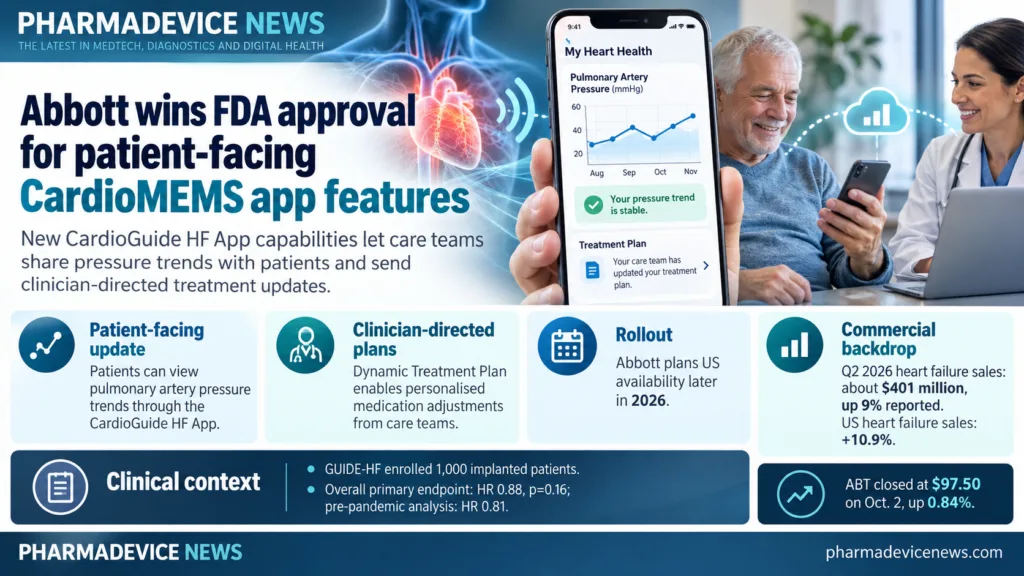
Abbott Laboratories (NYSE: ABT) has received United States Food and Drug Administration approval for new patient-facing capabilities within its CardioMEMS HF System, allowing care teams to give patients access to pulmonary artery pressure trends through the CardioGuide HF App. The update also introduces a Dynamic Treatment Plan feature through which clinicians can communicate personalised medication adjustments to CardioMEMS patients, with Abbott planning to make the capabilities available later in 2026.
The approval is less about changing what the implanted CardioMEMS sensor measures and more about changing who can see and act on the information generated by the system. CardioMEMS has historically centred on clinicians remotely reviewing pulmonary artery pressure data and using those readings to guide heart failure management, while the new workflow creates a more direct digital connection among the implanted sensor, the care team and the patient.
That distinction could become commercially and operationally important. Remote heart failure monitoring only creates value when information results in timely clinical action, and Abbott is now attempting to reduce the distance between detecting a pressure change and communicating the response to the patient.
Why does putting CardioMEMS pressure trends on a smartphone matter for heart failure care?
The CardioMEMS HF System uses a permanently implanted pulmonary artery sensor to remotely measure pulmonary artery pressure and heart rate. In the United States, the system is indicated for New York Heart Association Class II or III heart failure patients who have either experienced a heart failure hospitalisation during the previous year, have elevated natriuretic peptides, or meet the applicable indication criteria used by their clinicians.
Pulmonary artery pressure can begin rising before more obvious signs of worsening heart failure, such as increasing breathlessness, swelling or weight gain, become apparent. That makes pressure data potentially useful as an earlier signal that a patient’s haemodynamic status is deteriorating, although interpreting that signal and deciding whether medication should change remain clinical responsibilities rather than functions that can simply be automated away.
The CardioGuide HF App changes the information flow by allowing clinicians to enable patients to see their own pressure readings and trends on an iOS or Android smartphone. Patients will still take CardioMEMS readings using the system’s patient electronics, with information transmitted through Abbott’s Merlin.net Patient Care Network, but the app gives them visibility that was previously concentrated on the provider side.
That could improve engagement, particularly when clinicians ask patients to modify diuretics or other elements of an established heart failure management plan. The more difficult question is whether greater visibility produces better adherence and faster execution without creating unnecessary anxiety, confusion or additional workload for already stretched heart failure teams.
What does the clinical evidence actually show about pulmonary artery pressure guided management?
CardioMEMS has a substantial evidence base, but the results are more nuanced than a simple claim that remote pressure monitoring always improves outcomes. The earlier CHAMPION programme in New York Heart Association Class III patients supported reductions in heart failure hospitalisations when treatment was guided by pulmonary artery pressure, helping establish the clinical rationale behind the technology.
The larger GUIDE-HF randomised trial subsequently enrolled 1,000 successfully implanted patients across a broader heart failure population. In the overall analysis, haemodynamic-guided management did not significantly reduce the composite primary endpoint of all-cause mortality and total heart failure events, with a hazard ratio of 0.88 and a p-value of 0.16 compared with the control strategy.
A prespecified analysis focusing on events before the disruption created by the COVID-19 pandemic produced a more favourable result, with the primary endpoint rate lower in the haemodynamic-guided group and a hazard ratio of 0.81. Heart failure events were also reduced in that pre-pandemic analysis, but the overall trial result remains important when assessing claims about the magnitude and consistency of benefit.
That history matters for the new app because regulatory approval of a patient interface does not itself establish that displaying pressure trends to patients will independently improve clinical outcomes. Abbott is building the feature on top of an established haemodynamic monitoring platform, but the incremental value of the patient-facing layer will ultimately be judged through engagement, treatment adherence, workflow efficiency and real-world outcomes.
Could Dynamic Treatment Plan reduce the gap between detecting deterioration and changing therapy?
The Dynamic Treatment Plan may prove more consequential than simply displaying numbers on a smartphone. Through the Merlin.net portal, clinicians can configure individualised medication instructions associated with a patient’s management plan and communicate updates through the CardioGuide HF App.
The important control is that this remains a clinician-directed process. FDA approval does not turn CardioMEMS into an autonomous medication-management platform, and patients are not being asked to interpret pulmonary artery pressure values and independently determine treatment changes.
That design could help Abbott address one of the persistent weaknesses of remote monitoring programmes. Collecting physiological information is relatively easy compared with ensuring that the right person reviews it, decides what to do, communicates that decision and confirms that the patient understands and follows the plan.
A better-connected workflow could reduce some of those handoffs. It could also generate new implementation questions involving staffing, escalation protocols, patient education, response times and responsibility when pressure trends move outside expected ranges.
How do Medicare coverage and Abbott’s heart failure growth change the commercial picture?
The commercial environment for implantable pulmonary artery pressure monitoring has become more supportive following the Centers for Medicare and Medicaid Services national coverage determination for FDA-authorised implantable pulmonary artery pressure sensors. Coverage operates under Coverage with Evidence Development and therefore should not be interpreted as unrestricted reimbursement for every patient or every use, but the national framework removes some of the geographic variability that previously complicated adoption.
Hospital systems still have to identify appropriate candidates, implant the device, establish remote monitoring workflows and maintain clinical resources capable of responding to the information produced. That means CardioMEMS adoption is partly a device sale and partly an organisational change project, which helps explain why reimbursement and workflow design can matter almost as much as the sensor itself.
Abbott’s financial performance suggests heart failure is already a meaningful growth business. The company reported approximately $401 million of worldwide heart failure sales in the second quarter of 2026, up 9% on a reported basis from the corresponding period, while United States heart failure sales increased 10.9%.
Worldwide Medical Devices sales reached approximately $5.85 billion during the quarter and grew 9% on a reported basis. CardioGuide and Dynamic Treatment Plan therefore arrive within an established device franchise rather than as a standalone digital-health experiment, giving Abbott a commercial infrastructure that smaller remote-monitoring companies would struggle to reproduce.
What does the latest CardioMEMS development mean for Abbott Laboratories shares?
Abbott Laboratories shares entered the October 5 session after closing at $97.50 on October 2, up 0.84% that day but still below their levels earlier in September. The stock had been under broader pressure before the CardioMEMS announcement, leaving the market more focused on Abbott’s overall growth trajectory and execution than on any single product enhancement.
The latest CardioMEMS approval is therefore better viewed as an incremental strengthening of the heart failure franchise than as a standalone earnings event. A patient-facing app is unlikely to materially change Abbott’s financial profile immediately, but stronger patient engagement could help make the existing implantable monitoring ecosystem stickier for clinicians and health systems.
The more significant strategic benefit may come from integrating hardware, remote physiological data and clinician-directed digital intervention into one platform. That model creates recurring relationships with patients and providers after implantation rather than allowing the commercial interaction to end when the device is placed.
What will determine whether CardioGuide becomes more than a useful interface upgrade?
The first practical milestone will be Abbott’s planned United States rollout later in 2026. Adoption metrics worth watching include how many existing CardioMEMS patients activate the app, how frequently care teams enable patient access, whether Dynamic Treatment Plans are incorporated into routine practice and whether the additional connectivity changes adherence or hospital utilisation.
Patient-facing physiological data can be empowering when the information is understandable and linked to a clear clinical plan. It can be considerably less useful when patients receive data without knowing what changes are clinically meaningful, which makes education and clinician oversight central to the product’s value proposition.
Abbott has already crossed the regulatory hurdle for the new functionality. The next test is operational: whether connecting patients more directly to CardioMEMS data shortens the path from an early haemodynamic warning to an appropriate treatment response without creating new complexity for clinicians.
If that workflow proves scalable, CardioGuide could become more important than its appearance as a smartphone companion suggests. The strategic opportunity is not merely to let patients see pulmonary artery pressure readings, but to make the implanted sensor part of a more continuous, responsive heart failure management system.