LRE Medical will demonstrate a connected in vitro diagnostic instrument framework at ADLM 2026, showing how embedded software, cloud connectivity and cybersecurity can be integrated into custom diagnostic systems from the beginning of product development. The company plans to present the demonstration at booth 883 during the ADLM Clinical Lab Expo in Anaheim, California. LRE Medical described the architecture as a foundation for remote services, lifecycle management and future artificial intelligence applications.
The announcement is primarily an engineering and product-development proposition rather than the launch of a newly authorised diagnostic device. LRE Medical has not disclosed a named instrument, assay, artificial intelligence model, clinical intended use or regulatory submission associated with the demonstration. The significance therefore lies in how the company is positioning its development framework for diagnostics original equipment manufacturers, not in evidence of diagnostic performance or improved patient outcomes.
That distinction matters because “AI-ready” can imply more maturity than an architecture alone establishes. A secure and structured flow of instrument data is an important prerequisite for many artificial intelligence applications, but it does not validate an algorithm, establish clinical utility or make a future diagnostic function ready for regulatory review. LRE Medical’s ADLM presentation should consequently be assessed as an enabling platform demonstration whose value will depend on what individual diagnostics manufacturers build, verify and commercialise on top of it.
Why is LRE Medical integrating connectivity before an IVD instrument reaches final development?
LRE Medical’s central argument is that connectivity should be treated as part of the instrument architecture rather than added after the mechanical, optical and analytical systems have already been finalised. The company said its integrated approach combines mechanics, electronics, optics, embedded software, cloud infrastructure, cybersecurity and manufacturing engineering within a common development model.
This approach addresses a familiar challenge in diagnostics development. Adding remote access, cloud services or secure update mechanisms late in an instrument programme can affect hardware resources, software architecture, network interfaces, risk controls, verification plans and regulatory documentation. A late redesign may also introduce dependencies that were not considered when the original product requirements were defined.
Early integration can make it easier to establish how data will move between the instrument, laboratory network and external services. It can also allow security controls, update mechanisms, audit functions and recovery procedures to be incorporated into the design history rather than treated as post-development accessories.
However, the company has not published comparative development data showing how much time, cost or technical risk its framework can remove. Any acceleration will remain programme-specific and will depend on the assay, device classification, intended market, user environment, software complexity and cybersecurity profile of the finished instrument.
The ADLM demonstration may therefore be most relevant to diagnostics companies that possess assay or biomarker expertise but do not maintain large internal teams covering instrument engineering, embedded software, cloud architecture, industrialisation and serial manufacturing. For those manufacturers, a coordinated development partner could reduce the number of technical handovers. It does not remove the need for device-specific design controls, verification, validation and regulatory evidence.
What operational problems could a securely connected IVD platform solve for laboratories?
Traditional laboratory instruments can generate large amounts of operational information without giving manufacturers continuous visibility into performance, component status or software configuration. When a fault occurs, a service team may need to diagnose the problem using telephone support, manually exported logs or an on-site visit. That process can prolong downtime and leave laboratories uncertain about when testing capacity will be restored.
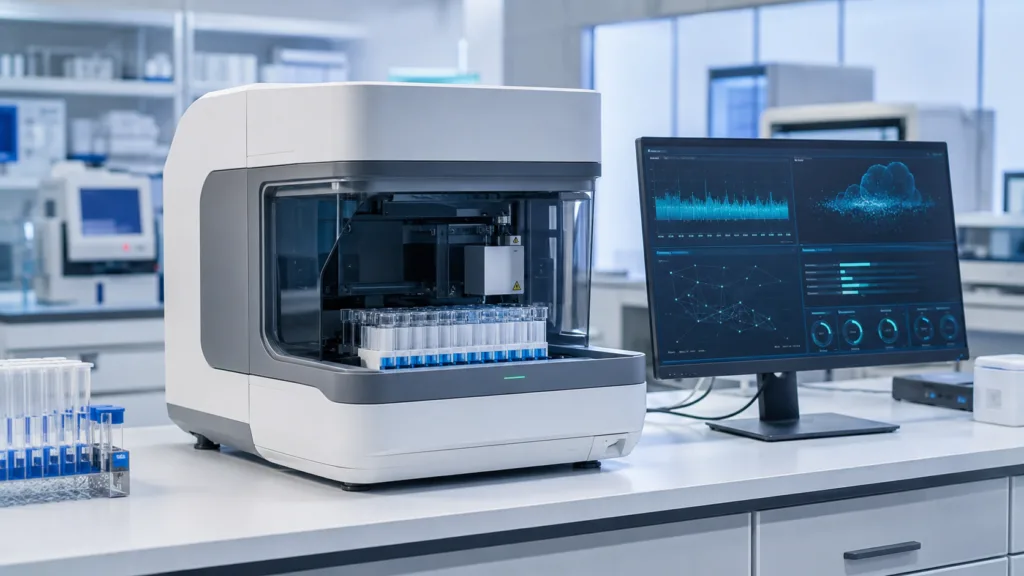
LRE Medical said its connected framework is intended to support remote diagnostics, fleet monitoring, lifecycle monitoring, controlled software management and proactive service. Its ADLM demonstration will show an IVD instrument securely exchanging information with cloud-based services.
Remote visibility could help an authorised service team identify recurring errors, declining component performance or configuration problems before an instrument becomes unavailable. It could also help manufacturers understand how instruments perform across an installed fleet, although the permissible use of field data would depend on contractual controls, data governance and applicable privacy requirements.
Software distribution is another potential advantage. Connected architecture can support controlled delivery of security patches, maintenance releases and authorised functionality. Yet laboratory instruments cannot be treated like ordinary consumer electronics. An update that changes instrument behaviour, interrupts testing or creates incompatibility with another system can affect laboratory operations and potentially the performance of the finished device.
A commercially credible platform will therefore require more than a cloud connection. Laboratories and healthcare information technology teams will need clear controls covering authentication, access privileges, update approval, audit logging, rollback, network segmentation, incident response and continuity when connectivity is unavailable. LRE Medical has not disclosed the detailed technical controls, interoperability standards or cloud infrastructure used in the demonstration, leaving those areas as important subjects for prospective customers to examine.
Does an AI-ready instrument architecture amount to an artificial intelligence diagnostic product?
The short answer is no. LRE Medical is demonstrating an architecture that could support future artificial intelligence functions, not announcing an artificial intelligence model that interprets diagnostic results or guides clinical decisions.
An instrument can be technically capable of collecting structured data, connecting to cloud services and receiving managed software updates without containing a regulated artificial intelligence function. Some future applications may be operational, such as predictive maintenance, service prioritisation or manufacturing analysis. Others could become clinically relevant if they influence test interpretation, quality assessment or diagnostic decisions.
That distinction would materially affect the evidence and regulatory pathway. An artificial intelligence function involved in clinical interpretation would ordinarily require a defined intended use, representative development data, analytical and clinical performance evidence, risk management, human-factors assessment and controls for monitoring performance after deployment. Developers may also need to address bias, data drift, model updates and performance differences across instruments, laboratories and patient populations.
The United States Food and Drug Administration has increasingly framed artificial intelligence-enabled device development as a total product lifecycle responsibility. Its guidance work addresses transparency, risk management, real-world performance monitoring and controlled modification of artificial intelligence-enabled device software. A connected foundation can help implement some of those activities, but architecture does not replace the evidence required for a specific function.
For diagnostics original equipment manufacturers, the practical value of LRE Medical’s framework may be that it preserves future development options. A manufacturer could design an instrument that is capable of supporting new digital services without committing to a particular artificial intelligence use at launch. Whether that flexibility justifies additional development complexity and cost will depend on the product roadmap and the likelihood that future functions can satisfy clinical, technical and regulatory requirements.
Why will cybersecurity determine whether connected diagnostics can scale safely?
Connectivity expands the usefulness of an instrument, but it also expands its attack surface. A standalone device with restricted physical access presents a different risk profile from an instrument that communicates with laboratory networks, cloud services, remote support tools and software distribution systems.
Cybersecurity consequently needs to be incorporated into product requirements, architecture, verification and post-market processes. It cannot be reduced to encryption or a firewall added shortly before commercial release. Manufacturers must consider asset identification, authentication, authorisation, secure communications, software integrity, vulnerability monitoring, patch delivery, incident response and recovery throughout the device lifecycle.
The United States Food and Drug Administration’s February 2026 medical-device cybersecurity guidance provides recommendations concerning secure device design, labelling and documentation for premarket submissions involving cybersecurity risk. The guidance also reinforces the importance of lifecycle planning, including updates and vulnerability management.
This regulatory direction strengthens LRE Medical’s argument for designing connectivity early. If security requirements are considered only after the core instrument is complete, limitations in processing capacity, software separation or update mechanisms may be difficult to correct without substantial redesign.
Nevertheless, a framework cannot provide universal compliance. The finished device manufacturer will still need to assess the precise intended use, connectivity configuration, data handled, clinical environment and foreseeable threats. Security will also depend on operational responsibilities after deployment, including who monitors vulnerabilities, who authorises updates, how quickly patches are delivered and what happens when a laboratory delays installation.
Can LRE Medical convert its connected framework into a meaningful OEM advantage?
LRE Medical operates as a contract development and manufacturing partner for complex point-of-care, benchtop diagnostic, medical and life-sciences devices. The company supports customers from concept development and industrialisation through serial production and lifecycle management.
The connected framework extends that model further into software-defined instrumentation. Instead of supplying only mechanical, optical or electronic development capacity, LRE Medical is presenting itself as a partner capable of coordinating physical instrument engineering with embedded software, cloud services, cybersecurity and manufacturing.
That positioning could appeal to smaller and mid-sized diagnostics developers seeking to avoid building every engineering function internally. It may also interest established manufacturers that need an external platform for a specialised assay, a new point-of-care format or a faster development programme.
The commercial challenge is that connected diagnostics is already a crowded field. Large laboratory-instrument manufacturers offer remote service, data management and fleet-monitoring capabilities across installed platforms. LRE Medical’s opportunity is therefore unlikely to rest on connectivity alone. Its differentiation will depend on whether it can translate these capabilities into custom, manufacturable instruments while preserving customer control over data, intellectual property, regulatory strategy and future software development.
Prospective customers will also need clarity about platform ownership and long-term support. Questions involving cloud hosting, software maintenance, component obsolescence, cybersecurity monitoring and access to technical documentation can become commercially significant over an instrument lifecycle that may last many years.
What should diagnostics manufacturers watch during the ADLM 2026 demonstration?
ADLM 2026 is scheduled for July 26 to July 30 at the Anaheim Convention Center, with the Clinical Lab Expo running from July 28 to July 30. The event is expected to bring together more than 700 exhibitors across over 200 laboratory product categories.
For LRE Medical, the most useful outcome will not be the visual impact of an instrument communicating with a cloud service. Diagnostics manufacturers will be looking for evidence that the architecture can be adapted to different assays, instrument formats, laboratory networks and regional regulatory requirements without creating another layer of proprietary complexity.
They are also likely to examine how responsibilities are divided between LRE Medical and the eventual legal manufacturer. Connectivity, remote servicing and software updates create ongoing obligations that continue long after design transfer and commercial launch. Clear responsibility for monitoring, documentation, incident management and change control will be essential.
The ADLM showcase gives LRE Medical an opportunity to demonstrate that connected instrument development is more than a collection of digital features. The framework will become commercially persuasive if the company can show that secure connectivity, manufacturing readiness and lifecycle governance operate as one coherent system.
The immediate milestone is the booth 883 demonstration. The more consequential test will come later, when an original equipment manufacturer uses the framework to develop a named diagnostic instrument, defines its intended use, verifies its cybersecurity controls and takes the finished product through the relevant regulatory and commercial pathway. Until then, LRE Medical has presented a potentially useful engineering foundation, not evidence that an artificial intelligence-enabled diagnostic device is ready for clinical deployment.