Subtle Medical, Inc. has received U.S. Food and Drug Administration clearance for SubtleHD(CT), an AI-powered image enhancement software product designed to reduce noise and improve low contrast detectability in computed tomography imaging. The clearance marks the medical imaging software developer’s first CT product and expands its FDA-cleared portfolio across MRI, PET, and CT at a time when radiology departments are under pressure to improve image quality, standardise output, and manage growing scan volumes.
Why does Subtle Medical’s CT clearance matter beyond another radiology AI approval?
The importance of SubtleHD(CT) lies in the operational problem it is trying to solve. Radiology departments are not merely looking for new algorithms that produce better looking images. They are trying to handle rising imaging demand, mixed scanner fleets, workforce pressure, older equipment, and increasingly complex clinical expectations without constantly replacing capital-intensive hardware. Subtle Medical’s latest clearance therefore sits at the intersection of clinical image quality, radiology productivity, infrastructure utilisation, and healthcare economics.
What is genuinely new for Subtle Medical is the move into CT image enhancement after building an AI imaging portfolio that already included MRI and PET products. CT remains one of the most widely used diagnostic imaging modalities, and it supports emergency care, oncology, cardiovascular assessment, pulmonary evaluation, trauma workups, and routine diagnostic pathways. By entering CT, Subtle Medical is moving from a narrower advanced imaging productivity story into one of the highest-volume areas of hospital imaging.
The risk is that FDA clearance does not automatically translate into clinical adoption, reimbursement, or workflow transformation. Radiologists and hospital administrators will still need to see whether SubtleHD(CT) improves image consistency in daily practice, works reliably across scanner generations, integrates smoothly into existing picture archiving and communication systems, and avoids creating artefacts that could affect interpretation. The commercial question is not whether AI can enhance an image in principle. It is whether the software can consistently improve operational performance without adding new layers of uncertainty for radiologists.
How could AI-powered CT image enhancement change the economics of scanner utilisation?
The most commercially interesting part of SubtleHD(CT) is its potential to help hospitals extract more value from imaging infrastructure they already own. CT scanners are expensive assets, and many healthcare systems operate a mix of newer and older machines across main hospitals, outpatient centres, emergency departments, and satellite facilities. If AI image enhancement can improve clarity and consistency across this mixed installed base, providers may be able to reduce quality variation without immediately replacing scanners.
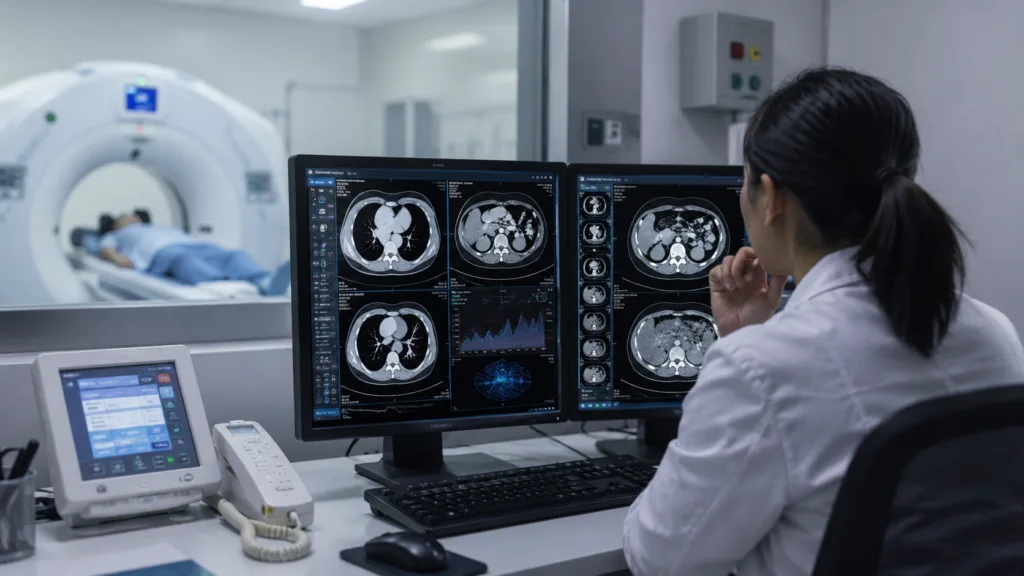
That matters because capital equipment replacement cycles are often slower than clinical demand growth. Hospitals may want newer scanners, but budget constraints, procurement timelines, construction requirements, and competing investment priorities can delay upgrades. A software-based enhancement layer could be attractive if it allows older systems to remain clinically useful for longer, improves output consistency across sites, or helps radiology groups standardise interpretation quality across distributed networks.
However, the economics are not automatic. Imaging leaders will need to compare software licensing costs against measurable benefits such as fewer repeat scans, better diagnostic confidence, shorter scan protocols, higher throughput, reduced variation, or improved patient experience. If the software is positioned only as a visual enhancement tool, buyers may be cautious. If it can demonstrate operational impact in scanner utilisation, workflow consistency, or protocol optimisation, the value proposition becomes stronger. The next test for Subtle Medical is proving that SubtleHD(CT) is not just a technical improvement, but an economic lever for imaging departments.
What does the move into CT reveal about Subtle Medical’s platform strategy?
Subtle Medical’s expansion into CT suggests that the medical imaging software developer is building a modality-spanning AI platform rather than a single-use product line. Its portfolio already includes AI-powered products for MRI and PET, and SubtleHD(CT) adds another major imaging category. That platform logic matters because health systems increasingly prefer tools that can operate across different equipment vendors, scanner generations, and clinical environments instead of isolated point solutions that require separate procurement, IT validation, and radiology training.
A vendor-neutral approach could be particularly relevant in large hospital systems and imaging networks. Many providers do not run uniform scanner fleets. They may have multiple equipment brands, different software versions, varied site protocols, and inconsistent image quality across locations. A software layer that works across this complexity could help imaging departments create more standardised output while preserving flexibility in equipment procurement.
The limitation is that platform ambition often increases implementation complexity. A multi-modality AI imaging portfolio must satisfy different clinical use cases, data flows, radiologist expectations, and regulatory requirements. CT image enhancement is not the same as PET enhancement or MRI acceleration. Each modality has distinct physics, artefact risks, image quality metrics, and clinical interpretation needs. Subtle Medical’s platform strategy will depend on whether it can show that its underlying AI approach adapts safely and effectively across modalities without becoming a generic technology story.
Why is CT image quality improvement clinically important in a high-volume modality?
CT image quality is clinically important because small differences in noise, contrast, sharpness, and lesion conspicuity can affect diagnostic confidence. Low contrast detectability is especially relevant when radiologists are looking for subtle abnormalities in soft tissue, lungs, liver, vessels, or other complex anatomy. An AI tool that improves low contrast detectability and reduces noise could help radiologists interpret difficult scans more confidently, particularly when image acquisition conditions are not ideal.
The clinical context also includes radiation dose management. CT imaging requires a balance between diagnostic quality and radiation exposure. Lower-dose protocols can reduce exposure but may increase image noise. If AI enhancement can support acceptable image quality in noisy or lower signal conditions, it could become part of broader dose optimisation strategies. That does not mean SubtleHD(CT) automatically lowers radiation dose in every setting. It means hospitals may explore whether the software can support protocols that preserve diagnostic quality while improving consistency.
The risk is that image enhancement must not obscure clinically relevant information or create false reassurance. Radiologists will need to understand how the software changes image appearance, where it performs best, and where caution is needed. AI-enhanced images must remain diagnostically trustworthy across patient sizes, disease patterns, anatomical regions, scanner types, and acquisition parameters. In imaging, a cleaner image is valuable only if it preserves truth. Adoption will depend on whether radiologists feel the software improves confidence rather than simply smoothing complexity.
How does FDA clearance shape confidence in AI imaging software adoption?
FDA clearance is an important threshold because it indicates that the device has passed the applicable premarket review pathway for its intended use. For hospitals, that matters because radiology AI tools are increasingly scrutinised by compliance teams, clinical governance committees, procurement leaders, and risk managers. A cleared device has a stronger pathway into clinical evaluation than an unregulated research algorithm or wellness-oriented software product.
However, FDA clearance is not the end of clinical due diligence. Radiology departments often run their own validation processes before deploying AI tools across clinical workflows. They may test performance on local scanner models, patient populations, image protocols, and reporting environments. They may also assess integration with radiology worklists, PACS, vendor-neutral archives, and existing quality assurance processes. In other words, clearance opens the door, but local evidence and workflow fit determine whether the product gets used meaningfully.
The broader regulatory question is how AI imaging software will be monitored after deployment. AI tools can behave differently across sites because imaging protocols, scanners, and patient populations vary. Regulators, hospitals, and vendors will increasingly need post-market surveillance, version control, performance monitoring, and transparent update practices. Subtle Medical’s success in CT will therefore depend not only on clearance, but on whether it can support responsible, scalable implementation in real-world radiology environments.
What could SubtleHD(CT) mean for radiologists facing workload and consistency pressures?
Radiologists are working in an environment where imaging volumes continue to rise and case complexity is increasing. CT is central to that pressure because it is fast, widely available, and heavily used across acute and routine care. If SubtleHD(CT) can improve image clarity and reduce noise without disrupting interpretation workflows, it could support radiologists by reducing variability and improving confidence in challenging reads.
The most realistic benefit may be consistency rather than replacement. AI image enhancement is not designed to diagnose disease independently or replace radiologist judgment. Its value lies in improving the image input that radiologists interpret. That distinction matters because many AI adoption debates in radiology have been overframed around automation. In practice, some of the most useful AI tools may be those that quietly improve acquisition, reconstruction, quality, triage, or workflow rather than trying to perform full diagnostic substitution.
The risk is that radiologists may resist tools that alter image appearance without clear transparency or evidence. Even if an enhanced image looks better, clinicians may want access to original images, clear labelling, and confidence that subtle findings are not being suppressed or modified. Subtle Medical will need to support radiologist trust through education, validation data, clear workflow integration, and evidence that the tool improves interpretability without masking pathology.
Why could hospital IT integration become as important as image enhancement performance?
AI imaging software must fit into a complex hospital technology environment. Radiology departments already operate PACS, radiology information systems, electronic health records, scanner consoles, vendor-neutral archives, cybersecurity controls, and quality assurance workflows. A product that improves image quality but creates operational friction may struggle to scale, especially in large enterprise settings.
Subtle Medical’s positioning around seamless integration is therefore commercially important. If SubtleHD(CT) can be deployed without disrupting existing scanner workflows, radiologist reading patterns, or hospital IT systems, the adoption barrier becomes lower. Vendor-neutral compatibility is especially relevant because hospitals do not want to be locked into one scanner manufacturer’s ecosystem for AI enhancement. A software layer that supports multiple scanner generations and vendors could appeal to providers trying to standardise imaging quality across diverse assets.
The unresolved question is whether integration remains simple at enterprise scale. Small deployments can look smooth, while multi-site rollouts can expose differences in network architecture, imaging protocols, storage systems, cybersecurity requirements, and radiologist preferences. For Subtle Medical, technical reliability, service support, and implementation discipline may be as important as the AI model itself. In medtech software, the best algorithm still needs a boringly reliable deployment model.
How does this clearance fit into the broader AI medical device market?
SubtleHD(CT) enters a crowded but still evolving AI medical device landscape. Radiology has been one of the most active areas for AI-enabled medical devices because imaging data are digital, workflow demand is high, and measurable tasks can often be defined around detection, reconstruction, enhancement, triage, or quantification. That makes radiology a logical proving ground for medical AI, but also a competitive market where differentiation can become difficult.
Subtle Medical’s differentiation is less about claiming AI novelty and more about targeting a practical bottleneck. Many AI radiology tools focus on detection or triage. SubtleHD(CT) focuses on image enhancement, which may make its adoption case more operationally grounded. Instead of asking radiologists to accept an algorithmic diagnosis, it asks whether improved image quality can make existing workflows more efficient and consistent.
The limitation is that the market is becoming more disciplined. Hospitals have seen many AI tools with promising demonstrations but uneven real-world impact. Procurement teams increasingly want evidence of clinical utility, workflow value, cybersecurity readiness, support infrastructure, and economic return. The fact that Subtle Medical now has a broader cleared portfolio may help its credibility, but buyers will still judge SubtleHD(CT) on performance, integration, and measurable value.
What risks could slow adoption despite FDA clearance and technical promise?
The first adoption risk is evidence depth. Hospitals may want peer-reviewed data or site-level validation showing that SubtleHD(CT) improves clinically relevant outcomes, not just visual appearance. Measures such as repeat scan reduction, reader confidence, protocol consistency, diagnostic performance, or throughput impact could influence buying decisions. Without such evidence, the product may remain attractive but optional.
The second risk is reimbursement and budget ownership. AI software often faces a practical question: who pays for it and who benefits? Radiology departments may see workflow value, but capital committees, health system executives, or outpatient imaging operators may require financial justification. If there is no direct reimbursement attached to AI image enhancement, adoption may depend on whether the software reduces costs, increases capacity, improves patient experience, or protects service quality.
The third risk is clinical conservatism. Radiology is a high-stakes specialty where missed findings and false confidence can have serious consequences. Even supportive radiologists may want careful implementation and monitoring before relying on enhanced images in routine practice. Subtle Medical will need to balance commercial momentum with responsible adoption. In AI medical devices, moving too fast can create trust problems. Moving with strong evidence can create a more durable market.
What should radiology leaders and medtech observers watch next?
Radiology leaders should watch for clinical validation data that show how SubtleHD(CT) performs across scanner vendors, body regions, protocols, patient sizes, and real-world imaging environments. The most useful evidence will not be limited to image examples. It will show whether the software improves diagnostic confidence, reduces noise without compromising pathology visibility, supports protocol optimisation, and fits into daily reporting workflows.
Medtech observers should track whether Subtle Medical can convert a multi-modality cleared portfolio into enterprise contracts. The company’s installed base across more than 1,300 scanners gives it a platform from which to pursue broader adoption, but CT is a demanding market with high volumes and exacting radiologist expectations. If SubtleHD(CT) gains traction, it could strengthen the argument that AI imaging software can extend infrastructure value rather than simply add another diagnostic overlay.
For now, Subtle Medical’s FDA clearance is best understood as a meaningful platform expansion rather than a settled market shift. The clearance gives SubtleHD(CT) regulatory legitimacy and places the product in one of the most important imaging categories. The next stage will test whether AI-powered CT enhancement can deliver what hospitals increasingly need: better image quality, more consistent performance, and stronger scanner economics without forcing a full hardware reset.