The first patient has received TScan Therapeutics’ TSC-101 in the pivotal Phase 3 ALLOHA-2 trial for adults with acute myeloid leukemia or myelodysplastic syndromes undergoing allogeneic hematopoietic cell transplantation. The donor-derived T-cell receptor therapy is administered after the transplant has engrafted and is intended to eliminate residual recipient blood cells that could allow the cancer to return. The trial will assess relapse-free survival in approximately 310 participants, with topline results anticipated in mid-2028, but the supporting Phase 1 evidence remains based on small, biologically assigned groups and early surrogate measures.
How TSC-101 is designed to eliminate residual cancer without attacking donor blood cells
Allogeneic hematopoietic cell transplantation can provide long-term disease control for some patients with acute myeloid leukemia and myelodysplastic syndromes by replacing the patient’s blood-forming system with cells from a healthy donor. Relapse remains a major cause of treatment failure, particularly when small amounts of malignant or recipient-derived tissue survive the transplant. Detectable measurable residual disease before or after transplantation is associated with a higher risk of the cancer returning.
TSC-101 is manufactured from T cells collected from the same donor who supplies the transplant. Those cells are genetically engineered to express a T-cell receptor that recognizes HA-2, an antigen derived from the MYO1G protein, when HA-2 is displayed by the HLA-A02:01 molecule. The treatment is therefore limited to patients who are positive for HLA-A02:01 and receive a transplant from a donor who is negative for that HLA type.
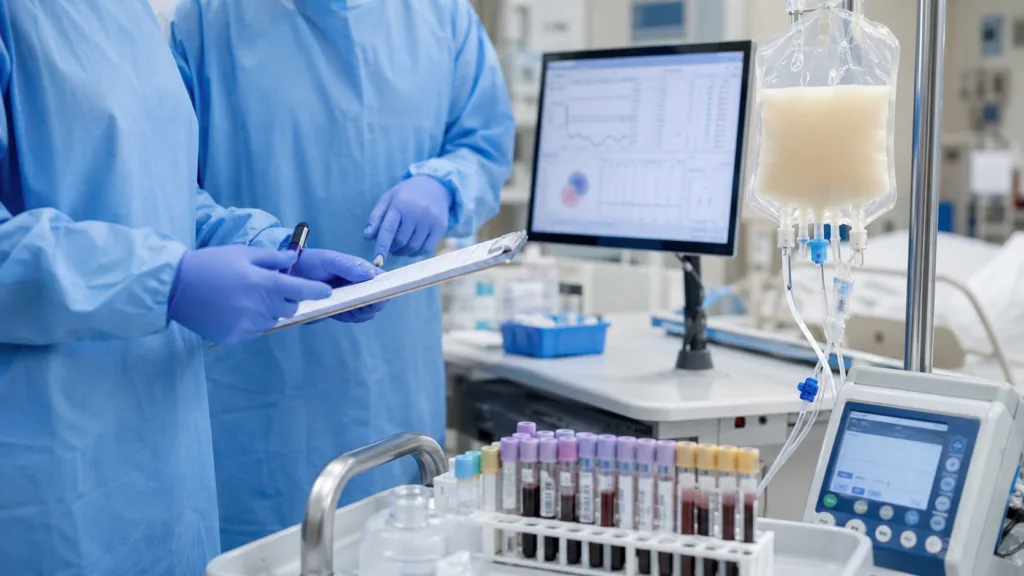
After transplantation, the engineered T cells are intended to recognize and eliminate remaining recipient-derived blood cells, including residual leukemia or myelodysplastic cells. Because the donor’s new blood cells do not carry HLA-A*02:01, they should not display the HA-2 target in the form recognized by TSC-101 and are expected to be spared. This selective mismatch is designed to strengthen the graft-versus-leukemia effect while promoting complete donor chimerism, the replacement of the patient’s blood-forming system by donor-derived cells.
The approach differs from conventional autologous CAR-T therapy, in which a patient’s own cells are modified to target a surface protein on cancer cells. TSC-101 is donor-derived, uses a T-cell receptor rather than a chimeric antigen receptor and is administered as part of a transplant strategy rather than as an independent replacement for transplantation.
The biological logic is attractive because residual malignant and non-malignant recipient blood cells share the HA-2 and HLA combination targeted by the therapy. Eliminating them may reduce the reservoir from which relapse develops. The same mechanism requires precise patient and donor selection, however, and cannot be applied to patients who lack HLA-A*02:01 or cannot identify an appropriate donor.
ALLOHA-2 will compare two TSC-101 infusions with transplantation alone
ALLOHA-2 is a multicenter, controlled Phase 3 study expected to enroll approximately 310 adults with acute myeloid leukemia or myelodysplastic syndromes. All participants will undergo allogeneic transplantation using reduced-intensity conditioning, an approach commonly considered for older patients or people unable to tolerate more intensive preparative regimens.
Patients who are HLA-A02:01-positive and have an appropriate donor are assigned to receive TSC-101 following transplantation. Participants who are HLA-A02:01-negative, or who are positive but do not have a suitable donor, enter the transplant-only control group. TScan describes this as biological assignment or genetic randomization because group placement is determined by inherited HLA status and donor compatibility rather than by a conventional random allocation process.
Patients in the experimental group will receive two TSC-101 infusions after successful engraftment. Relapse-free survival is the primary endpoint, while overall survival and event-free survival are major secondary measures. The study is recruiting across the United States, and TScan anticipates a topline readout in mid-2028. Participants receiving TSC-101 will also enter long-term surveillance for as long as 15 years after their final infusion, reflecting regulatory requirements for monitoring genetically modified cellular therapies.
Using relapse-free survival as the primary endpoint is important because the pivotal trial is designed to show whether early elimination of recipient cells produces an actual clinical benefit. Donor chimerism may provide an early indication that the therapy is working biologically, but it is not equivalent to preventing relapse or prolonging life.
The biologically assigned design also creates an interpretive challenge. The treatment and control groups may differ in HLA status, donor availability or transplant characteristics that influence outcomes independently of TSC-101. Conventional randomization usually helps distribute known and unknown risk factors more evenly. TScan reached agreement with the FDA on a pivotal design that mirrors the Phase 1 study, but the company will still need to demonstrate adequate balance between groups and apply statistical methods capable of addressing important baseline differences.
Early ALLOHA results support Phase 3 testing but do not establish relapse prevention
The Phase 3 launch follows the Phase 1 ALLOHA trial, including a newer Cohort C treated with TSC-101 produced through the company’s commercial-ready manufacturing process. At the June 8, 2026 data cutoff, 11 of 14 treated patients had reached complete donor chimerism approximately three weeks after their first infusion. Two additional patients showed improving chimerism, and 13 of 14 had declining levels of recipient-derived cells after treatment.
No Cohort C patient had relapsed by that cutoff. The observation is encouraging but immature because several participants had only limited follow-up and relapse risk continues well beyond the first weeks or months following transplantation. A result recorded soon after infusion cannot determine whether the therapy prevents recurrence over multiple years.
The Phase 1 program has produced longer-term signals in earlier participants. As of a September 2025 analysis, four of 19 evaluable TSC-101 recipients had relapsed, compared with six of 18 evaluable controls. Relapse-free survival numerically favored treatment with a hazard ratio of 0.50, but the difference was not statistically significant. The dataset was too small to exclude chance, and the confidence around the estimated treatment effect remained wide.
Three treated patients who had reached two years after transplantation remained free of disease, compared with one of four controls at the same follow-up point. These numbers support continued investigation but involve too few patients for reliable conclusions about durable efficacy.
TScan has also reported an association between early complete donor chimerism and lower subsequent relapse risk. That relationship strengthens the rationale for using chimerism as an early pharmacodynamic marker, although it does not prove that forcing chimerism with TSC-101 will necessarily produce the same survival benefit. ALLOHA-2 is designed to test that connection directly through relapse-free survival.
Safety findings have so far appeared manageable within the context of transplantation. Earlier TSC-101 infusions produced no dose-limiting toxicities, and overall adverse events were described as similar to those seen in the biologically assigned control arm and generally consistent with complications expected after transplantation. In Cohort C, one Grade 1 cytokine-release syndrome event was reported after TSC-101 and resolved, while treatment-emergent acute graft-versus-host disease did not appear more frequent than in controls.
These observations require confirmation in hundreds of patients. Transplant recipients are medically vulnerable and can experience infections, graft-versus-host disease, organ toxicity, relapse and non-relapse mortality even without an additional engineered-cell infusion. The Phase 3 analysis must separate adverse events attributable to TSC-101 from those caused by the transplant, conditioning regimen or underlying disease.
HLA restrictions and donor-specific manufacturing could limit future clinical reach
TSC-101 addresses only a genetically defined portion of the transplant population. HLA-A*02:01 is present in an estimated 42% of people in the United States, while the HA-2 antigen is much more common. Eligible patients must also have a donor whose HLA profile allows the engineered cells to target recipient tissue without attacking the newly established donor-derived blood system.
Each product is manufactured from an individual transplant donor, making execution more complex than supplying a standardized drug from inventory. The donor’s cells must be collected, engineered, tested and released on a schedule coordinated with transplantation and engraftment. TScan reported an approximately 90% manufacturing success rate in Cohort C, meaning manufacturing reliability and turnaround time will remain clinically important as enrollment expands across more sites.
The company is developing TSC-102-A01 and TSC-102-A03 for patients carrying other common HLA types. Those candidates target CD45 and are expected to enter Phase 1 testing, potentially broadening the population addressable by the transplant-based TCR-T strategy. They remain separate experimental products and cannot be assumed to reproduce TSC-101’s emerging safety or biological activity.
ALLOHA-2 represents an unusually direct test of whether an engineered donor-cell therapy can improve the curative potential of allogeneic transplantation by removing residual recipient disease. The first patient infusion moves TSC-101 beyond early chimerism data and into a trial powered around relapse rather than a surrogate laboratory measure.
A positive result would require more than showing that recipient cells disappear shortly after treatment. TSC-101 must produce a durable improvement in relapse-free survival without causing enough graft-versus-host disease, immune toxicity, infection or treatment-related mortality to erase that benefit. Until the mid-2028 readout, the therapy remains supported by a compelling mechanism and encouraging but limited early clinical evid