
Sound Health Systems, Inc., operating as SoundHealth, has closed an oversubscribed Series A led by Shangbay Capital to accelerate the growth of its Sonu nasal congestion device and Spatial Sleep consumer wellness product. The financing appears to add approximately $5.25 million and take the company’s total disclosed funding to $12.25 million, rather than representing an entirely new $12.25 million injection, because SoundHealth had already announced a $7 million seed round in July 2024 and its latest release described the larger figure as cumulative funding. Medical-device publication MassDevice also reported the new Series A amount as $5.25 million.
The distinction matters because funding totals help investors, potential commercial partners and industry observers judge how much capital the privately held company may have available for product expansion. SoundHealth did not disclose its latest valuation, the ownership percentage sold, the complete investor syndicate or its expected cash runway. It said the proceeds would support commercial growth, recruitment, product development and additional outcomes research across breathing and sleep applications.
The financing moves SoundHealth beyond the earliest device-development stage and into a more demanding commercial phase. Sonu already has United States regulatory clearance for a defined medical indication, while Spatial Sleep is marketed as a wellness product with a smaller and less mature evidence package. SoundHealth must now demonstrate that regulatory clearance, early clinical evidence and provider interest can be converted into repeatable product demand, sustainable distribution and credible health-technology economics.
Why does the $12.25 million SoundHealth funding figure require closer interpretation?
SoundHealth’s July 30, 2026 announcement carried a headline stating that the company had raised $12.25 million. The body of the release, however, said the Series A brought total funding to date to $12.25 million. SoundHealth previously announced a $7 million seed financing led by Moai Capital and J4 Ventures in July 2024, making approximately $5.25 million the arithmetically consistent size of the latest round.
This is not merely a technical editorial difference. A $12.25 million fresh Series A would imply substantially more new operating capital than a $5.25 million round, especially for a company attempting to finance hardware manufacturing, consumer marketing, provider education, clinical research and software development simultaneously. The cumulative total still represents meaningful funding for an emerging medical-device business, but it also increases the importance of careful capital allocation.
Shangbay Capital led the financing, with founder William Dai indicating that the investor regarded SoundHealth as operating at the intersection of artificial intelligence, consumer health and clinically informed device development. SoundHealth has not disclosed whether its earlier seed investors participated in the Series A or whether additional strategic investors joined the round.
The company’s next stage is therefore likely to be judged less by headline funding and more by measurable commercial progress. Relevant indicators would include unit shipments, active users, provider conversion rates, revenue growth, customer acquisition costs, product returns and evidence that users continue engaging with the technology after their initial purchase.
What must SoundHealth prove commercially with the FDA-cleared Sonu device?
Sonu is SoundHealth’s principal regulated product. The device uses acoustic resonance delivered through a wearable headband to provide temporary relief from moderate to severe nasal congestion associated with allergic and non-allergic rhinitis. Its current United States Food and Drug Administration-cleared indication covers at-home use by people aged 12 and older.
The regulatory history gives SoundHealth a more substantial foundation than many consumer breathing-technology businesses. The United States Food and Drug Administration granted a De Novo request for the original adult indication in December 2023, establishing a Class II regulatory classification for an external mechanical stimulator intended to relieve congestion. A subsequent 510(k) clearance issued in April 2025 expanded the indicated population from adults aged 22 and older to people aged 12 and above.
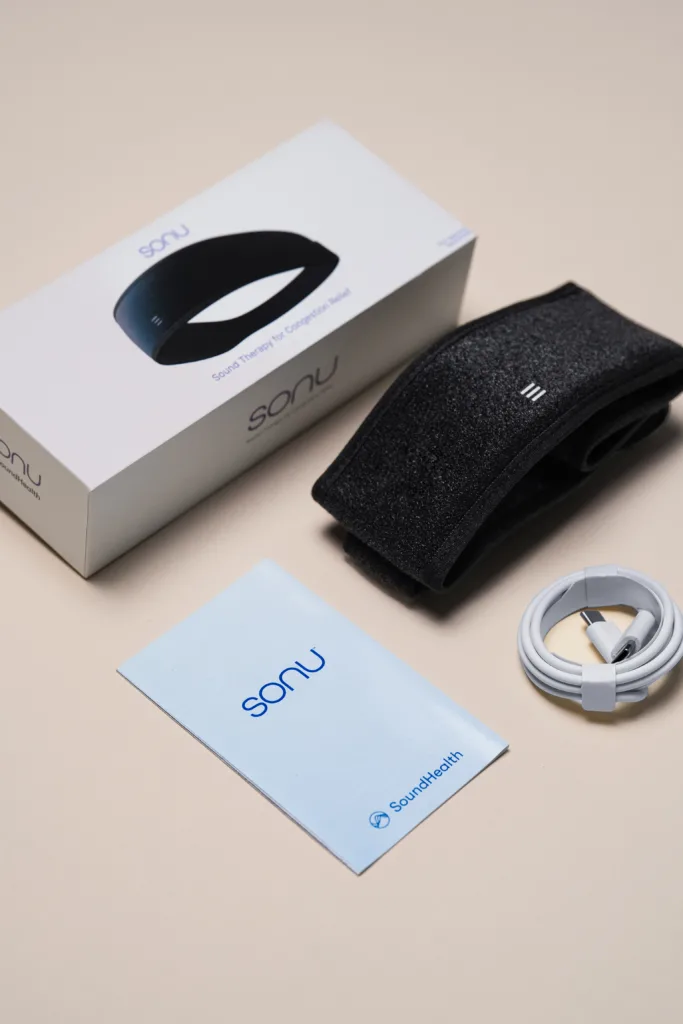
Clearance nevertheless represents permission to market Sonu for its stated indication, not proof of broad commercial adoption. The device must compete with established approaches to rhinitis management, including intranasal corticosteroids, antihistamines, saline products and other therapies selected according to symptoms and clinical circumstances. Professional guidance has continued to recommend intranasal steroids for patients whose allergic rhinitis affects quality of life, meaning Sonu enters a market with familiar, comparatively inexpensive treatment options.
SoundHealth currently lists Sonu at approximately $299 and limits direct product availability to the United States. At that price, the company needs to communicate a clear practical advantage to patients who may otherwise use lower-cost medicines or over-the-counter products. Convenience, a non-drug mechanism and home use may support differentiation, but the financing announcement did not provide revenue, shipment, prescription, reimbursement or conversion data that would show how quickly that differentiation is producing sales.
SoundHealth reported that its users had completed more than 500,000 acoustic resonance sessions and that over 1,000 medical and dental professionals had recommended its products. Those figures suggest growing engagement and provider awareness, but they remain company-reported activity measures rather than independently verified indicators of revenue, sustained symptom improvement or market penetration. The number of sessions also cannot be directly translated into the number of paying customers because individual users may complete multiple sessions.
How strong is the clinical evidence supporting Sonu’s acoustic resonance approach?
The evidence supporting Sonu is more developed than the typical evidence offered for a general consumer wellness wearable. The adult dataset reviewed during the De Novo process included a multicentre, randomised, double-blind and sham-controlled study involving 52 participants treated for two weeks. The United States Food and Drug Administration’s review recorded statistically significant improvements in nasal congestion and total nasal symptom scores compared with the sham group.
The study design is an important strength because sham-controlled testing can help separate a device’s treatment effect from expectations associated with wearing and activating the product. The disclosed sample was nevertheless small, and the treatment period was brief. The regulator specifically noted that repeated use beyond two weeks had not been studied in the original evidence package, leaving longer-duration performance and risk less certain.
SoundHealth’s paediatric expansion was supported by a separate 31-person study involving participants between 12 and 21 years of age. The study was single-arm and non-randomised, making it less able to separate treatment-related changes from placebo effects, natural symptom variation or changes in background care. The company reported reductions in nasal symptom scores and no adverse events in the disclosed paediatric study, but the absence of reported events in a small study does not establish an absence of risk across broader real-world use.
The regulatory documents identify potential risks including skin irritation, pain, discomfort, headache, vertigo, tinnitus and possible hearing-related effects, alongside the possibility that treatment may be ineffective or that congestion may worsen. These are not evidence that such outcomes are common, but they reinforce why safety language should remain qualified and why post-market data will matter as the user base grows.
Additional controlled studies, longer follow-up and evidence showing how Sonu performs alongside or against established rhinitis management could strengthen the commercial proposition. Payers and clinicians may also look for evidence of reduced medication use, improved sleep, better daily functioning or fewer healthcare visits before treating the device as more than an optional symptom-management tool.
Why does Spatial Sleep create a different regulatory and evidence challenge?
Spatial Sleep broadens SoundHealth’s addressable market by moving beyond nasal congestion and into consumer sleep technology. The product combines a smartphone-based facial scan, machine-learning personalisation and bone-conduction audio intended to deliver customised binaural stimulation during a 45-minute session. SoundHealth lists Spatial Sleep at approximately $319.
The product is positioned as a wellness device and is not intended to diagnose, treat, cure or prevent a disease. That distinction separates Spatial Sleep from Sonu, which has a specific FDA-cleared medical indication. It also means the company must avoid allowing consumer marketing to imply that Spatial Sleep is an authorised treatment for chronic insomnia or another diagnosed sleep disorder.
SoundHealth has reported results from a 20-person pilot study of customised binaural beats in adults with chronic insomnia. The study reported an average 11.28-point reduction in Insomnia Severity Index scores, a 70% response rate, high adherence and no adverse effects during the disclosed study period. The findings were published in the Journal of Sleep Medicine, but the small sample and limited duration mean that larger controlled trials are required before drawing conclusions about comparative effectiveness, durability or performance across different populations.
Spatial Sleep also enters an area where behavioural treatment standards are well established. The American Academy of Sleep Medicine has strongly recommended multicomponent cognitive behavioural therapy for insomnia in adults with chronic insomnia disorder. A wellness device may still find users seeking an accessible, drug-free sleep routine, but SoundHealth will need to show whether its technology improves outcomes beyond general relaxation, expectancy effects or other consumer sleep products.
The immediate commercial opportunity may be attractive because wellness products can often reach consumers without the time and expense associated with obtaining a disease-specific medical-device clearance. The trade-off is that the wellness category is crowded, reimbursement is unlikely to be the initial demand driver and consumer retention may depend heavily on perceived benefit, app experience and marketing efficiency.
Can healthcare-provider distribution convert early interest into repeatable revenue?
SoundHealth has been building a provider-oriented route to market alongside direct consumer sales. In February 2026, it announced a collaboration under which Vivos Therapeutics would act as a reseller and introduce SoundHealth technology through a network of more than 2,000 dentists and sleep-focused healthcare providers. The arrangement also included access to SoundHealth’s facial-scanning and voice-biomarker capabilities.
That channel could give SoundHealth access to patients already discussing breathing, airway and sleep concerns with healthcare professionals. Provider recommendation can also improve consumer confidence in a device that is unfamiliar and more expensive than many conventional symptom-relief products.
A reseller agreement, however, is not equivalent to widespread prescribing, purchasing or product utilisation. SoundHealth and Vivos Therapeutics have not publicly disclosed minimum purchase commitments, sales targets, revenue-sharing terms or the number of providers that have actively ordered or recommended the products through the collaboration. The commercial value will depend on conversion within the network rather than its headline size.
Training and positioning will also be important. Providers must understand which product has an FDA-cleared indication, which product remains in the wellness category and what claims are supported by the available evidence. Any blurring of those distinctions could create regulatory, reputational or patient-expectation risks as distribution expands.
Why could SoundHealth’s artificial intelligence and biometric data strategy become increasingly important?
SoundHealth’s devices are presented as personalised systems rather than simple acoustic wearables. The company collects facial geometry and other information used by its artificial intelligence and machine-learning-enabled applications, while its Vivos collaboration references facial scanning and voice-biomarker technology. SoundHealth has published privacy and biometric-data notices describing aspects of this collection and processing.
The financing announcement did not disclose the size or demographic composition of the datasets used to develop the personalisation systems, whether performance has been externally validated across diverse populations or how frequently the underlying models are updated. These questions become more important when software output influences the frequencies or stimulation delivered by a health-related device.
SoundHealth does not necessarily need to disclose proprietary model architecture to establish credibility. It will, however, benefit from demonstrating that personalisation produces better outcomes than a standardised intervention, that performance remains consistent across relevant demographic groups and that user data are managed transparently.
Artificial intelligence may ultimately provide SoundHealth with differentiation, but the commercial proposition cannot rest on the presence of an algorithm alone. The stronger case would connect personalisation to reproducible clinical or user outcomes, while showing that the hardware, mobile application, manufacturing process and data-governance system can scale together.
What should investors and medical-device partners watch after the SoundHealth Series A?
The latest financing gives SoundHealth additional resources to expand sales and continue product development, but the amount is modest relative to the number of objectives the company is pursuing. Hardware inventory, marketing, clinical research, recruitment, regulatory work and artificial intelligence development can all consume capital rapidly, particularly when a company is building both regulated medical devices and consumer wellness products.
The next meaningful disclosures would include revenue growth, unit sales, active users, provider-channel conversion, gross margins and the proportion of purchases generated through professional recommendations rather than paid consumer marketing. For Sonu, longer-duration evidence and clearer information about repeat use would strengthen the clinical and commercial case. For Spatial Sleep, a larger controlled study would help determine whether the early insomnia findings remain persuasive in a more rigorous setting.
SoundHealth has cleared an important early hurdle by securing regulatory clearance for Sonu and attracting specialist healthcare investors. Its next hurdle is more exacting: proving that an acoustic resonance platform can move from encouraging studies and engagement statistics into a durable medical-device business.
The Series A should therefore be viewed as a commercial execution milestone rather than an endpoint. By the time SoundHealth returns to the funding market, investors are likely to expect more than cumulative session counts. They will want evidence that patients are buying the devices, providers are converting recommendations into sustained demand and the company’s personalised acoustic technology delivers benefits that justify its price in a competitive breathing and sleep market.