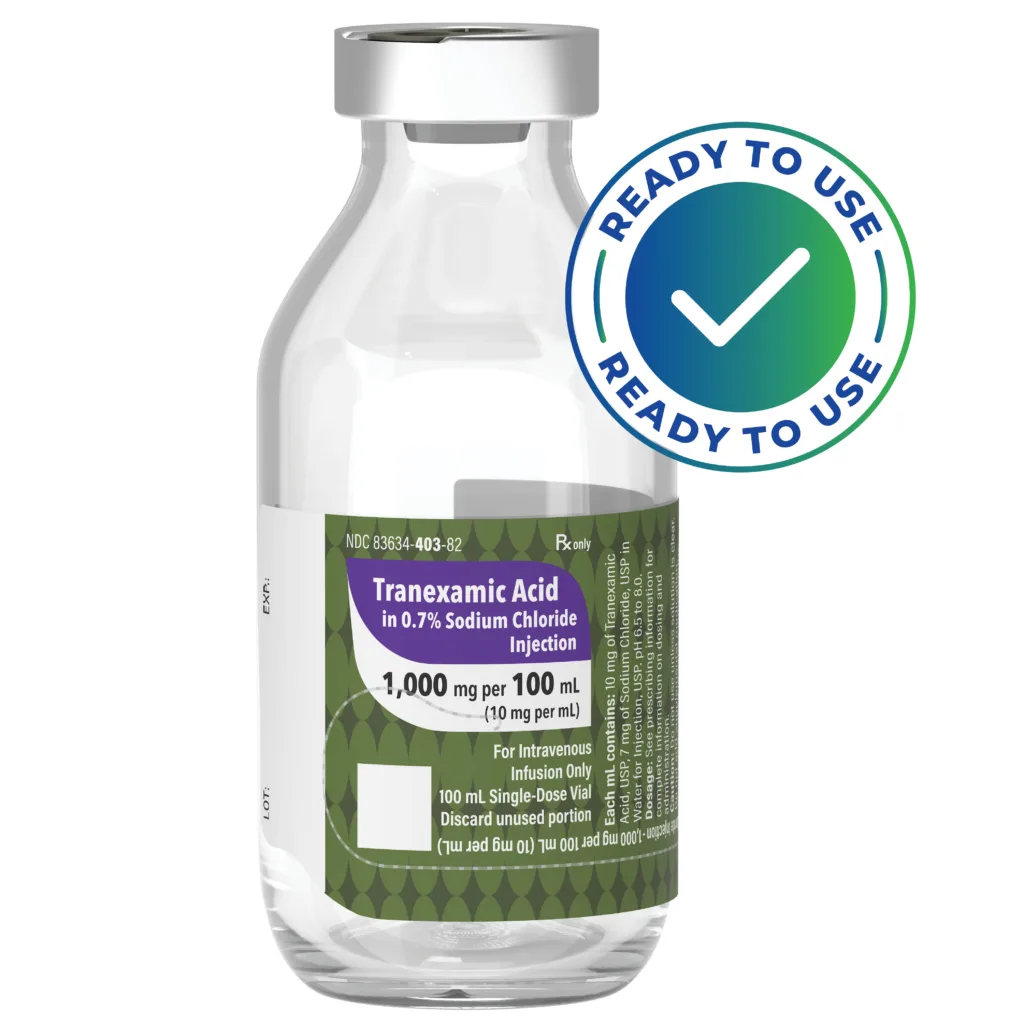
Avenacy has launched Tranexamic Acid in 0.7% Sodium Chloride Injection in the United States, adding a ready-to-use injectable formulation for patients with hemophilia who need short-term bleeding control during and after tooth extraction. The Schaumburg, Illinois-based specialty pharmaceutical firm said the product contains the same active ingredient as Pfizer’s CYKLOKAPRON and represents its 27th product launch since the company’s inception in October 2023.
Why Avenacy’s ready-to-use tranexamic acid launch matters for hospital injectable safety and workflow efficiency
Avenacy’s new tranexamic acid product is not a novel active ingredient, and that is precisely why the launch matters in a different way. The strategic significance lies less in therapeutic innovation and more in formulation readiness, hospital usability, injectable supply reliability, and the growing push to reduce medication preparation burdens in acute and supervised care settings.
Tranexamic acid is an antifibrinolytic agent used to reduce or prevent bleeding in specific clinical contexts. In this case, the U.S. indication is focused on patients with hemophilia requiring short-term use for two to eight days to reduce or prevent hemorrhage and reduce the need for replacement therapy during and after tooth extraction. That is a narrow but clinically relevant setting where predictable dosing, preparation reliability, and product availability can matter to providers.
The commercial backdrop is also modest but meaningful. U.S. sales of tranexamic acid injection were approximately $30.2 million for the 12 months ended March 2026, with ready-to-use presentations accounting for roughly $15 million of that total. This is not a blockbuster market, but it is the kind of essential injectable category where hospital buyers often value dependable supply, simple administration workflows, and reduced preparation complexity more than marketing scale.
The launch also fits a broader pattern in the U.S. injectable medicines market. Hospitals continue to face pressure from labor constraints, pharmacy workload intensity, medication safety expectations, and periodic supply chain fragility. Ready-to-use injectable products can help address some of those operational pressures because they reduce steps associated with compounding, dilution, transfer, or manual preparation. However, the commercial test is whether procurement teams see enough practical value to shift purchasing behavior in a category with established alternatives.
How ready-to-use injectable formats are changing competition beyond active ingredients
The most important distinction in Avenacy’s launch is that competition is not centered on the molecule itself. Tranexamic acid is well understood, and CYKLOKAPRON has long established the therapeutic reference point. The competitive battleground is presentation, packaging, reliability, and fit within hospital medication-use systems.
Avenacy is positioning the product as a single-dose ready-to-use vial containing 1,000 mg per 100 mL, equal to 10 mg per mL, supplied in cartons of 10 vials. For hospital pharmacies, this kind of format can reduce friction when compared with products that require additional preparation steps. Fewer handling steps can support faster workflow and may lower the possibility of preparation-related errors, particularly in environments where injectable medicines are managed under time pressure.
That said, ready-to-use does not automatically equal rapid uptake. Hospitals and group purchasing organizations tend to evaluate injectable products through a practical lens that includes acquisition cost, contract availability, existing formulary preferences, supply consistency, storage requirements, labeling clarity, and nursing or pharmacy workflow impact. Avenacy’s ability to translate a product launch into meaningful adoption will depend on how well the product fits into these procurement and formulary decision pathways.
The launch also highlights how specialty pharmaceutical firms can build relevance without owning high-profile intellectual property. By focusing on essential injectable products, differentiated labeling, and ready-to-use formats, Avenacy is attempting to compete in a part of the market where execution can be as important as discovery. That model can be attractive, but it requires consistent product availability and disciplined portfolio selection because margins in generic and specialty injectable markets can be sensitive to pricing pressure and competitor entry.
What Avenacy’s 27th product launch reveals about its injectable portfolio strategy
Avenacy’s statement that tranexamic acid is its 27th product launch since October 2023 is arguably the larger strategic signal. The U.S.-based specialty pharmaceutical firm is building an injectable portfolio at a rapid pace, targeting medications used in medically supervised settings such as acute care hospitals, outpatient clinics, and physician offices.
For a young company, the 27-product milestone suggests a portfolio-led strategy rather than a single-asset strategy. That matters because injectable supply relationships are often built across product breadth, not just one product. Hospitals and wholesalers may be more willing to engage with a supplier that can provide multiple critical injectable medicines, especially when those products address recurring operational needs.
However, scaling an injectable portfolio brings its own risks. Avenacy depends on a global network of development and contract manufacturing partners that have undergone FDA inspections based on current good manufacturing practice standards. That model can support faster portfolio expansion, but it also creates reliance on external manufacturing capacity, regulatory execution, quality systems, and supply continuity. In injectable medicines, one quality issue or supply interruption can quickly affect customer trust.
The company’s packaging and labeling strategy is also central to the story. Avenacy has emphasized differentiated labeling intended to support accurate medication selection. In hospital environments, packaging is not cosmetic. It can influence how quickly clinicians identify a product, how easily pharmacy staff distinguish similar presentations, and how effectively systems reduce look-alike or selection risks. The unresolved question is whether this differentiation becomes a measurable procurement advantage or remains a useful but secondary feature.
Why the hemophilia indication keeps the clinical opportunity focused but operationally relevant
Tranexamic Acid Injection’s indicated use in hemophilia patients during and after tooth extraction places the product in a very specific clinical setting. The value proposition is not broad bleeding control across every hospital scenario. It is tied to reducing or preventing hemorrhage and reducing the need for replacement therapy in a defined short-term use window.
That narrow indication can be commercially limiting, but it also creates clarity. Clinicians and pharmacists know where the product fits, and there is less ambiguity around the approved use described in the labeling. For injectable suppliers, that clarity can help with formulary positioning because the product is not trying to redefine care standards or compete through a new clinical claim.
The key limitation is that a narrow indication can restrict growth unless broader institutional demand for tranexamic acid formulations supports recurring volume. Avenacy’s cited market data suggest ready-to-use presentations already account for about half of the U.S. tranexamic acid injection market by sales. That indicates there is an existing customer base for convenience-focused formats, but it also means the company is entering a segment where the value proposition may already be understood by buyers.
Clinicians tracking injectable medication use are likely to view the launch through a practical lens. The product does not change the role of tranexamic acid in hemophilia care, but it may give hospitals another ready-to-use option in a category where preparation simplicity and supply availability can be meaningful. The question is not whether the molecule works differently. The question is whether Avenacy can make the product easier to stock, select, and administer within existing care pathways.
What could limit adoption despite the appeal of ready-to-use tranexamic acid injection
The biggest commercial challenge for Avenacy is that ready-to-use injectables must justify their place in a cost-sensitive procurement environment. Hospitals may appreciate reduced preparation time and potential safety advantages, but purchasing decisions are often constrained by budgets, contract terms, wholesaler relationships, and therapeutic equivalence considerations.
Another limitation is the size of the addressable market. With total U.S. tranexamic acid injection sales of about $30.2 million over the latest cited 12-month period, this is a targeted category rather than a major revenue pool. Avenacy may still benefit if the launch strengthens its portfolio and hospital relationships, but investors and industry observers should not treat the product as a transformational standalone asset.
Regulatory and manufacturing execution will also remain important. Injectable medicines face strict quality expectations because they are administered directly into clinical settings where contamination, labeling errors, or supply inconsistency can carry serious consequences. Avenacy’s partner-based manufacturing model can support scalability, but it also requires ongoing oversight across suppliers and sites.
There is also a competitive risk. If ready-to-use tranexamic acid demand continues to grow, other suppliers may pursue similar presentations or more aggressive contracting strategies. In generic and specialty injectable markets, competition can quickly compress pricing unless suppliers offer clear reliability, service, packaging, or access advantages.
Why this launch is incremental clinically but strategic commercially
The Avenacy launch should be viewed as an incremental clinical development but a strategically relevant commercial move. It does not introduce a new mechanism of action, expand the approved indication, or change the therapeutic profile of tranexamic acid. What it does is strengthen the availability of a ready-to-use injectable presentation in a hospital-focused market where operational efficiency and medication safety remain persistent priorities.
For Avenacy, the product expands a rapidly growing portfolio and reinforces its positioning as a supplier of critical injectable medications rather than a conventional drug developer. That distinction matters. The company’s success will depend less on clinical differentiation and more on execution across supply, quality, labeling, wholesaler access, and formulary penetration.
The most important thing to watch next is whether Avenacy can turn product count into institutional stickiness. Launching 27 products in less than three years signals speed, but hospital markets reward reliability over noise. If Avenacy can maintain consistent supply and win trust across multiple injectable categories, the tranexamic acid launch could be another small but useful building block in a larger essential medicines platform.