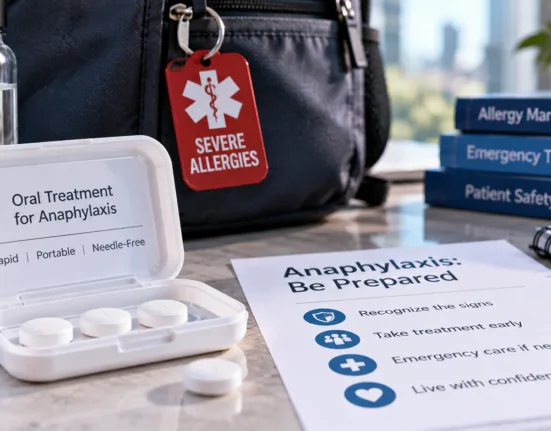
ALK Abello has received United Kingdom marketing authorisation for EURneffy 1 mg, making the adrenaline nasal spray available as a needle-free emergency treatment option for children aged 4 years and older who weigh 15 kg to less than 30 kg and are at risk of anaphylaxis. The approval from the Medicines and Healthcare products Regulatory Agency extends the EURneffy franchise into a younger pediatric population after the earlier UK authorization of EURneffy 2 mg for adults and children weighing at least 30 kg.
The decision matters because anaphylaxis is a time-sensitive, potentially life-threatening allergic reaction where rapid adrenaline administration can determine clinical outcome. For decades, children at risk of severe allergic reactions have largely depended on adrenaline auto-injectors. EURneffy 1 mg introduces a different route of administration for younger children, addressing one of the most persistent practical barriers in allergy care: whether caregivers, schools, and families can carry and use emergency adrenaline quickly and correctly when a severe reaction begins.
Why needle-free adrenaline matters in pediatric anaphylaxis care
Anaphylaxis can develop within minutes after exposure to triggers such as foods, insect stings or bites, medicines, or other allergens. In children, food allergy is one of the most common causes, and severe reactions can happen in homes, schools, restaurants, playgrounds, and other settings where specialist medical help may not be immediately available. This makes community-based emergency treatment central to risk management.
Adrenaline is widely recognized as the first-line emergency treatment for anaphylaxis, but real-world use remains imperfect. Families may delay treatment because symptoms are confusing, caregivers may hesitate to inject a child, and devices may not always be carried consistently. In pediatric care, that hesitation can be especially important because adults around the child may be anxious, undertrained, or afraid of doing harm.

EURneffy 1 mg attempts to reduce one part of that burden by removing the needle from emergency adrenaline delivery. A nasal spray may feel less intimidating for some caregivers than an injection, particularly in school or childcare settings where non-medical staff may need to act. The clinical value of that design will depend not only on pharmacology, but also on whether the product improves confidence, carriage, and timely administration in real-world emergencies.
The approval therefore should not be understood only as a product expansion. It is part of a broader shift in anaphylaxis management toward emergency treatments that are easier to carry, easier to explain, and easier to use under pressure. In a severe allergic reaction, a simpler device can matter if it reduces delay.
How the UK approval expands the EURneffy treatment pathway for severe allergies
The new authorization fills an important age and weight gap in the UK EURneffy label. EURneffy 2 mg had already been approved for emergency treatment of anaphylaxis in adults and children weighing at least 30 kg. EURneffy 1 mg now extends the needle-free option to children aged 4 years and older who weigh from 15 kg to less than 30 kg. This makes more pediatric patients eligible for the nasal spray formulation.
That weight-based approach is clinically important because adrenaline dosing in emergency allergy treatment must account for body size. A pediatric dose must provide adequate exposure while maintaining an acceptable safety profile. ALK Abello said EURneffy 1 mg showed comparable absorption and pharmacodynamic effect in children weighing 15 kg to less than 30 kg as the 2 mg dose did in children and adults above 30 kg.
For allergy specialists, the practical question will be how the new product is integrated into allergy action plans. Children at risk of anaphylaxis are often advised to have emergency medication available across multiple settings, including at home, at school, during travel, and during extracurricular activities. A needle-free treatment could influence how clinicians counsel families, teachers, and caregivers about rapid response.
The product may also be relevant for children who have needle fear or for caregivers who worry about injecting correctly. However, a nasal spray does not eliminate the need for training. Families still need clear instructions on when to use adrenaline, how to administer the spray, when to call emergency services, and why carrying two devices may be recommended in case a second dose is needed.
Why safety and pharmacology will shape clinician confidence in EURneffy 1 mg
The clinical evidence package will be central to how rapidly allergy specialists adopt EURneffy 1 mg. According to ALK Abello, the EURneffy development program includes data from more than 700 participants, and the product provides rapid absorption of adrenaline within minutes of administration. The company also reported that EURneffy 2 mg performed as well as traditional adrenaline auto-injectors or intramuscular adrenaline in a range of pharmacology scenarios, including single and repeat doses, self-administration, and use during nasal congestion from allergies.
For the pediatric 1 mg dose, the most common adverse reactions reported in children weighing 15 kg to less than 30 kg included nasal congestion, upper respiratory tract congestion, dry throat, nasal dryness, and paraesthesia. ALK Abello also said there were no clinically relevant safety differences between pediatric and adult populations treated with EURneffy.
These details matter because emergency allergy treatment needs to be both effective and trusted. Parents and physicians may be open to needle-free treatment, but they will still want confidence that nasal administration provides clinically appropriate adrenaline exposure in the moments when it matters most. The nasal route must also remain reliable in the real-world conditions of allergic reactions, including stress, crying, congestion, or caregiver anxiety.
Safety expectations are somewhat different for emergency medicines than for chronic therapies. Adrenaline can produce known cardiovascular and systemic effects, but anaphylaxis is an emergency where the consequences of undertreatment can be severe. The risk-benefit balance usually favors prompt adrenaline use when anaphylaxis is suspected. The key adoption question is whether EURneffy 1 mg makes prompt treatment more likely without creating new practical concerns.
How EURneffy could affect schools, caregivers, and allergy action plans
The pediatric approval could have a meaningful impact beyond specialist clinics. Many severe allergic reactions in children occur outside the direct supervision of allergy specialists. Schools, nurseries, sports programs, and family caregivers often become the first responders. That means product design and training are not secondary issues. They are central to treatment success.
A pocket-sized nasal spray that does not require priming may be easier for some caregivers to understand and administer. This could be especially important in schools, where staff may be trained to recognize anaphylaxis but may still feel nervous about injecting a child. If a needle-free option reduces hesitation, the approval could improve the likelihood that adrenaline is used quickly.
However, clinical education will be essential. A new device format can reduce some barriers while creating new training needs. Families and schools must understand that EURneffy is still an emergency adrenaline treatment, not a substitute for medical evaluation. They must also know when a second dose may be needed and when emergency services should be contacted.
The approval may also influence how allergy clinics structure shared decision-making with families. Some caregivers may prefer the long-established familiarity of auto-injectors. Others may strongly prefer a needle-free option. Clinicians will need to discuss availability, dosing, correct use, storage, school policies, and the child’s individual risk profile.
Why this approval could influence the broader emergency allergy treatment market
EURneffy 1 mg adds competitive pressure to a market historically dominated by adrenaline auto-injectors. Auto-injectors remain established, familiar, and widely incorporated into allergy action plans. However, the emergence of needle-free adrenaline products gives clinicians and patients a new choice in emergency preparedness.
The broader market implication is that device design may become more important in anaphylaxis treatment. For years, innovation in severe allergy care has focused heavily on awareness, diagnosis, avoidance, and immunotherapy. Emergency adrenaline delivery has remained largely injection-based. Needle-free formulations could shift expectations, especially if they improve carriage rates and reduce administration delays.
The UK approval also reflects a wider international rollout. EURneffy is approved in the United Kingdom and European Union under that brand name, while the product is marketed or approved as neffy in several other major markets. That global regulatory momentum may increase physician familiarity and support broader discussion about nasal adrenaline as a legitimate emergency option.
Still, market adoption will depend on reimbursement, prescribing behavior, pharmacy availability, caregiver training, and inclusion in clinical guidelines or institutional protocols. A needle-free product can attract attention quickly, but sustained use will depend on whether clinicians believe it solves a real-world problem without compromising emergency reliability.
What clinicians will watch after the EURneffy 1 mg pediatric approval
Clinicians will be watching whether EURneffy 1 mg changes behavior in the settings where anaphylaxis emergencies actually happen. If families carry the product more consistently, if caregivers feel more confident using it, and if administration happens sooner during severe allergic reactions, the approval could have a practical impact beyond pharmacokinetic data.
Allergy specialists will also want real-world evidence in younger children. Clinical development data support the approval, but routine use can reveal important details about device handling, caregiver acceptance, administration under stress, and outcomes after use in true emergency settings. These data may influence future guideline discussions and prescribing preferences.
The approval also raises broader questions about how to modernize anaphylaxis preparedness. A child’s treatment plan depends not only on which drug is prescribed, but also on whether the adults around the child understand the plan. EURneffy 1 mg may make the device easier to use, but it does not remove the need for education, repetition, and emergency readiness.
The most balanced interpretation is that EURneffy 1 mg gives UK clinicians and families a meaningful new option for pediatric anaphylaxis preparedness. It does not make existing auto-injectors obsolete, and it does not remove the urgency of recognizing and treating severe allergic reactions quickly. What it does offer is a needle-free adrenaline pathway for younger children, which could be significant if it improves confidence, carriage, and timely use when anaphylaxis occurs.