Royal Philips has announced the expanded commercial availability of its LumiGuide 3D Device Guidance system across the United States and Europe, following its debut at RSNA 2025. Integrated with the Azurion image-guided therapy platform, LumiGuide replaces continuous X-ray with real-time, light-based navigation powered by Fiber Optic RealShape (FORS) technology. This rollout marks a pivotal moment in Philips’ strategic effort to minimize radiation exposure during complex endovascular procedures and shift procedural imaging into the AI-guided, software-first era.
Why Philips’ LumiGuide challenges long-standing fluoroscopy conventions
The central breakthrough of LumiGuide lies in its ability to visualize device movement inside the body using light rather than ionizing radiation. The system leverages fiber optics embedded in guidewires and compatible catheters to produce full-color, real-time 3D images. In doing so, it bypasses the need for continuous fluoroscopy, offering an alternative that not only improves device visualization but also reduces procedural radiation exposure for both patients and healthcare providers.
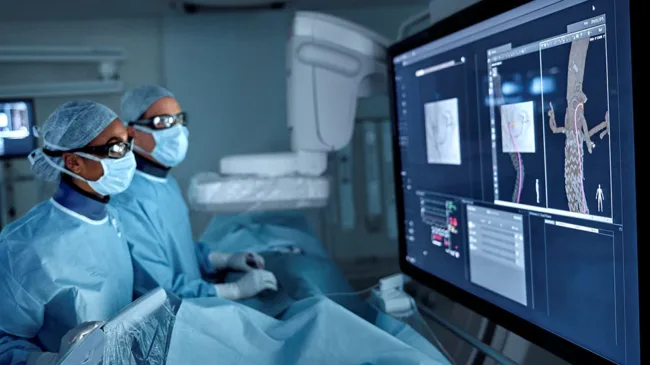
This stands in contrast to the majority of interventional imaging systems that focus on optimizing X-ray dosage rather than eliminating it altogether. By reframing the navigation process itself through a different physical medium—light—Philips is not just improving an existing modality but offering an entirely different way to perform vascular procedures. This raises important strategic and clinical questions for interventional radiology, vascular surgery, and even health system procurement.
How LumiGuide fits into Philips’ broader AI-integrated procedural vision
Rather than being offered as a standalone device, LumiGuide is built as an embedded module within Philips’ Azurion platform, the company’s image-guided therapy backbone deployed in more than 80 countries. Azurion supports a wide array of procedures across cardiovascular, neurovascular, and interventional oncology domains, treating over 6.4 million patients annually.
LumiGuide joins an expanding family of AI-supported tools on Azurion, including DeviceGuide and VeriSight 3D ICE. This portfolio approach signals a deliberate shift in Philips’ business model from hardware-centric systems to intelligent, data-connected procedural ecosystems. By integrating LumiGuide directly into Azurion, Philips is minimizing workflow disruption, reducing the training burden, and increasing the likelihood of clinician adoption—especially in sites already using its platform.
What changes for vascular specialists and hospital imaging labs
In clinical practice, the real-time 3D visibility of catheters and guidewires could enable more intuitive and precise device navigation, particularly in high-stakes procedures such as fenestrated endovascular aneurysm repair (FEVAR). Clinicians like Dr. Adam Beck from the University of Alabama at Birmingham have already reported that LumiGuide improves procedural efficiency and minimizes reliance on fluoroscopy pedals, suggesting potential gains in both case throughput and occupational safety.
Importantly, light-based navigation may shift the procedural learning curve. Traditional fluoroscopy depends on flat, two-dimensional projections that require extensive spatial reasoning. LumiGuide provides orientation cues from any angle, making it easier for newer clinicians to understand device positioning in three-dimensional space. This could lower training barriers and enable greater standardization across operators and sites.
What remains unproven as LumiGuide scales up
Despite its technical promise and early procedural experience, LumiGuide faces several adoption headwinds. Device compatibility remains limited, with Philips yet to outline a clear roadmap for expanding its light-enabled instrument portfolio. Hospitals using multi-vendor catheters or hybrid imaging environments may find it challenging to achieve full procedural integration without costly overhauls.
Another challenge lies in software robustness. LumiGuide uses artificial intelligence to align its light-based images with the patient’s anatomy. Real-time performance is crucial, and any lag or registration error could compromise safety. While Philips cites more than 2,000 clinical procedures performed to date, broader deployment across variable clinical environments could surface reliability issues that were not apparent in controlled or early-access settings.
Moreover, questions persist around scale manufacturing of fiber optic-enabled guidewires and catheter systems. Unlike conventional X-ray-visible materials, FORS-enabled components require advanced photonic integration and rigorous quality controls. Any constraint on production volume or supply chain redundancy could limit Philips’ ability to meet demand if LumiGuide adoption accelerates.
Why reimbursement and cost-benefit calculus could shape adoption pace
From a health economics standpoint, LumiGuide’s expansion raises critical questions about reimbursement, particularly in systems that have yet to attach financial value to radiation-free procedural options. While the technology offers clear occupational and procedural safety advantages, hospitals may hesitate to upgrade unless payers begin to recognize these benefits through differentiated codes or outcome-based incentives.
Philips will need to make a strong case that LumiGuide not only improves safety but also enhances productivity and long-term cost-effectiveness. Reductions in fluoroscopy time and procedure duration could translate into higher case volumes and reduced equipment fatigue. But these gains must be proven through post-market health economic evaluations, particularly in cost-sensitive systems like the U.S. Centers for Medicare and Medicaid Services (CMS) or value-based European payors.
What industry observers will watch after RSNA 2025
Philips’ decision to announce LumiGuide’s global rollout at RSNA 2025, rather than at a vascular or cardiology-specific congress, was a strategic move to position the technology as a cross-specialty innovation. It signals an ambition to take light-based navigation beyond endovascular surgery and into adjacent domains such as electrophysiology, neurointervention, and even structural heart procedures.
Industry analysts will be watching for new clinical studies demonstrating LumiGuide’s impact on procedural success rates, complication reduction, and long-term outcomes. Regulatory observers will be looking for how Philips navigates expanding device approvals, especially as the FORS technology is applied to more catheter types or interventional modalities. Meanwhile, competitors such as Siemens Healthineers and GE HealthCare may respond by accelerating their own AI-augmented or radiation-light platforms, increasing the competitive pressure in the interventional imaging segment.
What comes next for Philips’ low-radiation strategy
LumiGuide’s launch builds on other radiation-safety investments by Philips, including ClarityIQ for dose optimization, DoseAware for real-time radiation monitoring, and EchoNavigator for fusion imaging. Together, these tools form a cohesive thesis: that procedural imaging is moving into a phase where intelligence, not exposure, defines success.
If LumiGuide delivers consistent, reproducible performance in broader clinical settings, it could emerge as a new standard for radiation-free guidance in high-complexity procedures. But its ability to reshape procedural norms will depend on clinician confidence, operational scalability, regulatory flexibility, and economic validation.
In the broader context of minimally invasive therapy, LumiGuide represents not just a technical evolution but a cultural one: a bet that the interventional suite of the future will prioritize precision, AI-assisted decision-making, and zero-exposure navigation—using light to illuminate the next frontier of care.

Why Philips LumiGuide could disrupt image-guided therapy with real-time light-based 3D navigation added by Srinath B on
View all posts by Srinath B →